
The 15-second version
You type. Real nodes appear — built, wired, named, in your open scene. One Ctrl+Z reverses the whole build. It asks first before anything risky, and says UNKNOWN instead of guessing. It tells you what doesn't work — Known limitations is the most-read section on purpose.
New in v5.52.0 — the weak domains became lookups:
- APEX stopped being guesswork. 2,286 callbacks enumerated from the live runtime, a 441-cell wire-typing matrix, and panel recipes migrated off node names that never existed. It regenerates per build, so it can't quietly go stale.
- The parm gate got teeth. A phantom parameter name is now rejected before anything mutates — and answered with the real one (
code→ suggestskernelcode). - Cook results can't fake success. No measurement, no promotion: anything unmeasured stays UNKNOWN instead of defaulting to fine.
- Production hardening opened. A seven-blueprint audit indexed 112 findings — 3 critical — each with a file:line anchor and first-hand evidence. The critical ones are published, not buried.
Shipped in v5.51.0 — close the tab, keep the session: Closing the panel no longer kills your session. The heartbeat moved out of the panel into a process-lifetime owner, closing the tab is a deliberate detach (not a fake freeze), and reopening reconnects to the same session with chat history intact. Also live: the CURIOUS / EXPERT / ML switcher actually switches profiles, the shelf grew icons + tooltips, chat text breathes (+0.75pt), and the Token tab counts real spend on the selected model — or says UNKNOWN. Two more red gauges turned green (runtime heartbeat R.2, shelf currency R.7); the ones still red are listed honestly below.
The shape of it — two pictures
How a change ships (nothing merges without the crucible; nothing pushes without a human word):
flowchart LR
    M[mission JSON] --> C[compile + validate] --> O[orchestrator] --> L[Opus agents in worktrees]
    L --> X[adversarial crucible] --> W{Joe reads verdict,<br>says merge per leg} --> G[Gate C push]
    L -.->|close-gate: receipt is branch HEAD<br>+ RELEASE on the bus, or the leg holds| X
Why closing the panel is safe now:
flowchart LR
    P[panel closes] -->|deliberate detach| B[runtime_beat<br>process-lifetime owner]
    B -->|beat continues| F[freeze watchdog<br>stays calm]
    S[runtime + session_store] -->|survives| R[reopen: same session,<br>history intact]
    NB[new Houdini boot] -->|scoped: previous work<br>parked, never destroyed| CL[panel starts clean]
    CL -->|/restore-session| R
Still on board, from v5.50.0 — the knowledge layer stops guessing: retrieval repair lands. Scout finally sees the node corpus, ambiguous type names disambiguate by context, datasheets carry real internal parm names + channels, and the dense path can honestly say "not found" — 0/25 confident-wrong on fresh adversarial probes. Under it: a build-freshness release gate, a single-writer ingest ledger, and a parameterized help-archive pin. Release notes →
Jump to: Artists · Demo · Limitations · Install · First prompt · Verify it yourself
For artists — the one-minute version
You type what you want. Real nodes appear in your scene — built, wired, and named. "Give me a Vellum cloth setup on this mesh" becomes actual nodes, not a chat answer.
One Ctrl+Z undoes the whole thing. Every operation is grouped, so a ten-node build reverses in a single undo. You can always get your scene back.
It asks before anything risky. Writing files, big changes — a human clicks approve. It never bakes gigabytes to disk on its own.
It says "I don't know" instead of guessing. Unmeasured things are reported as unknown, never invented. When something isn't supported yet, it tells you so.
It is not magic and not a render button. Read Known limitations — this project's habit is saying what doesn't work before you find out mid-shot.
Watch it work
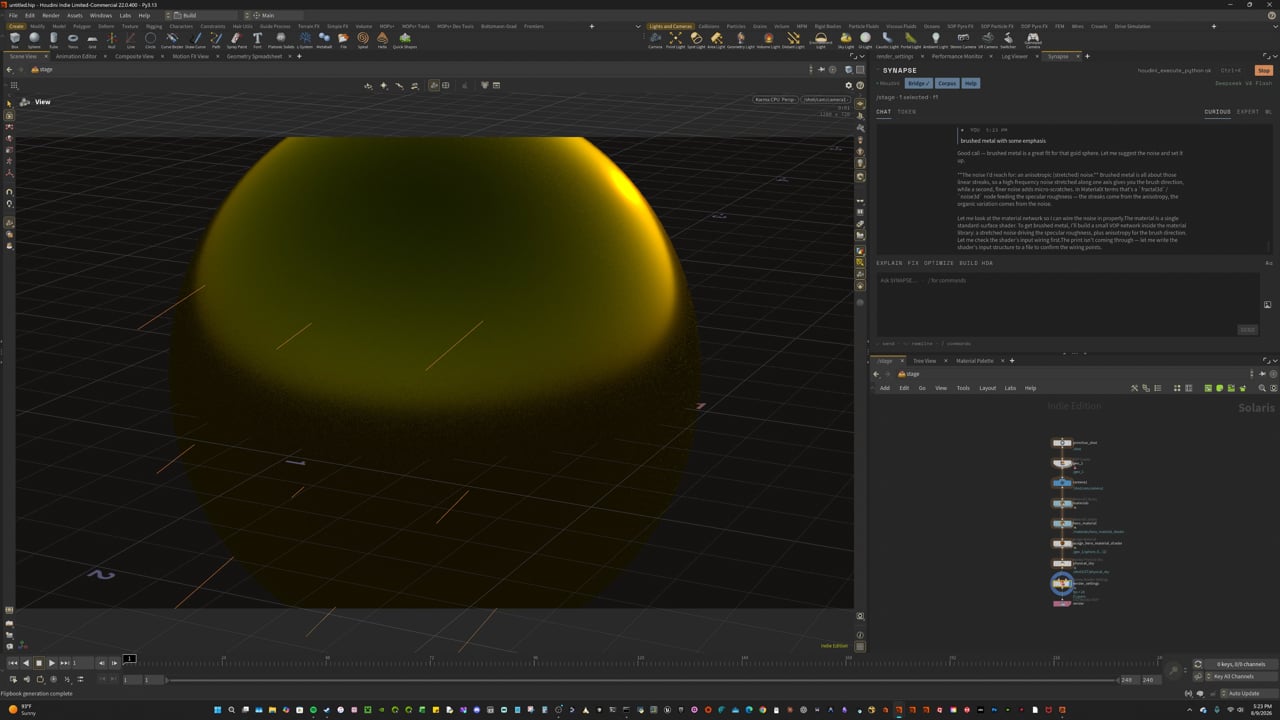
SYNAPSE in practice: plain English in, undoable nodes out.
Runs your model
Five engines behind one seam. The roster and the producer path are the same thing: python/synapse/panel/providers/.
Ollama needs no API key, and nothing leaves the machine. SYNAPSE talks to your local server at its default address, http://localhost:11434.
Your pick persists. Engine choice is saved to .synapse/panel_settings.json and survives restarts.
The one design choice
Everything else follows from where the agent lives.
%%{init: {'theme':'base','themeVariables':{'primaryColor':'#4d4d4d','primaryTextColor':'#FFFFFF','primaryBorderColor':'#000000','lineColor':'#000000','textColor':'#FFFFFF','secondaryColor':'#404040','tertiaryColor':'#333333','clusterBkg':'#333333','clusterBorder':'#000000','edgeLabelBackground':'#333333','nodeTextColor':'#FFFFFF'}}}%%
flowchart LR
    subgraph OUT["outside-in"]
        H1[Houdini] -->|whole scene, every turn| C1[cloud model]
        C1 -->|answer| H1
    end
    subgraph IN["inside-out — SYNAPSE"]
        H2[Houdini] --> A[agent in-process]
        A -->|only what you asked about| C2[cloud model]
        C2 --> A
        A -->|acts in place| H2
    end
Measured, not claimed. Grounding payload across a 13 → 25,850 node ladder rises 443 → 113,411 tokens. That is 256× — not flat. The same probe without depth bounds rises 2,788×.
The honest statement: cost scales with what you ask about, not with the size of your scene.
The mechanism is bounded depth. Single-call coverage falls to 10% on the largest scenes, with 100% completeness inside the window it reads. There is currently no delta path — every inspect is a full re-read.
Producer: harness/notes/token_bench/, 2026-07-27. Proxy tokenizer, no live-model arm.
Known limitations
Read this here rather than discover it mid-shot.
The short list — the five most likely to bite:
synapse_inspect_scene hangs over external MCP (panel path fine) · how-to prose is still H21 · no delta path (every inspect re-reads) · a stopped mantra render leaves a valid-looking empty EXR · undo groups, it does not roll back on exceptions.
Full detail on every item below.
synapse_inspect_scene does not return over the external MCP surface. It hangs to the idle timeout. The function itself is instantaneous when called directly — 0.08s for the whole of a 5,764-node scene — so the fault is in the main-thread marshal under MCP, not in introspection. The panel's WebSocket path is unaffected and is demonstrated working on that same scene.
The retrieval corpus is Houdini 21 documentation. Symbols and node types are H22 and verified; the prose is not yet converted. Most consequential for Copernicus.
No delta path. Every inspect is a full re-read. Re-asking about the same thing costs the same again.
A render can be stopped, but not from RopNode. No cancel method exists there. hou.ActiveRender is documented, #status: ni, and absent at runtime. SYNAPSE now stops renders through rkill (render_stop), with two limits worth knowing:
- Only background renders can be stopped — those are the only ones
rpscan see. A foreground, in-process render is not reachable. - Only Karma/husk renders can be stopped by ROP path. A mantra render shows up in
rpsas the bare wordmantrawith no node identity, so SYNAPSE refuses to guess which one is yours and asks for an explicit PID instead.
Stopping a mantra render leaves a valid-looking but empty frame. mantra writes the EXR header to the real output path immediately and keeps pixels in a .mantra_checkpoint sidecar, so a stopped render leaves a ~1KB EXR that opens fine and contains no image. A "does the file exist?" check will pass it. Detect it by the leftover .mantra_checkpoint, or by a header missing renderTime. Stopping a Karma render is safe — husk only writes the declared output on completion, so it simply never appears.
The chat-time UI grip is closed (v5.40.1). Mid-chat node-selection freezes — the bridge-down Qt-fallback class — no longer fire; tool calls and context-gather run off the main thread. See The chat freeze, and what fixed it below. Distinct from the render freezes covered there.
execute_python results are stringified over the live WS. A dict comes back as its Python repr ("result": str(result)). Parse with ast.literal_eval; a handler-side fix is queued but needs a Houdini restart to go live, so the client-side parse is the current contract. Found by the bench's first live contact, 2026-08-02.
The PDG rollback has never executed. bridge.py:1718 passes remove_files=; the real keyword is remove_outputs. It raises TypeError every time.
41 node types in use are deprecated — 39 of them deprecated in the docs while the runtime says nothing, so a probe alone cannot see them.
Emergency halt is surfaced, and the shipped mechanism alone was not enough. It now lives in the panel's ⋯ overflow as a control distinct from Stop. Worth knowing why it is not just a button on the old function: EmergencyProtocol.trigger_emergency_halt walks /obj only. Probed against a real cook at /tasks/h3b_topnet on 22.0.368 it returned ALL_OPERATIONS_HALTED in 0.0s and the cook was still running three seconds later — and /tasks is where TOP networks live by default. The halt handler therefore does its own scene-wide sweep and reports the three results separately: what the bridge halt did, which TOP networks it then cancelled, and which background renders are still running (it does not kill those — rkill * would reach renders this session never started).
Node grounding is uneven, and the shape of it changed. 603 Copernicus, LOP and Cop2 types now carry build-pinned reference from nodes.zip — but that is what a node is, not how to use it together. Workflow prose is still H21. And 88 live types ship with no help page at all, so documentation cannot ground them by any method. 37.9% of LOP parameters are documented — the ceiling from documentation alone.
Token figures are proxy-measured, and no genuine outside-in comparison has been built.
What it knows, and where that comes from
This matters more than the feature list, and it is the thing to check first.
%%{init: {'theme':'base','themeVariables':{'primaryColor':'#4d4d4d','primaryTextColor':'#FFFFFF','primaryBorderColor':'#000000','lineColor':'#000000','textColor':'#FFFFFF','secondaryColor':'#404040','tertiaryColor':'#333333','clusterBkg':'#333333','clusterBorder':'#000000','edgeLabelBackground':'#333333','nodeTextColor':'#FFFFFF'}}}%%
flowchart TD
    K[what SYNAPSE knows] --> S[symbols and node types]
    K --> N[H22 node reference]
    K --> P[prose and how-to]
    S --> S1["h22_symbol_table.json<br/>35,908 symbols, re-stamped per build"]
    S --> S2["connectivity_22.json<br/>lop_solaris_knowledge_22.json"]
    N --> N1["rag/corpus/h22_nodes.json<br/>603 live types, 22.0.368"]
    P --> P1["rag/skills/houdini21-reference<br/>H21 documentation"]
    S1 --> OK["verified against the running build<br/>gate goes STALE if they diverge"]
    S2 --> OK
    N1 --> OK
    P1 --> GAP["NOT yet converted to H22"]
Symbols are H22. The table is stamped against the running build, and phantom_gate_status goes stale if they diverge.
Node reference is H22. Extracted from nodes.zip — the reference that ships with the build — and every entry validated by probing its documented type against the running catalogue. Only matched entries are written, so a phantom is never stored rather than filtered at read time.
Prose is H21. The retrieval corpus is Houdini 21 documentation, accurately labelled as such. If you ask a how-to question, SYNAPSE may answer from H21 material and tell you so.
And the Copernicus gap is now closed on the node axis. It was the sharpest hole in this diagram — Copernicus barely existed in H21, so prose could never cover it. Ask about chromakey or grunge_rust by name and you get a build-pinned answer. Ask how to composite and you still get H21 prose.
What it does
Builds networks. Ask for a Solaris scene, a material graph, a COP chain — it wires the nodes and tells you what it chose.
Explains itself. Every mutation records what it did and why.
Stays on the main thread. All hou.* calls marshal to Houdini's main thread.
Says no when it can't. This took four fixes in one day (2026-08-02), all the same disease — a green light that couldn't report failure. get_health now carries write_plane (it used to say healthy over a dead write path); composition_valid carries a real verdict (it had zero assignment sites — an integrity anchor that could never fail); operations that fail before validation say so instead of inheriting "ran and passed"; and value-only edits the reduced hash cannot see are counted as unobservable_deltas rather than vanishing. Producers: commits 68ab53e, 57c4ec6, 73284e1; pinned by tests/test_write_plane_health.py (26), tests/test_stage_exceeds_cache_and_composition_valid.py (13), tests/test_r306_reduced_mode_surfacing.py (19).
Writes memory on a fresh scene. The first memory_write on an unsaved scene used to die with WinError 5 — $JOB points into Houdini's install bin/, which the seat can't write. Scene memory now resolves a writable address (discovery still reads the raw $JOB root, so studio show-configs keep working). Verified end-to-end on the live seat, twice, against a captured cold-boot baseline. Producer: scripts/live_probes/probe_g1_acceptance_ws.py → VERDICT: PASS.
Refuses to boot on a render node — narrowly. hou.isUIAvailable() gates the daemon, the Fork Bomb guard. But it protects a component with no production callers today while other surfaces boot headless. A guard that exists, not a guarantee that holds.
The full claim, unpacked
This is the package description in long form — everything the one-liner compresses.
115 tools, two paths. The full safety set (undo-wrapped, reversible, provenance-recorded) rides the audited /mcp bridge path. The direct /synapse path is RBAC-gated, main-thread-marshalled execution with observe-only provenance. Scene mutations are undo-wrapped and reversible. Filesystem and network effects of executed code are not.
A registry-wide truth contract. A result may not claim an outcome the handler did not observe.
A self-improving utility flywheel. Proposed node-graphs are validated against probe-verified Houdini truth — node wiring plus Solaris/LOP context — before they build.
A five-engine chat panel. Switch between Claude, Google Gemini, NVIDIA Nemotron, local Ollama, and any custom OpenAI-compatible endpoint. Raw-stdlib providers, no vendor SDK.
Pipeline citizenship. Tokens stay raw, per-frame render paths, OCIO color-managed previews, per-show config.
Studio operability. Rotating logs, synapse_doctor diagnostics + bundle, env-var conformance, bounded autonomy with a stop control that takes effect between operations, an upgrade runbook, egress + key-provisioning docs.
A two-tier audit trail. Tier-0 Floor hook + the agent.usd Ledger.
Crash-atomic escrowed memory. And a process-wide stall-detection chain (detect → breaker → emergency-halt report) that reports and degrades rather than unblocking a parked session.
Verified end-to-end on Houdini 22.0.368. 22.0.400: symbol-stamped 2026-08-09 (35,908 symbols, gate armed); e2e re-verification pending — see docs/SUPPORT_MATRIX.md.
Install
Four steps. The third is the one people miss.
1 — Clone
git clone https://github.com/JosephOIbrahim/Synapse.git
2 — Package file
python scripts/install_synapse_package.py
Writes the package file — Documents/houdini22.0/packages/synapse.json — for you, correctly encoded.
SYNAPSE ships two installers, and the split matters: scripts/install_synapse_package.py installs the package file (this step); install.py installs the shelf, panel, and icons. Order: package file first, then install.py.
3 — Verify
python scripts/install_synapse_package.py --verify
Read-only. Prints pass/fail per requirement.
4 — Doctor
With the server up, run the synapse_doctor tool — ask the panel, or call it from any connected MCP client. Diagnostics plus a support bundle (see Studio operability, above). Registered in mcp_server.py; implemented in python/synapse/server/doctor.py.
At Documents/houdini22.0/packages/synapse.json:
{
    "name": "synapse",
    "enable": true,
    "env": [
        { "var": "SYNAPSE_ROOT", "value": "C:/path/to/Synapse" },
        {
            "var": "PYTHONPATH",
            "value": ["$SYNAPSE_ROOT/python", "$SYNAPSE_ROOT"],
            "method": "prepend"
        }
    ],
    "hpath": "$SYNAPSE_ROOT/houdini"
}
Three things that bite
Save the JSON without a BOM. PowerShell's Set-Content -Encoding utf8 writes one. Houdini's parser rejects it silently.
# writes a BOM - Houdini will not load this
Set-Content synapse.json $text -Encoding utf8

# no BOM
[System.IO.File]::WriteAllText($path, $text, (New-Object System.Text.UTF8Encoding $false))
hpath, not path. On H22 the keyword is hpath — SideFX use it exclusively in their own packages. The deprecated path still works, which is why nobody notices.
PYTHONPATH needs both entries. shared/ lives at the repo root, not under python/.
Get any of these wrong and import synapse still succeeds, the version still prints, and the panel never appears. No error. Just absence.
First prompt
Nothing to set up beyond Install. Fresh empty scene. No OCIO. No demo scaffold. No harness runner.
- Open Houdini — new, empty scene.
- Open the SYNAPSE panel.
- Type:
Make me simple terrain — a grid displaced with mountain noise.
This prompt maps to a recipe the panel ships with — mountain_displace in python/synapse/panel/recipe_book.py: a 100×100 grid SOP wired into a mountain SOP (height 1.5). Two nodes, one connection.
What you'll see: a terrain-like displaced surface in the viewport. That visible bump-scape is the proof the install worked — no test suite required.
Looking for the full staged walkthrough instead? That's demo/README.md — the staged demo, which does carry pipeline prerequisites (OCIO, the demo hip).
Troubleshooting
The panel didn't appear.
Run the doctor first: the synapse_doctor tool, callable from any connected MCP client — no panel required (registered in mcp_server.py, implemented in python/synapse/server/doctor.py).
Why there's no error message to read: get the package file wrong — a BOM, path instead of hpath, a missing PYTHONPATH entry — and import synapse still succeeds, the version still prints, and the panel never appears. No error. Just absence.
So work it from the file, not the console: re-run step 3 (python scripts/install_synapse_package.py --verify), then check Three things that bite under Manual install.
The two paths
%%{init: {'theme':'base','themeVariables':{'primaryColor':'#4d4d4d','primaryTextColor':'#FFFFFF','primaryBorderColor':'#000000','lineColor':'#000000','textColor':'#FFFFFF','secondaryColor':'#404040','tertiaryColor':'#333333','clusterBkg':'#333333','clusterBorder':'#000000','edgeLabelBackground':'#333333','nodeTextColor':'#FFFFFF'}}}%%
flowchart LR
    T[agent turn] --> M["/mcp — audited"]
    T --> S["/synapse — live"]
    M --> A1[undo-wrapped]
    M --> A2[provenance-recorded — Tier-0]
    M --> A3["scene-hashed<br/>pays the stage cost — gated"]
    S --> B1[RBAC-gated]
    S --> B2[partial undo]
    S --> B3["no stage term<br/>by construction — flat cost"]
Consent prompts on the /mcp path belong to the MCP host (e.g. Claude Desktop's tool-approval), not to Synapse; Synapse's guarantee is provenance.
Connect on ws://localhost:9999/synapse — the path matters, a bare host:port returns HTTP 400.
Security posture, stated plainly. RBAC is inactive in local mode by default. The live surface is a localhost WebSocket; origin validation is fail-safe — a connection with an unrecognized Origin is rejected, never waved through. No auth key is required or checked unless one is configured. The enable path: set SYNAPSE_DEPLOY_MODE to a non-local mode and configure an auth key — that turns RBAC enforcement and key checking on.
Found a vulnerability? SECURITY.md — private GitHub security advisories, never a public issue. It also states who patches the vendored python/synapse/_vendor/ dependencies (we do).
The cost asymmetry on the right is measured, both sides: the /mcp path's stage hashing is where scene-scale cost lives (and where the gate below operates); the live path skips that term by construction (integrity_envelope.py:219) and stays flat — ping ~0.4 ms, set_parm ~3.7 ms whether the stage holds 100k or 4M authored elements. Producer: python _benchmark_latency.py --tier live, first live rows 2026-08-02, .claude/live_rows_v5420.json, measured on 22.0.397.
One wire-contract wart worth knowing on the live path: execute_python results come back stringified — a dict arrives as its Python repr, not JSON (handlers.py, "result": str(result)). Parse with ast.literal_eval client-side, never eval.
Fast, and staying fast
Three instruments landed 2026-08-02, built on one finding.
The finding. Houdini-side cost was believed to be "1–70 ms per op — the 5%." True on small scenes; at scale, stage hashing on the audited path cost 6.9–7.7 s per op at 100k prims. And the axis everyone assumed — prim count — was wrong: cost tracks authored array volume. A 4-prim PointInstancer at 2M instances cost 2,017.9 ms per op while the prim-keyed gate said the scene was small — a 16,677× miss. Producers: 98b556f (measured floor), harness/latency/LEDGER.md §1 (the volume evidence, C2 crucible).
%%{init: {'theme':'base','themeVariables':{'primaryColor':'#4d4d4d','primaryTextColor':'#FFFFFF','primaryBorderColor':'#000000','lineColor':'#000000','textColor':'#FFFFFF','secondaryColor':'#404040','tertiaryColor':'#333333','clusterBkg':'#333333','clusterBorder':'#000000','edgeLabelBackground':'#333333','nodeTextColor':'#FFFFFF'}}}%%
flowchart LR
    B["board<br/>harness/latency/verify.py<br/>8 checks"] --> R["ratchet<br/>perf_ratchet.py<br/>ARMED — counts may fall,<br/>never silently rise"]
    R --> F["floor<br/>perf_baseline.json<br/>human-promoted only"]
    B --> C["bench<br/>bench_scale.py<br/>offline: counts ONLY<br/>live: wall-clock, build-stamped"]
    C --> K["the curve:<br/>gate flips on VOLUME alone<br/>500k–1M elements at 4 prims"]
The gate now keys on both terms — prim count and authored volume — so the bypass class is closed. The ratchet pins it: a deterministic counted proxy (stage traversals, prims visited — never wall-clock, because CI has no pxr and a timer would flake), floor read at merge-base(origin/master) so a branch cannot gate against its own doctored floor. The bench maps it: the offline tier emits counts only — a CI-runnable tier that reported latency numbers would be the exact dishonesty this guards against, and that rule is enforced in code, not prose.
Producers: board harness/latency/verify.py → 8 PASS · ratchet harness/verify/perf_ratchet.py → 8 PASS · curve python scripts/bench_scale.py --axis volume · all re-runnable.
The chat freeze, and what fixed it
A third freeze class — distinct from the render freeze and the marshal self-deadlock.
The symptom. Mid-chat, Houdini's UI grips. You can't select nodes, the viewport won't update, and it stays that way until the tool call finishes. No render is running — just a chat turn.
The cause. Chat turns run on a background thread, but every tool call has to reach hou.* on the main thread. With the local bridge up, the call rides the hwebserver /mcp thread and marshals cleanly. With the bridge down, the call fell back to a Qt signal that ran the whole handler inline on the main thread — so every internal marshal hit the no-timeout inline path and the GUI stalled for the handler's full duration. A lying "connected" SessionStart signal made this fire in ordinary sessions, not just broken ones.
The fix (v5.40.1). Tool calls and the panel's own context-gather now spawn a daemon thread off the main thread, so the marshal takes the deferred path — the same path the bridge-up call takes, with a per-call timeout and UI events interleaved. Node selection and the viewport stay live mid-chat.
%%{init: {'theme':'base','themeVariables':{'primaryColor':'#4d4d4d','primaryTextColor':'#FFFFFF','primaryBorderColor':'#000000','lineColor':'#000000','textColor':'#FFFFFF','secondaryColor':'#404040','tertiaryColor':'#333333','clusterBkg':'#333333','clusterBorder':'#000000','edgeLabelBackground':'#333333','nodeTextColor':'#FFFFFF'}}}%%
flowchart TB
TURN["agent turn<br/>ClaudeWorker · QThread"]:::panel
TURN -->|"tool_use block"| BR{"local MCP endpoint<br/>reachable?"}:::obs
BR -->|"yes — bridge UP"| WS["hwebserver /mcp thread<br/>(off main)"]:::obs
WS --> HDLR1["SynapseHandler.handle<br/>on hwebserver thread"]:::panel
BR -->|"no — bridge DOWN"| DAEMON["daemon thread<br/>synapse.panel.tool.<tool><br/>execute_tool_off_main"]:::panel
DAEMON --> HDLR2["SynapseHandler.handle<br/>on daemon thread"]:::panel
HDLR1 --> ROM["run_on_main<br/>inside handler"]:::obs
HDLR2 --> ROM
ROM -->|"caller NOT main thread<br/>→ DEFERRED path"| DEF["hdefereval.executeDeferred<br/>+ per-tool timeout<br/>interleaved with UI events<br/>(node select / viewport live)"]:::ok
ROM -.->|"OLD: caller IS main thread<br/>→ Fast path 2<br/>fn() inline, NO timeout"| FROZEN["Qt loop stalled<br/>cannot select nodes<br/>(the freeze this closed)"]:::hot
TURN -.->|"10s QTimer · chat send"| CTX["context-gather sibling"]:::panel
CTX -->|"_refresh_context_off_main"| GATHER["daemon thread<br/>synapse.panel.ctx.gather<br/>gather_context_off_main"]:::panel
GATHER --> ROMCTX["run_on_main<br/>2s · observe-only<br/>record_stall=False"]:::obs
ROMCTX -->|"DEFERRED path"| DEFCTX["hou.selectedNodes / paneTabs<br/>read interleaved ·<br/>sheds on busy main thread"]:::ok
classDef panel fill:#4d4d4d,stroke:#000000,color:#FFFFFF
classDef obs fill:#4d4d4d,stroke:#000000,color:#FFFFFF
classDef hot fill:#262626,stroke:#000000,color:#FFFFFF
classDef ok fill:#5e5e5e,stroke:#000000,color:#FFFFFF
What it does not fix. The residual in-process render freeze is a separate class (out-of-process husk is Indie-blocked). The websocket read loop's cancel gap is still open. The 2026-07-27 latency report's "Houdini-side is milliseconds" verdict still holds for the bridge-up path but is stale for the bridge-down case this closed. CI is red on an unrelated mcp-library drift on the runners, not this fix — the local suite is green.
Producers: 6f354ae (tool dispatch off-main) + bf74ed7 (context-gather off-main) · PR #50, merge d15d9b2 · pinned by tests/test_offmain_fallback.py (8) + tests/test_context_poll_offmain.py (6) + tests/test_chat_panel.py::TestStaleContextGather (4).
Undo, precisely
This used to say "every mutation is reversible." That was overstated.
hou.undos.group() groups undo entries so one Ctrl+Z reverses a whole operation.
It does not roll back when something raises. On the exception path a partial network survives and you undo it deliberately.
Wrapping is not reversing.
Two test numbers, and they mean different things
| interpreter | result | |
|---|---|---|
| Gate | system Python 3.14 | 5,551 passed · 0 failed (2026-08-02) |
| Shipping | hython3.13 — what Houdini runs |
4,048 passed · 110 failed · 771 errors |
The gate runs with the vendored SDK inactive; shipping runs with it active. They share almost no dependency surface.
Most of that gap is environment. Six packages close 88% of the failures:
websockets mcp pytest-asyncio orjson xxhash filelock
Those are shipping dependencies that are not shipped.
Verifying any of this
python harness/progress.py                     # every harness, every live wave
python harness/latency/verify.py               # the latency board (8 checks)
python harness/verify/perf_ratchet.py          # the armed speed floor
python harness/verify/version_agreement.py     # every version location
python harness/verify/bom_audit.py             # every JSON, VERSION included
powershell harness/run_suite_shipping_python.ps1
(heats_status.py is retired — it rendered real receipts into a hardcoded layout, which is the failure mode these tools exist to avoid. progress.py discovers; it does not list.)
Each fails on an unfixed tree. That was demonstrated before any of them was trusted.
House rule: no number enters a document without a producer path beside it.
Licence
MIT. Patent applications pending on the USD cognitive-state substrate, digital injection, and predictive lighting.
No comments yet
Be the first to share your take.