
:switzerland: Part of the Swiss Public Data MCP Portfolio
:balance_scale: fedlex-mcp





MCP Server for Swiss federal law, consultations & official terminology — search the SR, monitor consultation deadlines, and translate terms across the national languages via Claude Desktop or Claude.ai
Overview
fedlex-mcp connects AI assistants (Claude) with three official Swiss SPARQL data sources:
- Federal law via the Fedlex SPARQL endpoint — the Systematic Compilation (SR), Official Compilation (AS), Federal Gazette (BBl) and treaties.
- Consultations (Vernehmlassungen) via the same Fedlex endpoint (
jolux:Consultation) — the pre-parliamentary phase in which anyone can comment on a draft. - TERMDAT, the Federal Chancellery's terminology database, via the LINDAS SPARQL endpoint — official term equivalents across de/fr/it/rm/en.
All three are SPARQL-based, which is exactly why they live in one server rather than three: no new technology stack, only new queries against known patterns.
Metaphor: USB-C for federal law. Fedlex tells you what you have to respond to. TERMDAT tells you what it is called in the other national languages.
Features
- :balance_scale: 12 tools, 2 resources across federal law, consultations and terminology
- :mag: SPARQL-powered — two isolated endpoints (Fedlex + LINDAS), no shared failure mode
- :globe_with_meridians: 5 languages — German, French, Italian, Romansh, plus English for terminology
- :unlock: No API key required — all data under open reuse licences
- :cloud: Dual transport — stdio (Claude Desktop) + Streamable HTTP (cloud)
Anchor demo query
"Which education-related consultations are currently open, until when does the deadline run, which office is in charge — and what are the key technical terms in French and Italian for the response?"
A single conversation chains three tools across two endpoints:
fedlex_get_open_consultations(topic="education")
   → fedlex_get_consultation(event_id="proj/2026/71/cons_1")
   → termdat_lookup_term(term="Volksschule", target_languages=["fr","it"])
Every open consultation carries deadline, days_remaining (computed at
request time in Europe/Zurich, 0 = deadline is today) and a derived
status — an expired consultation never shows up as running. Fedlex says
what you must respond to and by when; TERMDAT says how to name it in the
other national languages.
Use
topic="education", notkeyword="Volksschule". Fedlex consultations have no subject taxonomy — filtering is free-text over the title, and the word "Volksschule" appears in zero consultation titles. Thetopicfilter expands to a disclosed keyword union (Bildung, Schule, Berufsbildung, Hochschule, …) and reports exactly which terms it searched.
Prerequisites
- Python 3.11+
- uv (recommended) or pip
Installation
Run via uv's uvx — no clone or manual install needed. Add to your MCP client config (mcpServers for Claude Desktop, Cursor and Windsurf; use a top-level servers key for VS Code in .vscode/mcp.json):
{
  "mcpServers": {
    "fedlex-mcp": {
      "command": "uvx",
      "args": [
        "fedlex-mcp"
      ]
    }
  }
}
Installation from source
# Clone the repository
git clone https://github.com/malkreide/fedlex-mcp.git
cd fedlex-mcp

# Install
pip install -e .
# or with uv:
uv pip install -e .
Or with uvx (no permanent installation):
uvx fedlex-mcp
Quickstart
# stdio (for Claude Desktop)
python -m fedlex_mcp.server

# Streamable HTTP (port 8000)
python -m fedlex_mcp.server --http --port 8000
Try it immediately in Claude Desktop:
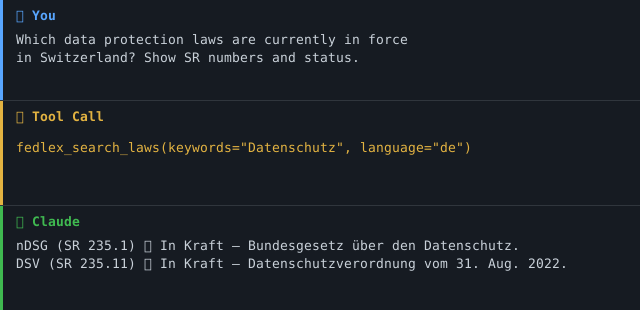
"Show me all valid federal laws on vocational training" "What does the Data Protection Act say? Is it still in force?" "Which consultations on education are open right now, and until when?" "What is 'Volksschule' called in French and Italian in official terminology?"
Configuration
Claude Desktop
Edit ~/Library/Application Support/Claude/claude_desktop_config.json (macOS) or %APPDATA%\Claude\claude_desktop_config.json (Windows):
{
  "mcpServers": {
    "fedlex": {
      "command": "python",
      "args": ["-m", "fedlex_mcp.server"]
    }
  }
}
Or with uvx:
{
  "mcpServers": {
    "fedlex": {
      "command": "uvx",
      "args": ["fedlex-mcp"]
    }
  }
}
Config file locations:
- macOS:
~/Library/Application Support/Claude/claude_desktop_config.json - Windows:
%APPDATA%\Claude\claude_desktop_config.json
Cloud Deployment (SSE for browser access)
For use via claude.ai in the browser (e.g. on managed workstations without local software):
Render.com (recommended):
- Push/fork the repository to GitHub
- On render.com: New Web Service -> connect GitHub repo
- Set start command:
python -m fedlex_mcp.server --http --port 8000 - In claude.ai under Settings -> MCP Servers, add:
https://your-app.onrender.com/sse
"stdio for the developer laptop, SSE for the browser."
Demo
Available Tools
| # | Tool | Source | Description |
|---|---|---|---|
| 1 | fedlex_search_laws |
Fedlex | Search the Systematic Compilation (SR) by keyword in title |
| 2 | fedlex_get_law_by_sr |
Fedlex | Get a law by its SR number (e.g. 235.1 = Data Protection Act) |
| 3 | fedlex_get_recent_publications |
Fedlex | Latest publications from the Official Compilation (AS) |
| 4 | fedlex_get_upcoming_changes |
Fedlex | Laws entering into force soon (legal monitoring) |
| 5 | fedlex_search_gazette |
Fedlex | Search the Federal Gazette (BBl) |
| 6 | fedlex_get_law_history |
Fedlex | All versions of a law (version history) |
| 7 | fedlex_search_treaties |
Fedlex | International treaties (SR numbers starting with 0.) |
| 8 | fedlex_get_open_consultations |
Fedlex | Deadline monitoring — open consultations (eventEndDate >= today, Europe/Zurich); each with days_remaining + derived status, sorted by shortest deadline; optional topic/keyword |
| 9 | fedlex_search_consultations |
Fedlex | Full-text search over consultation title/description, with filters (topic, status, deadline range, office) |
| 10 | fedlex_get_consultation |
Fedlex | Detail for one eventId: deadline, days_remaining, office, derived status, documents |
| 11 | termdat_lookup_term |
LINDAS | Term → equivalents in de/fr/it/rm/en incl. definition |
| 12 | termdat_get_concept |
LINDAS | Full TERMDAT entry for a URI or ID |
Example Use Cases
| Query | Tool |
|---|---|
| "Show me all valid federal laws on vocational training" | fedlex_search_laws |
| "What does the Data Protection Act say?" | fedlex_get_law_by_sr |
| "Which laws enter into force in the next 3 months?" | fedlex_get_upcoming_changes |
| "Show me the version history of the DSG" | fedlex_get_law_history |
| "Which consultations on education are open, and until when?" | fedlex_get_open_consultations |
| "Find closed consultations about the language act" | fedlex_search_consultations |
| "Give me the full detail and documents for consultation proj/2026/71/cons_1" | fedlex_get_consultation |
| "What is 'Volksschule' called in French and Italian?" | termdat_lookup_term |
| "Show the full TERMDAT entry 40109" | termdat_get_concept |
→ More use cases by audience →
Architecture
Two isolated SPARQL endpoints behind one server. Separate httpx clients and
timeouts mean a LINDAS outage never breaks the fedlex_* tools, and vice versa.
+-------------------+     +------------------------------+     +--------------------------+
|   Claude / AI     |---->|  Fedlex MCP                  |---->|  Fedlex SPARQL Endpoint  |
|   (MCP Host)      |<----|  (MCP Server)                |<----|  fedlex.data.admin.ch    |
+-------------------+     |                              |     |  (law + consultations)   |
                          |  12 Tools . 2 Resources      |     +--------------------------+
                          |  Stdio | SSE                 |
                          |                              |     +--------------------------+
                          |  Isolated clients:           |---->|  LINDAS SPARQL Endpoint  |
                          |   - Fedlex  (law + cons.)     |<----|  lindas.admin.ch/query   |
                          |   - LINDAS  (TERMDAT)         |     |  (fch/termdat, TERMDAT)  |
                          |                              |     +--------------------------+
                          |  No authentication required  |
                          +------------------------------+
Data Model
JOLux Ontology — federal law (Fedlex)
jolux:ConsolidationAbstract  <-  SR entry
  +-- jolux:isRealizedBy  ->  jolux:Expression (URI ends in /de, /fr, /it, /rm)
     +-- jolux:title               "Federal Act of 19 June 1992 on Data Protection"
     +-- jolux:titleShort          "DSG"
     +-- jolux:historicalLegalId   "235.1"

jolux:inForceStatus:  .../0 In force  ·  .../1 No longer published in SR  ·  .../3 No longer in force
JOLux Ontology — consultations (Fedlex, same endpoint)
jolux:Consultation
  +-- jolux:eventId                     "proj/2026/71/cons_1"
  +-- jolux:eventTitle                  multilingual (de/fr/it)
  +-- jolux:eventDescription            multilingual
  +-- jolux:consultationStatus          -> vocabulary URI (0..6, /2 = "Laufend"/running)
  +-- jolux:foreseenImpactToLegalResource  -> the legal resource it will amend (link to SR)
  +-- jolux:hasSubTask  ->  ?t
        +-- jolux:eventStartDate                      <- opened_on
        +-- jolux:eventEndDate                        <- the deadline (xsd:date, calendar day)
        +-- jolux:institutionInChargeOfTheEvent       <- lead department
        +-- jolux:institutionInChargeOfTheEventLevel2 <- lead office
        +-- jolux:opinionHasDraftRelatedDocument      <- consultation documents
There is no subject taxonomy on jolux:Consultation — thematic filtering is
free-text over eventTitle only, and status is derived from the deadline
(not the source status field).
Legislative lifecycle — where consultations sit (all in this one server):
  Vernehmlassung            Bundesblatt (BBl)          Systematische Sammlung (SR)
  (consultation)     ─────► (dispatch / act text) ───► (consolidated law in force)
  ────────────────         ─────────────────────      ───────────────────────────
  fedlex_get_open_          fedlex_search_gazette      fedlex_search_laws
    consultations           (eli/fga/…)                fedlex_get_law_by_sr
  fedlex_search_                                       fedlex_get_law_history
    consultations                                      (eli/cc/…)
  fedlex_get_consultation
        │  jolux:foreseenImpactToLegalResource
        └───────────────────────────────────────────► links a consultation forward
                                                       to the SR resource it amends
The consultation stage is the earliest public point of influence — the tools above answer what is open and until when, before a draft reaches the Bundesblatt.
schema.org — terminology (TERMDAT via LINDAS, graph fch/termdat)
<concept>  = https://register.ld.admin.ch/termdat/40109      (a schema.ld.admin.ch/Term, ValidatedEntry)
  +-- schema:name         preferred name per language (de/fr/it/en; rm effectively absent)
  +-- schema:description  multilingual definition
  +-- schema:hasPart  ->  <term> = .../termdat/40109/3/de     (synonym/variant, language + position suffix)
SPARQL endpoints: https://fedlex.data.admin.ch/sparqlendpoint · https://lindas.admin.ch/query
Licence: Free reuse per fedlex.admin.ch; TERMDAT via LINDAS under open reuse.
Architecture decision
ARCH A — live SPARQL only, for all three data areas, consistent with the existing Fedlex integration (decided 2026-07-18).
Both sources are unauthenticated SPARQL endpoints with acceptable latency, so no
dump/offline fallback is needed: if the Fedlex endpoint is down the server cannot
function anyway, and adding a cache would only mask that. LINDAS is a separate
endpoint, and its outage must not degrade the fedlex_* tools.
Isolation requirement: Fedlex and LINDAS use separate httpx clients, separate
timeouts and separate error/status reporting. A LINDAS timeout cannot fail a
fedlex_* call and vice versa (covered by an isolation test).
Languages
| Code | Language |
|---|---|
de |
German (default, most complete coverage) |
fr |
French |
it |
Italian |
rm |
Romansh |
Project Structure
fedlex-mcp/
+-- src/fedlex_mcp/
|   +-- __init__.py              # Package
|   +-- server.py                # 12 tools, 2 resources (Fedlex + LINDAS)
+-- tests/
|   +-- test_server.py           # Unit tests (mocked)
+-- .github/workflows/ci.yml     # GitHub Actions (Python 3.11/3.12/3.13)
+-- pyproject.toml
+-- CHANGELOG.md
+-- CONTRIBUTING.md               # Contributing guide (English)
+-- CONTRIBUTING.de.md            # Contributing guide (German)
+-- SECURITY.md                   # Security policy (English)
+-- SECURITY.de.md                # Security policy (German)
+-- LICENSE
+-- README.md                    # This file (English)
+-- README.de.md                 # German version
Known Limitations
- SPARQL complexity: Very broad keyword searches may time out (45s timeout)
- Language coverage: German has the most complete data; other languages may have gaps
- Historical data: Not all historical versions of laws have machine-readable metadata
- Rate limiting: The endpoints may throttle high-frequency requests
Consultations — scope and reliability (read this before relying on it)
- Federal only. No cantonal consultations. Fedlex holds federal (Bund) consultations. Cantonal consultations — often the more relevant ones for a school authority (Schulamt) — are not in Fedlex and not covered here. This is a hard scope boundary, not a gap to be worked around.
- This is not a push service. MCP is pull-based: the server answers on request which consultations are open and which expire soon. It cannot notify, schedule, or alert. Recurrence comes from you or an external scheduler — never from the server. "No open consultations" means nothing is open right now, not nothing is coming.
- Thematic filtering is free-text, and imperfect.
jolux:Consultationhas no subject/classification taxonomy (verified live 2026-07-20) — filtering is substring search over the title only.topic="education"expands to a disclosed keyword union and deliberately over-matches (a too-narrow filter would falsely reassure); expect some false positives (e.g. "Ausbildung" inside an unrelated title) and, for niche wording, possible false negatives. The response always states which terms were searched. - Coverage / latency: ~2,553 consultations; the historical corpus 1960–1991 sits with the Federal Archives, out of scope. Newly opened consultations appear with the upstream Fedlex publication latency (not real-time).
- Deadlines end on the calendar day in Europe/Zurich;
days_remainingis computed at request time, never cached.0= the deadline is today.
Live findings (verified 2026-07-20):
| Query | Status | Records | Note |
|---|---|---|---|
COUNT(?s) {?s a jolux:Consultation} |
OK | 2,553 | full inventory |
hasSubTask with start/end dates |
OK | 2,505 of 2,553 | 48 without any deadline |
Open consultations (eventEndDate >= today) |
OK | 42 | deadlines into autumn 2026 |
consultation-status vocabulary |
OK | 7 values | /0../6, /2 = running |
| Title contains "volksschule" / "lehrplan" | OK | 0 / 0 | anchor term itself finds nothing → use topic |
Title contains "bildung" (single) vs topic="education" union |
OK | 44 vs 66 | keyword union is broader |
REGEX(LCASE(?t), "a|b") alternation |
BROKEN | 0 | silently empty on this endpoint → OR-chained CONTAINS instead |
- Quirk 1 — the deadline wins over the status field. Status
/2("Laufend"/running) andeventEndDateare two independent signals. The server derivesstatusfrom the date: past deadline ⇒Abgeschlossen, regardless of what the source status claims — so an expired consultation is never listed as running. When the two disagree the record is markedstatus_conflict: trueand keeps the raw label instatus_source.
TERMDAT (LINDAS) — findings (verified 2026-07-18)
| Query | Status | Records | Note |
|---|---|---|---|
COUNT(DISTINCT ?s) a schema.ld:Term in graph |
OK | 77,692 | |
Language tags on schema:name |
OK | de/fr/it/en | rm effectively absent (0) |
Search schema:name = "Volksschule" |
OK | 1 | returns term URI …/termdat/40109/3/de |
Concept URI …/termdat/40109 |
OK | – | 4 language variants + definition |
- Quirk 2 — reality-check discrepancy (stated plainly). The Federal Chancellery communicates roughly 400,000 TERMDAT entries. LINDAS contains 77,692. The difference is unexplained — presumably only the validated, released subset is published as Linked Data. A negative terminology hit does not mean the term is missing from TERMDAT; it only means it is not in the LINDAS subset. Every TERMDAT response carries this note so the model draws no false conclusion.
- Quirk 3 — two URI levels. Concept URIs (
…/termdat/40109) carry the preferred names and the definition; term URIs with a language/position suffix (…/termdat/40109/3/de) are synonyms/variants linked viaschema:hasPart. The tools accept both forms and normalise internally to the concept ID.
What this tool is not
- Not a subscription or alerting service. It does not watch, notify, e-mail, or remind. It answers when asked. Any recurring check is driven by you or an external scheduler, outside the server.
- Not a cantonal source. Federal (Bund) consultations only — see Known Limitations.
- Not legal advice. It returns public metadata and links to official documents. Deadlines and status are derived mechanically from the published data; verify anything decision-critical against the linked Fedlex page.
Related processes across the portfolio
Swiss federal legislation runs a chain, and this server covers one part of it — the pre-parliamentary consultation. The full chain is representable across three MCP servers:
Vernehmlassung  →  Botschaft  →  Parlament  →  Referendum
(consultation)     (dispatch)    (debate)      (popular vote)
   fedlex-mcp        fedlex-mcp    parlament-mcp   swiss-democracy-mcp
- Consultation (pre-parliamentary): this server —
fedlex_*consultation*tools. - Parliamentary phase:
parlament-mcp— debates, motions, votes in the Federal Assembly. - Popular vote / referendum:
swiss-democracy-mcp— federal popular votes. Consultations are a distinct, earlier stage — no overlap, but the same legislative lifecycle.
Project Phase
This server is in Phase 1 (read-only). All tools are annotated
readOnlyHint: true / destructiveHint: false and only ever query the public
Fedlex SPARQL endpoint — there are no write, send, or filesystem capabilities.
| Phase | Scope | Status |
|---|---|---|
| 1 — Read-only | Query SR/AS/BBl/treaties | ✅ current |
| 2 — Write-capable | (none planned) | — |
| 3 — Multi-agent | (none planned) | — |
A transition to a later phase would require an audit re-run and the human-in-the-loop controls described in the audit catalog before any write-capable tool is added.
MCP Protocol Version
The protocol version is negotiated at the initialize handshake by the
mcp Python SDK; the supported range is
declared in pyproject.toml (repeating it here only lets it go stale). The SDK
is kept current via monthly Dependabot PRs
(.github/dependabot.yml); protocol-relevant bumps are noted in
CHANGELOG.md.
Testing
# Unit tests (no API key required)
PYTHONPATH=src pytest tests/ -m "not live"

# Integration tests (live API calls)
pytest tests/ -m "live"
Safety & Limits
- Read-only: All tools perform SPARQL SELECT queries only — no data is written, modified, or deleted on either endpoint. All 12 tools are annotated
readOnlyHint: true/destructiveHint: false/idempotentHint: true. - No personal data: Fedlex holds public law, gazettes and consultation metadata; TERMDAT holds official terminology. No personally identifiable information (PII) is processed or stored by this server.
- Rate limits: The Fedlex and LINDAS SPARQL endpoints are public services without a documented rate limit; use
limitparameters conservatively (default 20, max 100). The server enforces a 45s timeout per request per endpoint and retries only transient failures. - Endpoint isolation: Fedlex and LINDAS use separate clients and timeouts — a LINDAS outage does not affect the
fedlex_*tools. - Data freshness: Results reflect the endpoints at query time. No caching is performed by this server.
- Terms of service: Data is subject to the reuse conditions of fedlex.admin.ch — free reuse for commercial and other purposes.
- No guarantees: This server is a community project, not affiliated with the Swiss Federal Chancellery. Availability depends on the upstream SPARQL endpoint.
Changelog
See CHANGELOG.md
Contributing
See CONTRIBUTING.md
Security
See SECURITY.md for the security posture, hardening controls, and how to report a vulnerability.
License
MIT License — see LICENSE
Author
Hayal Oezkan . malkreide
Credits & Related Projects
- Fedlex: fedlex.admin.ch — Swiss Federal Chancellery
- TERMDAT / LINDAS: lindas.admin.ch — Linked Data service of the Swiss administration
- Protocol: Model Context Protocol — Anthropic / Linux Foundation
- Related: parlament-mcp — Swiss Federal Assembly (parliamentary phase)
- Related: swiss-democracy-mcp — Swiss federal popular votes (referendum phase)
- Related: swiss-cultural-heritage-mcp — Swiss cultural heritage data
- Related: zurich-opendata-mcp — City of Zurich open data
- Related: swiss-transport-mcp — Swiss public transport
- Portfolio: Swiss Public Data MCP Portfolio
No comments yet
Be the first to share your take.