
ZClassic23




Write exact C23. Any node builds it, runs it under bounded authority, and reproduces the result byte-for-byte — with no central software registry.
ZClassic23 is a public ZClassic blockchain full node in one self-contained C23 binary, and that same node is a decentralized C23 software commons. People and AI agents propose exact source; nodes fetch it, build it in confinement, run it, and check each other's results. Nothing is accepted because of who produced it.
Here is the whole idea in one command — two pilot programs fly a deterministic dogfight, and your machine re-derives the exact same match:
git clone https://github.com/ZclassiC23/zclassic.git
cd zclassic
make arena-demo
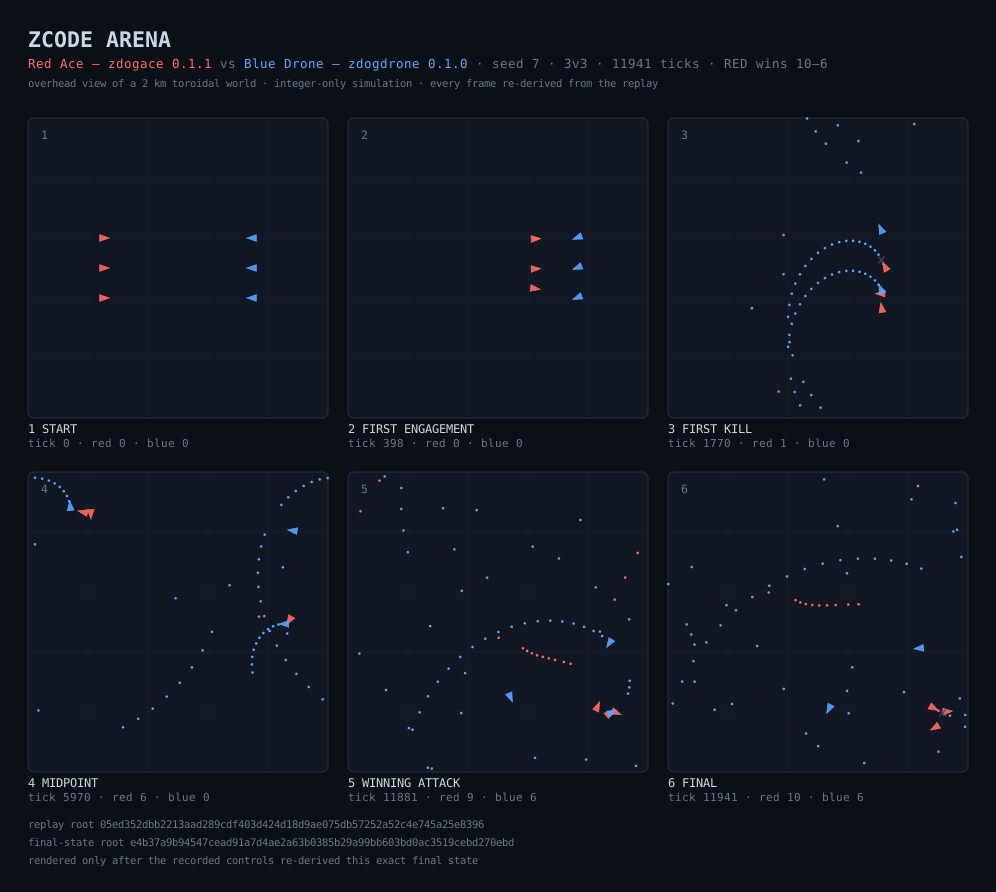
ZCODE ARENA
Red Ace defeated Blue Drone 10-6
11,941 deterministic ticks

Replay verification:       MATCH
Result vs pinned roots:    MATCH
Altered control byte:      REFUSED (match-incomplete)

Replay root:               05ed352dbb2213aad289cdf403d424d18d9ae075db57252a52c4e745a25e8396
Final-state root:          e4b37a9b94547cead91a7d4ae2a63b0385b29a99bb603bd0ac3519cebd270ebd
No blockchain sync, no Tor, no wallet, no browser, no JavaScript, no Python, no
network, no running node — just a C compiler. Those roots are the point: a
second machine that builds the same sources prints the same digests, and a
single altered byte is refused by name. Write your own pilot, verify a replay,
and read the two-node proof and the honest gaps in
docs/ARENA.md.
One binary, one onion, one stack. ZClassic23 is first a public ZClassic blockchain full node: consensus-compatible validation, wallet custody, peer networking, synchronization, and optional in-process Tor in one C23 binary.
The same full-node network can optionally act as a decentralized C23 software commons. Ordinary nodes can publish, discover, fetch, verify, build, independently reproduce, and serve exact C23 packages without GitHub or a central package registry. Downloaded C is inert by default: fetching and storing do not authorize building, testing, installing, linking, executing, or deployment.
VERIFY, DON’T TRUST. Any agent may propose code and any node may perform computation, but each receiving node verifies exact objects, signatures, roots, and evidence under its own local policy. No result is accepted because of who produced it.
ZClassic23 implements the ZClassic (ZCL) consensus rules—Equihash 200,9
proof-of-work plus transparent and Sapling shielded transactions—and must
remain bit-for-bit consensus-compatible with zclassicd.
The same process — no extra daemons, no sidecars, no reverse proxy — also runs:
| Tor onion service | in-process, so the node's HTTP surface is reachable with no domain name, no static IP, and no TLS certificate |
| Block explorer + REST API | /explorer and /api/v1, served over the onion or over HTTPS |
| Wallet | transparent and Sapling shielded keys — see the encryption caveat below before storing value |
| P2P marketplace | yardsale: signed, expiring sale ads gossiped between nodes, settled bilaterally over Tor — buyer and seller IPs stay hidden |
| Decentralized C23 Commons | publish, discover, fetch, verify, build, independently reproduce, and serve content-addressed C23 packages; metaverse and creation tools are optional application layers |
| Name registry (ZNAM) | on-chain names resolving to ZCL/BTC/LTC/DOGE addresses plus text records |
| Messaging | Sapling-memo on-chain messages, and direct node-to-node messages |
| Command registry | typed commands with declared input/output schemas, byte budgets and risk classes — the interface an AI agent uses to operate the node (discover help lists the live set) |
It links only stock libc plus static archives built from pinned,
SHA-256-verified sources. There is no runtime dependency to install, no
configuration server to reach, no account, and no API key.
Verify, don’t trust
- Content roots identify exact bytes.
- Signatures identify the key that made a statement.
- Build, test, and reproduction receipts record exact observations under bound inputs; independent reproduction checks an exact build claim.
- Each node verifies evidence locally and decides acceptance under its own policy.
- Evidence proves only its declared claim. It does not by itself prove that arbitrary code is safe, correct, secure, useful, or worthy of acceptance.
No central service or project developer is an authority a node must rely on. Workers and coding agents are untrusted producers of independently verifiable proposals and evidence.
What ZClassic23 does not do
- It has no central coordinator or central package registry.
- It never executes downloaded C merely because it was fetched or stored.
- It does not claim that tests, signatures, or reproduction prove general safety.
- The C23 Commons does not change ZClassic consensus.
- It does not require one AI vendor; Codex, Claude, and future models are replaceable proposal engines.
- It has no live ZC23 token economics today; those surfaces remain simulation-only.
git clone https://github.com/ZclassiC23/zclassic.git && cd zclassic
make
build/bin/zclassic23
What you can do with it
Every command below runs against your own node, on your own machine.
Hold and spend ZCL from your own node
A full ZClassic node with a built-in wallet — transparent addresses and shielded Sapling addresses in the same binary. You are not asking a service for your balance; you validated every block yourself.
build/bin/zclassic-cli getnewaddress          # transparent
build/bin/zclassic-cli z_getnewaddress        # shielded
build/bin/zclassic-cli z_getbalance <addr>
Receiving and sending shielded funds, plus verifying and relaying shielded transactions, use the in-tree native C23 Sapling implementation. No Rust toolchain, library, or runtime is part of ZClassic23.
Serve a site with no domain name and no certificate
Build the bundled Tor and your node becomes a hidden service in-process — no
SOCKS proxy, no second daemon, no port forwarding, no certificate. Your node
serves its own block explorer and REST API on your own .onion.
git submodule update --init vendor/tor      # then build per docs/BUILD.md
build/bin/zclassic23 -tor
build/bin/zclassic23 status                 # your .onion address
The default build links a Tor stub, so -tor runs the node normally without
an onion and says so in the log. The onion is opt-in because it is a large
dependency, not because it is unfinished.
Prefer clearnet? Drop a certificate at <datadir>/ssl/fullchain.pem and
privkey.pem and the HTTPS explorer starts on port 8443 once the node is near
tip. With no cert and no Tor, there is deliberately no public endpoint — the
node is private by default.
Buy and sell without exposing your IP
Yardsale is the built-in P2P marketplace. Sellers pin up signed, expiring sale
ads; nodes gossip them byte-identically; a buyer settles directly with the
seller through a short bilateral ceremony. There is no matching engine and no
middleman. Everything rides the onion surface — the ad board at /yardsale,
and the mutating accept step is served only on the onion, never on
clearnet HTTPS — so neither side needs to expose an IP address, a domain name,
or an account.
build/bin/zclassic23 -tor                    # your .onion hosts /yardsale
build/bin/zclassic23 discover help yardsale  # the typed ad/ceremony commands
Any node can host its own MVC-style web app on its onion the same way the
explorer and yardsale do — the recipe is
docs/cookbook/13_host_your_own_mvc_onion_app.md.
Register an on-chain name
ZNAM is a working on-chain registry. Names are 1–63 characters, first-come, and one name can carry addresses for ZCL, BTC, LTC and DOGE at once, plus free-form text records like an email or a URL.
build/bin/zclassic-cli name_register "yourname"
build/bin/zclassic-cli name_resolve  "yourname"
Browse the chain locally
The node serves a block explorer at /explorer with a JSON API under /api,
over your onion or over HTTPS. Start API discovery at /api/v1:
/api/v1/service-catalog lists what your node can host, advertise, verify or
construct. It is not on the RPC port — a plain GET to 18232 returns
405, by design.
Send messages peer-to-peer
On-chain messages ride inside the 512-byte encrypted Sapling memo field, so they are shielded and permanent. Off-chain messages go directly between connected nodes.
build/bin/zclassic-cli msg_send  <addr> "text"
build/bin/zclassic-cli msg_inbox
Be aware: off-chain messages are plaintext on the wire today. The encrypted transport is written but not switched on by default. On-chain messages are shielded; off-chain ones should be treated as postcards.
Mine
Equihash 200,9, in the same binary, validating what it mines against the same rules as the rest of the network.
Let an AI agent operate the node
The binary contains a typed native command registry with declared input and output schemas, byte budgets, auth levels, and risk classes, so an agent can operate the node directly. The live catalog is discoverable; no vendor SDK or model lock-in is required.
build/bin/zclassic23 status                 # height, peers, sync, health, one call
build/bin/zclassic23 discover help          # the live command catalog
build/bin/zclassic23 discover search <query>     # find a command by keyword
build/bin/zclassic23 discover schema <leaf>      # exact input keys before you call
build/bin/zclassic23 code map               # navigate the source tree
build/bin/zclassic23 ops logs --pattern='error|warn'
Every reply is self-describing and size-bounded, and no failure reply lacks a
next action to run. A stall is never silent: either the tip gap grows or a
blocker is named. Full contract:
docs/NATIVE_COMMAND_INTERFACE.md.
Working on this repository with an agent? Start with
AGENTS.md — the mission, the safety boundary, the first five
commands in a fresh clone, and the lint gates the agent must respect. The
daily-driver manuals are docs/DEVELOPING.md and
docs/CODEBASE_MAP.md, and
docs/AI_SAFETY_GATES.md lists the gates that stop
an agent from claiming a result it cannot cite.
Measure peers, and play P2P games
A P2P game framework rides the same network layer — peer latency in microseconds, and a working TicTacToe as the reference implementation.
build/bin/zclassic23 core network peers latency
Build on the C23 Commons
The optional C23 Commons can publish and verify exact packages and support application layers such as signed spaces and the ZC23 Living Commons projection. These applications sit below the public full node and package reproduction network in the product priority order.
build/bin/zclassic23 zcode guide                    # the creator's map: find, inspect, fetch, create, improve
build/bin/zclassic23 discover search metaverse      # orient in the command tree
build/bin/zclassic23 metaverse property list --input='{"datadir":"/tmp/zcl23-tour"}'
build/bin/zclassic23 zcode commons status --input='{"workspace":"/tmp/zcl23-tour-commons"}'
Honest scope: ZC23 patronage today is simulation-only — no live token, and
every live-money path fails closed by design. The tour, the architecture, and
the truth-about-status page: docs/METAVERSE.md.
Getting there
make doctor probes your machine and prints the exact install line for
anything missing. What you need: gcc 14+ (or clang with working
-std=c23), GNU make, git, and a C++ compiler for the LevelDB test oracle.
make -j"$(nproc)"   # node + CLI + RPC tool -> build/bin/
make -j"$(nproc)" dev-bin  # a fast non-LTO build for iterating -> build/bin/zclassic23-dev
make -j"$(nproc)" test     # all registered parallel groups
make lint           # the defensive-coding gates
The make dev-bin target is the non-LTO developer build; invoke it with the
parallel form above so its per-translation-unit work uses the available CPUs.
The first make runs make vendor once, which downloads pinned third-party
sources, checks each against a pinned SHA-256, and compiles them locally. After
that every build is offline. Clone to passing test suite is about ten minutes
and 1.6 GB of disk; make first-build-timing measures it on your own hardware.
The shipped binary links only stock libc plus static archives in
vendor/lib/, so there is nothing to install at runtime and nothing to keep
updated.
Datadir is ~/.zclassic-c23/ (-datadir=DIR). Default ports: P2P 8033,
RPC 18232.
Public start here: docs/GETTING_STARTED.md is the
fresh-machine walkthrough — build, run a node and explorer, and set up an
isolated development instance.
When something looks wrong
The node is built to report its own state, so begin with its typed diagnostics:
build/bin/zclassic23 status                    # height, peers, sync, blocker, health
build/bin/zclassic23 core sync diagnose        # why sync is where it is
build/bin/zclassic23 ops logs --pattern='error|warn'
build/bin/zclassic23 ops health                # synced / has_peers / tip_stale / tip_lag
If the height is frozen, status names the cause in primary_blocker — a stall
is never a silent stop. If peers stay at 0, add onion seeds to
~/.config/zclassic23/onion-seeds so the node can find peers without DNS.
Deeper paths, including kill-9 and out-of-memory recovery, are in
docs/RUNBOOK.md.
Reaching the chain tip
A fresh node is honestly empty — getblockcount returns 0 until blocks are
actually folded, never a phantom tip — and then syncs from peers. There are no
DNS seeders; the node bootstraps from verified IP seeds baked into the sealed
consensus core plus a Tor onion directory, harvesting peers from each onion's
/directory.json. Add your own seeds in ~/.config/zclassic23/onion-seeds.
A plain start from an empty datadir takes hours. If you already run the C++
zclassicd, importing its headers first is the fast path:
build/bin/zclassic23 --importblockindex ~/.zclassic   # headers FIRST
build/bin/zclassic23                                  # then a normal boot
Order matters — skipping the import leaves a ~3.1M-header hole and the node
pins. Every path, including the prebuilt starter pack and its honest limits, is
in docs/BOOTSTRAPPING.md and
docs/SYNC.md.
Properties, and how to check them yourself
Don't take these on assertion — each one names the mechanism and the command that shows it.
Inputs to a validity decision: two. The binary you compiled, and the proof-of-work-heaviest header chain. There is no operator attestation, no certificate authority, and no registry lookup anywhere in a consensus path.
core/ is byte-sealed. Checkpoints, chain params and consensus math are
pinned by core/MANIFEST.sha3. Any byte change fails the check-core-seal
gate; changing it requires a recorded unseal (core/UNSEAL.md).
This binds an AI agent working on the code exactly as much as it binds you.
make lint # check-core-seal is one of the gates it runs
Consensus stays bit-compatible with zclassicd. Enforced by the
check-consensus-parity gate plus a golden-value test group; consensus-changing
contributions are declined
(docs/CONSENSUS_PARITY_DOCTRINE.md).
make -j"$(nproc)" t-fast ONLY=consensus_parity
The process restricts itself before it reports ready. -sandbox=steady
applies no_new_privs, PR_SET_DUMPABLE(0), Landlock datadir grants and a
seccomp deny-list, installed with seccomp TSYNC so already-running P2P and
validation threads are covered rather than only new ones.
build/bin/zclassic23 dumpstate sandbox # per-thread coverage
No subprocess execution. Zero system() and popen() in shipped
app/lib/config code, enforced by a lint gate rather than convention.
This describes the full-node runtime boundary. An explicitly admitted C23
Commons build or test action may invoke its bound toolchain only inside the
separate bounded worker lifecycle; fetching source never invokes it.
Wallet key encryption at rest is single-writer. The keystore file path
wraps keys in AES-256-GCM (PBKDF2-HMAC-SHA512, 200k iterations), and the
wallet_keys / wallet_sapling_keys / wallet_seed secret columns in
node.db have exactly one writer — the encryption-aware wallet_sqlite
layer (lib/wallet/src/wallet_sqlite.c). The old plaintext mirror
(node_db_sync_wallet_keys → db_wallet_key_save) is deleted, and a lint
gate ratchets that it never returns. With no passphrase set, keys are stored
as raw 32-byte blobs (Bitcoin-Core unlocked-wallet semantics — the datadir
must be protected). A boot-time scrub
(wallet_sqlite_scrub_plaintext_r, run from config/src/boot_services.c)
wraps any legacy plaintext secret rows into WKS1 envelopes in place
whenever a passphrase is configured; it never deletes rows. The full
picture is in
docs/CUSTODY_MODEL.md.
Crash recovery is executed, not claimed. make test-crash-bootstrap kill-9s
a node mid-write on an isolated datadir and requires it to fold back to its tip
with no manual repair.
Read-only queries are constrained by construction.
zclassic23 core storage query is SELECT-only, rejects semicolons, auto-LIMITs,
carries a wall-clock budget, and denies wallet-secret tables by name.
The gates run on your machine, without reliance on a hosted CI service:
make lint, make ci.
Full boundary: docs/SECURITY_AND_INTEGRITY.md.
The gates that specifically stop an AI agent from claiming a result it cannot
cite: docs/AI_SAFETY_GATES.md.
Where it is today
Pre-v1. Don't make it your only mainnet node yet. The bar for v1 is the
eight acceptance criteria in docs/MVP.md.
Working now: full node and validation, wallet, mining, explorer and REST API, onion service, the yardsale P2P marketplace (signed ad gossip + bilateral settlement), the ZCODE package commons and metaverse surfaces (simulation-complete, no live ZC23), ZNAM names, on-chain shielded messaging, the native command registry, P2P games.
Not finished yet, plainly: off-chain messaging is plaintext on the wire; cross-chain atomic swaps have contract and settlement plumbing but are not an end-to-end trade; the older chunk-serving file market (distinct from yardsale) gates chunks but payment settlement is not wired through; ZC23 issuance and custody are pre-genesis and simulation-only; the ~1-minute cold sync the fast-sync stack is designed for is a target, not today's proven path.
Ask the running node rather than treating this page as live state:
zclassic23 status.
Going further
docs/GETTING_STARTED.md— first run on a fresh machinedocs/NATIVE_COMMAND_INTERFACE.md— the agent interfacedocs/HOW_THE_NODE_WORKS.md— the node as a state machinedocs/FRAMEWORK.md— architecture: the laws and the eight code shapesdocs/CODEBASE_MAP.md— where everything livesdocs/DEVELOPING.md— the developer operating manualdocs/BUILD.md— vendored sources, versions, build stepsdocs/RUNBOOK.md— operating and troubleshootingdocs/MVP.md— v1 criteria and honest readinessAGENTS.md— model-neutral coding-agent entry point
Something wrong? zclassic23 status first, then
docs/RUNBOOK.md. File bugs through GitHub Issues — the
templates in .github/ISSUE_TEMPLATE/ ask for the
two things that make a report actionable. Security reports:
.github/SECURITY.md. Contributing:
.github/CONTRIBUTING.md.
License
Copyright 2026 Rhett Creighton. Apache License 2.0 — see LICENSE.
Upstream notices (Bitcoin Core, Zcash, zclassicd, Tor, SQLite, secp256k1,
LevelDB, dcrdex) are in NOTICE; concept attributions in
docs/ATTRIBUTIONS.md.
No comments yet
Be the first to share your take.