
Wizard

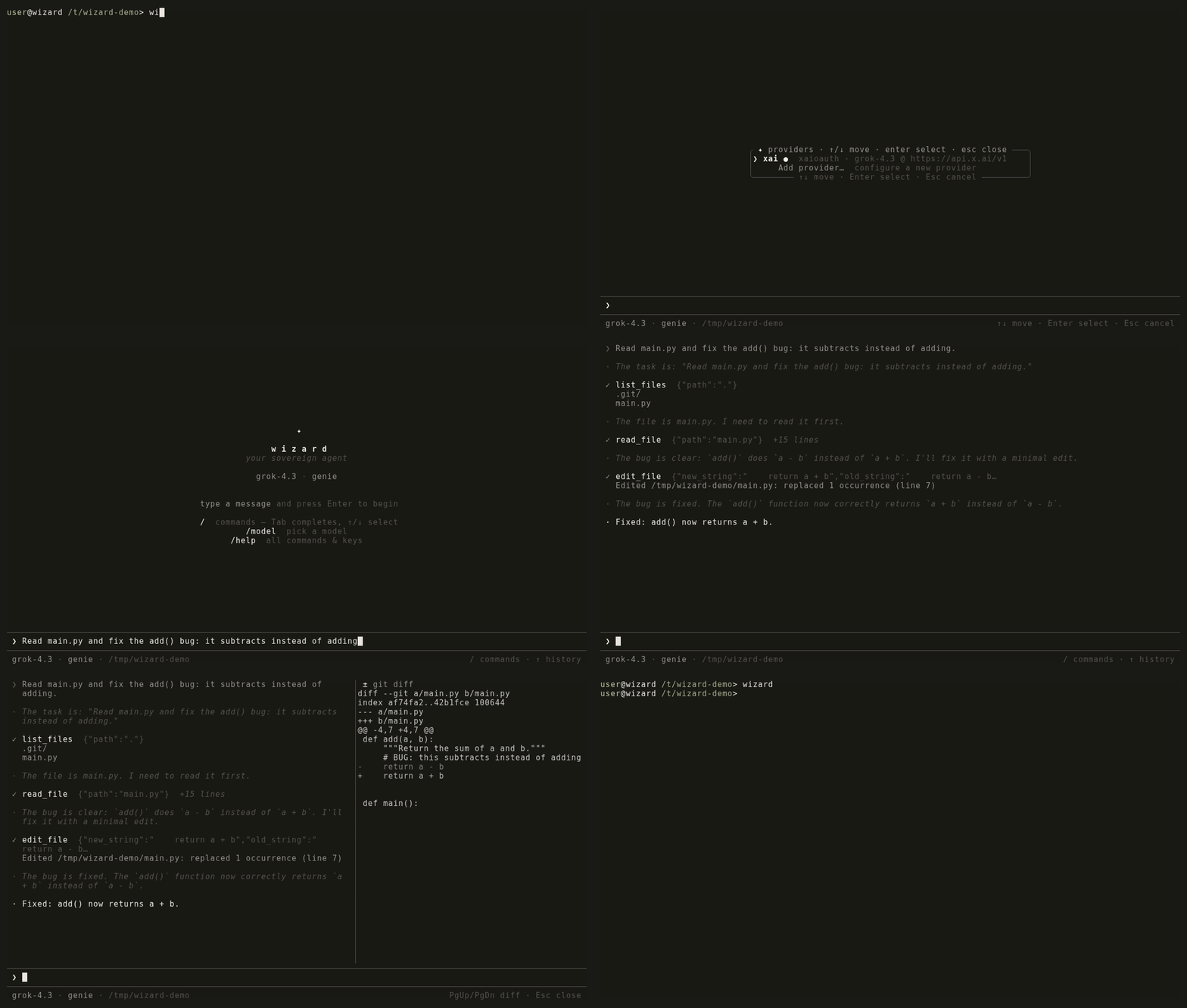
One line. Your sovereign agent. Self-extending. Bring any model.
curl -fsSL https://raw.githubusercontent.com/teddytennant/wizard/main/install.sh | bash
That installs the wizard binary. First run asks which provider you want and handles the rest. Pick Local and Wizard sizes a Qwen 3 GGUF to your hardware and runs llama.cpp's llama-server for you, no API key needed. Or sign in with an xAI or ChatGPT account, or drop in a key for xAI, OpenAI, Anthropic, Google Gemini, DeepSeek, Groq, Mistral, Moonshot, Z.AI, MiniMax, Together, Fireworks, Cerebras, OpenRouter, Cloudflare Workers AI, or any OpenAI-compatible endpoint, and switch live with /provider. One fast Rust binary on Linux and macOS. Everything it keeps lives under ~/.wizard/ in files you can read: TOML for config, markdown for memory, JSONL for sessions — edit or delete any of them.
Other ways to install: local-stack preinstall, minimal, bring-your-own-model, Nix, macOS, Termux, plus a first-run walkthrough, all in Getting started.
What it does
- Any model, switchable live. Speaks the OpenAI-compatible chat API (streaming + native tool calls, with a prompt-based JSON fallback), so xAI, OpenAI, Anthropic, Gemini, DeepSeek, Groq, Mistral, Moonshot, Z.AI, MiniMax, Together, Fireworks, Cerebras, OpenRouter, Cloudflare Workers AI, Ollama, and any OpenAI-compatible endpoint (vLLM, LM Studio, and friends) all work.
/providerswitches the live agent between them. Keys live in env vars or~/.wizard/credentials.toml(mode 0600), never in plaintext config. See Providers. - Runs models locally, fully managed. Pick Local and Wizard downloads a GGUF sized to your VRAM, then starts, supervises, and reuses
llama-serverfor you, including a Metal build on Apple Silicon. See Model tiers and Bring your own model. - Model fusion (
/fusion). Run a panel of your providers as a debate. The members critique each other's drafts, then you get one tool-capable answer synthesized from the lot. See Fusion. - Mixture of agents (
/ultra). Fan a turn out to N read-only subagents on the model you're already using (each with a different lens, each reading the actual repo), have a judge compare their drafts, then execute from the verdict. See Ultra. - Self-extension (
/evolve), powered by LuaJIT. Add skills, MCP servers, scripted tools, and subagents as plain files that go live on/reload. Scripted tools default to embedded LuaJIT: the just-in-time compiler runs your glue in-process, no external interpreter onPATH. Wizard can also rebuild its own binary, gated on a cleancargo build --release --locked, a passingcargo test --release --locked, and a smoke test (minutes, not seconds). Every change is logged, and the prior binary is kept onemvfrom rollback. See Self-extension. - Runtime MCP, both directions. stdio and HTTP MCP servers merge into the tool registry without a rebuild: the path for computer use, browser control, and databases. Wizard also serves its own tools over stdio (
wizard mcp-serve), so any MCP client can call them. See MCP. - Editor embedding (ACP).
wizard acpruns Wizard as an Agent Client Protocol agent, so ACP editors (Zed, Neovim, Emacs) drive it as their coding agent, streaming assistant text, reasoning, and tool calls into the editor. See ACP. - Genie / Sovereign modes, plus
--continuous. An interactive direct-action TUI (genie), headless autonomous runs (sovereign), or a perpetual mission (--continuous) that compacts its own context and self-heals through outages. See Modes. - Agent-managed context. Sessions are JSONL under
~/.wizard/sessions/. Auto-compaction keeps long runs inside the window. A live pressure signal and the mid-turncompacttool let the agent shed history on every surface (including headless/gateway). Durable facts go tomemorywhen the task changes. See Agent-managed context. - A window (preview).
wizard guiopens the agent in its own window: one process, no webview, no loopback HTTP, with a transcript you can select across, a subagent rail, a git rail whose changed files open their diff, and a console that can answer a shell command that prompts. It needs a build with--features native, and that build ships as its own binary rather than replacing the one you already have:curl | bashwithWIZARD_NATIVE=1placeswizard-nativebesidewizard, so the command iswizard-native gui. From a checkout,cargo build --release --features nativeand thenwizard gui. There is no second GUI: the browser one this replaced — a loopback HTTP server and a JavaScript page — is deleted. To drive a headless box, run the TUI over SSH, usewizard -p, point an ACP editor atwizard acp, or run the Telegram gateway. Still settling; the TUI remains the surface everything ships to first. See Native GUI. - Persistent memory. The agent keeps what it learns as plain markdown under
~/.wizard/memory/<project>/: typed (user/feedback/project/reference), linked with[[name]], indexed into the system prompt each session./memoryreads it back. It is your file, not a black box. See Memory. - Harness evolution (AHE). The shipped defaults were improved offline by an evaluate → analyze → improve loop (80% → 100% pass@1 on a Terminal-Bench sample). The old local
wizard benchtrajectory runner is gone; AHE superseded it. See Self-extension / harness. - Messaging gateway. Run headless as a bot you talk to from your phone (Telegram), each inbound message a sovereign agent turn in your project. See Gateway.
- Buzz rooms. Drop Wizard into Buzz (Block's human+agent workspace) as an ACP member via
buzz-acpor a Desktop custom harness; room I/O isbuzz-cli. See Buzz. - Make it your own. After a deep evolve modifies its source,
/publishforks upstream to your GitHub and hands out a one-line installer for your variant.wizard skills search/installshares one piece instead of the whole thing, from a git-backed registry with no backend and no accounts. The client is in this binary; the public registry it points at is not published yet, so today it installs from anyregistry.jsonyou pointWIZARD_REGISTRY_URLat. See Fork and distribute.
Fewer moving parts. A single memory-safe Rust binary with an embedded LuaJIT for self-extension: no garbage-collected app runtime, no second interpreter to install and keep patched. Be clear about what that is and is not: embedding LuaJIT removes a dependency, not a capability. A scripted tool you or /evolve wrote runs with Lua's os and io libraries available, so os.execute works, and it runs inside the Wizard process with your privileges. A tool installed from the registry is held to an allowlisted subset (no os, no io) unless you explicitly grant it more, which is a restriction on a stranger's code and not a sandbox around it. Read SECURITY.md before autonomous runs; every tool executes as you.
haha suckers
You thought you needed an interpreter and to write your TUI in bloated TypeScript. No. Just have the just-in-time compiler for LuaJIT. Wizard is Rust + Ratatui for the surface, and when it extends itself the glue is Lua that the JIT compiles in-process: fast, no Node, no Electron, no shipping a second runtime next to the binary. Self-extension without the bloat tax.
Limitations
- Platforms. Linux (x86_64, aarch64), macOS (Apple Silicon and Intel), and Termux on Android (source build into
$PREFIX/bin). Windows isn't supported; run it under WSL2. - Releases are signed, and the installer enforces it.
install.shfetcheschecksums.txtandchecksums.txt.minisig, verifies the signature under the key inlined in the script, then verifies each asset's SHA-256 against that file;wizard updateapplies the same rules with the key compiled in. Every failure aborts, and there is no flag to skip the check. Verifying needsminisignonPATHor an OpenSSL with ed25519 and blake2b (macOS ships LibreSSL, which has neither, sobrew install minisignfirst), or addWIZARD_BUILD_FROM_SOURCE=1to build from the release tag instead. See Getting started. - Small local models are worse than frontier models. A 4B-36B quantized Qwen will misformat tool calls, miss context, and need more steering than Claude- or GPT-class models. Wizard mitigates with retry prompts and a refusal to act on a truncated tool call, plus a prompt-based JSON tool protocol for models with no native tool calling — though the probe that selects that protocol only asks Ollama, so a model served by
llama-server(the default local backend) is taken at its word and always gets native tool calls. The 27B+ tiers make much better agents than the 9B tier, and the 4B tier that 8 GB machines get is a floor: it exists so such a machine has a local option at all, not because it is a good agent. - No sandbox. Tools run with your privileges, with no per-action approval gate in either mode. Read SECURITY.md before running on anything you don't trust, and prefer a container/VM for autonomous or continuous work.
- Context windows are finite. Wizard searches and reads selectively rather than ingesting the whole repo, auto-compacts older history, and instructs the agent to compact / reset deliberately when the task changes, but long sessions still eventually push out early detail. See Agent-managed context.
Docs
Everything is indexed in docs/README.md, grouped by what you are trying to do. The headline pages:
- Getting started: install (all flavors, Nix, macOS, Termux), tiers, providers, first run, in-place updates (
wizard update), the download mirror, troubleshooting - Usage: slash commands,
wizard agents, the subagent rail, token usage and cost, todos, project instructions,/uiinterfaces, themes and color depth - Native GUI:
wizard gui, the agent in its own window (WIZARD_NATIVE=1to install a build that has it) · Graph explorer (deferred, not reachable in 2.0) - Gateway: run Wizard as a Telegram bot
- Buzz: join a Buzz workspace as an ACP agent (
buzz-acpor Desktop) - Modes: genie, sovereign, and continuous
- Self-extension:
/evolvetiers, gates, rollback - Fusion: the
/fusiondebate panel - Ultra: the
/ultramixture of agents - Bring your own model: any GGUF, or custom Ollama models
- Computer use: desktop control — mouse, keyboard and screenshots — on Linux and macOS, for a model that can see
- Custom commands & @files: your own
/commands;@pathfile references - Memory: what Wizard remembers between sessions, and
/memory - Hooks: lifecycle hooks, and the trust gate on a project's own hooks · Tasks · Web · Headless output · Checkpoints
- Interactive commands: answering a shell command that prompts, and what the timeout does while it waits
- Doctor & status:
wizard doctordiagnostics,wizard doctor --bundlebug reports,/status - Logs:
~/.wizard/logs/, theWIZARD_LOGfilter - Scheduler: cron-scheduled headless runs
- Fleet: parallel workers over git worktrees
- Mesh:
wizard peers, trust states, and what does and does not ship - Sync:
wizard syncmoves config, skills, and custom tooling between machines as a signed bundle - Fork and distribute: publish your evolved Wizard, and the skills and tools registry (
wizard skills) - Architecture: how it's built
- Security: threat model
- WIZARD.md: the agent's bundled behavioral charter, inherited and editable by every fork
- CHANGELOG.md: what changed in 2.1, what breaks coming from 1.x, and what to do about each break
Development
Rust 2024, Ratatui, Tokio, embedded LuaJIT (mlua). Single binary, < 60 MB stripped.
git clone https://github.com/teddytennant/wizard
cd wizard
cargo build --release
./target/release/wizard
There's also a Nix flake: nix run github:teddytennant/wizard, or nix develop for a shell with the Rust toolchain and llama-cpp.
Acknowledgements
Local inference is powered by llama.cpp (ggml-org): Wizard installs its llama-server when you pick the local option. Ollama is a first-class supported provider.
License
MIT AND Apache-2.0 — both at once, not a choice between them. Wizard's own code is MIT (LICENSE-MIT). The terminal-UI code ported from OpenAI Codex and xAI grok-build stays under Apache-2.0 (LICENSE-APACHE); NOTICE names every file it landed in and docs/ui-skins.md has the file-by-file table.
No comments yet
Be the first to share your take.