
talkthrough-mcp




Quickstart · Tools · Benchmarks · FAQ · Troubleshooting · Changelog · Contributing
Don't write a bug report. Record it.
Give Claude Code or Codex a narrated .mov/.mp4 — talkthrough turns it
into searchable transcript, exact frames, OCR and wall-clock timestamps,
locally — so your agent writes an evidence-backed issue draft or investigates
the fix.
Also works for meetings, workshops, product demos, and production incidents.
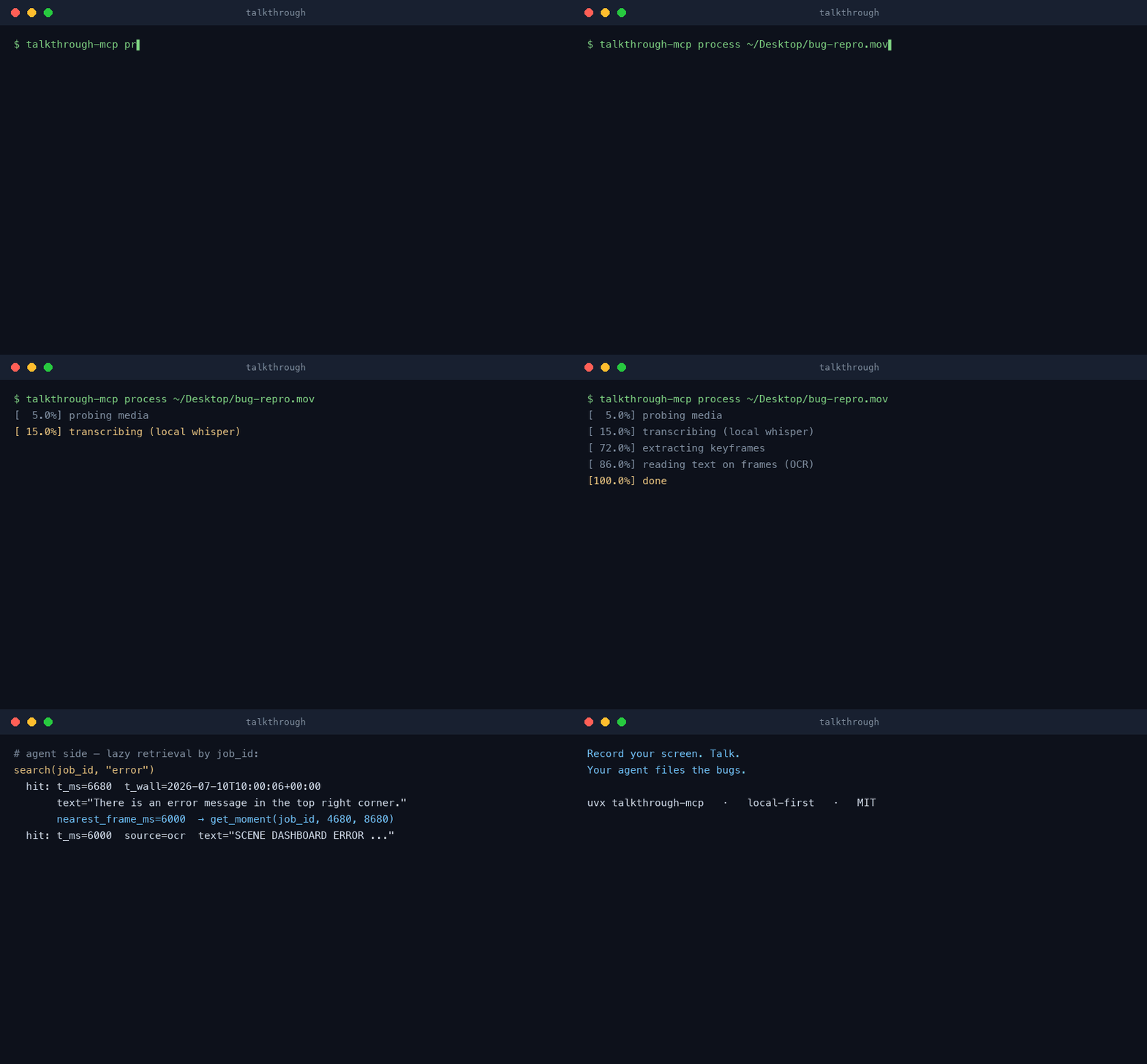
Illustration — an animation of the /talkthrough:bug storyline, not a screen
capture: the recording is indexed locally (transcript · keyframes · OCR ·
wall-clock), the evidence checkpoint is assembled, and the draft is ready to
file with your own tracker tooling (gh, Jira, a GitHub MCP server —
talkthrough itself never leaves your machine and never posts anything).
Real runs, no animation:
- ▶ Watch the demo with sound (1:18) — an
unedited session: a narrated recording goes in, a ready-to-file
bug-report.mdcomes out. - Silent recording → issue draft —
the whole thing as files you can re-run: a Playwright-recorded, audio-free
.mp4and the unedited agent output. Every number is reproducible — processing that file givesjob_id 8703a66bbe77a7d0(the job id is the sha256 prefix, soshasum -a 256predicts it), 17 keyframes / 4 unique, and 0 transcript segments because there is no audio track.
Quickstart
One command, no system dependencies: ffmpeg falls back to a bundled build,
OCR is pip-only, and whisper models download themselves on first use. The
only prerequisite is uv (brew install uv or
curl -LsSf https://astral.sh/uv/install.sh | sh).





Claude Code
Two install paths — pick one, not both (the plugin already includes the server; installing both would register it twice):
Server only — the 8 tools + 6 prompts, and nothing else on your system. Choose this for a minimal setup, or when you manage MCP servers yourself across several clients:
claude mcp add -s user talkthrough -- uvx "talkthrough-mcp[diarization]"
Full plugin — the same server, plus native slash commands
(/talkthrough:bug, /talkthrough:triage-recording, …) that handle the
ceremony for you, a ready-made triage subagent, and an agent skill that
teaches Claude the workflow. Choose this for the best out-of-the-box
experience:
/plugin marketplace add korovin-aa97/talkthrough-mcp
/plugin install talkthrough@talkthrough
Every other MCP client
claude_desktop_config.json:
{
  "mcpServers": {
    "talkthrough": {
      "command": "uvx",
      "args": [
        "talkthrough-mcp[diarization]"
      ]
    }
  }
}
More: integrations/claude-desktop/
~/.cursor/mcp.json (or project .cursor/mcp.json):
{
  "mcpServers": {
    "talkthrough": {
      "command": "uvx",
      "args": [
        "talkthrough-mcp[diarization]"
      ]
    }
  }
}
More: integrations/cursor/
~/.codex/config.toml (or project-scoped .codex/config.toml in trusted projects):
[mcp_servers.talkthrough]
command = "uvx"
args = ["talkthrough-mcp[diarization]"]
More: integrations/codex/
~/.gemini/settings.json:
{
  "mcpServers": {
    "talkthrough": {
      "command": "uvx",
      "args": [
        "talkthrough-mcp[diarization]"
      ]
    }
  }
}
More: integrations/gemini-cli/
cline_mcp_settings.json (via MCP Servers UI):
{
  "mcpServers": {
    "talkthrough": {
      "command": "uvx",
      "args": [
        "talkthrough-mcp[diarization]"
      ]
    }
  }
}
More: integrations/cline/
~/.openclaw/openclaw.json:
{
  "mcp": {
    "servers": {
      "talkthrough": {
        "command": "uvx",
        "args": [
          "talkthrough-mcp[diarization]"
        ]
      }
    }
  }
}
More: integrations/openclaw/
opencode.json (project) or ~/.config/opencode/opencode.json:
{
  "mcp": {
    "talkthrough": {
      "type": "local",
      "command": [
        "uvx",
        "talkthrough-mcp[diarization]"
      ],
      "enabled": true
    }
  }
}
More: integrations/opencode/
~/.config/goose/config.yaml:
extensions:
  talkthrough:
    enabled: true
    type: stdio
    cmd: uvx
    args: ["talkthrough-mcp[diarization]"]
More: integrations/goose/
~/.copilot/mcp-config.json:
{
  "mcpServers": {
    "talkthrough": {
      "command": "uvx",
      "args": [
        "talkthrough-mcp[diarization]"
      ]
    }
  }
}
More: integrations/copilot-cli/
~/.codeium/windsurf/mcp_config.json:
{
  "mcpServers": {
    "talkthrough": {
      "command": "uvx",
      "args": [
        "talkthrough-mcp[diarization]"
      ]
    }
  }
}
More: integrations/windsurf/
settings.json (Zed):
{
  "context_servers": {
    "talkthrough": {
      "source": "custom",
      "command": {
        "path": "uvx",
        "args": [
          "talkthrough-mcp[diarization]"
        ]
      }
    }
  }
}
More: integrations/zed/
Any other MCP stdio client uses the same server command: uvx "talkthrough-mcp[diarization]".
Per-engine folders with exactly these snippets plus verification steps live
in integrations/; agents can self-install via
llms-install.md.
Who said what (speaker diarization) — included in the configs above
Multi-person recordings (meetings, interviews, panels) can carry S1/S2/…
speaker labels. Every install button, snippet, and the plugin above already
ship the [diarization] engine, so asking your agent "who said what" just
works — diarization itself still runs only when requested per call
(process_media(path=..., diarize=true, num_speakers=<count if known>)),
and its models download once on first use.
Prefer the minimal server without the diarization engine? Use
uvx talkthrough-mcp as the command instead (the MCP registry entry also
resolves to this lean form) — an explicit diarize=true will then answer
with the one-line install fix. Details in
Speakers.
Local checkout (development)
git clone https://github.com/korovin-aa97/talkthrough-mcp
claude mcp add talkthrough -- uv run --directory /path/to/talkthrough-mcp talkthrough-mcp
Then, in your agent:
Process
~/Desktop/recording.movand triage it — or just invoke thetriage-recordingserver prompt.
Tools
| Tool | What it does |
|---|---|
process_media(path, recorded_at?, vocabulary?, language?, model?, diarize?, num_speakers?, force?) |
Ingest a video/audio file: local STT, keyframes, OCR, wall-clock, opt-in speaker labels. Returns a compact summary. Idempotent by content hash — re-calls are instant; diarize=true on a processed job adds speakers without re-transcribing. |
get_transcript(job_id, start_ms?, end_ms?, format?) |
Paginated transcript as segments, text, or srt (speaker-prefixed when diarized, plus a roster header); truncation returns next_start_ms. |
get_frames(job_id, at_ms? | start_ms?+end_ms?, max_frames?, include_duplicates?) |
Keyframe images nearest a timestamp or evenly thinned across a range (unique frames by default, max 6/call); each frame names its absolute path. |
get_moment(job_id, start_ms, end_ms) |
The "one remark" bundle: transcript slice + up to 3 frames + their OCR text + wall-clock range (+ speakers_in_range when diarized). |
search(job_id, query, speaker?, match_mode?) |
Substring search over the transcript AND on-screen OCR text. all_words remains the default; any_word broadens lexical recall. Hits carry t_ms/t_wall, frame refs, and the speaker when diarized. The optional filter accepts a raw label or saved name. |
label_speakers(job_id, labels, evidence?) |
Atomically persist verified names for anonymous speaker labels. Raw S1/S2 labels remain canonical; blank/null removes a name. |
extract_frame(job_id, at_ms, crop?) |
Exact-timestamp full-resolution re-extract from the source video (optional crop) when keyframes miss the instant; returns the file's absolute path. |
list_jobs() |
Recent processed recordings with source paths, durations, wall-clock starts, counts, and speaker counts when diarized. |
Every tool description ships 10+ usage examples, so agents pick the right tool without extra prompting.
Server prompts (slash commands in MCP clients)
| Prompt | Workflow |
|---|---|
bug |
One recording → evidence-backed GitHub issue draft (silent, narration-free recordings work too) |
triage-recording |
Narrated screencast → precise findings JSON (bug/feature/question routing, frame evidence) |
spec-from-workshop |
Recorded workshop → structured spec with quoted decisions and open questions |
backlog-from-demo |
Product demo → prioritized backlog with timestamped evidence |
meeting-actions |
Meeting audio → action items, decisions, open questions |
correlate-with-logs |
Recording remarks ↔ system logs via wall-clock windows |
The same prompts live as plain files in examples/prompts/
if your client doesn't surface MCP prompts. The findings contract used by
triage-recording is examples/output-contract.schema.json.
Works as a skill too (no MCP required)
The same workflow ships as a cross-engine Agent Skill
at .agents/skills/talkthrough/ — Claude Code,
Codex CLI ($talkthrough), Cursor, Copilot, Gemini CLI, Goose and other
SKILL.md-compatible tools read it. Agents without MCP wiring can drive the
CLI directly: talkthrough-mcp process recording.mov --json prints the
same summary the MCP tool returns, and the job store is shared either way.
Wall-clock anchoring
Every timestamped result carries both t_ms (video-relative) and t_wall
(ISO 8601 real time) once the recording start is known. Resolution ladder:
recorded_atparameter (agent/user override) → confidenceexact- QuickTime
com.apple.quicktime.creationdatetag, carries the local timezone (QuickTime Player recordings; ⌘⇧5 wrote it before macOS 26) →high - Container
creation_timetag (UTC) →medium— macOS 26+ ⌘⇧5/ReplayKit screen recordings land here (nocreationdatetag anymore); passrecorded_at=when local-tzt_wallmatters - File mtime minus duration (recorders finalize files at recording END) →
low - Nothing → tools still work with relative
t_msonly
Why it matters: "the upload spinner froze here" becomes a ±30 s grep window in your server logs.
Speakers (optional diarization)
With the [diarization] extra installed (included in every generated config —
see Quickstart),
process_media(diarize=true) labels who said what — locally, like everything
else here (sherpa-onnx runtime, no
torch, no accounts, no GPU):
- Speakers become
S1,S2, … in order of first appearance; new diarized jobs split speaker changes at word boundaries, while old jobs continue to report honest segment-level precision. Every transcript segment gets aspeaker, and the tools surface it everywhere — roster with talk time inget_transcript,speakers_in_rangeinget_moment,speakeronsearchhits,S1:prefixes in the text/SRT formats, a speaker count inlist_jobs. - Know the headcount? Pass
num_speakers. Clustering toward an exact k removes the main failure mode of unknown-count mode (similar voices merging or one voice splitting). It is a target, not a guarantee: the clusterer can converge on fewer clusters than k, and a re-run that changed nothing says so in the payload (labels_changed: false). Agents are instructed to pass the headcount via the tool guidance; do the same in your own calls. - Already processed a recording? Calling
process_media(diarize=true)on it re-runs only diarization — whisper is not re-run, and labels land in the existing job. Same for changingnum_speakers. The diarization stage itself still re-scans the full audio: minutes on long recordings. - Labels start anonymous. After checking self-introductions, vocatives, or
video evidence, call
label_speakersto preserve a verified mapping such asS1→ "Alice" across sessions. The roster can expose bounded OCRname_candidates, but those are raw hints and are never saved automatically. The raw label remains present besidespeaker_name.
Models download once (~47 MB total) from pinned, checksum-verified URLs into
~/.talkthrough/models/; warm runs are zero-network like the rest of the
pipeline. Speed on an M-series CPU (4 threads): a 26-minute meeting diarizes
in about 2 minutes (RTF ≈ 0.08), on top of the transcription time. Memory:
expect on the order of 1–1.5 GB peak RSS while an hour-plus meeting is being
diarized (measured on a real 73-minute recording); it is released when the
stage completes.
| Role | Model | Download | Weights license |
|---|---|---|---|
| Segmentation | pyannote segmentation-3.0 (ONNX export by k2-fsa) | 7 MB | MIT |
| Embedding (default) | NeMo en_titanet_small |
40 MB | Apache-2.0 (per its NGC model card, the NeMo Toolkit license) |
| Embedding (alt) | WeSpeaker en_voxceleb_resnet34_LM |
27 MB | CC-BY-4.0 |
| Embedding (alt) | 3D-Speaker campplus_sv_en_voxceleb_16k |
30 MB | Apache-2.0 |
The default won a real-meeting accept-eval (RU/EN/ES + a 3-speaker 26-minute
meeting): it was the only candidate to isolate all three real voices at
num_speakers=3, at 2× the speed of the runner-up.
Pick an alternate embedding model (or point at your own .onnx file for
offline machines) via TALKTHROUGH_DIARIZATION_EMB_MODEL; tune the
unknown-count sensitivity via TALKTHROUGH_DIARIZATION_THRESHOLD (see
docs/TROUBLESHOOTING.md). Honest quality notes
live in Limitations.
Privacy
Everything runs locally: your recordings never leave your machine, speech is
transcribed by a local whisper model, OCR and speaker diarization are local
ONNX inference, and there is no telemetry. The only network access is one-time
tool/model downloads (ffmpeg build, whisper model, OCR models, diarization
models — the latter pinned by URL + sha256). Diarization keeps no voiceprint
database: voice embeddings live only in process memory, and only anonymous
turn labels (S1/S2) land on disk. Your agent sees only the payloads the
MCP tools return (text and selected frames) in your existing session;
talkthrough itself makes no LLM calls.
Languages
Narration in any of Whisper's ~99 languages works: the language is
auto-detected per recording, and the summary reports both language and
language_probability so agents can tell a confident detection from a shaky
one (silence or music at the start can fool the detector — pin it with
language="ru" and force=true when that happens). Speaker diarization is
acoustic — it fingerprints voices, not words — so it is language-independent
and works across all of those languages unchanged.
Pick the model for your languages — per call (model= parameter, agents do
this themselves when a transcript comes back garbled) or as the server
default (TALKTHROUGH_WHISPER_MODEL):
| Model | Size | Best for |
|---|---|---|
small (default) |
464 MB | English and major-language narration on CPU |
large-v3-turbo |
~1.5 GB | recommended for non-English — near-large quality at near-small speed |
medium |
~1.5 GB | conservative alternative to turbo |
tiny / base |
75–145 MB | quick drafts, CI |
*.en variants |
— | English-only, slightly faster/better for EN |
Tips that work in every language: pass product names via
vocabulary="Term1, Term2" (biases the decoder so jargon survives), and note
that the workflow prompts instruct agents to write digests in the
narrator's language while keeping quotes verbatim — the server never
translates (exact quotes are evidence; translation is the agent's job).
On-screen text (OCR) defaults to RapidOCR's Latin + Chinese models. For other
scripts set TALKTHROUGH_OCR_LANG to your language — ru/uk (→ the
eslav pack), ja, ko, ar, hi, el, th, or any RapidOCR pack name
like cyrillic — and reprocess with force=true; the matching recognition
model downloads once. Spoken-language support is unaffected either way.
Configuration
| Env var | Default | Meaning |
|---|---|---|
TALKTHROUGH_WHISPER_MODEL |
small |
default whisper model (tiny/base/small/medium/large-v3/large-v3-turbo); the model tool param overrides per call |
TALKTHROUGH_OCR |
on |
set off to skip OCR |
TALKTHROUGH_OCR_LANG |
Latin+Chinese | recognition script for on-screen text: a language code (ru, ja, ko, ar, hi, …) or a RapidOCR pack name (eslav, cyrillic, latin, …); the model downloads once |
TALKTHROUGH_OCR_PARAMS |
— | advanced: JSON object of raw RapidOCR params merged over the derived ones, e.g. {"Rec.lang_type": "cyrillic"} |
TALKTHROUGH_DIARIZE |
off |
set on to diarize by default (needs the [diarization] extra; degrades with a warning without it); an explicit diarize tool param always wins |
TALKTHROUGH_DIARIZATION_THRESHOLD |
0.5 |
clustering sensitivity when num_speakers is unknown: fewer speakers than expected → lower it; more → raise it |
TALKTHROUGH_DIARIZATION_SEG_MODEL |
pyannote-segmentation-3-0 |
segmentation model: allowlist name or a path to a local .onnx (offline preseed) |
TALKTHROUGH_DIARIZATION_EMB_MODEL |
nemo_en_titanet_small |
embedding model: allowlist name (see Speakers) or a local .onnx path |
TALKTHROUGH_DIARIZATION_THREADS |
min(4, cpus) |
ONNX threads for both diarization models |
TALKTHROUGH_MAX_SECONDS |
7200 |
max media duration |
TALKTHROUGH_MAX_FRAMES |
600 |
keyframe budget per job, spread across the whole duration (the 1 s selection floor auto-grows to duration/budget on long recordings) |
TALKTHROUGH_HOME |
~/.talkthrough |
job store root |
CLI
The pipeline is also a CLI — useful for pre-processing long recordings outside an agent session (the store is content-addressed, so the agent then queries the same job instantly):
talkthrough-mcp process ~/Videos/long-session.mov   # prints the summary
talkthrough-mcp process demo.mov --json             # machine-readable
talkthrough-mcp process sync.m4a --diarize --num-speakers 3   # who said what
talkthrough-mcp gc --keep-days 30                   # clean the job store
talkthrough-mcp serve                               # stdio MCP server (default)
First run notes: missing system ffmpeg triggers a one-time static-ffmpeg
download; the first transcription downloads the whisper model (~460 MB for
small); both are cached. After that, expect roughly 3× faster than real time
on an Apple-Silicon CPU with the default model, OCR included (a 2-minute clip
processes in ~40 s) — and instant re-runs on the same file. Progress streams
as MCP progress notifications, and the CLI prints stage lines. More:
docs/TROUBLESHOOTING.md.
Windows
CI runs lint, the unit suite, a full CLI smoke, and a diarize smoke on
windows-latest (static-ffmpeg Windows build, whisper tiny transcription,
OCR, the instant idempotent re-run, and a speaker-roster assert through the
native sherpa-onnx stack). Notes: the per-job lock always serializes threads;
POSIX also uses fcntl for cross-process locking. Quote paths with spaces
(uv run talkthrough-mcp process "C:\Videos\Screen Recording.mp4").
If something breaks, please open an issue.
Supported inputs
Video: .mov .mp4 .webm .mkv — audio-only: .m4a .mp3 .wav .ogg
.flac (transcript tools only; frame tools explain why they're unavailable).
Local files only.
Limitations
Honest edges, so you can decide fast:
- Speaker labels are word-level and opt-in on new jobs. Each Whisper word
is assigned by maximum overlap with the diarization turns, so fast exchanges
split without losing the raw label. Old jobs remain readable and honestly
report
attribution_precision="segment"; reprocess withforce=trueto add word timings. Sub-second interjections ("yeah", "mhm") can still be absorbed when the diarization engine does not detect a separate turn, and heavy crosstalk degrades clustering (the segmentation model tracks at most 2 simultaneous voices). Quality is pyannote-3.x-generation. The comfort zone without hints is roughly 2–8 speakers; passnum_speakerswhenever the headcount is known — it removes the worst failure mode at any size, and it is the way to go for large meetings (10+). - Local files only. No URL/YouTube ingestion (#5) — download first.
- Keyframes + transcript, not motion analysis. A glitch between scene
changes can be invisible in the frame set;
extract_framere-checks any instant, but frame-by-frame motion reasoning is your multimodal model's job. - STT quality tracks the model you pick. The default
smallfavors speed; non-English narration wantsmodel="large-v3-turbo"(see Languages). - OCR reads crisp UI text well; tiny or low-contrast print is best-effort.
- Wall-clock confidence depends on recorder metadata — worst case pass
recorded_at=(see the ladder above). - Windows caveats — POSIX lock degrades to a no-op; see the Windows section above.
How it compares
| talkthrough | cloud recorder SaaS | meeting notetakers | typical video-analyzer MCPs | |
|---|---|---|---|---|
| Runs fully locally | ✅ | ❌ | ❌ | varies |
| Any local video/audio file | ✅ | browser/app captures | meetings only | ✅ |
| Wall-clock anchoring (log correlation) | ✅ | ❌ | ❌ | ❌ |
| Who-said-what speaker labels | ✅ local, opt-in | some | ✅ cloud | ❌ |
| Ships agent workflows (prompts, skill, findings contract) | ✅ | ❌ | ❌ | ❌ |
| OCR of on-screen text, searchable | ✅ | some | ❌ | rare |
FAQ
Why not just upload the video to a multimodal model (e.g. Gemini)?
For a short, non-sensitive clip — do that. The trade-offs appear with length
and sensitivity: an hour of screen recording costs on the order of a million
tokens per question, the file leaves your machine, and you still can't map a
remark to 14:32:07 UTC to grep your server logs. talkthrough indexes once,
locally, then answers any number of follow-ups from the index.
Why not screenpipe?
Different job. screenpipe is an always-on recorder of your machine going
forward (commercial license). It can't open the .mov a teammate or customer
just sent you. talkthrough analyzes any file it's handed — the two compose
fine.
There are agent skills that "watch" videos. Why a server with an index? Watch-style skills push a budgeted frame dump into the context window (and go sparse on long videos), often call cloud STT for the audio, and keep nothing. talkthrough builds a persistent local index — transcript + OCR, full-text searchable — retrieves exact frames lazily, anchors everything to wall-clock time, and answers the next question without reprocessing.
I use Jam for bug reports — do I need this? Keep Jam for browser bugs: console+network captured at record time is great evidence. talkthrough covers what a browser extension can't — desktop apps, mobile screencasts, ops incidents, meetings, any file — with no account, and correlates with server-side logs via wall-clock time.
Which agent model do I need to drive this? For v0.3.0 we ran 210 isolated agent cells across 6 model configs (Claude haiku/sonnet/opus, Codex gpt-5.5 at two reasoning efforts, and gpt-5.4-mini) and 35 logical scenarios on 5 real recordings plus safety and speaker-label fixtures. All 102 LLM-judged full-grid results and every mechanical zero were manually audited; the 30 new speaker behavior runs passed, and old-server control left 0 release-caused regressions. This is a model-drift snapshot, not a leaderboard: see the current matrix in docs/MODEL-NOTES.md. The chart and narrative in benchmarks/ remain the historical v0.2.0 snapshot.
Can't I just script ffmpeg + whisper myself?
Yes — that's exactly this pipeline. What you'd be rebuilding: scene-change
detection with perceptual dedup, OCR, transcript+OCR search, the wall-clock
ladder, MCP tools with embedded usage examples, six workflow prompts, and a
findings contract. One uvx command instead of an afternoon of glue.
Is it really local? What leaves my machine? Nothing at runtime. The network is used only for one-time downloads (ffmpeg build, whisper/OCR/diarization models). No telemetry. See Privacy — and SECURITY.md treats a violation of this promise as a vulnerability.
For agents & tooling
Machine-readable entry points, so AI agents can install and use this server without a human reading docs:
llms-install.md— step-by-step install instructions for agentsllms.txt— index of the documentation.agents/skills/talkthrough/SKILL.md— an Agent Skill teaching the tool workflow; discovered automatically inside a checkout by Codex CLI ($talkthrough) and readable by Claude Code, Cursor, Copilot, Gemini CLI and other SKILL.md-compatible toolsAGENTS.md— instructions for coding agents contributing to this reposerver.json— MCP registry manifestintegrations/— per-engine adapters, all generated from one source of truth and drift-tested (incl. the Claude Code plugin underintegrations/claude-code/)
Roadmap
URL/YouTube ingestion · cloud STT · embeddings/semantic search ·
hosted/remote mode · .mcpb bundle · whisper.cpp backend
License
MIT
No comments yet
Be the first to share your take.