
Starlight Intelligence System
One shared brain for your entire AI fleet — across every tool and every repository.
Persistent memory. Attested knowledge. Sovereign control.
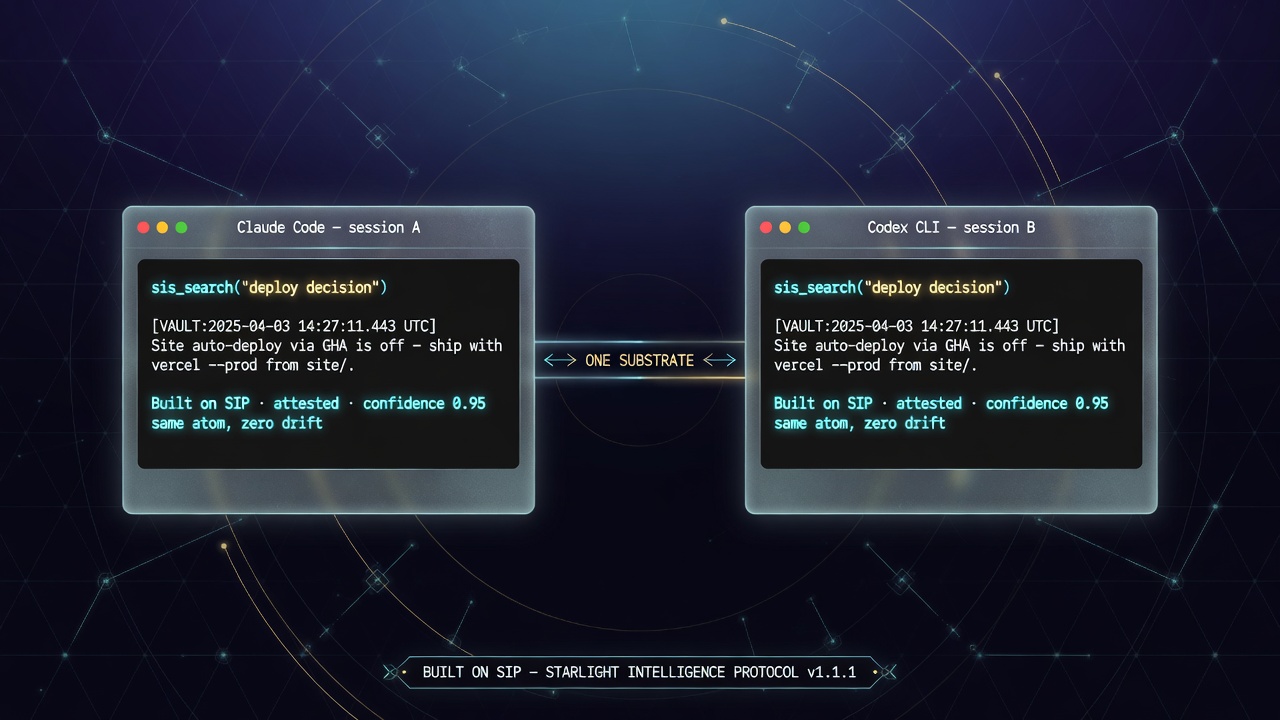
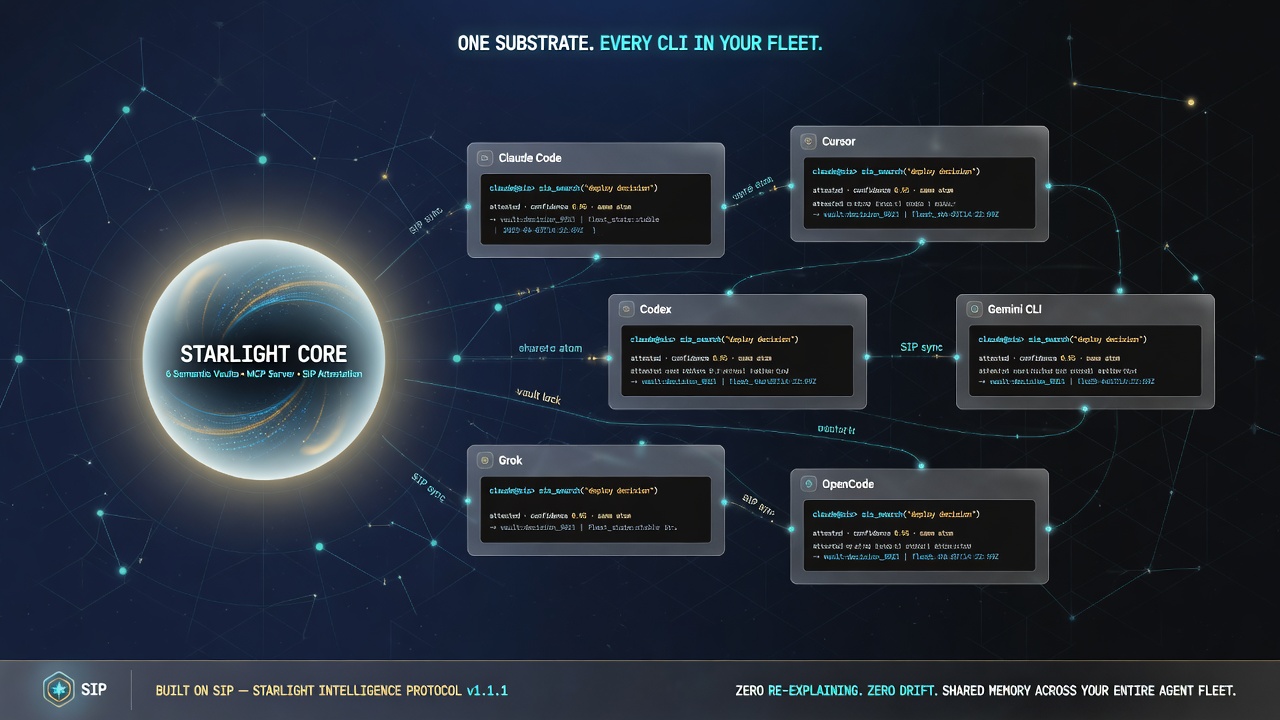
Claude Code, Cursor, Codex, Gemini CLI, OpenCode, Antigravity — they all read from and write to the same six semantic vaults, with full provenance. No more explaining the same thing to every agent. No drift. No lost decisions.





Claude Code, Cursor, Codex, Gemini, and OpenCode — all reading the exact same attested memory from one substrate.
Starlight is two things in one repository:
- SIP — the open Starlight Intelligence Protocol: a clean contract for sovereign memory, identity, and governance that anyone can adopt.
- SIS — the reference implementation: source-counted agent definitions, auto-activating skills, six semantic vaults, a production MCP server, and the repeatable Estate Factory for running full sovereign agent armies.
The current 144 agents and all other fast-moving counts are dated in metrics/current.json and enforced by both the agent harness and site build.\n\nUse just the memory layer in your current tools. Adopt the protocol. Or run the complete system Frank uses every day.
Purpose
Starlight Intelligence System (SIS) is the sovereign AI substrate for memory, orchestration, skills, governance, and evals across Claude Code, Codex, Cursor, Gemini, and Antigravity. Dual-layer: SIP substrate you can adopt/fork, plus this repo's reference operational build (vaults, MCP, agents).
How People Experience It
- Builders: 60-second start → forge alliances → spawn vertical intelligence systems → attest artifacts.
- Operators: six vaults under
~/.starlight/vaults, MCP tools, platform adapters, named agents. - Public narrative: constellation / ecosystem maps and Health Intelligence (and sibling verticals) downloads.
- Humans land on: README → 60-second start → substrate files → operational quick start.
How Agents Explore It
- Read
CLAUDE.md(deepest) andAGENTS.md(SIP file-contract / Codex entry). - Check
agents/AGENT_REGISTRY.mdbefore inventing agents. - Memory first: vaults exist — query, then write durable notes for future sessions.
- Run harness gates before claiming production readiness; prefer proof over console language (#35).
- Cross-links: starlight-memory · starlight-evals · starlight-swarm · ACOS · FrankX.
Foundry: portable capabilities for ChatGPT and Codex
Starlight Foundry turns intent into a typed Task Envelope, resolves existing capabilities, compiles the smallest justified skill or agent system, and issues an evidence receipt before promotion.
/forge skill <brief>
/forge agent <brief>
/forge swarm <brief>
/forge vertical <brief>
/forge plugin <brief>
/prove <package-or-artifact>
/evolve <package-or-receipt>
The skills-only starlight-foundry plugin works as the portable ChatGPT Work/Codex surface. Agent creation fails unless a durable decision-right, memory, tool, ownership, or ongoing-trigger boundary is proven.
Read the Foundry architecture · Inspect the contracts · Run the demo
Usefulness
- Humans: portable sovereign memory + multi-agent fleet that compounds.
- Agents: shared cognitive architecture, SAGE self-healing patterns, alliance/vertical forge.
- Portfolio role: substrate under GenCreator/ACOS/Arcanea ops; mesh and Wealth OS drafts stay issue-tracked until harness-proven.
60-second start
git clone https://github.com/frankxai/Starlight-Intelligence-System
cd Starlight-Intelligence-System && npm install && npm run build
node dist/cli.js init --vaults
Note: npm currently serves v6.0.1 of
@arcanea/starlight-intelligence-system— two major versions behind this repo. Use the git path above until v8.x is published.
Then add to your MCP config (Claude Code, Cursor, Codex, Gemini, etc.), pointing at the dist/mcp-server.js inside your clone:
{
  "mcpServers": {
    "starlight": {
      "command": "node",
      "args": ["/path/to/Starlight-Intelligence-System/dist/mcp-server.js", "--vault-dir", "~/.starlight/vaults"]
    }
  }
}
(If you installed via npm instead, the path is node_modules/@arcanea/starlight-intelligence-system/dist/mcp-server.js — but see the version note above.)
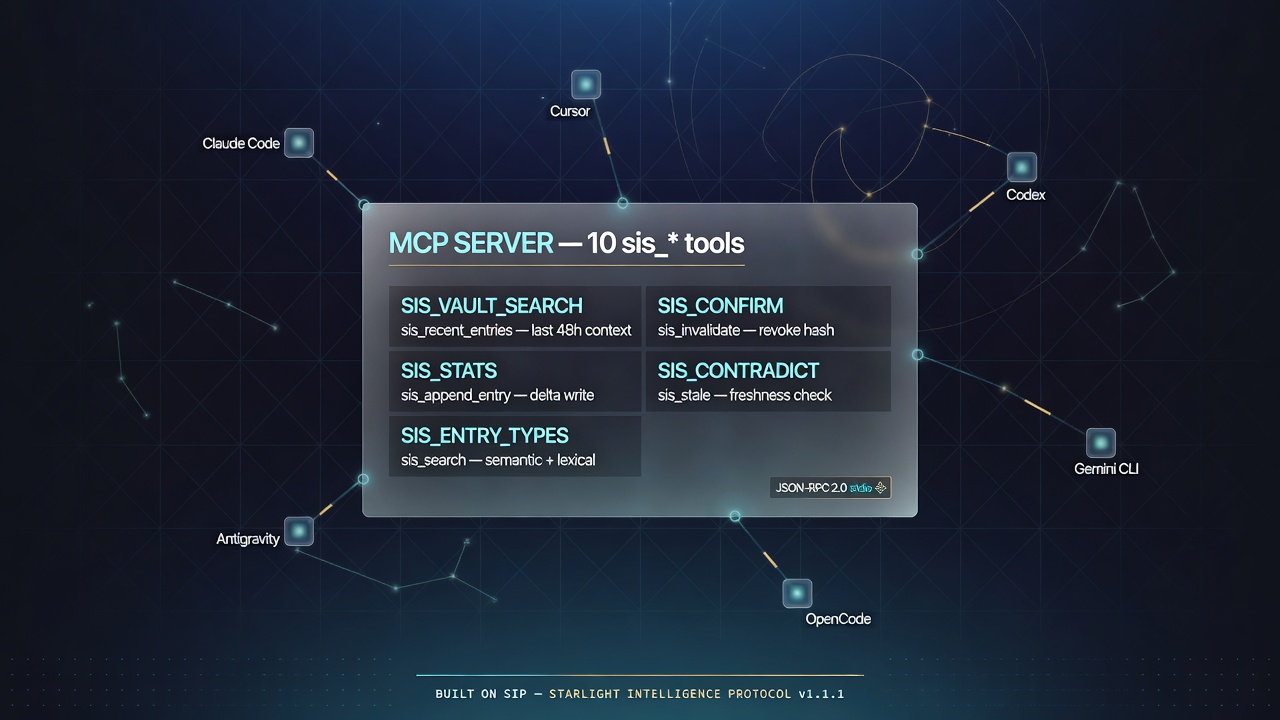
Restart your client. Every agent now shares the same memory. Thirteen sis_* tools appear instantly (verified by JSON-RPC handshake, 2026-07-12).
Two layers, one repo
| Layer | What it is | Best for |
|---|---|---|
| SIP (Protocol) | Open standard. Six clean layers for memory, attestation, commands, and sovereignty. | Forking the protocol or building your own systems |
| SIS (Reference) | Complete working system: source-counted agents and skills, six vaults, MCP server, Estate Factory. | Running it as your daily multi-agent brain |
Use the protocol alone, the memory layer alone, or the full reference implementation. They are designed to compose.
Getting started locally — SETUP.md (30-minute full setup including private state). Just want the protocol spec — use the lightweight SIP kit instead.
See CHANGELOG.md for history.
Why It Matters
flowchart TB
  Human["Human intent"] --> Vaults["6 semantic vaults (JSONL truth)"]
  Vaults --> Index["SQLite + FTS5 index"]
  Index --> MCP["MCP server (13 sis_* tools)"]
  MCP --> Adapters["Every CLI you use"]
  Adapters --> Work["Safer, consistent, memory-aware work"]
  Work --> Vaults
The difference:
- One source of truth instead of N fragmented contexts
- Knowledge that compounds instead of resetting every session
- Attestation so you always know what came from where
- The same memory works in Claude, Cursor, Codex, Gemini — simultaneously
We made the hard parts (temporal decay, contradiction detection, cross-tool sync) automatic.
For production sovereign systems
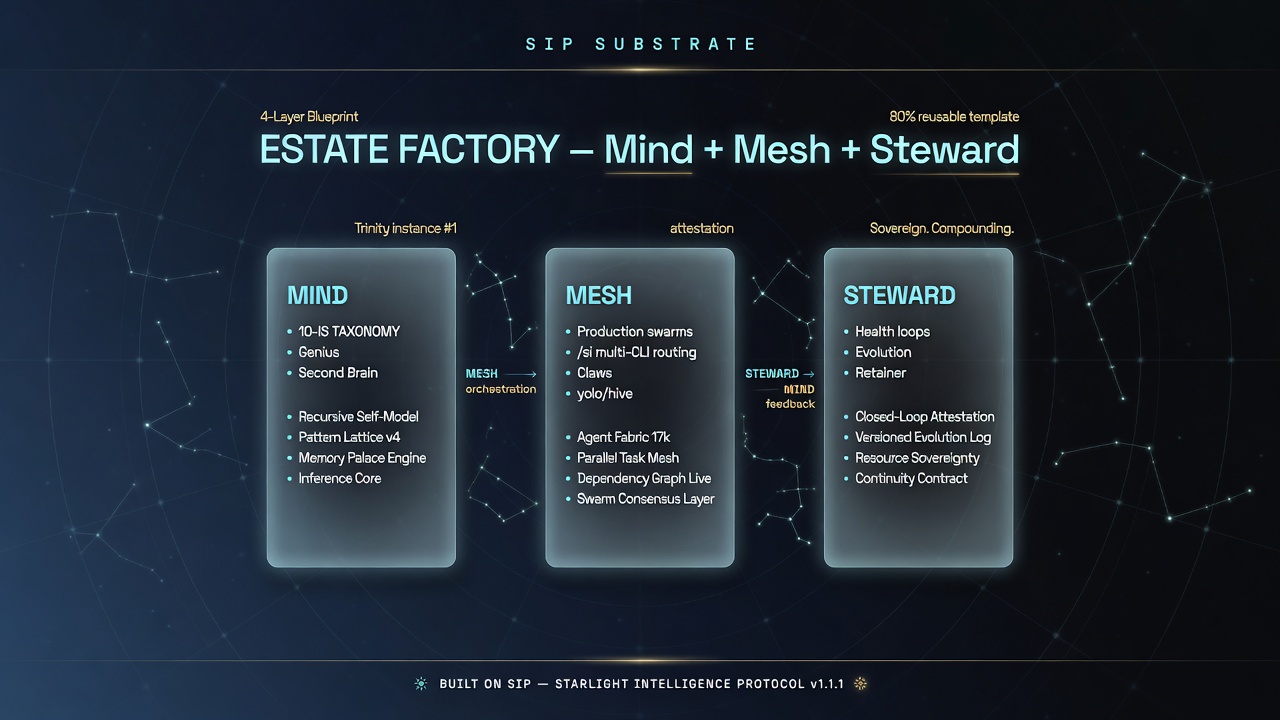
Starlight includes a complete Estate Factory pattern for running real "Mind + Mesh + Steward" agent armies at scale.
- Mind: Your grounded intelligence layers
- Mesh: Coordinated swarms with routing, synthesis, and operations
- Steward: Health monitoring, evolution, and long-term value
A 4-layer blueprint plus reusable templates lets you stand up new estates quickly while keeping them 100% yours.
Full workflow and templates: docs/delivery/estate-army-commissioning-workflow.md.
The substrate (SIP)
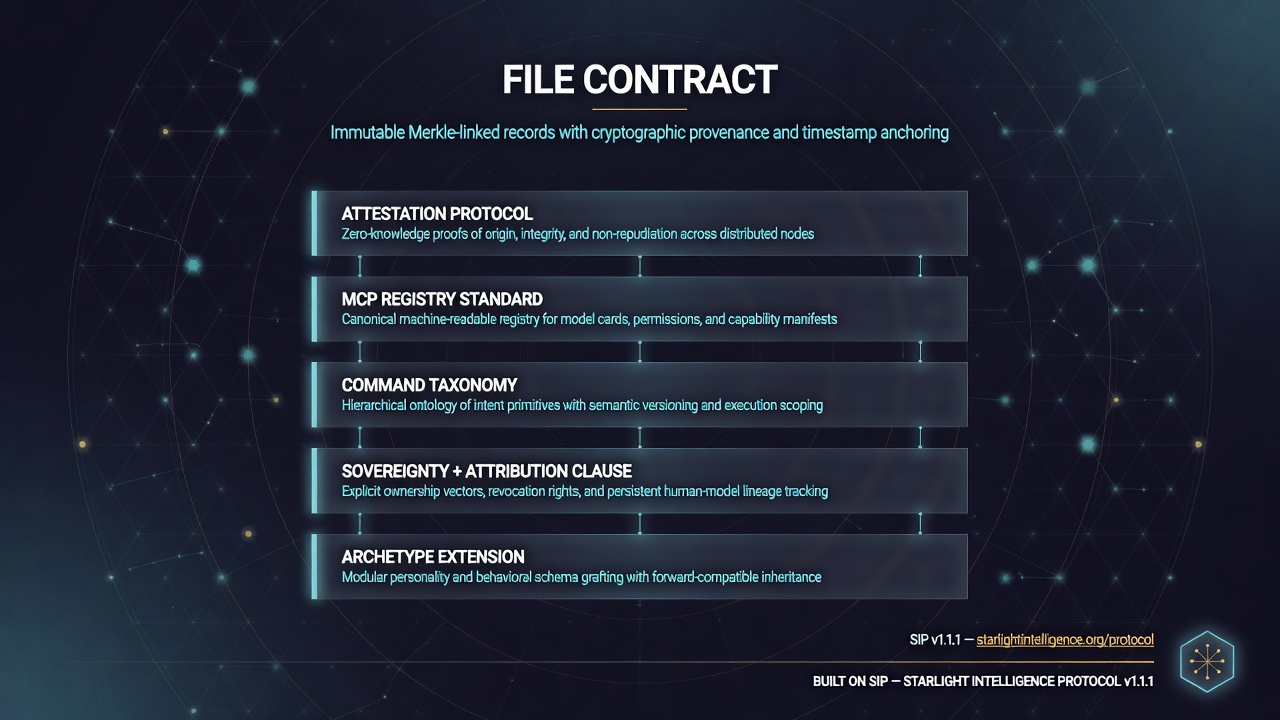
Starlight Intelligence Protocol — the contract that lets sovereign parties compose intelligence systems without losing sovereignty. Six layers:
- File contract — canonical names and shapes for
SKILL.md,AGENTS.md/VOICES.md,MEMORY.md,CANON.md,SOUL.md,STACK.md,.claude/commands/*, plus.arc/.nea/.skillextensions. - Attestation protocol — verifiable "Built on SIP" attribution via
/sip-attest. Refuses decorative use. - MCP registry standard — how MCP servers declare, compose, version (
mcp.jsonschema). - Command taxonomy — protocol / alliance / vertical / sovereign tiers with explicit decision rights.
- Sovereignty + attribution clause — the non-negotiable social contract.
- Archetype extension — optional canon adoption (Arcanea archetypes available CC-BY-NC).
Canonical URL: starlightintelligence.org/protocol · Source of truth: SIP.md in this repo.
Substrate files at a glance
| File | What it does |
|---|---|
SIP.md |
The protocol spec (six layers). |
SIS.md |
Substrate map — verticals, composition rules, what SIS does and doesn't provide. |
ALLIANCE.md |
The alliance forging method — how 2-5 sovereign nodes compose without collapsing into one entity. |
STACK.md |
Recommended sovereign stack (L0-L6). Defaults, not mandates. |
VOICES.md |
Five canonical voice archetypes (architect, sovereign-creator, protocol-defender, implementer, overseer). |
VERTICALS.md |
Public registry of sovereign verticals + alliance class definitions. |
MEMORY.md |
Template for per-instance state. |
REGISTRY.md |
MCP server registry. |
SKILL.md |
Substrate-layer behavior (what AI adopts when working at this layer). |
.claude/commands/ |
9 substrate-tier slash commands (/sip-attest, /alliance-forge, /alliance-reflect, /alliance-decide, /vertical-spawn, /luminor-board, /sovereign-signal, /openclaw-audit, /wealth-dpi) among 121 total command files. |
Forge an alliance, spawn a vertical
# Pressure-test before committing
/luminor-board "Open-source the agent layer or keep it closed?"

# Forge an alliance under SIP
/alliance-forge trinity "architect,sovereign-creator,protocol-defender,implementer"

# Spawn a vertical IS under SIS
/vertical-spawn anime-legends "anime-aesthetic fiction + character design"

# Attest a shipped artifact
/sip-attest path/to/artifact.md
Every cross-party artifact carries the "Built on SIP" attestation block. Silent composition is a breach.
The operational layer (reference build)
This repo also ships Frank's working implementation — the daily-driver intelligence system that runs on top of SIP. Use it directly, fork it, or replace it entirely with your own layer above the substrate.
Quick start (operational layer, 2 minutes)
Option 1: As an MCP server (recommended for AI tools)
First, seed your vault directory so the system has somewhere to read from
(a fresh install has no ~/.starlight/vaults yet):
# From a git clone of this repo (npm registry is at stale v6.0.1 — see note above):
node dist/cli.js init --vaults
# → seeds the six JSONL vaults in ~/.starlight/vaults (welcome entry + public examples)
Then point your MCP client at that directory:
{
  "mcpServers": {
    "starlight": {
      "command": "node",
      "args": [
        "/path/to/Starlight-Intelligence-System/dist/mcp-server.js",
        "--vault-dir",
        "~/.starlight/vaults"
      ]
    }
  }
}
For an npm installation, use node_modules/@arcanea/starlight-intelligence-system/dist/mcp-server.js instead; the clone path above is required for the current v8.x workflow.
Restart Claude Code. You now have thirteen sis_* tools available in every session.
(If you skip the seed step the server still works — it auto-seeds an empty
--vault-dir on first boot so the empty state is never silently broken.)
Option 2: As a library
npm install @arcanea/starlight-intelligence-system # registry serves v6.0.1 — for v8.x, install from the git clone until republished
import { StarlightIntelligence } from "@arcanea/starlight-intelligence-system";
import { createAdapter } from "@arcanea/starlight-intelligence-system/adapters";

const sis = new StarlightIntelligence();
sis.initialize();

sis.remember({
  content: "Always Read a file before editing — catches stale state",
  category: "pattern",
  tags: ["workflow", "edit-safety"],
  confidence: 0.95,
});

const adapter = createAdapter("claude-code");
const context = await adapter.generate({ vaultDir: "~/.starlight/vaults" });
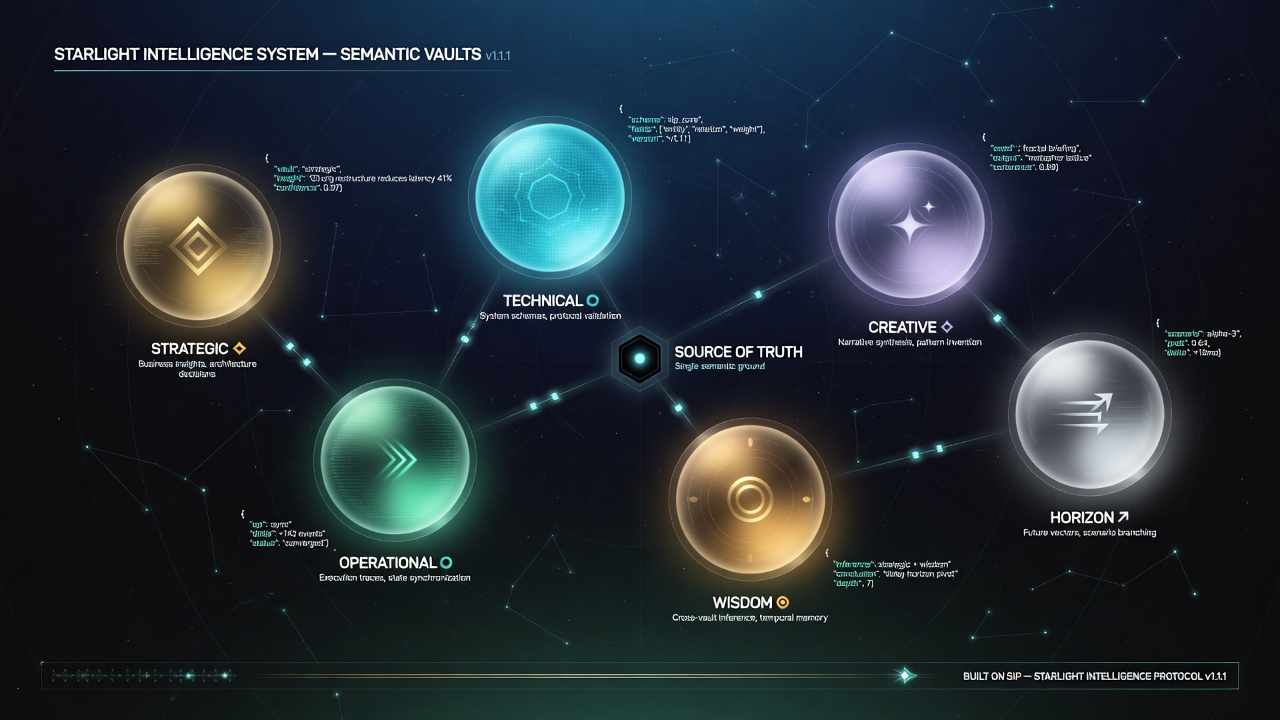
The six vaults
| Vault | Symbol | Purpose | Example entry |
|---|---|---|---|
| Strategic | ◆ | Business insights, architecture decisions, competitive moats | "Open Core + Founding Circle beats premium tiers at this stage" |
| Technical | ⬡ | Implementation learnings, stack decisions, patterns | "SQLite FTS5 with bm25 beats embeddings for <10k entries" |
| Creative | ✦ | Design preferences, aesthetic rules, voice, lore | "Never Cinzel. Space Grotesk display, Inter body." |
| Operational | ▸ | Workflow patterns, execution lessons, process rules | "Max 2 worktrees. Digest pattern for terminal output." |
| Wisdom | ◎ | Deep principles, truths, cross-domain insights | "Memory that compounds is intelligence that grows" |
| Horizon | ↗ | Vision statements, append-only ledger of human intentions | "Build the substrate that makes AI agents continuous" |
Each vault is a JSONL file. Human-readable. Git-versionable. Greppable.
Where memory lives. The MCP server and
src/retrieval.tsread*.jsonlfiles in your--vault-dir(default~/.starlight/vaults) — that is the one source of truth at runtime. The repo ships two example sets for reference only:public-vault/*.jsonlis the canonical starter content thatstarlight init --vaultscopies into your vault dir;memory/vaults/*.mdare human-readable narrative snapshots and are not read by the engine. Seed once, then your own~/.starlight/vaultsis what counts.
What the operational layer adds on top of SIP
- SQLite hybrid retrieval —
src/retrieval.tsbuilds a rebuildable FTS5 shadow index over JSONL vaults with bm25 ranking. Keyword + temporal today (measured recall in CI vianpm run eval:retrieval); optionalsqlite-vecsemantic layer is roadmapped indocs/bring-your-own-model.md. - Temporal reasoning —
src/temporal.tsadds validity windows and a 90-day confidence half-life. - Contradiction detection —
src/contradiction.tsfinds conflicting entries via word-trigram Jaccard with opposing-signal boosting. - Dreaming —
src/dreaming.tsprocesses session transcripts in the background. - Five platform adapters — Claude Code, Cursor, Codex, Gemini CLI, OpenCode share the same vaults.
- MCP v2 —
src/mcp-server.tsships thirteen tools over JSON-RPC 2.0 stdio.
MCP tools
| Tool | Description |
|---|---|
sis_vault_search |
Free-text search across vaults |
sis_recent_entries |
Latest entries from one or all vaults |
sis_stats |
Total entry counts per vault |
sis_append_entry |
Write a new entry to a vault |
sis_entry_types |
List supported vault types and entry categories |
sis_search |
Keyword + temporal search (term-overlap score, tag boost, staleness penalty) |
sis_confirm |
Touch lastConfirmed on an entry |
sis_invalidate |
Mark an entry as expired |
sis_contradict |
Flag two entries as contradictory |
sis_stale |
List entries not confirmed within a threshold |
sis_goal_status |
Read the current state of a tracked goal |
sis_goal_update |
Update a tracked goal with attested state |
sis_goal_log |
Append progress evidence to a tracked goal |
Platform adapters
| Platform | Memory file | MCP config | Max tokens |
|---|---|---|---|
| Claude Code | CLAUDE.md |
~/.claude/settings.json → mcpServers |
200,000 |
| Cursor | .cursorrules |
Cursor settings → MCP | 128,000 |
| Codex | AGENTS.md |
~/.codex/config.toml |
192,000 |
| Gemini CLI | GEMINI.md |
~/.gemini/settings.json |
1,000,000 |
| OpenCode | AGENTS.md (compact) |
~/.config/opencode/opencode.json |
128,000 |
The 7 named agents (operational layer)
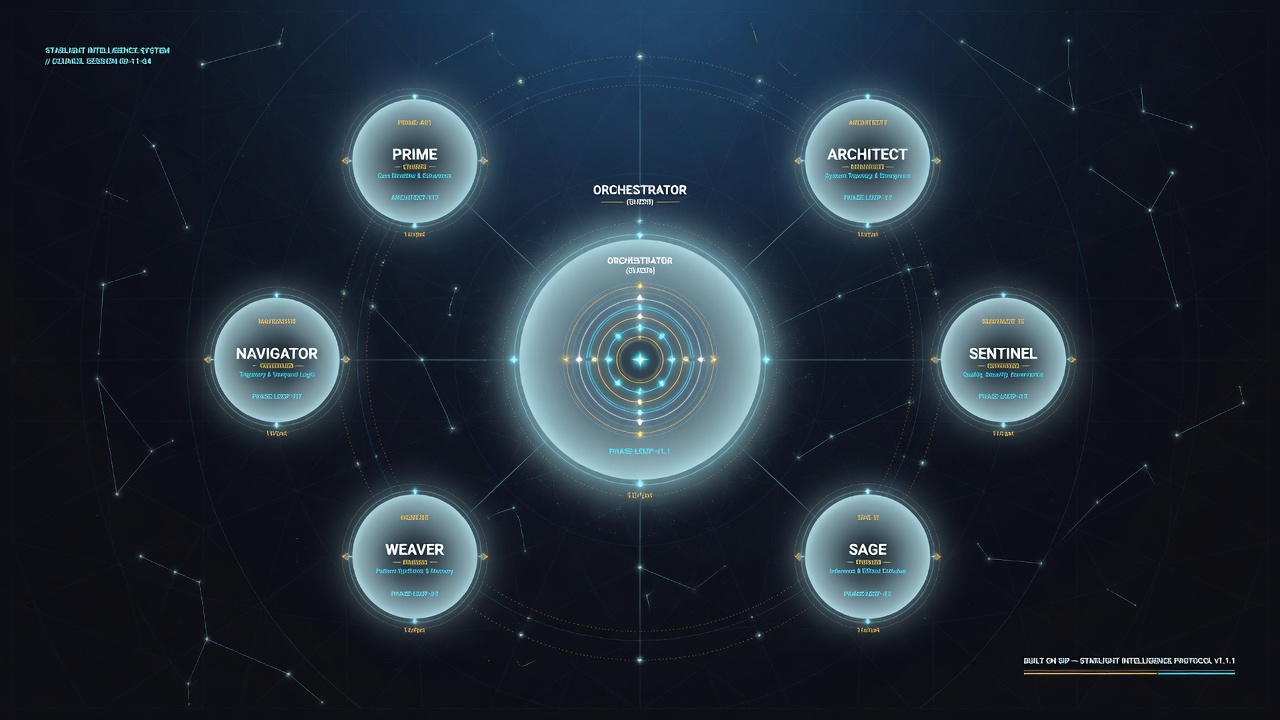
The reference build maps SIP's 5 voice archetypes to 7 named runtime agents — Orchestrator, Prime, Architect, Navigator, Sentinel, Weaver, Sage. Full registry: agents/AGENT_REGISTRY.md.
Voice archetypes are abstract; named agents are specific implementations. Anyone forking SIP can choose entirely different agents above the substrate.
Fork patterns
| If you want to... | Take | Leave |
|---|---|---|
| Adopt SIP for your own creator stack | SIP.md, SKILL.md, VOICES.md, .claude/commands/sip-attest.md, .claude/commands/alliance-forge.md |
Everything in agents/, memory/, skills/, src/ |
| Use the MCP memory server, no protocol | src/, dist/, npm package |
Substrate spec files |
| Forge an alliance under SIP | SIP.md, ALLIANCE.md, VOICES.md, the 9 substrate commands in .claude/commands/ |
Operational layer |
| Run the full reference build | All of it | Nothing |
Public canonical URL
starlightintelligence.org/protocol mirrors SIP.md. This repo is the source of truth.
Architecture (operational layer)
            ┌─────────────────────────────────────────┐
            │  JSONL vaults  (source of truth)        │
            │  ~/.starlight/vaults/*.jsonl            │
            │  human-readable · git-versionable       │
            └────────────────┬────────────────────────┘
                             │
                             │  rebuildable from JSONL
                             ▼
            ┌─────────────────────────────────────────┐
            │  SQLite + FTS5  (shadow index)          │
            │  bm25 ranking · temporal filters        │
            └────────────────┬────────────────────────┘
                             │
                             │  JSON-RPC 2.0 over stdio
                             ▼
            ┌─────────────────────────────────────────┐
            │  MCP server  (13 sis_* tools)           │
            └────────────────┬────────────────────────┘
                             │
        ┌────────────────────┼────────────────────────┐
        ▼            ▼       ▼       ▼        ▼       ▼
   Claude Code   Cursor   Codex   Gemini   OpenCode   Your tool
Guides
- Architecture Guide — full stack map, 10 IS taxonomy, agent architecture, MCP architecture, infrastructure topology, deployment runbook
- MCP Setup Guide — register the SIS MCP server with every coding agent (Claude Code, Cursor, Windsurf, Codex, Gemini CLI, Antigravity, Hermes) + Railway shared server
- Hermes + Claude Code + OpenClaw Guide — dual-stack setup: Hermes on VPS + Claude Code local + OpenClaw on Railway + phone integration
- Infrastructure Deployment Guide — full 5-surface deployment: Vercel + Railway + VPS + local + phone
Development
git clone https://github.com/frankxai/Starlight-Intelligence-System.git
cd Starlight-Intelligence-System
npm install
npm run build       # tsc to dist/
npm test            # 82+ orchestrator tests
npm run lint        # tsc --noEmit
src/ is under 3,000 lines of TypeScript with zero runtime dependencies outside better-sqlite3. Substrate docs (SIP.md, SIS.md, etc.) are markdown-only — no build dependency.
License
- Code (operational layer + substrate-tier commands): MIT — see
LICENSE. - Substrate spec docs (
SIP.md,SIS.md,ALLIANCE.md,STACK.md,VOICES.md,VERTICALS.md,MEMORY.md,REGISTRY.md,SKILL.md): MIT, sameLICENSE. The "Built on SIP" attestation request is a social-layer convention captured inNOTICE, not a license restriction. - Arcanea canon (if your fork composes with it): CC-BY-NC 4.0, © Arcanea BV. Lives in
frankxai/arcanea-ecosystem; canon is compose-only — not redistributed under this repo's MIT. - Trademarks: ARCANEA, FRANKX, STARLIGHT INTELLIGENCE — registered or in registration, reserved rights.
"Built on SIP" is an attestation phrase, not a trademark. Use of the phrase requires actual SIP composition per /sip-attest rules. Full attribution + canon + trademark summary in NOTICE (Apache-style — LICENSE for legal rights, NOTICE for propagation conventions).
Visuals
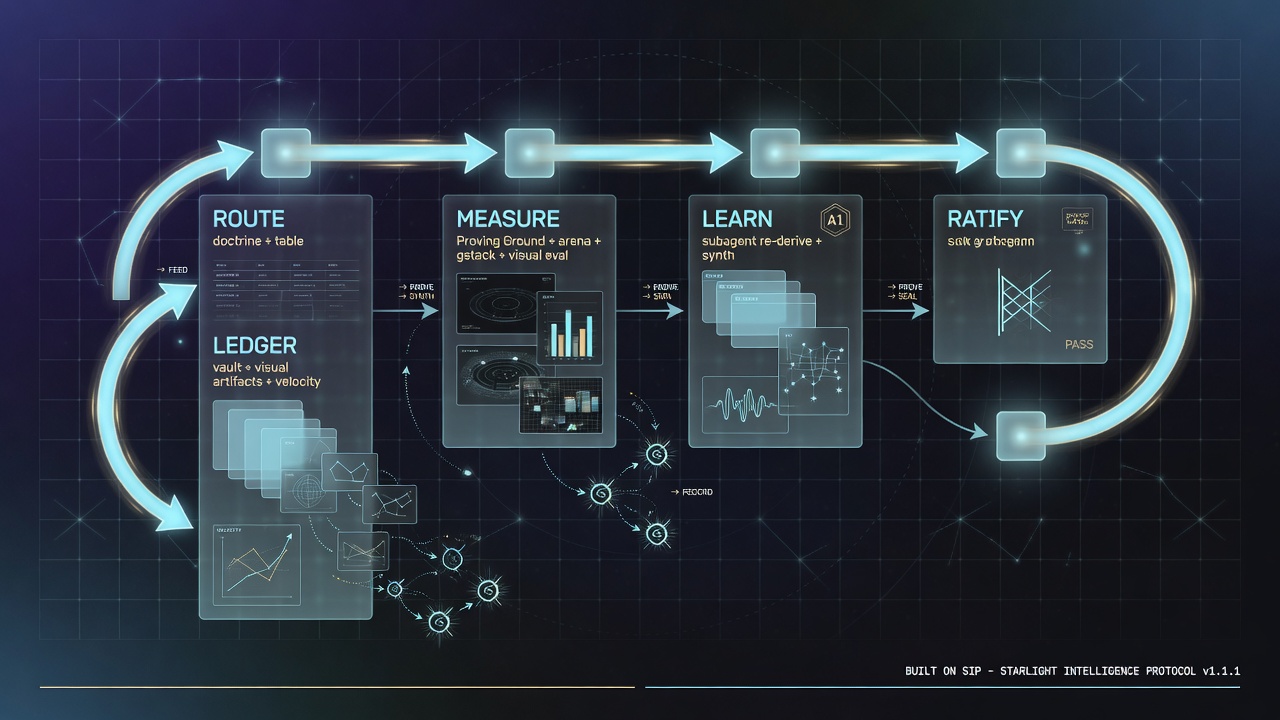
We treat system diagrams and live-state artifacts as first-class deliverables.
All visuals in docs/visuals/ follow the same premium dark technical language and carry Built on SIP attestation. They are used in the Queen loop, research, and the public site.
Browse them: docs/visuals/VISUALS.md · Motion experience: docs/queen-motion/
Related
- Arcanea — Creator platform; canon-defining vertical built on SIS
- FrankX — Architect brand; SIP thought leadership
- Public Vaults — Browse and fork vaults
- Protocol page — Canonical SIP spec
- GitHub — Source, issues, discussions
Built on SIP · Starlight Intelligence Protocol · v1.1.1 · v8.3.0 · MIT
Advanced: The Estate Factory
For organizations and sovereign operators who want a full production intelligence estate (not just tools), Starlight provides a complete repeatable delivery system — Mind + Mesh + Steward — with high reuse across engagements.
See docs/delivery/estate-army-commissioning-workflow.md and the templates/estate-os/ profile for the current approach.
No comments yet
Be the first to share your take.