
Social Media Toolkit
Maturity: alpha. The normalized
PostBundlecontract is versioned, but public platform pages and endpoints can change without notice.
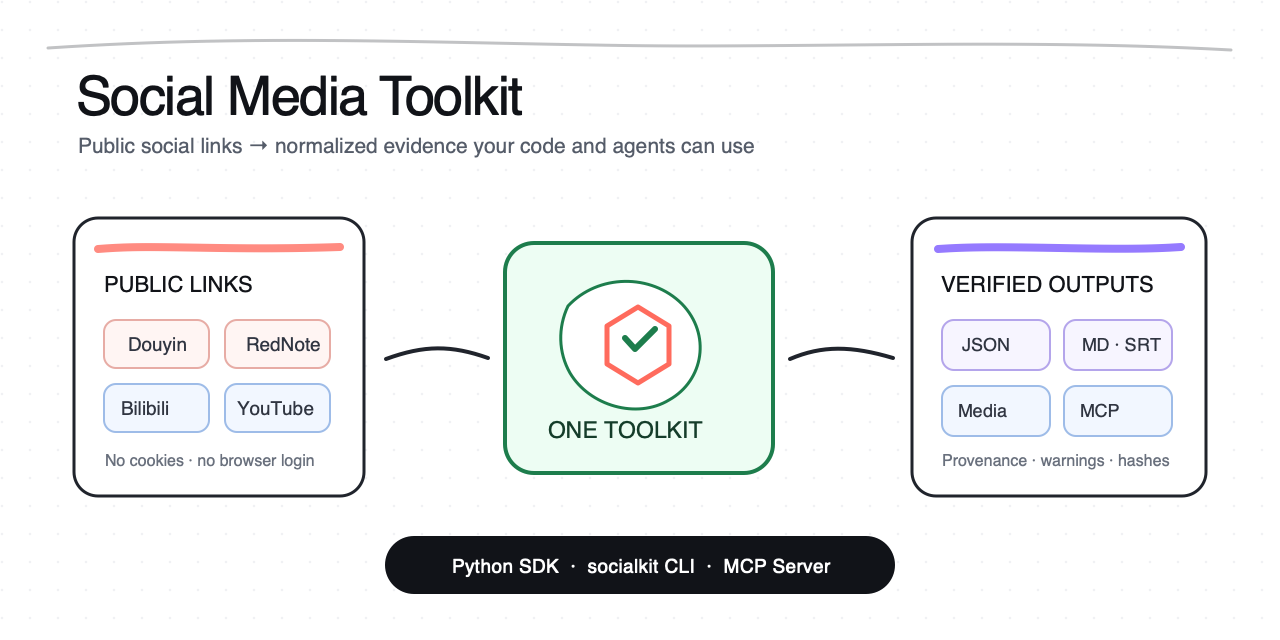
Social Media Toolkit is an open-source Python SDK, socialkit CLI, and Model Context Protocol (MCP) server for developers and AI agents that need one auditable interface for public social-media extraction. It does not require a browser profile, cookies, a logged-in session, Agent Switch, or the maintainer's machine.
Quick start
Install or update
Prerequisite: Node.js 18+ with npm / npx.
npx -y github:JNHFlow21/social-media-toolkit
socialkit doctor
The installer:
- reuses
uvwhen available or downloads it from the official Astral installer; - installs the Python package in an isolated
uv toolenvironment; - exposes
socialkitandsocial-media-toolkit-mcpon the user command path; - never reads provider credentials or creates a project
.envfile.
socialkit doctor returns JSON. A machine with only the free public-reading path configured can report "status": "partial"; use its warnings field to see which optional text or long-recording capabilities are unavailable.
{
  "status": "partial",
  "supported_platforms": ["douyin", "xiaohongshu", "bilibili", "youtube"],
  "local_asr_fallback": false,
  "warnings": ["optional capability setup guidance"]
}
Run the same npx command to update. Uninstall with:
uv tool uninstall social-media-toolkit
git clone https://github.com/JNHFlow21/social-media-toolkit.git
cd social-media-toolkit
uv sync --locked
uv run socialkit doctor
First useful result
Inspect a public share URL without downloading media or starting GetNote / ASR:
socialkit inspect "SHARE_URL"
The command returns a normalized, provenance-bearing bundle:
{
  "schema_version": "1.0",
  "source": {"platform": "youtube", "url": "https://example.invalid/public-post"},
  "post": {"title": "Example public post"},
  "media": {"videos": [], "covers": [], "images": [], "audio": []},
  "content": {},
  "comments": {},
  "provenance": {"routes": ["platform:public"]}
}
The example is synthetic. Real fields depend on what the public source exposes.
What it can do
| Outcome | Interface | Requirements | Possible cost |
|---|---|---|---|
| Normalize public metadata | SDK / CLI / MCP | Python dependencies; YouTube uses yt-dlp |
No |
| Get readable text | GetNote → native subtitle/body → Volcengine ASR | Depends on the selected route | GetNote membership or Volcengine ASR may cost money |
| Create timed YouTube transcripts | Manual cues → automatic cues → timed Volcengine ASR | yt-dlp; ASR also needs ffmpeg and credentials |
ASR/TOS may cost money |
| Download video, cover, or images | Explicit download / capture request |
An explicit output directory | Toolkit is free |
| Sample public comments | Douyin top-level public sample | No cookies or account | No |
| Use the same logic from an agent | Six MCP tools | MCP-compatible client | Depends on selected route |
Platform matrix
| Platform | Metadata | Text | Video | Cover / images | Public comments |
|---|---|---|---|---|---|
| Douyin | ✅ | GetNote → Volcengine ASR | ✅ | ✅, including public image posts | ✅ bounded top-level sample |
| Xiaohongshu / RedNote | ✅ | GetNote → post body / Volcengine ASR | ✅ | ✅ | — |
| Bilibili | ✅ | GetNote → native subtitle → Volcengine ASR | ✅ | ✅ | — |
| YouTube | ✅ | GetNote → manual subtitle → automatic subtitle → Volcengine ASR | ✅ | ✅ | — |
Douyin comment sorting applies only to the public sample returned by the source. It is not a platform-wide ranking, and the toolkit does not paginate or backfill missing items.
Text and transcript routes
The normal readable-text route has one deterministic order:
flowchart LR
    U["Public link"] --> G["GetNote original content"]
    G -->|"no usable text"| N["Native subtitle or post body"]
    N -->|"video still has no text"| V["Volcengine cloud ASR"]
    V -->|"failure"| E["Explicit error"]
There is no local Whisper fallback, alternate ASR provider, OCR/Vision fallback, LLM rewriting, browser automation, CDP, Playwright, or cookie-backed extraction.
Timed YouTube mode is a separate evidence route because every segment must point back to the source video:
manual subtitle cues → automatic subtitle cues → timed Volcengine ASR
It writes only the requested MD/SRT/JSON artifacts to an explicit output directory. Temporary media is deleted before the call returns. --force-asr --speaker-info can bypass existing captions and request anonymous speaker clusters such as SPEAKER_01; those labels do not identify real people.
Duration-aware ASR
| Media duration | Route | Extra requirement |
|---|---|---|
| Up to 2 hours | Volcengine flash ASR | VOLCENGINE_ASR_API_KEY |
| Over 2 and up to 5 hours | Volcengine standard ASR | Two TOS secrets plus bucket/region/endpoint configuration |
| Over 5 hours | Rejected before media download | No automatic chunking |
The standard route uploads one temporary private TOS object, submits a presigned URL, and deletes the object on success or failure.
Optional configuration
Public metadata, public media downloads, supported public comments, and native captions do not require a Volcengine key.
GetNote
npm install -g @getnote/cli
getnote auth login
GetNote manages its own credentials. Its service may require a paid membership. Calling text, a text-enabled capture, or a full-chain smoke test is the execution signal for the documented route and can save the URL to the user's GetNote account.
Volcengine ASR and TOS
Secret names:
VOLCENGINE_ASR_API_KEY
TOS_ACCESS_KEY
TOS_SECRET_KEY
Non-sensitive long-recording settings:
TOS_BUCKET
TOS_REGION
TOS_ENDPOINT
TOS_OBJECT_PREFIX            # optional
TOS_PRESIGN_EXPIRES          # optional
Inject secrets through the operating system, MCP client, or another secret manager. Do not commit them or write them to a project .env file. Non-sensitive TOS settings may instead live at ~/.config/social-media-toolkit/config.json:
{
  "volcengine_tos": {
    "bucket": "example-private-bucket",
    "region": "example-region",
    "endpoint": "https://example-tos-endpoint.invalid",
    "object_prefix": "social-media-toolkit/long-asr"
  }
}
The repository never stores secret values. Agent Switch is an optional maintainer integration, not a package dependency.
CLI examples
# Metadata only: no persistent write, GetNote, or ASR
socialkit inspect "SHARE_URL"

# Readable canonical text; may use GetNote or paid ASR
socialkit text "SHARE_URL"

# Timed YouTube transcript artifacts
socialkit text "YOUTUBE_URL" \
  --timed \
  --output "/absolute/path/to/transcripts" \
  --outputs md,srt,json

# Force timed ASR with anonymous speaker clusters
socialkit text "YOUTUBE_URL" \
  --timed --force-asr --speaker-info \
  --asr-context-file "/absolute/path/to/public-context.json" \
  --output "/absolute/path/to/transcripts" \
  --outputs json,md,srt

# Bounded Douyin public-comment sample
socialkit comments "DOUYIN_URL" --sort likes --limit 20

# Explicit persistent media download
socialkit download "SHARE_URL" \
  --include video,cover,images \
  --output "/absolute/path/to/output"
--speaker-info and --asr-context-file require --force-asr. Context is a bounded public-metadata vocabulary hint, not identity mapping.
Python SDK
from social_media_toolkit import SocialMediaToolkit

toolkit = SocialMediaToolkit()

bundle = toolkit.inspect("SHARE_URL")
text = toolkit.get_text("SHARE_URL")
timed = toolkit.get_text(
    "YOUTUBE_URL",
    timed=True,
    output_dir="/absolute/path/to/transcripts",
    outputs="md,srt,json",
)
comments = toolkit.get_comments("DOUYIN_URL", sort_by="likes", limit=20)
The SDK, CLI, and MCP server use the same SocialMediaToolkit orchestrator and the same versioned result contracts.
MCP server
Start the stdio server:
social-media-toolkit-mcp
Client configuration:
{
  "mcpServers": {
    "social-media-toolkit": {
      "command": "social-media-toolkit-mcp"
    }
  }
}
Do not place secrets in this JSON. Use the client's secret store or secure process environment.
| MCP tool | Purpose |
|---|---|
social_inspect |
Normalize public metadata without download or transcription |
social_get_text |
Run the readable or timed text contract |
social_get_comments |
Fetch the supported public-comment sample |
social_download |
Explicitly download requested media |
social_capture_bundle |
Combine normalized data and requested downloads |
social_doctor |
Report dependencies and configuration names without values |
Trust and boundaries
| Area | Contract |
|---|---|
| Access | Public URLs only; no access-control bypass, browser login, or private analytics |
| Credentials | Standard environment or client secret store; values are never returned or logged |
| Persistent writes | Only explicit output directories and the optional user config file |
| Temporary data | ASR media and standard-route TOS objects are deleted before return |
| Telemetry | No product telemetry |
| Network | Public platform/GetNote reads and optional Volcengine/TOS calls |
| Publishing | Uploading or publishing to social accounts is intentionally out of scope |
| Legal | Users remain responsible for platform terms, copyright, and local law |
The downloader accepts HTTP(S), rejects local/private literal IPs, bounds download size, sanitizes filenames, and records SHA-256 manifests. See SECURITY.md for private vulnerability reporting.
Compatibility and distribution
- Python 3.10–3.12 are the supported package runtimes.
- Node.js 18+ is required only for the one-command bootstrap.
- macOS, Linux, and Windows are exercised by CI; platform endpoints themselves may still change independently.
- The canonical user distribution is the GitHub-backed
npxinstaller and isolateduv toolenvironment. - Versioned source distributions, wheels, npm tarballs, and checksums are attached to GitHub Releases.
Architecture and documentation
- Architecture and side effects
- Capability matrix and limitations
- Release history
- Contributor guide
- Security policy
- Machine-readable project map
Development
uv sync --locked
uv run python -m unittest discover -s tests
uv run python -m compileall social_media_toolkit social_post_extractor_mcp
uv build
npm test
npm pack --dry-run
git diff --check
Tests use synthetic fixtures and must not contain real cookies, tokens, private media, or user content.
Repository activity
Contributing, support, and license
Bug reports and focused feature proposals are welcome through GitHub Issues. Read CONTRIBUTING.md before opening a pull request, and use GitHub's private vulnerability reporting for security issues.
Licensed under the Apache License 2.0.
No comments yet
Be the first to share your take.