
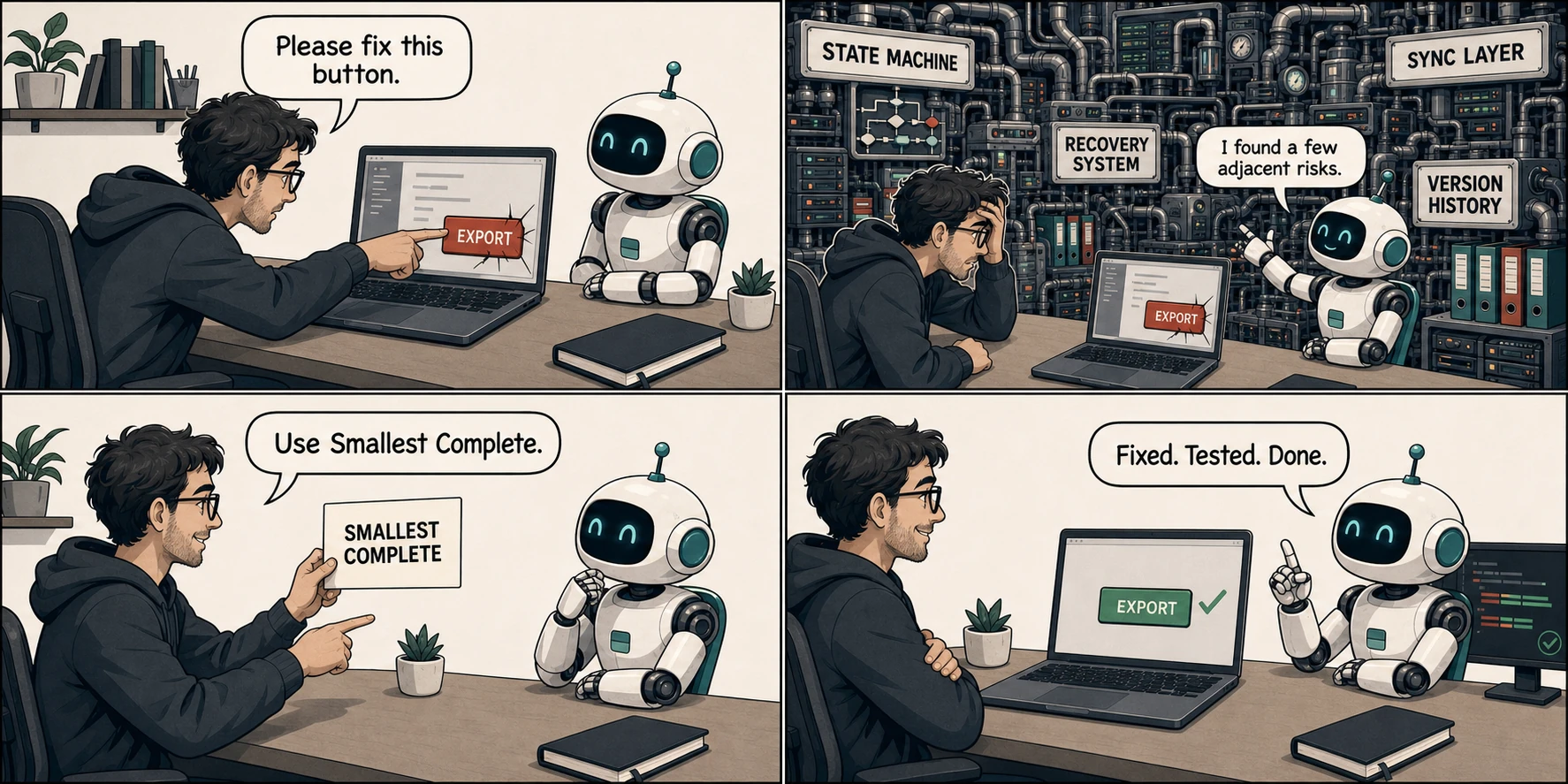
Smallest Complete — Stop one task from becoming ten.
A lightweight Skill for Codex and ChatGPT agents: finish exactly what was asked,
prove it works, and stop before the side quests. For non-trivial coding and
architecture work, it also applies an
elegant-architecture
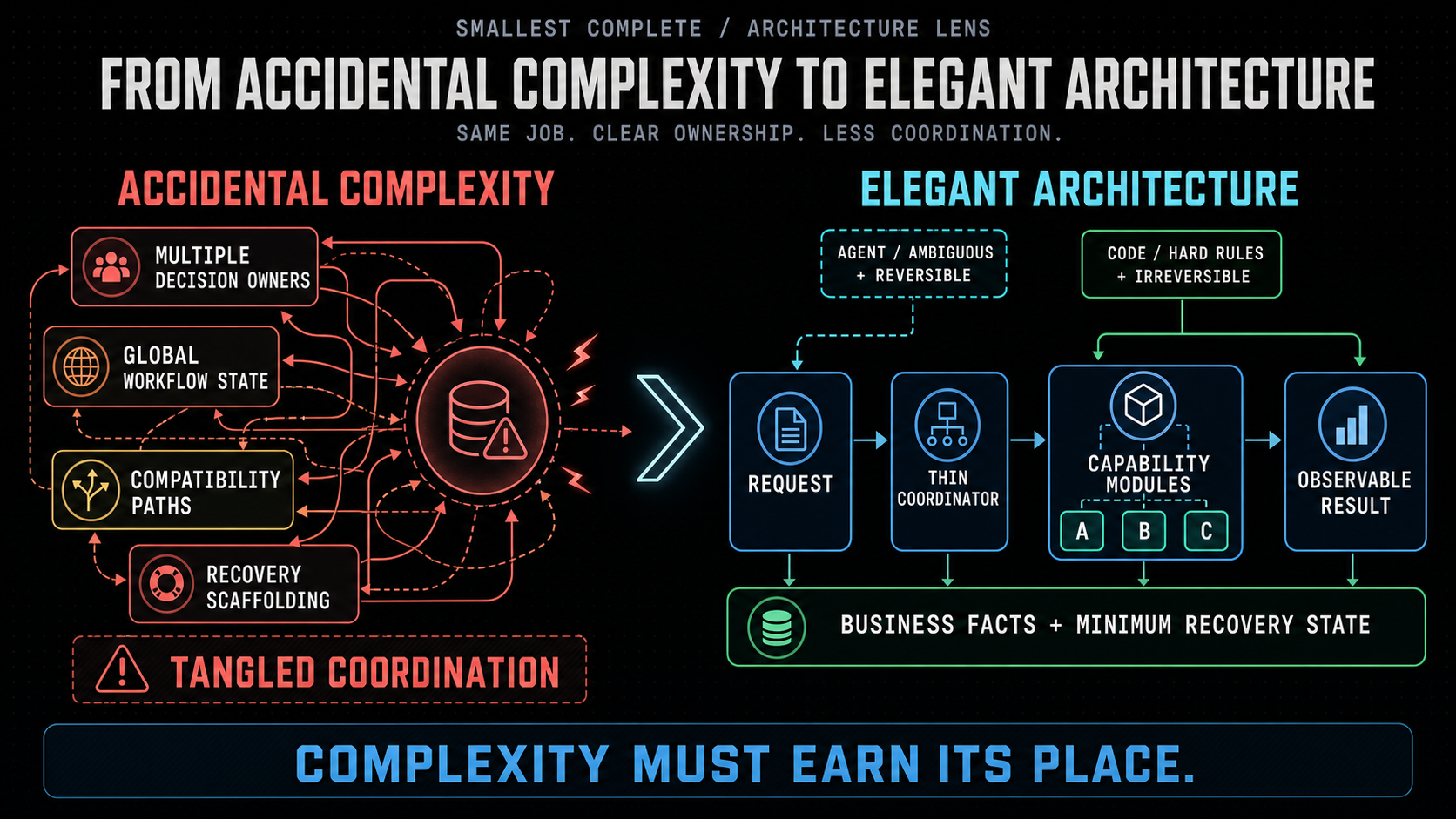
lens—clear control, explicit ownership, and only the state the real job requires.
Install with one prompt
Paste → send → start a new task.
Install Smallest Complete from https://github.com/JetXu-LLM/smallest-complete.
Follow INSTALL.md exactly.
Codex reads the installation contract, protects your existing setup, installs the Skill, and verifies the result. When it finishes, start a new task.
Review every install, update, and uninstall step →
| Installs | Preserves | Never adds |
|---|---|---|
| One Skill directory + one global activation block | Existing Skills and AGENTS.md instructions |
Runtime, hooks, dependencies, accounts, or telemetry |
One Skill, two disciplines
Smallest Complete watches for the same failure at two moments: doing more than was authorized, and making necessary code or architecture more tangled than the evidence requires.
| Scope discipline | Architecture discipline | |
|---|---|---|
| Applies to | Complex Codex and ChatGPT Work tasks | Non-trivial coding, debugging, refactoring, migration, system design, or architecture work |
| Question | Is this inside what was actually authorized? | Is this the clearest structure the evidence requires? |
| Stops | Scope creep and adjacent “helpful” work | Extra decision owners, shared workflow state, and tangled coordination |
| Source | Core SKILL.md |
Conditional elegant-architecture.md reference |
First it keeps the result inside the ask. Then, when the task genuinely requires code or architecture, it keeps the structure clear.
When the task really needs architecture
Scope discipline decides whether something belongs in the job. Architecture discipline decides whether the necessary software structure has earned its ongoing cost.
For architecture design, non-trivial coding, refactoring, migration, or
debugging that may change ownership, control flow, state, interfaces, or
operations, the Skill reads
elegant-architecture.md
before planning or editing.
Read the complete architecture guidance →
The core contract
| Principle | Meaning |
|---|---|
| Smallest | No adjacent deliverables, speculative systems, or permanent machinery. |
| Complete | The requested result actually works and required behavior is preserved. |
| Proven | Completion claims match observable evidence. |
| Stop | Useful discoveries do not silently become new work. |
In practice
| You ask | Smallest Complete response |
|---|---|
| “Fix CSV export when descriptions contain commas.” | Fix escaping at the owning boundary, test it, stop. No export platform. |
| “Refactor this ingestion workflow.” | Keep one clear control path, a thin coordinator, capability-owned rules, and only required state. No parallel architecture “just in case.” |
| “Turn these notes into five slides.” | Research what the deck needs, deliver five strong slides, stop. No brand system. |
For research, writing, analysis, and other ChatGPT Work tasks, inquiry stays as broad as the requested result needs. The boundary applies to deliverables and actions—not to useful thinking.
Deliberately small
| Runtime | None |
| Background process | None |
| Skill network calls | None |
| Telemetry | None |
| Guarantee | None—it is guidance for capable agents, not an enforcement layer |
The complete mechanism is one Skill, one conditional architecture reference, and one activation paragraph. The project practices what it asks agents to do.
Go deeper
- The complete elegant-architecture reference
- Why capable agents expand the mission
- Design and architectural choices
- Evaluation without invented success rates
- The complete Skill source
- The exact global activation block
- Contributing
Bring us the case we missed
The most useful contribution is not agreement. It is a concrete task where the Skill helped, failed, made no difference, activated at the wrong time, or gave architecture advice that was wrong for the real system.
Comparative runs and counterexamples are especially welcome. You do not need to propose a fix—a sanitized prompt, expected result, observed behavior, and the available evidence are enough to start.
Open a behavior report → · See what makes a useful contribution →
Star it if it earned it
If Smallest Complete stopped one bounded task from becoming an architecture project—or helped you build the architecture the task actually needed—click Star at the top of this page. It helps the next developer find it before their next five-line fix becomes a framework.
License
MIT. Independent project; not affiliated with or endorsed by OpenAI or Anthropic.
No comments yet
Be the first to share your take.