
skill-subtraction



The core of AI skill management is "lean and focused," not "more is better."
A systematic audit tool for installed AI skills. It scans every installed skill, evaluates value by category, and generates structured keep / archive / uninstall recommendations to keep your skill set lean and efficient.
Inspired by Swyx (Latent Space host / smol.ai founder): most people keep adding skills until dozens pile up — and few ever get used.
Demo
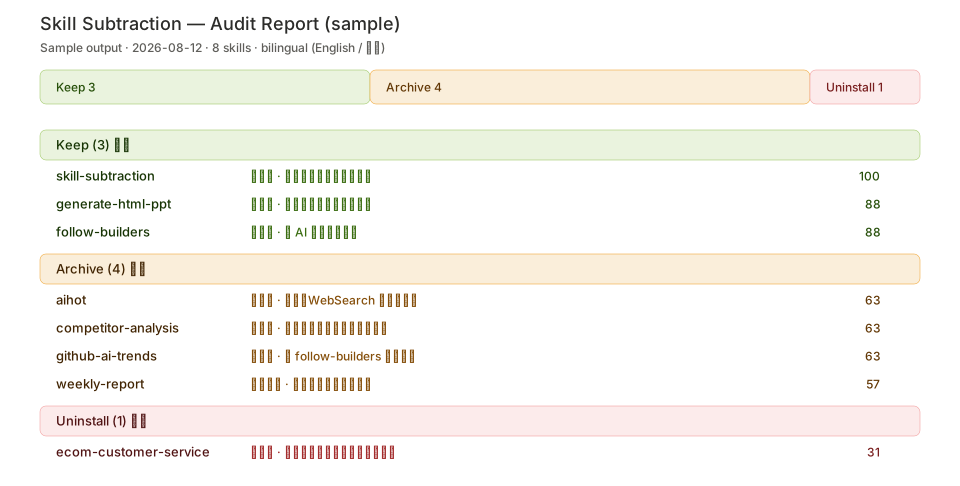
See real generated samples: English report · 中文报告
Why subtraction?
| Problem | Description |
|---|---|
| Cognitive overload | More skills = higher selection cost, defeating the purpose of efficiency |
| Judgment interference | Outdated skills act as noise, clouding decisions on new problems |
| High maintenance cost | Skills need updates and debugging; too many means wasted effort |
Features
- Agent Skills standard compliant — strictly adheres to frontmatter specifications (
nameanddescriptiontop-level, non-standard fields inmetadata:or body) with English-primary, bilingual trigger descriptions for reliable cross-platform execution (Codex, Claude Code, Cursor, WorkBuddy, etc.) - Auto-scan — detects the hosting agent platform from its own path (
~/.workbuddy/skills/→ WorkBuddy,~/.codex/skills/→ Codex, …), scans all installed skills, plus project-level skills in the workspace - Bilingual output — Chinese or English reports via
--lang zh/--lang en; stderr, issue descriptions, and report templates fully localized - Multi-platform — WorkBuddy, Codex, Claude Code, Cursor, Cline, Continue, LobsterAI, and anything following the
~/.<agent>/skills/convention;--allscans every installed platform - Score-based evaluation — classifies skills into 6 industry functional domains (dev & engineering, data & connectors, content & media, domain business, productivity, meta & agent control) plus subcategories, and scores each on 6 weighted metrics (usage frequency, necessity, current relevance, enabled status, maintenance, unique value)
- Smart recommendations — keep / archive / uninstall with special rules: dedup, disabled-skill detection, project-end detection, batch-install detection
- Safe cleanup — archives save skill configs first; uninstall only executes after explicit user confirmation
Installation
Requires Python 3.10+ and an agent that follows the ~/.<agent>/skills/ directory convention.
| Agent | Command |
|---|---|
| Codex (in-session installer) | /skill-installer install https://github.com/helloyxs/skill-subtraction |
| Claude Code | cp -r skill-subtraction ~/.claude/skills/ |
| Cursor | cp -r skill-subtraction ~/.cursor/skills/ |
| WorkBuddy | cp -r skill-subtraction ~/.workbuddy/skills/ |
| Any agent (clone) | git clone https://github.com/helloyxs/skill-subtraction ~/.<agent>/skills/skill-subtraction |
Cursor also auto-loads
~/.claude/skills/and~/.codex/skills/, so one copy can serve multiple agents.
Usage
Just say (English or 中文):
- "Audit my installed skills" / "帮我检查一下装了哪些技能"
- "Do a skill subtraction" / "做一次技能减法"
- "Which skills should I keep or delete?" / "哪些技能该留、哪些该删"
- "Clean up my skills" / "审计我的技能"
The skill auto-triggers and runs a 5-step workflow:
- Scan —
python3 scripts/audit_skills.py --lang <zh|en>collects metadata for all installed skills (batch-install detection, install-source stats) - Classify — 6 functional domains (dev & engineering / data & connectors / content & media / domain business / productivity / meta & agent control) plus subcategories; identify install source (user / platform / agent-created)
- Evaluate — 6 weighted metrics, composite score 24–100
- Recommend — keep / archive / uninstall report (language follows the conversation)
- Cleanup — only after user confirmation (archive saves config first)
Run the scan script directly
python3 scripts/audit_skills.py              # user-level skills (Chinese, default)
python3 scripts/audit_skills.py --lang en    # English output
python3 scripts/audit_skills.py --agent codex
python3 scripts/audit_skills.py --all        # scan all installed platforms
python3 scripts/audit_skills.py --workspace /path/to/workspace
python3 scripts/audit_skills.py --skills-dir "C:\Users\admin\AppData\Roaming\LobsterAI\SKILLs"
Output is a JSON array; each entry includes name, agent, scope, path, description, agent_created, has_scripts, has_references, file_count, dir_size, last_modified, version, plus source_stats and batch_installs. Exit codes: 0 = clean, 2 = scan done with error-level issues (CI-friendly).
Evaluation framework
| Composite score | Recommendation | Description |
|---|---|---|
| 80–100 | Keep | High-value, master it deeply |
| 50–79 | Archive | Save config, uninstall, re-activate when needed |
| 24–49 | Uninstall | Low value, clean up directly |
Special rules (override scoring): zero usage + irrelevant → uninstall · complete overlap → keep the best one (dedup) · disabled & never invoked → uninstall · project ended → uninstall · platform-preinstalled + never triggered → archive.
Full framework (classification, 6-metric scoring detail, dedup priority, archive standard) in references/evaluation_framework.md.
Audit cycle
| Frequency | Scenario |
|---|---|
| Quarterly | When skill count exceeds 10 |
| After each project ends | Clean up project-level skills |
| When business direction shifts | Re-evaluate business-type skills |
| When feeling "too many skills" | Anytime |
Directory structure
skill-subtraction/
├── SKILL.md                          # Skill definition (workflow + triggers)
├── LICENSE                           # MIT License
├── README.md                         # English README
├── README_zh.md                      # 中文说明
├── agents/
│   └── openai.yaml                   # Codex marketplace manifest
├── assets/
│   └── demo-report.svg               # Demo screenshot
├── examples/
│   ├── audit_report_en.md            # Sample English report
│   └── audit_report_zh.md            # 中文示例报告
├── scripts/
│   └── audit_skills.py               # Scan script, outputs structured JSON
└── references/
    └── evaluation_framework.md       # Full evaluation framework
No comments yet
Be the first to share your take.