
skill-hunter-company · skill 猎头公司
Find the right AI skills, install them with confidence, and keep your skill library clean.
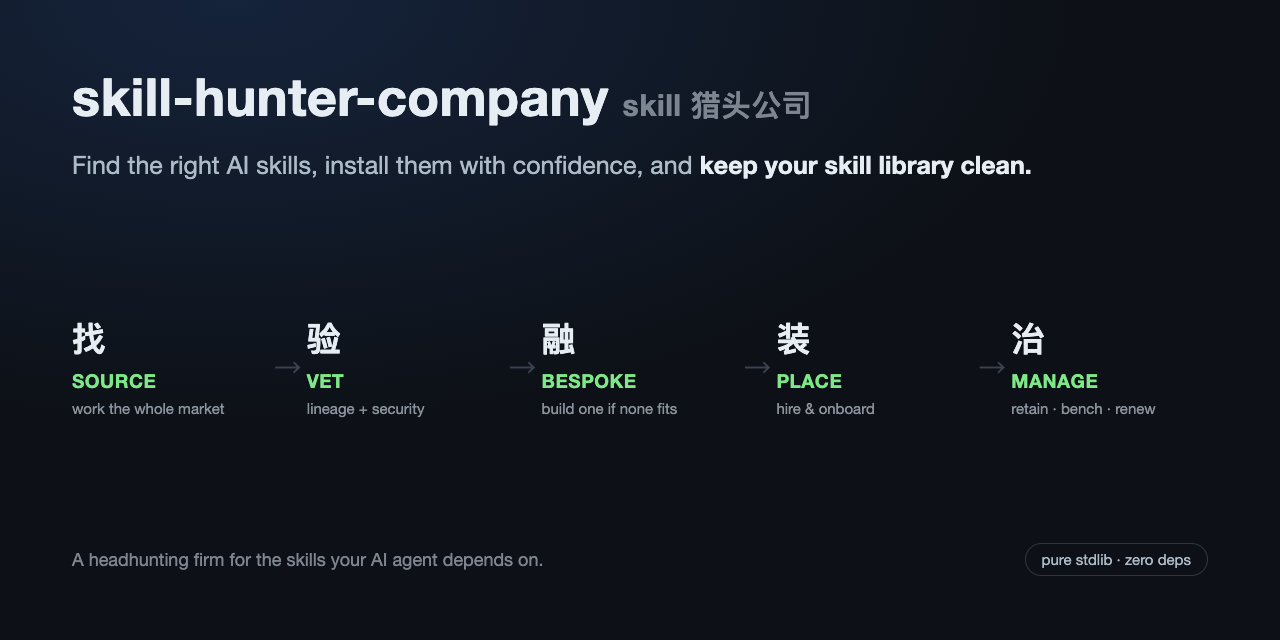
A retained headhunting firm for the skills your AI agent depends on.
A good executive-search firm doesn't dump 15 résumés on your desk. It works the
market for you, hands you a short list of finalists it has already vetted, places
the right one — and then keeps managing the talent so your team doesn't quietly
rot. skill-hunter-company does exactly that for Claude Code / agent skills.
It is not "another skill search box." Search boxes give you a wall of look-alikes ranked by stars and walk away. This firm runs the full lifecycle — and treats every stage as a place where a hire can go wrong.
Why a firm, not a search box
A skill goes through five gates between the moment you want it and the moment you're sick of it. A search box walks you through the first gate and leaves; the other four are on you, and each one is a place a hire goes wrong. Here's each gate, as a scene at the firm.
Source · 找 You type "powerpoint" into the box and get a wall of near-identical results sorted by stars. The one ranked seventh with thirty stars is a rewrite of the top result that happens to fit you better — and you'll never scroll to it. A headhunter doesn't post a job ad, and doesn't ask you to write the perfect one either. You say what you're after in plain words; the firm turns it into the search and works the whole market, including the candidates a keyword box never surfaces.
Vet · 验 You like a skill. Decent stars, author you've never heard of. Is it what it says it is, or someone else's skill with a new coat of paint and a line of code that quietly phones home? The fine print on the marketplace reads "no security review." A headhunter checks the background first: who's the original, where it forked from, whether it has a record. The candidates that don't clear it, you never meet.
Bespoke · 融 Sometimes you reach the bottom of the list and find three half-fits and nothing whole. Settle for the closest, or build one yourself? Here the headhunter says: there's no right person on the market, so we'll make one — take the best of each and combine them.
Place · 装 Picked one. The rest is easy, right? Getting them in the door is just the start. Installing a skill is trivial; installing the right one, cleanly, with no surprises, is not.
Manage · 治 A year ago you hired a batch of skills and never looked at them again. Your former favorite is three upstream versions behind; the bench is full of skills that have never once been called, plus a few pairs doing the same job — each drawing a context-budget paycheck every session. Nobody tells you who to let go. Unless you hired the firm that watches the roster.
A search box barely covers "find." The other four gates are on you. A firm covers all five.
What you actually get (real runs)
Source the market for a need — say it in plain words; the firm distills the keywords, runs several passes, and folds copies into one (no padded list):
$ firm.py source "make a powerpoint deck from my notes"
   keyword passes: powerpoint slide deck notes · slide deck notes · powerpoint slide

🗂  Shortlist — 27 distinct candidates across 3 passes:
  1. microsoft/powerpoint                           ★1117
  2. NyxTides/ppt-image-first                        ★1061
  3. ningzimu/image-to-editable-ppt-skill           ★587
  4. skrun-dev/slide-deck-generator                 ★201
  5. w1163222589-coder/slide-image-to-editable-pptx ★143
Review the team you already hired — performance, bench strength, redundant hires:
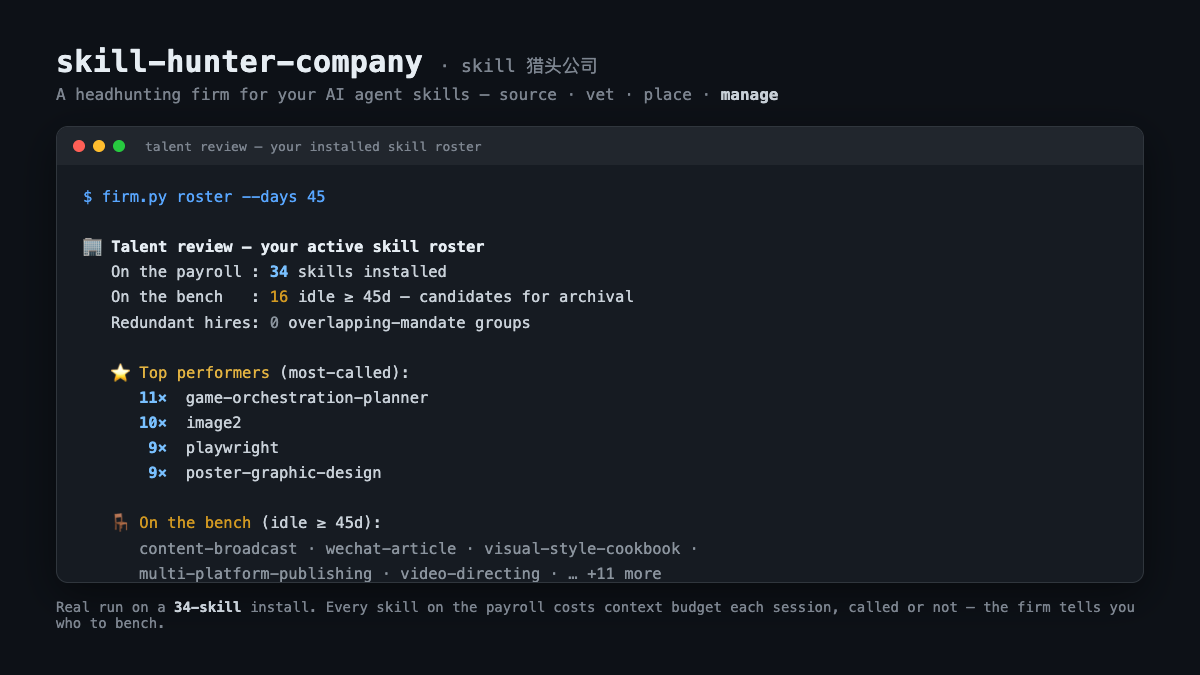
$ firm.py roster --days 45

🏢 Talent review — your active skill roster
   On the payroll : 34 skills installed
   On the bench   : 16 idle ≥ 45d — candidates for archival
   Redundant hires: 0 overlapping-mandate groups

   ⭐ Top performers (most-called):
        11×  game-orchestration-planner
        10×  image2
         9×  playwright
   🪑 On the bench (idle ≥ 45d):
      • content-broadcast        never called
      • wechat-article           never called
      • visual-style-cookbook    never called
      …
Numbers above are from a real install of 34 skills. Every skill on the payroll costs context budget each session, called or not — the firm tells you who to bench.
Cases
- Case 01: source a skill for a need
- Case 02: review the team you already hired
- Case 03: vet a social publishing skill
The engagement
flowchart LR
    S["找 Source<br/>work the market"] --> V["验 Vet<br/>due diligence"]
    V --> B["融 Bespoke<br/>develop one"]
    B --> P["装 Place<br/>hire & onboard"]
    P --> M["治 Manage<br/>retain · bench · succeed"]
    M -.re-search.-> S
| Stage | Headhunting term | What it does | Department |
|---|---|---|---|
| 找 Source | sourcing / talent mapping | turn a plain-language brief into keyword passes, search across sources, fold copies into one, surface low-star improvements star-sorting hides | world-aid |
| 验 Vet | due diligence / reference check | trace lineage (original vs fork vs re-skinned clone), security background check | skill-lineage (+ SkillSpector/OSV) |
| 融 Bespoke | bespoke search / develop the talent | no whole candidate? extract the best mechanism from each and build one | skill-fusion |
| 装 Place | placement / onboarding | make the offer — install and smoke-test | world-aid |
| 治 Manage | retention / bench strength / succession | track performance, flag stale & overlapping hires, bench the idle | this repo |
Two ways to engage the firm:
- Default engagement (most clients):
source → vet → place. You need a skill; the firm finds, checks, and hires the right one. - Retained client (power users):
roster → bespoke → (re)place. The firm watches your whole roster over time — develops bespoke skills, retires the stale, keeps the bench deep.
Engage the firm (quick start)
git clone https://github.com/a28939876-max/skill-hunter-company
cd skill-hunter-company

# 1. Bring the back-office departments online (fetches the sibling repos)
python3 ensure_firm.py

# 2. Work the market — plain language is fine; the firm distills the keywords
python3 firm.py source "make a powerpoint deck from my notes"

# 3. Background-check a finalist, then make the hire
python3 firm.py vet  ningzimu/image-to-editable-ppt-skill
python3 firm.py place https://github.com/ningzimu/image-to-editable-ppt-skill
Pure Python stdlib, zero install. Anonymous works out of the box;
set GITHUB_TOKEN (and SKILLSMP_API_KEY) to lift rate limits and unlock full
lineage background checks.
Without a firm vs with the firm
| A search box | skill-hunter-company | |
|---|---|---|
| Finding | a wall of look-alikes by star count, and you have to guess the right keywords | say it in plain words; a short list comes back, copies folded into one, low-star improvements surfaced |
| Trust | install and pray | due-diligence dossier: lineage + security before you ever meet a bad hire |
| No perfect fit | settle for the closest | commission a bespoke skill from the best parts |
| After hiring | forgotten | ongoing talent management — bench the idle, retire the redundant, follow upstream |
| Your context budget | bloats silently | the firm tells you exactly who to let go |
The departments (a constellation, not a monolith)
This firm is an orchestrator. Each department is a standalone open-source project with its own sharp focus — you can hire the whole firm, or just one desk:
- world-aid — sourcing & placement. The lightweight find-and-install engine.
- skill-lineage — due diligence. Lineage, fork/mirror/clone detection, the background-check desk.
- skill-fusion — bespoke search. Extract-and-rewrite mechanisms into one new skill (four manual quality gates).
- SkillSpector / OSV — security backend. We don't reinvent the scanner; we use the best one as a policy signal.
world-aid = lightweight find+install engine. skill-hunter-company = the complete lifecycle firm.
The family
Built and shipped alongside its siblings: world-aid (find+install) · skill-lineage (lineage) · world-intro (the open-source launch pipeline that shipped all of these).
Honest notes
- Just describe the need — the firm distills the keywords. The sourcing engine
under-recalls on full sentences, so
sourceturns your brief into a few keyword passes (broad → narrow), runs each, and merges.source "make a powerpoint deck from my notes"went from 0 hits (one verbatim pass) to 27 candidates (3 distilled passes). Pass--exact "<keywords>"to skip distillation and search verbatim. - Sources degrade gracefully. Aggregator down or rate-limited? The firm reports it and carries on with whatever desks are open — it never crashes the search.
- Lineage needs a token. Background checks hit the GitHub API; set
GITHUB_TOKENor you'll seeHTTP 403and an empty dossier. - Who is this for? If you install a handful of skills and move on, a search box is enough. The firm earns its keep when you run a roster — many skills, over time, where provenance, drift, and bloat actually cost you.
License
MIT — see LICENSE.
No comments yet
Be the first to share your take.