
SimplerDevelopment





▶️ GitHub strips
<video>embeds that point at external hosts, so the image above is a static hero. Click it (or this link) to watch the walkthrough.
Overview
SimplerDevelopment is an open-source, self-hostable platform for agencies and operators — the stack you'd otherwise rent from Webflow, HubSpot, Notion AI, Calendly, Mailchimp, and DocuSign, rebuilt as one codebase you actually own. Per-tenant client websites, a CRM, an AI Company Brain (RAG over client knowledge), workflow automations, bookings, a storefront, email campaigns, surveys, e-signatures, and Stripe billing all live in a single multi-tenant portal.
Here's the part that makes it different: every one of those modules is driveable by an AI agent. The platform ships 450+ Model Context Protocol (MCP) tools, so Claude, Cursor, or any MCP client can build a page, move a deal, or send a campaign the same way you would by clicking. Apache-2.0, no per-seat pricing, no rug-pull — bring your own Postgres and API keys and run it yourself.
See it in action
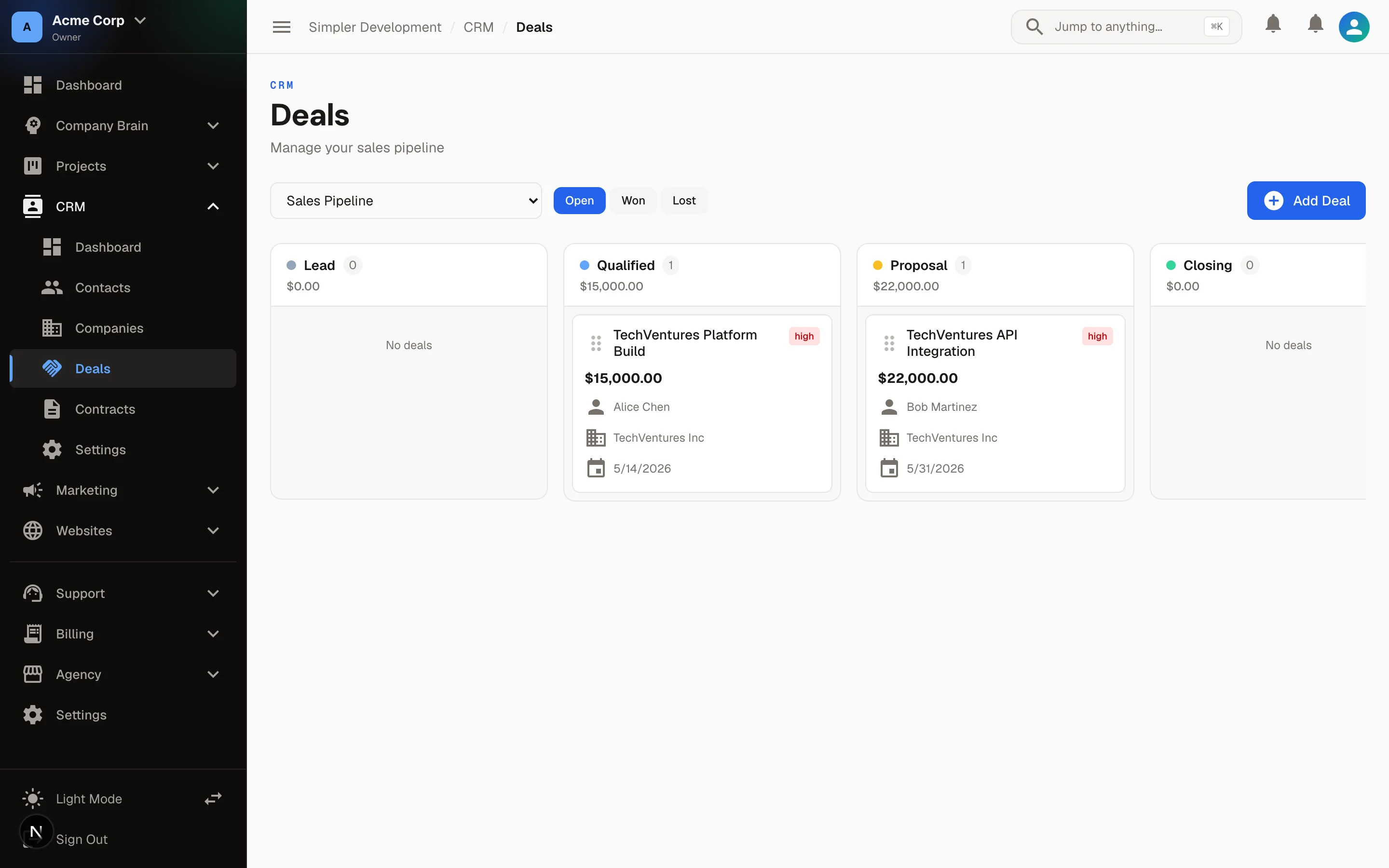
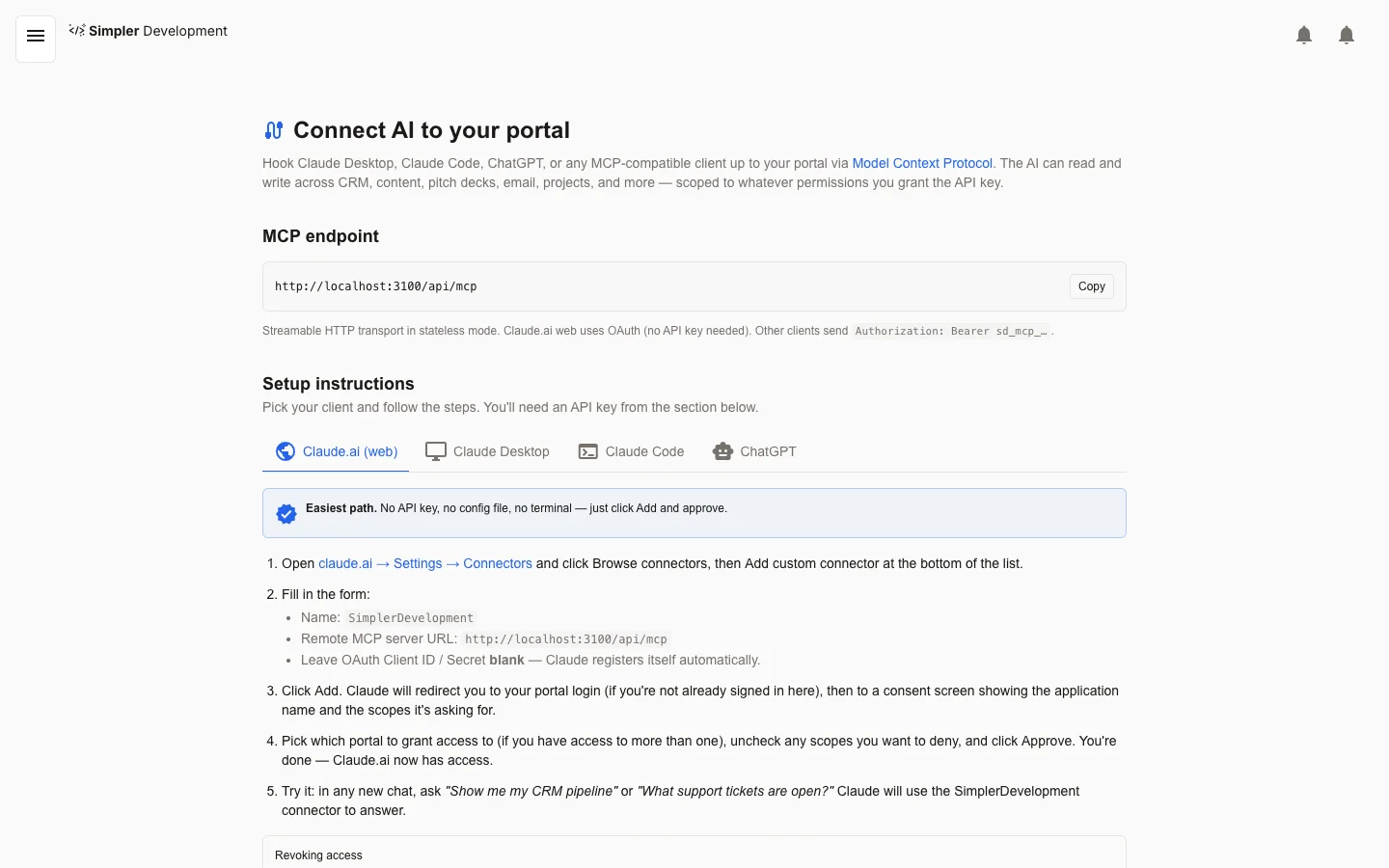
| CRM pipeline | Company Brain — Ask | Visual editor |
|---|---|---|
 |
 |
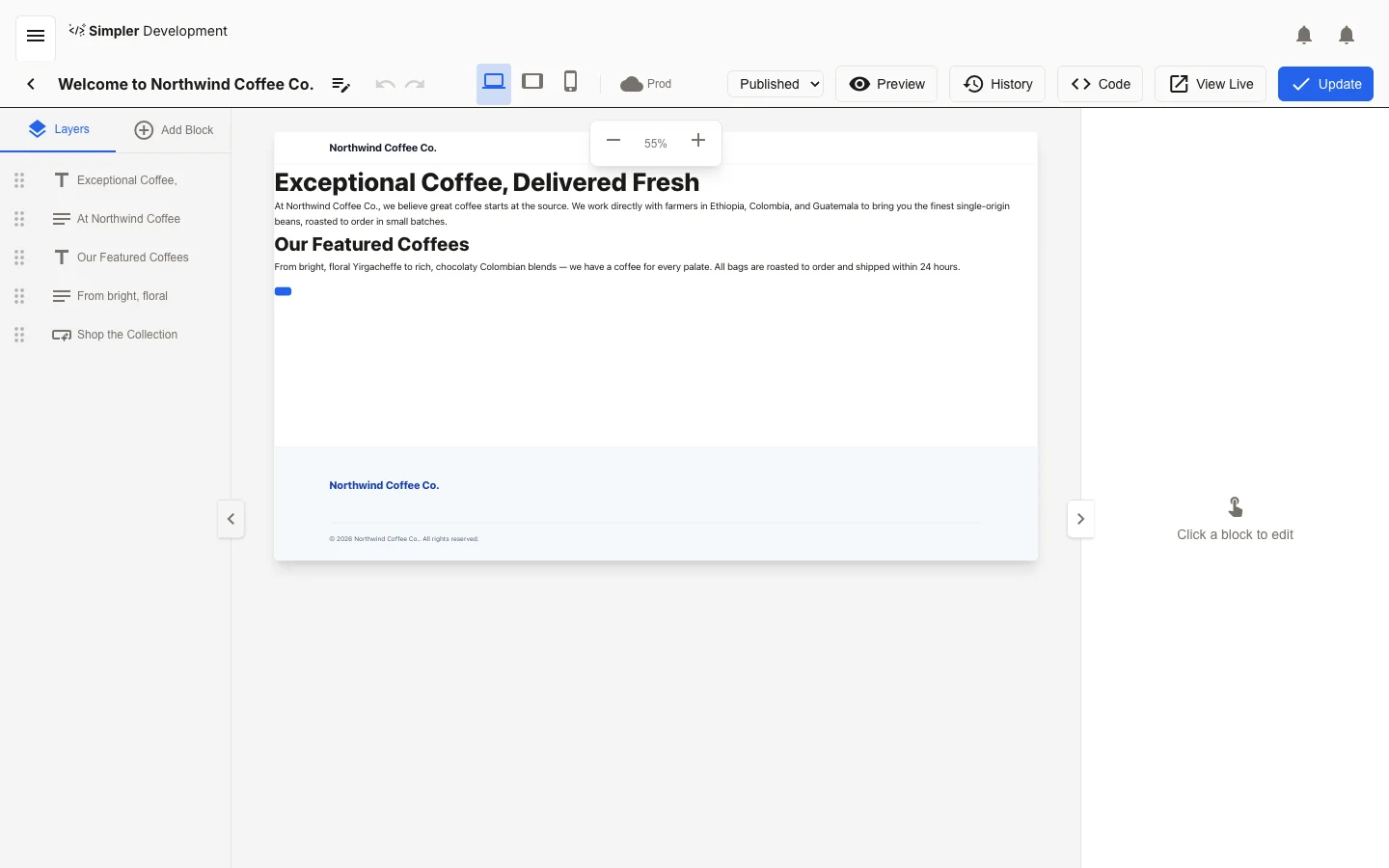 |
More screenshots for every module: simplerdevelopment.com/solutions.
Getting started
One command takes you from nothing to a running stack — it clones the repo, installs dependencies, and walks you through setup (secrets, database, seed data):
simpler create my-awesome-agency-platform
Don't have the simpler CLI yet? The same front door works through your package manager:
bunx create-simplerdevelopment my-awesome-agency-platform
# or
npm create simplerdevelopment@latest my-awesome-agency-platform
When it finishes, cd in and start the dev server — the portal is at http://localhost:3000:
cd my-awesome-agency-platform
bun dev
You'll want Docker (easiest — it brings its own Postgres) or Postgres 14+ with pgvector, plus Bun. The full walkthrough — manual setup, generating secrets, Docker vs. your own database, seeding, and troubleshooting — is in Getting Started →.
MCP
The whole platform is exposed to AI agents through an in-repo Model Context Protocol server (app/api/mcp/route.ts + lib/mcp/) — 450+ scoped tools spanning content, CRM, brain, commerce, email, bookings, and billing. Every tool carries a scope guard, so an agent can only reach what its key is allowed to.
- Connect the Portal MCP — wire up Claude.ai (OAuth), Claude Desktop/Code, or Cursor:
docs/mcp.md - MCP overview — the full tool catalog, by domain:
docs/api/mcp/overview.md
Prefer a terminal? The simpler CLI drives the same tool surface from a shell or CI job without loading MCP schemas into an agent's context. Extending the server (handler + schema + scope guard, in lockstep) is covered in docs/guides/MCP_TOOLS.md.
Features
Each product area is documented as a domain — a map of its key files, schema, routes, MCP tools, tests, and gotchas. Start at the index and follow the one you care about.
Websites & CMS · Visual Editor · Company Brain & AI · CRM · Bookings & Services · Storefront & Commerce · Email & Campaigns · Surveys · Pitch Decks · E-Sign & Approvals · Automations & Workflows · Billing & Stripe · Projects, Tickets & Kanban · Chat, Realtime & Voice · Agency, Onboarding & Branding · Integrations (Google, Microsoft, OAuth) · Plugins & Extension.
Claude Skills
Repeatable work is packaged as Claude skills so the moving pieces never drift apart. There are two families:
- Client skills — author real portal content (pages, decks, emails, surveys, booking pages, HTML embeds, whole websites) by talking to the SD MCP. Overview:
docs/skills/SD-AUTHORING-SKILLS.md. These also ship separately in thesimplerdevelopment-skillsrepo for Claude Desktop. - Developer skills — scaffold code with the invariants baked in: a CRUD resource (
simplerdev-feature-scaffold), a CMS block type (simplerdev-block-type), or an MCP tool (simplerdev-mcp-tool). Reference:docs/skills/SD-DEVELOPER-SKILLS.md.
New to the skill system? Start with the overview.
Agents & agentic development
This repo is built to be worked on by AI agents alongside humans — the agent tooling is first-class infrastructure, not an add-on. The root CLAUDE.md and per-area nested CLAUDE.md files carry the operating rules; .claude/index.md maps "I need to work on X" to the right guide.
The unifying idea for building your own agents against the platform: connect to the MCP server as a client and inherit all 450+ tools — never re-implement them. simplerdevelopment-agents/ is the worked example.
- Mastra — two production agents built on Mastra: a deterministic Workflow for the Company Brain (classify → plan → tool-loop → groundedness check, with a scorer eval layer) and a dynamic agent portal assistant whose model and tools are chosen per request. Learn it here:
simplerdevelopment-agents/MASTRA_GUIDE.md. - Mastra → Next.js — how the agents service plugs into the parent app: in multi-tenant mode it holds no per-tenant secrets — the Next.js app mints a short-lived, single-tenant token per request and the MCP client fails closed without one. Architecture, setup, and the adoption path:
simplerdevelopment-agents/BRAIN_AGENT_README.md. - Crew AI — a second reference implementation of the same MCP-client pattern is planned. Coming soon.
Deployment
Production runs on Vercel (Next.js framework mode); every other pushed branch gets a preview deploy. Background work — embedding processing, Gmail/Drive watch renewal, automation scheduling, brain daily notes, usage rollup, booking reminders — runs as Vercel cron jobs defined in vercel.json.
Want a one-click host with Postgres included? Use the Railway template — setup notes in docs/deploy/railway.md.
Sub docs
Dig deeper as you need it:
| Topic | Where |
|---|---|
| Architecture overview — route trees, tenancy, API envelope, block CMS | docs/agents/architecture-for-agents.md · Architecture index |
| Tech stack | see below |
| .env configuration | .env.example (canonical, annotated) · minimum-to-boot |
| Dev & testing guide | tests/TESTING_PLAN.md |
| CI/CD & coverage gates | tests/CI-GATES.md |
| Git hooks | .githooks/ (pre-commit / pre-push run the local CI gate) |
| Obsidian vault — durable architecture, domain maps, decision records | vault/ |
| All project docs | docs/ |
Tech stack
| Layer | Choice |
|---|---|
| Framework / UI | Next.js 16 (App Router) · React 19 · TypeScript 5 · Tailwind CSS 4 |
| ORM / DB | Drizzle ORM + PostgreSQL (pgvector) |
| Auth | NextAuth v5 (beta) |
| Package manager | Bun — always bun, never npm |
| Tests | Vitest (unit/integration) · Playwright (e2e) |
| Realtime | Yjs + y-websocket (packages/realtime-server) |
| AI | Anthropic SDK · OpenAI (embeddings) |
| Integrations | Stripe (billing) · AWS S3 (storage) · Resend (email) · Sentry (errors) |
Contributing
Contributions are welcome, and this codebase makes it easier than most — it ships with an unusually rich set of contributor docs. CONTRIBUTING.md explains how the monorepo is organized and how to add a block type, an MCP tool, or a CRUD resource; the root CLAUDE.md and nested per-subsystem CLAUDE.md files document the architecture invariants. New here? Grab a good first issue.
Use conventional commits (feat(scope):, fix(scope):, …). Run bun run typecheck and bun test before opening a PR; anything touching tenant data must also pass bun test:tenancy.
Security
Found a vulnerability? Please don't open a public issue — see SECURITY.md for private disclosure.
License
Apache License 2.0 © SimplerDevelopment.
No comments yet
Be the first to share your take.