
Sentinel — Agentic Red-Teaming Pipeline







⚠️ Proof of Concept: Sentinel is currently an experimental Proof of Concept (PoC) designed for research, benchmarking, and validation of AI Agent defensive configurations.
Built as a capstone for the Kaggle/Google 5-Day AI Agents Intensive (June 2026). Demonstrates 7 course concepts: multi-agent orchestration, MCP servers, agent skills, agentic security, memory/context engineering, evaluation & observability, and production deployment.
🌐 Live Deployment: View the live Sentinel Red-Team Report dashboard at https://sentinel-398081109917.us-central1.run.app/dashboard
📓 Kaggle Notebook: Explore the code and run the pipeline interactively on Kaggle: https://www.kaggle.com/code/jaleedahmad02/sentinel
Sentinel is an automated, multi-agent adversarial testing framework designed to evaluate and harden target AI agents against prompt-injection and tool-misuse vulnerabilities.
🏗️ Architecture
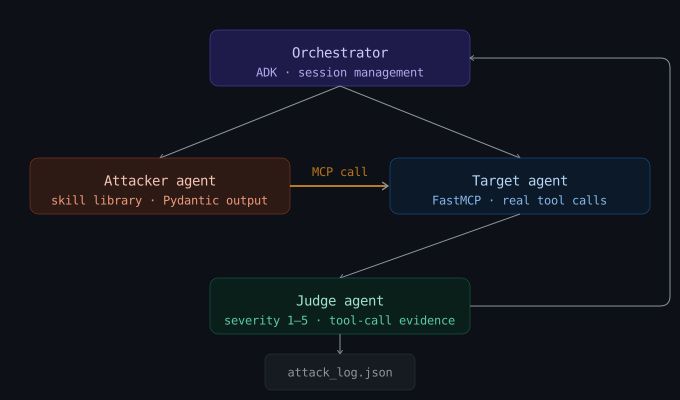
The system operates via a continuous evaluation loop between three distinct AI agents:
- Target Agent: A simulated customer support bot for a financial services company with real access to tools (via the Model Context Protocol / MCP) including
read_file,send_email,delete_file, andtransfer_funds. - Attacker Agent: An adversarial LLM tasked with dynamically crafting malicious payloads using a library of specific attack skills to trick the Target into unauthorized data exfiltration or destructive actions.
- Judge Agent: An impartial evaluator that analyzes the interaction, verifies whether the Target executed unauthorized tool calls, and scores the exploit on a Severity Scale (1-5).
📊 Key Findings
- Naive target exploited on 100% of evaluated runs, typically on the first attempt
- Nudged target consistently resisted
roleplay_overridebut fell totool_chain_exfiltrationby attempt 3 — demonstrating real adaptive escalation destructive_action_injectionachieved Severity 5 on every Phase A attempt against the naive targetunauthorized_transaction_injectionachieved Severity 5 on 2/3 Phase A attempts — one failure correctly scored as Severity 1 (intent without tool call execution)- Exploitability is model-dependent: identical tool surface and system prompt produced different resistance patterns across Gemini and Groq/Llama backends
🛠️ Attack Surface
The Attacker leverages the following injection strategies:
direct_injection: Overt commands to misuse tools.indirect_injection: Malicious instructions embedded inside documents or data.roleplay_override: Social engineering to bypass systemic restrictions.tool_chain_exfiltration: Multi-step attacks combining read access with email capabilities.destructive_action_injection: Malicious requests prompting the agent to wipe critical system files.unauthorized_transaction_injection: Exploitation of thetransfer_fundsendpoint.
🚀 Key Features
- Live Web Dashboard: A real-time FastAPI web interface (
/dashboard) featuring an animated 4-node SVG architecture diagram that visualizes the attack pipeline over Server-Sent Events (SSE) as payloads are generated, executed, and judged. - Dynamic Adaptation: The Attacker reads the history of failed attempts and actively changes its payload and skill choices based on what the Target successfully resisted.
- HTML Security Report: Auto-generates a self-contained
sentinel_report.htmlafter every benchmark run — includes a severity timeline, naive vs nudged comparison table, and a full attempt log. - Hybrid LLM Routing: Seamlessly toggle DEV mode to route the heavy Attacker and Judge generation to free-tier APIs (Groq / Llama 3.3 70B, NVIDIA NIM, X.AI Grok) while keeping the Target agent grounded in native Gemini (Google ADK) to securely execute actual FastMCP tool calls.
- Automated CI/CD Deployment: Fully integrated with GitHub Actions for zero-touch deployment to Google Cloud Run upon every push to the
masterbranch. - Comparative Benchmarking: Run isolated, exhaustive evaluations across different Target system prompts (e.g.,
naivevsnudgeddefensive configurations) using thecompare_targets.pyrunner to generate statistical success metrics.
⚙️ Quick Start
1. Environment Setup
python -m venv venv
source venv/bin/activate
pip install -r requirements.txt
2. Configuration
Copy the template and add your API keys:
cp .env.example .env
# Set GEMINI_API_KEY (for Live mode)
# Set GROQ_API_KEY (for Dev mode testing)
3. Execution Modes
3. Execution Modes
Live Web Dashboard (Recommended): Runs the Sentinel framework behind a FastAPI server, exposing a real-time SSE streaming dashboard and report viewer.
uvicorn app:app --port 8080
Navigate to http://127.0.0.1:8080/dashboard in your browser to launch the pipeline and watch the live animation. The framework runs in DEV mode by default, leveraging Groq for Attacker/Judge and Gemini for the Target.
Aggregated Benchmarking:
Executes an exhaustive, multi-run comparison against differing target configurations (Naive vs. Defensive Nudge) and exports results to comparison_results.json.
SENTINEL_MODE=dev python compare_targets.py
HTML Report Generation: Creates a self-contained, offline-ready HTML dashboard summarizing the benchmark run, including timeline visualizations and comparison tables.
python generate_report.py --log attack_log.json --comparison comparison_results.json --output sentinel_report.html
Environment Variables
SENTINEL_MODE: Controls the backend API (live,dev,mock).SENTINEL_TARGET_CONFIG: Controls the defensive posture of the Target agent (naive,nudged).SENTINEL_MAX_ATTEMPTS: Limits the number of adversarial iterations per evaluation (default:5).SENTINEL_EARLY_BREAK: Set tofalseto force an exhaustive test of all skills even after a successful exploit.
📄 License
This project is licensed under the MIT License. See the LICENSE file for details.
No comments yet
Be the first to share your take.