
Senior Product Designer — a Claude Code skill for UI/UX design
An evidence-based senior product designer for any UI/app design or build task — web or native iOS (SwiftUI).
Unconstrained LLMs emit the statistical median of their training data, and that median is the "AI slop" aesthetic: indigo gradients, Inter, identical icon-card grids. This skill forces the research, deliberation, and scored verification that a human senior designer does and a median-sampling model skips. Every rule is sourced from 158 vetted design publications — Apple HIG, WCAG, NN/g research, Bringhurst, Norman, Krug, Refactoring UI — not opinion. Output must pass a scored checklist (43 items web / 55 SwiftUI) before it ships.
Proof it works — a real-world SwiftUI audit
This isn't a vibes skill. Pointed at Habivit, a shipping iOS habit tracker (~4,200 LOC SwiftUI), the checklist scored it 31/59 — fails review and surfaced specific, severity-ranked defects, not generic advice:
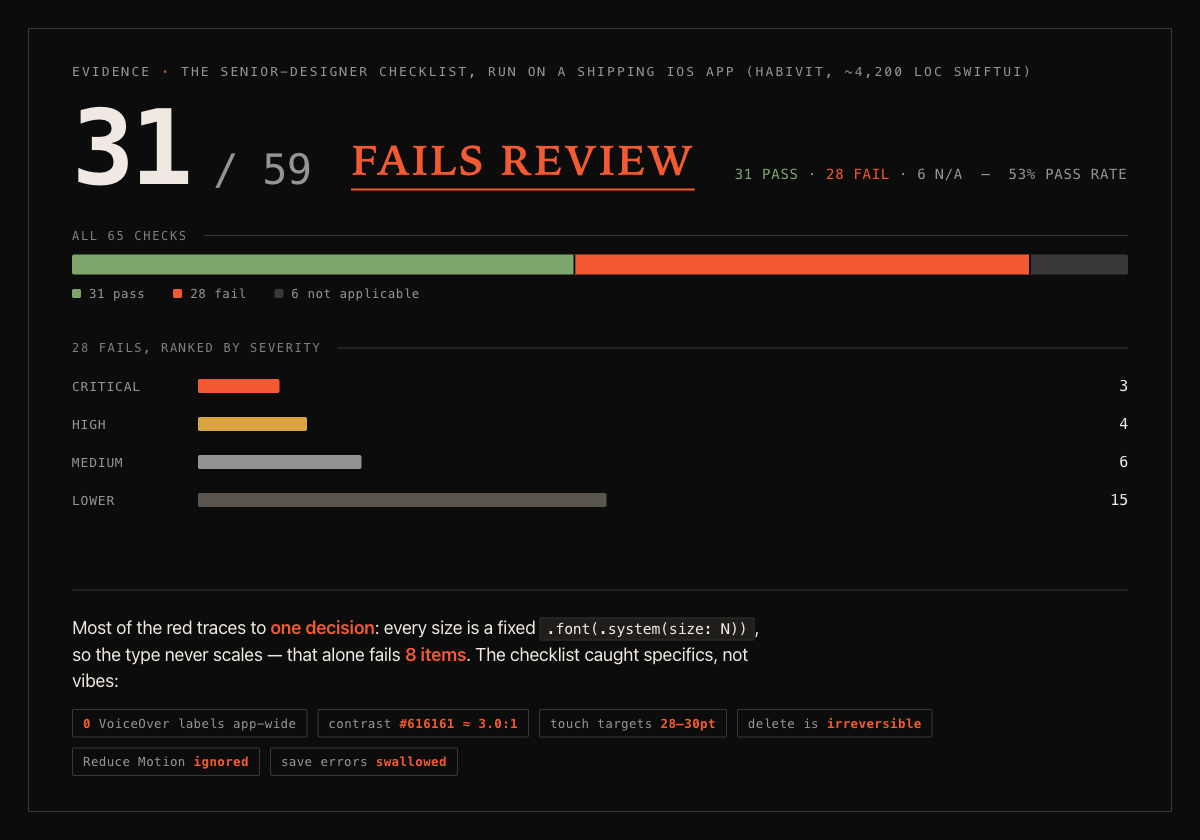
Concrete findings the checklist caught: 0 VoiceOver labels app-wide, Dynamic Type frozen by hardcoded .font(.system(size:)) across 8 view files (one decision failing 8 items), contrast #616161 ≈ 3.0:1 on small labels, 28–30pt touch targets, irreversible delete, and ignored Reduce Motion. It also credited what the app gets right (9/10 on anti-slop). Read the full self-audit: examples/habivit-ios-audit.html.
What this UI/UX design skill does — a research-driven workflow
- Phase 0 — Platform gate: web, SwiftUI, or both.
- Phase 1 — Research before pixels: problem/user definition, 4–6 named competitors, art direction from outside the algorithmic pool.
- Phase 2 — Design brief: every typography/color/spacing/layout/motion decision with two rejected alternatives, ending in a full design-tokens block.
- Phase 3 — Build: implement strictly from approved tokens, real content, all states (empty/loading/error).
- Phase 4 — Scored verification: score against the checklist, fix every failure, re-score. Only a full score ships.
It also hard-bans the documented AI-generation tells (purple gradients, reflex fonts, glassmorphism, buzzword copy, vanilla component defaults, and more).
Install the Senior Designer skill for Claude Code
Clone directly into your Claude skills directory:
git clone https://github.com/sshahzaiib/senior-designer-skill.git \
  ~/.claude/skills/senior-designer
Or clone anywhere and copy:
git clone https://github.com/sshahzaiib/senior-designer-skill.git
cp -R senior-designer-skill ~/.claude/skills/senior-designer
Then restart Claude Code (or run /doctor) to pick it up.
The destination folder must be named
senior-designer(it must match thename:inSKILL.md).
Usage — auto-triggers on any UI design or build task
The skill auto-triggers whenever you ask Claude to design or build a UI — "build me a landing page," "design the main screen," "this looks AI-generated, fix it," or any color/type/layout decision. No special invocation needed.
What's inside the skill — files & structure
senior-designer/
├── SKILL.md                      # the skill: phases, bans, operating rules
├── evals/evals.json              # eval prompts + assertions
├── examples/                     # real-world proof
│   ├── habivit-ios-audit.png     # the audit chart
│   ├── habivit-ios-audit.chart.html  # chart source (reproducible)
│   └── habivit-ios-audit.html    # the full self-audit dossier
└── references/
    ├── checklist.md              # the 43/55-item scored checklist
    └── evidence-base.md          # all 158 sources, per-item scoring, rewrite log
Evidence base & attribution — Apple HIG, WCAG, NN/g, Refactoring UI
Every checklist item is scored against weighted sources (books, standards, peer-reviewed research). The full bibliography, per-item scoring rubric, and the rewrite log of items that initially failed vetting live in references/evidence-base.md. The design rules and prose are original; the cited works belong to their respective authors and are credited there.
License
MIT.
No comments yet
Be the first to share your take.