
Enkrypt AI Secure MCP Gateway
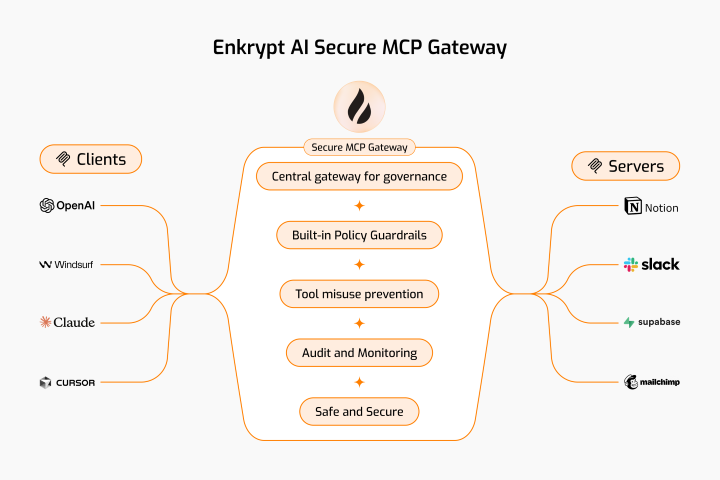
📖 Featured Blog Post: Learn how the Secure MCP Gateway prevents top attacks and vulnerabilities in our latest blog:
How Enkrypt's Secure MCP Gateway and MCP Scanner Prevent Top Attacks
Discover real-world attack scenarios, security best practices, and how our gateway protects your AI applications.
Overview
This Secure MCP Gateway is built with authentication, automatic tool discovery, caching, and guardrail enforcement.
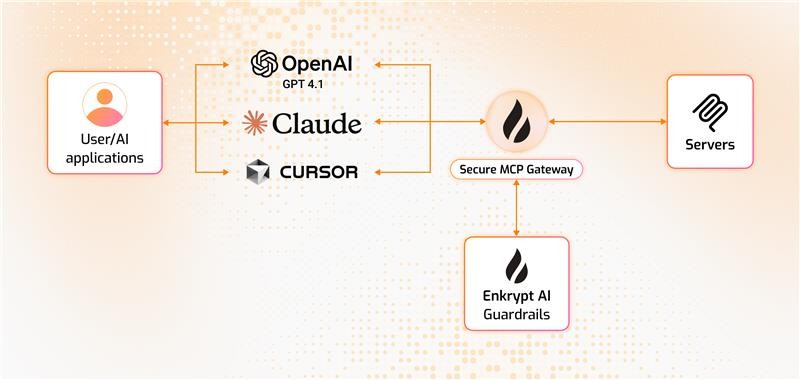
It sits between your MCP client and MCP servers. So, by it's nature it itself also acts as an MCP server as well as an MCP client :)
When your MCP client connects to the Gateway, it acts as an MCP server. When the Gateway connects to the actual MCP server, it acts as an MCP client.
-
Also see:
- CLI-Commands-Reference.md for the list of commands and their usage
- API-Reference.md for the list of API endpoints and their usage
- MCP Gateway Setup Notebook for a complete walkthrough of all the essential commands
Table of Contents
- 1. Features 🚀
- 2. High level steps of how the MCP Gateway works 🪜
- 3. Prerequisites 🧩
- 4. Gateway Setup 👨💻
- 5. (Optional) OpenTelemetry Setup 📊
- 6. Verify Installation and check the files generated ✅
- 7. Edit the Gateway config as needed ✏️
- 8. CLI Quick Start Guide 🖥️
- 9. (Optional) Add GitHub MCP Server to the Gateway 🤖
- 9.1 (Optional) Connect to MCP Servers with OAuth 🔐
- 10. (Optional) Protect GitHub MCP Server and Test Echo Server 🔒
- 11. Recommendations for using Guardrails 💡
- 12. Other tools available 🔧
- 13. (Optional) Sandbox Isolation 🛡️
- 14. Deployment Patterns 🪂
- 15. Uninstall the Gateway 🗑️
- 16. Troubleshooting 🕵
- 17. Known Issues being worked on 🏗️
- 18. Known Limitations ⚠️
- 19. Contribute 🤝
- 20. Testing 🧪
- 21. License
1. Features
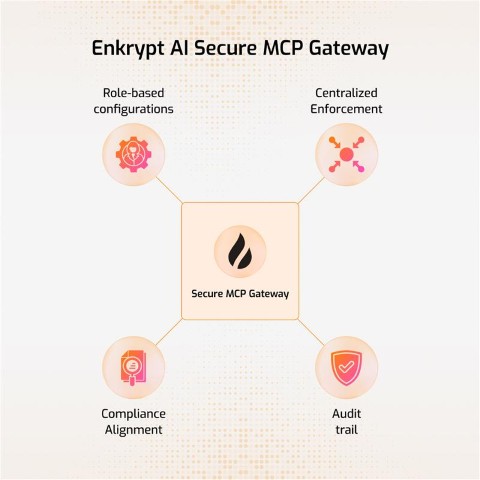
Below are the list of features Enkrypt AI Secure MCP Gateway provides:
-
Authentication: We use Unique Key to authenticate with the Gateway. We also use Enkrypt API Key if you want to protect your MCPs with Enkrypt Guardrails. Additionally, a secure
admin_apikey(256-character random string) is automatically generated for administrative REST API operations. -
Ease of use: You can configure all your MCP servers locally in the config file or better yet in Enkrypt (Coming soon) and use them in the Gateway by using their name
-
Dynamic Tool Discovery: The Gateway discovers tools from the MCP servers dynamically and makes them available to the MCP client
-
Restrict Tool Invocation: If you don't want all tools to be accessible of a an MCP server, you can restrict them by explicitly mentioning the tools in the Gateway config so that only the allowed tools are accessible to the MCP client
-
Caching: We cache the user gateway config and tools discovered from various MCP servers locally or in an external cache server like KeyDB if configured to improve performance
-
Guardrails: You can configure guardrails for each MCP server in Enkrypt both on input side (before sending the request to the MCP server) and output side (after receiving the response from the MCP server)
-
Logging: We log every request and response from the Gateway locally in your MCP logs and also forward them to Enkrypt (Coming soon) for monitoring. This enables you to see all the calls made in your account, servers used, tools invoked, requests blocked, etc.
-
Sandbox Isolation: MCP servers can be launched inside isolated sandbox environments (Docker, Podman, or microVMs) so that a compromised or malicious server cannot access the host filesystem, network, or other resources. Each sandbox is ephemeral — created per session and destroyed when done.
1.1 Guardrails
Input Protection: Topic detection, NSFW filtering, toxicity detection, injection attack prevention, keyword detection, policy violation detection, bias detection, and PII redaction (More coming soon like system prompt protection, copyright protection, etc.)
Output Protection: All input protections plus adherence checking and relevancy validation (More coming soon like hallucination detection, etc.) We also auto unredact the response if it was redacted on input.
1.2 Concepts
-
MCP Config is an array of MCP servers like
mcp_server_1,mcp_server_2,mcp_server_3etc.- Each config has a unique ID
-
User is a user of the gateway with unique email and ID
-
A project is a collection of users that share an MCP Config
- Project has a name and unique ID
- The MCP Config can be updated or can be pointed to a different config by the Admin
- Users can be added to multiple projects
-
An API Key is created for a user and project combination
- A user can have different API Keys for different projects
- This API Key is used to authenticate the user and identify the right project and MCP Config
-
See 6.5 Example config file generated and 7. Edit the Gateway config as needed for schema reference
2. High level steps of how the MCP Gateway works
-
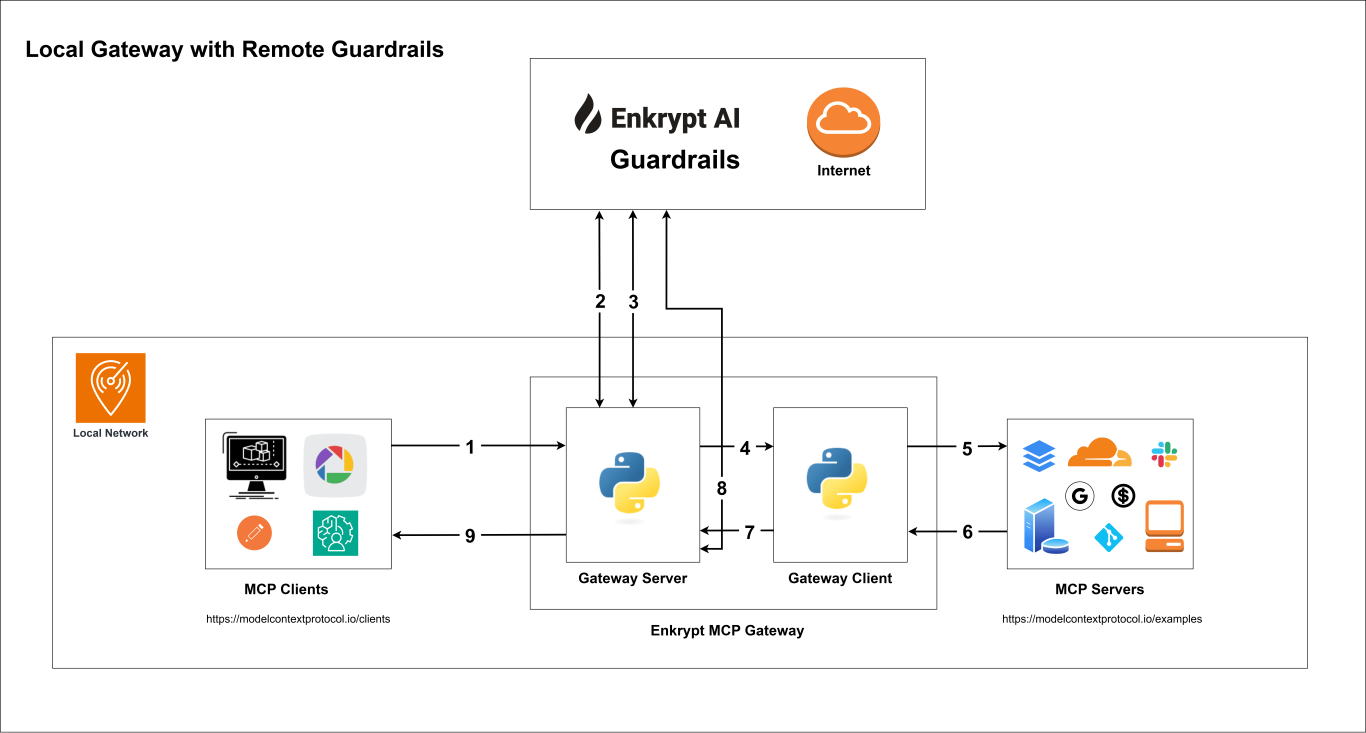
Your MCP client connects to the Secure MCP Gateway server with API Key (handled by
src/secure_mcp_gateway/gateway.py). -
Gateway server fetches gateway config from local
enkrypt_mcp_config.jsonfile or remote Enkrypt Auth server (Coming soon).- It caches the config locally or in an external cache server like KeyDB if configured to improve performance.
-
If input guardrails are enabled, request is validated before the tool call (handled by
src/secure_mcp_gateway/guardrail.py).- Request is blocked if it violates any of the configured guardrails and the specific detector is configured to block.
-
Requests are forwarded to the Gateway Client (handled by
src/secure_mcp_gateway/client.py). -
The Gateway client forwards the request to the appropriate MCP server (handled by
src/secure_mcp_gateway/client.py). -
The MCP server processes the request and returns the response to the Gateway client.
-
If it was a discover tools call, the Gateway client caches the tools locally or in an external cache server like KeyDB if configured. It then forwards the response to the Gateway server.
-
The Gateway server receives the response from the Gateway client and if output guardrails are enabled, it validates the response against the configured guardrails (handled by
src/secure_mcp_gateway/guardrail.py).- Response is blocked if it violates any of the configured guardrails and the specific detector is configured to block.
-
The Gateway server forwards the response back to the MCP client if everything is fine.
3. Prerequisites
-
Git 2.43or higher -
Python 3.11or higher installed on your system and is accessible from the command line using eitherpythonorpython3command -
pip 25.0.1or higher is installed on your system and is accessible from the command line using eitherpiporpython -m pipcommand -
uv 0.7.9or higher is installed on your system and is accessible from the command line using eitheruvorpython -m uvcommand
-
Check if Python, pip and uv are installed
-
If any of the below commands fail, please refer the respective documentation to install them properly
# ------------------

# Python

# ------------------

python --version

# Example output
Python 3.13.3

# If not, install python from their website and run the version check again

# ------------------

# pip

# ------------------
pip --version

# Example output
pip 25.0.1 from C:\Users\PC\AppData\Local\Packages\PythonSoftwareFoundation.Python.3.13_qbz5n2kfra8p0\LocalCache\local-packages\Python313\site-packages\pip (python 3.13)

# If not, try the following and run the version check again
python -m ensurepip

# ------------------

# uv

# ------------------

uv --version

# Or run with "python -m" if uv is not found directly

# If this works, use "python -m" before all uv commands from now on
python -m uv --version

# Example output
uv 0.7.9 (13a86a23b 2025-05-30)

# If not, try the following and run the version check again
python -m pip install uv
-
Install Claude Desktop as the MCP Client from their website if you haven't already and login to it
- If you are using Linux and cannot run any unofficial version of Claude Desktop, you can use any supported MCP Client to test the Gateway. If it does not support mcp cli
mcp installcommand, then go through the scripts code and run the commands supported manually.
- If you are using Linux and cannot run any unofficial version of Claude Desktop, you can use any supported MCP Client to test the Gateway. If it does not support mcp cli
-
Any other dependencies required for the MCP servers we want to proxy requests to
-
Follow the instructions of the respective MCP server to install its dependencies
-
Like
Node.js,npx,docker, etc.
-
-
(Optional) A cache server like KeyDB installed and running (If you want to cache externally and not locally)
If you want to protect your MCPs with Enkrypt Guardrails, you need to do the following:
-
Create a new account if you don't have one. It's free! 🆓 No credit card required 💳🚫
-
An
ENKRYPT_API_KEYwhich you can get from Enkrypt Dashboard Settings -
To protect your MCPs with Guardrails, you can use the default sample Guardrail
Sample Airline Guardrailto get started or you can create your own custom Guardrail -
To configure custom Guardrails, you need to either login to Enkrypt AI App or use the APIs/SDK
4. Gateway Setup
4.1 Local Installation with pip
4.1.1 Download and Install the Package
-
Activate a virtual environment
python -m venv .secure-mcp-gateway-venv # Activate the virtual environment # On Windows .secure-mcp-gateway-venv\Scripts\activate # On Linux/macOS source .secure-mcp-gateway-venv/bin/activate # Run the below to exit the virtual environment later if needed deactivate -
Install the package. For more info see https://pypi.org/project/secure-mcp-gateway/
pip install secure-mcp-gateway
4.1.2 Run the Generate Command
-
This generates the config file at
~/.enkrypt/enkrypt_mcp_config.jsonon macOS and%USERPROFILE%\.enkrypt\enkrypt_mcp_config.jsonon Windowssecure-mcp-gateway generate-config
Initializing Enkrypt Secure MCP Gateway
Initializing Enkrypt Secure MCP Gateway Common Utilities Module
Initializing Enkrypt Secure MCP Gateway Module
--------------------------------
SYSTEM INFO:
Using Python interpreter: C:\Users\PC\Documents\GitHub\EnkryptAI\secure-mcp-gateway\.secure-mcp-gateway-venv\Scripts\python.exe
Python version: 3.13.3 (tags/v3.13.3:6280bb5, Apr  8 2025, 14:47:33) [MSC v.1943 64 bit (AMD64)]
Current working directory: C:\Users\PC\Documents\GitHub\EnkryptAI\secure-mcp-gateway
PYTHONPATH: Not set
--------------------------------
Installing dependencies...
All dependencies installed successfully.
Initializing Enkrypt Secure MCP Gateway Client Module
Initializing Enkrypt Secure MCP Gateway Guardrail Module
Error: Gateway key is required. Please update your mcp client config and try again.
Getting Enkrypt Common Configuration
config_path: C:\Users\PC\.enkrypt\enkrypt_mcp_config.json
example_config_path: C:\Users\PC\Documents\GitHub\EnkryptAI\secure-mcp-gateway\.secure-mcp-gateway-venv\Lib\site-packages\secure_mcp_gateway\example_enkrypt_mcp_config.json
No enkrypt_mcp_config.json file found. Defaulting to example_enkrypt_mcp_config.json
--------------------------------
ENKRYPT_GATEWAY_KEY: ****NULL
enkrypt_log_level: info
is_debug_log_level: False
enkrypt_base_url: https://api.enkryptai.com
enkrypt_use_remote_mcp_config: False
enkrypt_api_key: ****_KEY
enkrypt_tool_cache_expiration: 4
enkrypt_gateway_cache_expiration: 24
enkrypt_mcp_use_external_cache: False
enkrypt_async_input_guardrails_enabled: False
--------------------------------
External Cache is not enabled. Using local cache only.
Initializing Enkrypt Secure MCP Gateway CLI Module
Generated default config at C:\Users\PC\.enkrypt\enkrypt_mcp_config.json
4.1.3 Example of the generated config file
- This is an example of the default configuration file generated by the CLI on macOS:
{
  "common_mcp_gateway_config": {
    "enkrypt_log_level": "INFO",
    "enkrypt_base_url": "https://api.enkryptai.com",
    "enkrypt_api_key": "YOUR_ENKRYPT_API_KEY",
    "enkrypt_use_remote_mcp_config": false,
    "enkrypt_remote_mcp_gateway_name": "enkrypt-secure-mcp-gateway-1",
    "enkrypt_remote_mcp_gateway_version": "v1",
    "enkrypt_mcp_use_external_cache": false,
    "enkrypt_cache_host": "localhost",
    "enkrypt_cache_port": 6379,
    "enkrypt_cache_db": 0,
    "enkrypt_cache_password": null,
    "enkrypt_tool_cache_expiration": 4,
    "enkrypt_gateway_cache_expiration": 24,
    "enkrypt_async_input_guardrails_enabled": false,
    "enkrypt_async_output_guardrails_enabled": false,
    "enkrypt_telemetry": {
      "enabled": true,
      "insecure": true,
      "endpoint": "http://localhost:4317"
    }
  },
  "mcp_configs": {
    "fcbd4508-1432-4f13-abb9-c495c946f638": {
      "mcp_config_name": "default_config",
      "mcp_config": [
        {
          "server_name": "echo_server",
          "description": "Simple Echo Server",
          "config": {
            "command": "python",
            "args": [
              "/Users/user/enkryptai/secure-mcp-gateway/venv/lib/python3.13/site-packages/secure_mcp_gateway/bad_mcps/echo_mcp.py"
            ]
          },
          "tools": {},
          "input_guardrails_config": {
            "enabled": false,
            "guardrail_name": "Sample Airline Guardrail",
            "additional_config": {
              "pii_redaction": false
            },
            "block": [
              "policy_violation"
            ]
          },
          "output_guardrails_config": {
            "enabled": false,
            "guardrail_name": "Sample Airline Guardrail",
            "additional_config": {
              "relevancy": false,
              "hallucination": false,
              "adherence": false
            },
            "block": [
              "policy_violation"
            ]
          }
        }
      ]
    }
  },
  "projects": {
    "3c09f06c-1f0d-4153-9ac5-366397937641": {
      "project_name": "default_project",
      "mcp_config_id": "fcbd4508-1432-4f13-abb9-c495c946f638",
      "users": [
        "6469a670-1d64-4da5-b2b3-790de21ac726"
      ],
      "created_at": "2025-07-16T17:02:00.406877"
    }
  },
  "users": {
    "6469a670-1d64-4da5-b2b3-790de21ac726": {
      "email": "[email protected]",
      "created_at": "2025-07-16T17:02:00.406902"
    }
  },
  "apikeys": {
    "2W8UupCkazk4SsOcSu_1hAbiOgPdv0g-nN9NtfZyg-rvYGat": {
      "project_id": "3c09f06c-1f0d-4153-9ac5-366397937641",
      "user_id": "6469a670-1d64-4da5-b2b3-790de21ac726",
      "created_at": "2025-07-16T17:02:00.406905"
    }
  }
}
- This is an example of the default configuration file generated by the CLI on Windows:
{
  "common_mcp_gateway_config": {
    "enkrypt_log_level": "INFO",
    "enkrypt_base_url": "https://api.enkryptai.com",
    "enkrypt_api_key": "YOUR_ENKRYPT_API_KEY",
    "enkrypt_use_remote_mcp_config": false,
    "enkrypt_remote_mcp_gateway_name": "enkrypt-secure-mcp-gateway-1",
    "enkrypt_remote_mcp_gateway_version": "v1",
    "enkrypt_mcp_use_external_cache": false,
    "enkrypt_cache_host": "localhost",
    "enkrypt_cache_port": 6379,
    "enkrypt_cache_db": 0,
    "enkrypt_cache_password": null,
    "enkrypt_tool_cache_expiration": 4,
    "enkrypt_gateway_cache_expiration": 24,
    "enkrypt_async_input_guardrails_enabled": false,
    "enkrypt_async_output_guardrails_enabled": false,
    "enkrypt_telemetry": {
      "enabled": true,
      "insecure": true,
      "endpoint": "http://localhost:4317"
    }
  },
  "mcp_configs": {
    "fcbd4508-1432-4f13-abb9-c495c946f638": {
      "mcp_config_name": "default_config",
      "mcp_config": [
        {
          "server_name": "echo_server",
          "description": "Simple Echo Server",
          "config": {
            "command": "python",
            "args": [
              "C:\\Users\\<User>\\Documents\\GitHub\\EnkryptAI\\secure-mcp-gateway\\.secure-mcp-gateway-venv\\Lib\\site-packages\\secure_mcp_gateway\\bad_mcps\\echo_mcp.py"
            ]
          },
          "tools": {},
          "input_guardrails_config": {
            "enabled": false,
            "guardrail_name": "Sample Airline Guardrail",
            "additional_config": {
              "pii_redaction": false
            },
            "block": [
              "policy_violation"
            ]
          },
          "output_guardrails_config": {
            "enabled": false,
            "guardrail_name": "Sample Airline Guardrail",
            "additional_config": {
              "relevancy": false,
              "hallucination": false,
              "adherence": false
            },
            "block": [
              "policy_violation"
            ]
          }
        }
      ]
    }
  },
  "projects": {
    "3c09f06c-1f0d-4153-9ac5-366397937641": {
      "project_name": "default_project",
      "mcp_config_id": "fcbd4508-1432-4f13-abb9-c495c946f638",
      "users": [
        "6469a670-1d64-4da5-b2b3-790de21ac726"
      ],
      "created_at": "2025-07-16T17:02:00.406877"
    }
  },
  "users": {
    "6469a670-1d64-4da5-b2b3-790de21ac726": {
      "email": "[email protected]",
      "created_at": "2025-07-16T17:02:00.406902"
    }
  },
  "apikeys": {
    "2W8UupCkazk4SsOcSu_1hAbiOgPdv0g-nN9NtfZyg-rvYGat": {
      "project_id": "3c09f06c-1f0d-4153-9ac5-366397937641",
      "user_id": "6469a670-1d64-4da5-b2b3-790de21ac726",
      "created_at": "2025-07-16T17:02:00.406905"
    }
  }
}
4.1.4 Install the Gateway for Claude Desktop
-
Run the following command to install the gateway for Claude:
secure-mcp-gateway install --client claude-desktop -
This will register Enkrypt Secure MCP Gateway with Claude Desktop.
-
NOTE: Please restart Claude Desktop after installation
Initializing Enkrypt Secure MCP Gateway
Initializing Enkrypt Secure MCP Gateway Common Utilities Module
Initializing Enkrypt Secure MCP Gateway Module
--------------------------------
SYSTEM INFO:
Using Python interpreter: C:\Users\PC\Documents\GitHub\EnkryptAI\secure-mcp-gateway\.secure-mcp-gateway-venv\Scripts\python.exe
Python version: 3.13.3 (tags/v3.13.3:6280bb5, Apr  8 2025, 14:47:33) [MSC v.1943 64 bit (AMD64)]
Current working directory: C:\Users\PC\Documents\GitHub\EnkryptAI\secure-mcp-gateway
PYTHONPATH: Not set
--------------------------------
Installing dependencies...
All dependencies installed successfully.
Initializing Enkrypt Secure MCP Gateway Client Module
Initializing Enkrypt Secure MCP Gateway Guardrail Module
Error: Gateway key is required. Please update your mcp client config and try again.
Getting Enkrypt Common Configuration
config_path: C:\Users\PC\.enkrypt\enkrypt_mcp_config.json
example_config_path: C:\Users\PC\Documents\GitHub\EnkryptAI\secure-mcp-gateway\.secure-mcp-gateway-venv\Lib\site-packages\secure_mcp_gateway\example_enkrypt_mcp_config.json
Loading enkrypt_mcp_config.json file...
--------------------------------
ENKRYPT_GATEWAY_KEY: ****NULL
enkrypt_log_level: info
is_debug_log_level: False
enkrypt_base_url: https://api.enkryptai.com
enkrypt_use_remote_mcp_config: False
enkrypt_api_key: ****_KEY
enkrypt_tool_cache_expiration: 4
enkrypt_gateway_cache_expiration: 24
enkrypt_mcp_use_external_cache: False
enkrypt_async_input_guardrails_enabled: False
--------------------------------
External Cache is not enabled. Using local cache only.
Initializing Enkrypt Secure MCP Gateway CLI Module
CONFIG_PATH:  C:\Users\PC\.enkrypt\enkrypt_mcp_config.json
GATEWAY_PY_PATH:  C:\Users\PC\Documents\GitHub\EnkryptAI\secure-mcp-gateway\.secure-mcp-gateway-venv\Lib\site-packages\secure_mcp_gateway\gateway.py
client name from args:  claude-desktop
Successfully installed gateway for claude-desktop
Path to gateway is incorrect. Modifying the path to gateway in claude_desktop_config.json file...
Path to gateway modified in claude_desktop_config.json file
Please restart Claude Desktop to use the gateway.
4.1.5 Example of the Claude Desktop Config after installation
-
~/Library/Application Support/Claude/claude_desktop_config.json{ "mcpServers": { "Enkrypt Secure MCP Gateway": { "command": "mcp", "args": [ "run", "/Users/user/enkryptai/secure-mcp-gateway/venv/lib/python3.13/site-packages/secure_mcp_gateway/gateway.py" ], "env": { "ENKRYPT_GATEWAY_KEY": "2W8UupCkazk4SsOcSu_1hAbiOgPdv0g-nN9NtfZyg-rvYGat", "ENKRYPT_PROJECT_ID": "3c09f06c-1f0d-4153-9ac5-366397937641", "ENKRYPT_USER_ID": "6469a670-1d64-4da5-b2b3-790de21ac726" } } } }
-
%USERPROFILE%\AppData\Roaming\Claude\claude_desktop_config.json{ "mcpServers": { "Enkrypt Secure MCP Gateway": { "command": "mcp", "args": [ "run", "C:\\Users\\<User>\\Documents\\GitHub\\EnkryptAI\\secure-mcp-gateway\\.secure-mcp-gateway-venv\\Lib\\site-packages\\secure_mcp_gateway\\gateway.py" ], "env": { "ENKRYPT_GATEWAY_KEY": "2W8UupCkazk4SsOcSu_1hAbiOgPdv0g-nN9NtfZyg-rvYGat", "ENKRYPT_PROJECT_ID": "3c09f06c-1f0d-4153-9ac5-366397937641", "ENKRYPT_USER_ID": "6469a670-1d64-4da5-b2b3-790de21ac726" } } } }
4.1.6 Install the Gateway for Cursor
-
Run the CLI Install Command for Cursor
secure-mcp-gateway install --client cursor -
This automatically updates your ~/.cursor/mcp.json (on Windows it is at: %USERPROFILE%.cursor\mcp.json) with the correct entry.
-
Although it is not usually required to restart, if you see it in loading state for a long time, please restart Cursor
-
~/.cursor/mcp.json{ "mcpServers": { "Enkrypt Secure MCP Gateway": { "command": "mcp", "args": [ "run", "/Users/user/enkryptai/secure-mcp-gateway/venv/lib/python3.13/site-packages/secure_mcp_gateway/gateway.py" ], "env": { "ENKRYPT_GATEWAY_KEY": "2W8UupCkazk4SsOcSu_1hAbiOgPdv0g-nN9NtfZyg-rvYGat", "ENKRYPT_PROJECT_ID": "3c09f06c-1f0d-4153-9ac5-366397937641", "ENKRYPT_USER_ID": "6469a670-1d64-4da5-b2b3-790de21ac726" } } } }
-
%USERPROFILE%\.cursor\mcp.json{ "mcpServers": { "Enkrypt Secure MCP Gateway": { "command": "uv", "args": [ "run", "--with", "mcp[cli]", "mcp", "run", "C:\\Users\\<User>\\Documents\\GitHub\\EnkryptAI\\secure-mcp-gateway\\.secure-mcp-gateway-venv\\Lib\\site-packages\\secure_mcp_gateway\\gateway.py" ], "env": { "ENKRYPT_GATEWAY_KEY": "2W8UupCkazk4SsOcSu_1hAbiOgPdv0g-nN9NtfZyg-rvYGat", "ENKRYPT_PROJECT_ID": "3c09f06c-1f0d-4153-9ac5-366397937641", "ENKRYPT_USER_ID": "6469a670-1d64-4da5-b2b3-790de21ac726" } } } }
4.1.7 Install the Gateway for Claude Code
Claude Code is Anthropic's CLI-based coding agent. It uses claude mcp add commands to configure MCP servers. Unlike Claude Desktop and Cursor which use JSON config files, Claude Code manages MCP servers through its own CLI.
Prerequisite: The
claudeCLI must be installed on your system. See Claude Code docs for installation.
Step 1: Install the gateway
secure-mcp-gateway install --client claude-code
This automatically:
- Reads your gateway key, project ID, and user ID from the generated config
- Runs
claude mcp addwith the correct credentials and gateway path - Registers the server with
--scope user(available across all Claude Code projects)
Step 2: Verify the server was added
claude mcp list
You should see Enkrypt-Secure-MCP-Gateway in the list.
Step 3: Use the gateway in Claude Code
Launch Claude Code and try:
list all servers, get all tools available
Get your credentials from the generated enkrypt_mcp_config.json and the gateway path:
python -c "import secure_mcp_gateway.gateway; print(secure_mcp_gateway.gateway.__file__)"
Then add the gateway manually:
claude mcp add --transport stdio --env ENKRYPT_GATEWAY_KEY=YOUR_GATEWAY_KEY --env ENKRYPT_PROJECT_ID=YOUR_PROJECT_ID --env ENKRYPT_USER_ID=YOUR_USER_ID --scope user Enkrypt-Secure-MCP-Gateway -- mcp run /path/to/secure_mcp_gateway/gateway.py
Note: The server name must use hyphens or underscores — Claude Code does not allow spaces in names.
4.2 Local Installation with git clone
4.2.1 Clone the repo, setup virtual environment and install dependencies
- Clone the repository:
git clone https://github.com/enkryptai/secure-mcp-gateway

cd secure-mcp-gateway
# ------------------

# Create a virtual environment

# ------------------

uv venv

# Example output
Using CPython 3.13.3 interpreter at: C:\Users\PC\AppData\Local\Microsoft\WindowsApps\PythonSoftwareFoundation.Python.3.13_qbz5n2kfra8p0\python.exe
Creating virtual environment at: .venv
Activate with: .venv\Scripts\activate

# ------------------

# Activate the virtual environment

# ------------------

# For 🍎 Linux/macOS, run the following
source ./.venv/Scripts/activate

# For 🪟 Windows, run the following
.\.venv\Scripts\activate

# After activating, you should see (enkrypt-secure-mcp-gateway) before the file path in the terminal

# Example:

# (enkrypt-secure-mcp-gateway) %USERPROFILE%\Documents\GitHub\EnkryptAI\secure-mcp-gateway>

# ------------------

# Install pip in the virtual environment

# ------------------

python -m ensurepip

# ------------------

# Install uv in the virtual environment

# ------------------

python -m pip install uv
- Install Python dependencies:
uv pip install -r requirements.txt
- Verify mcp cli got installed successfully:
mcp version

# Example output
MCP version 1.9.2
4.2.2 Run the setup script
-
This script creates the config file at
~/.enkrypt/enkrypt_mcp_config.jsonon macOS and%USERPROFILE%\.enkrypt\enkrypt_mcp_config.jsonon Windows based onsrc/secure_mcp_gateway/example_enkrypt_mcp_config.jsonfile -
It replaces
UNIQUE_GATEWAY_KEYand otherUUIDswith auto generated values and also replacesDUMMY_MCP_FILE_PATHwith the actual path to the test MCP filebad_mcps/echo_mcp.py -
It also installs the MCP client in Claude Desktop
-
NOTE: Please restart Claude Desktop after running the setup script to see the Gateway running in Claude Desktop
# On 🍎 Linux/macOS run the below
cd scripts
chmod +x *.sh
./setup.sh

# On 🪟 Windows run the below
cd scripts
setup.bat

# Now restart Claude Desktop to see the Gateway running
-------------------------------
Setting up Enkrypt Secure MCP Gateway enkrypt_mcp_config.json config file
-------------------------------
        1 file(s) copied.
Generated unique gateway key: WTZOpoU1mXJz8b_ZJQ42DuSXlQCSCtWOn3FX0jG8sO_FKYNJetjYEgSluvhtBN8_
Generated unique uuid: 7920749a-228e-47fe-a6a9-cd2d64a2283b
DUMMY_MCP_FILE_PATH: C:\Users\PC\Documents\GitHub\EnkryptAI\secure-mcp-gateway\src\secure_mcp_gateway\bad_mcps\echo_mcp.py
-------------------------------
Setup complete. Please check the enkrypt_mcp_config.json file in the ~\.enkrypt directory and update with your MCP server configs as needed.
-------------------------------
-------------------------------
Installing Enkrypt Secure MCP Gateway with gateway key and dependencies
-------------------------------
mcp is installed. Proceeding with installation...
ENKRYPT_GATEWAY_KEY: WTZOpoU1mXJz8b_ZJQ42DuSXlQCSCtWOn3FX0jG8sO_FKYNJetjYEgSluvhtBN8_
The system cannot find the path specified.
Package names only:
Dependencies string for the cli install command:
Running the cli install command: mcp install gateway.py --env-var ENKRYPT_GATEWAY_KEY=WTZOpoU1mXJz8b_ZJQ42DuSXlQCSCtWOn3FX0jG8sO_FKYNJetjYEgSluvhtBN8_
Initializing Enkrypt Secure MCP Gateway
Initializing Enkrypt Secure MCP Gateway Common Utilities Module
Initializing Enkrypt Secure MCP Gateway Module
--------------------------------
SYSTEM INFO:
Using Python interpreter: C:\Users\PC\Documents\GitHub\EnkryptAI\secure-mcp-gateway\.secure-mcp-gateway-venv\Scripts\python.exe
Python version: 3.13.3 (tags/v3.13.3:6280bb5, Apr  8 2025, 14:47:33) [MSC v.1943 64 bit (AMD64)]
Current working directory: C:\Users\PC\Documents\GitHub\EnkryptAI\secure-mcp-gateway\src\secure_mcp_gateway
PYTHONPATH: Not set
--------------------------------
Installing dependencies...
All dependencies installed successfully.
Initializing Enkrypt Secure MCP Gateway Client Module
Initializing Enkrypt Secure MCP Gateway Guardrail Module
Getting Enkrypt Common Configuration
config_path: C:\Users\PC\.enkrypt\enkrypt_mcp_config.json
example_config_path: C:\Users\PC\Documents\GitHub\EnkryptAI\secure-mcp-gateway\.secure-mcp-gateway-venv\Lib\site-packages\secure_mcp_gateway\example_enkrypt_mcp_config.json
Loading enkrypt_mcp_config.json file...
--------------------------------
ENKRYPT_GATEWAY_KEY: ****BN8_
enkrypt_log_level: info
is_debug_log_level: False
enkrypt_base_url: https://api.enkryptai.com
enkrypt_use_remote_mcp_config: False
enkrypt_api_key: ****_KEY
enkrypt_tool_cache_expiration: 4
enkrypt_gateway_cache_expiration: 24
enkrypt_mcp_use_external_cache: False
enkrypt_async_input_guardrails_enabled: False
--------------------------------
External Cache is not enabled. Using local cache only.
Initializing Enkrypt Secure MCP Gateway Module
--------------------------------
SYSTEM INFO:
Using Python interpreter: C:\Users\PC\Documents\GitHub\EnkryptAI\secure-mcp-gateway\.secure-mcp-gateway-venv\Scripts\python.exe
Python version: 3.13.3 (tags/v3.13.3:6280bb5, Apr  8 2025, 14:47:33) [MSC v.1943 64 bit (AMD64)]
Current working directory: C:\Users\PC\Documents\GitHub\EnkryptAI\secure-mcp-gateway\src\secure_mcp_gateway
PYTHONPATH: Not set
--------------------------------
Installing dependencies...
All dependencies installed successfully.
Getting Enkrypt Common Configuration
config_path: C:\Users\PC\.enkrypt\enkrypt_mcp_config.json
example_config_path: C:\Users\PC\Documents\GitHub\EnkryptAI\secure-mcp-gateway\.secure-mcp-gateway-venv\Lib\site-packages\secure_mcp_gateway\example_enkrypt_mcp_config.json
Loading enkrypt_mcp_config.json file...
--------------------------------
ENKRYPT_GATEWAY_KEY: ****BN8_
enkrypt_log_level: info
is_debug_log_level: False
enkrypt_base_url: https://api.enkryptai.com
enkrypt_use_remote_mcp_config: False
enkrypt_api_key: ****_KEY
enkrypt_tool_cache_expiration: 4
enkrypt_gateway_cache_expiration: 24
enkrypt_mcp_use_external_cache: False
enkrypt_async_input_guardrails_enabled: False
--------------------------------
External Cache is not enabled. Using local cache only.
[06/15/25 13:14:10] INFO     Added server 'Enkrypt Secure MCP Gateway' to Claude config                                                                                                             claude.py:137
                    INFO     Successfully installed Enkrypt Secure MCP Gateway in Claude app                                                                                                           cli.py:486
-------------------------------
Installation complete. Check the claude_desktop_config.json file as per the readme instructions and restart Claude Desktop.
-------------------------------
4.2.3 Setup Other MCP Clients
-
You can navigate to cursor's Global MCP file at
~/.cursor/mcp.jsonon Linux/macOS or%USERPROFILE%\.cursor\mcp.jsonon Windows- If you would like to use at a Project level place it inside your project. For details see Cursor's docs
-
You can also navigate to the file Via cursor's UI by clicking on
settingsgear icon on the top right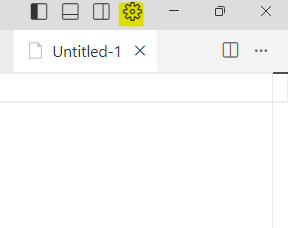
-
Click on
MCPand then click onAdd new global MCP serverwhich takes you to themcp.jsonfile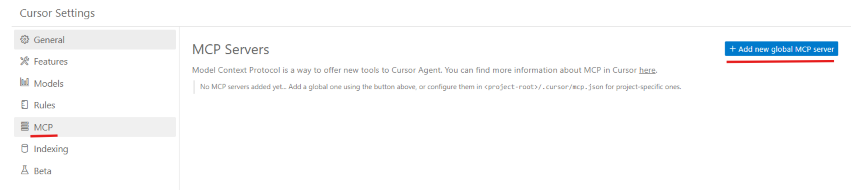
-
Example
mcp.jsonfile opened in the editor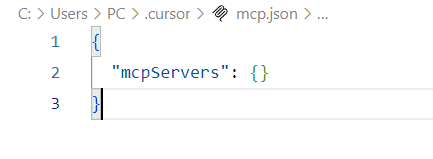
-
Once the file is opened at Global or Project level, you can copy paste the same config we used in
Claude Desktop. For reference, you can refer to Installation - 6.2 Example MCP config file generated 📄- Be sure to use your own file that was generated by the
setupscript in Installation - 4.2.2 Run the setup script 📥. Please do not copy paste the example config file in this repo.
- Be sure to use your own file that was generated by the
-
See Verify Cursor section to verify the MCP server is running in Cursor
-
Claude Code uses its own CLI to manage MCP servers instead of JSON config files
-
Get your credentials from the generated
enkrypt_mcp_config.json(gateway key, project ID, user ID) -
Find the gateway.py path:
python -c "import secure_mcp_gateway.gateway; print(secure_mcp_gateway.gateway.__file__)" -
Add the gateway to Claude Code:
claude mcp add --transport stdio --env ENKRYPT_GATEWAY_KEY=YOUR_GATEWAY_KEY --env ENKRYPT_PROJECT_ID=YOUR_PROJECT_ID --env ENKRYPT_USER_ID=YOUR_USER_ID --scope user Enkrypt-Secure-MCP-Gateway -- mcp run /path/to/secure_mcp_gateway/gateway.py -
Verify:
claude mcp list -
For detailed setup, see 4.1.7 Install the Gateway for Claude Code
4.3 Docker Installation
4.3.1 Build the Docker Image
docker build -t secure-mcp-gateway .
[+] Building 72.9s (20/20) FINISHED                                                                                                                                          docker:default
 => [internal] load build definition from Dockerfile                                                                                                                                   0.1s
 => => transferring dockerfile: 724B                                                                                                                                                   0.1s
 => [internal] load metadata for docker.io/library/python:3.11-alpine                                                                                                                  1.0s
 => [internal] load .dockerignore
No comments yet
Be the first to share your take.