
reflect — for builders who ship: Bezos-level thinking on every build decision, in 5 minutes
You know the phrase. "You're absolutely right!" It's an actual GitHub bug report (someone counted 12 in ONE conversation — including when they were wrong), it had a whole website counting it, and The Register wrote it up as "endless sycophancy annoys customers."
The funny meme has an unfunny version: ask your AI "should I launch this?" and it finds 5 reasons to launch. Ask "is launching a bad idea?" and it finds 5 reasons it is. Same product, opposite answers — it follows your lean. And the decisions keep coming: Stack Overflow's blog just called it "coding agents are giving everyone decision fatigue." The code takes 20 minutes now. The decisions still eat days.
reflect makes your AI argue first. The answer isn't allowed through until it survives an attack — because the problem with your decisions isn't information, it's honesty.
You're mid-build. Claude Code, Cursor, Codex — doesn't matter. And the decisions come at you all day:
Rewrite this mess or patch it? Ship now or polish? Build auth myself or pay for it? Kill the feature nobody uses? Postgres or the shiny thing?
And because building something means selling it too:
Price at $29 or $99? Take the agency deal? Niche down or stay broad? Quit the job? Monetize the side project or keep it free?
Most builders answer all of these with whatever mood they're in. The best — Bezos, Musk, Munger, DHH, Tobi Lütke — wrote down how they think before they answer. This loop treats "raise my prices" with the same rigor as "rewrite the module."
This turns that thinking into something your AI runs on your actual project.
You type one sentence:
reflect on: should I rewrite this module or keep patching it?
Five minutes later you have:
- A straight answer — first thing you read, in plain words. Not "here are some considerations."
- How sure it is (a real number, like ~75%), so you know whether to act now or test first.
- The exact next step, so the analysis turns into a commit, not a doc.
- "This flips if…" — the 1-3 things that would change the answer, so you stop relitigating it in the shower.
It reads your code before it opines
This is the part generic advice can't do. Connected to your repo, the loop:
- Runs
git logbefore recommending a rewrite — "why does this exist?" gets answered by history, not vibes. (The most expensive sentence in software is "how hard could a rewrite be.") - Searches for base rates instead of asserting them — "most migrations like this take 3x the estimate" comes with a source or an "I'm estimating" label, never disguised as fact.
- Runs the cheap test instead of describing it — if the answer hinges on a benchmark, a grep, or checking real usage numbers, it does that first. An hour of evidence beats a page of reasoning.
What's in the loop
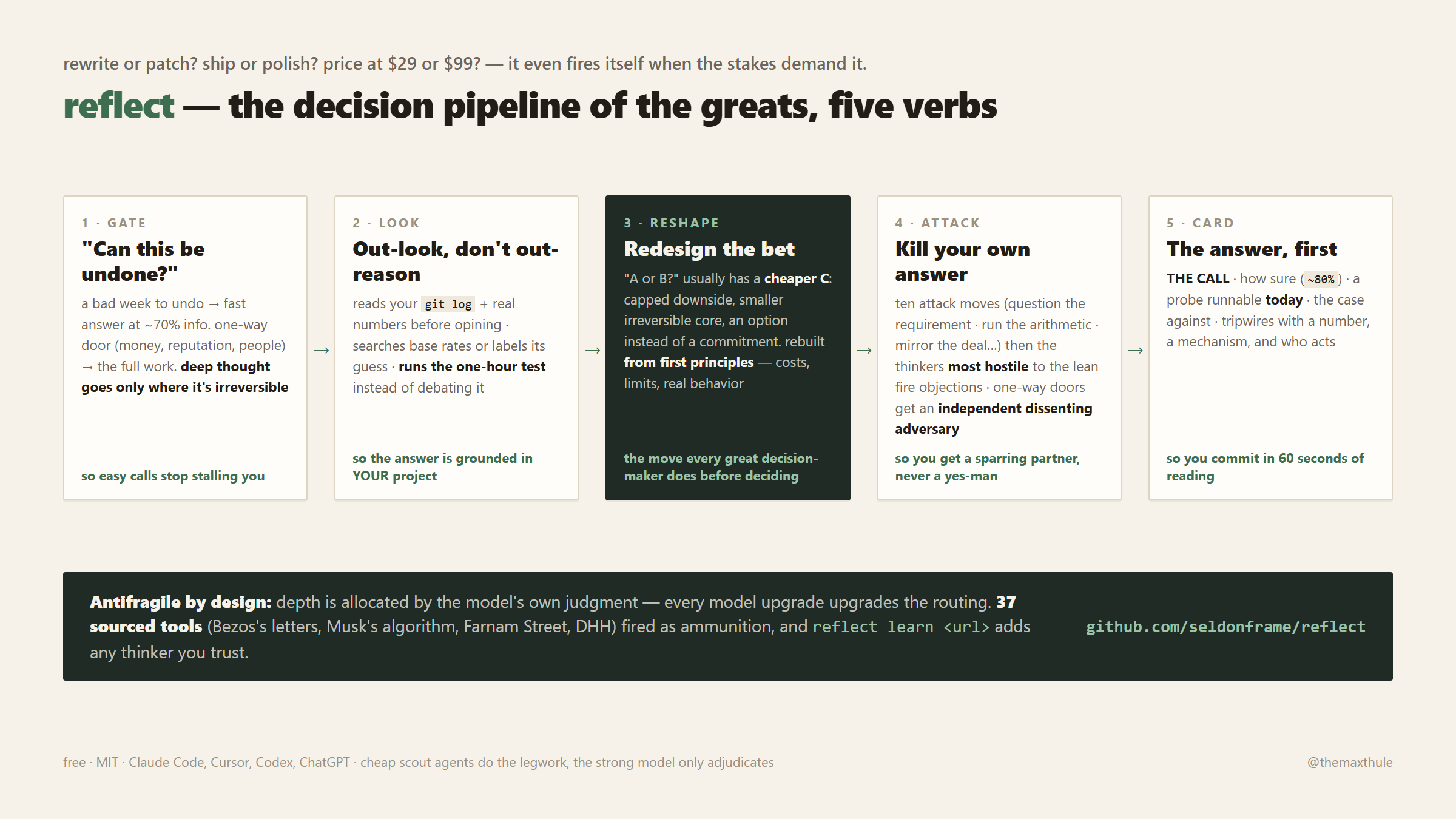
- First it asks: "can this be undone?" Bezos's rule. Reverting a shipped flag costs a bad hour → you get a fast answer at ~70% information, because slow-deciding reversible things is how projects stall. Deleting user data, a public API promise, a pricing change → it slows down and runs the full battery: rebuild the logic from first principles, imagine the decision already failed and find what killed it, check second-order effects, check the odds against base rates.
- It attacks its own answer before you see it. Ten moves run against its lean (question the requirement, run the arithmetic, find the disguised option, set the kill threshold, mirror the deal…) — then it fires the 1-2 thinkers MOST HOSTILE to its conclusion from a 37-tool library (Bezos's letters, Musk's algorithm, Farnam Street, DHH, Tobi Lütke, Wozniak — all sourced). On irreversible calls it spawns an independent adversary that gets the facts but not the lean. Every card shows THE CASE AGAINST — the best opposing argument, which earned that line by losing.
It grows with you: reflect learn <source>
Found a thinker whose judgment you trust? Point the loop at them:
reflect learn https://some-essay-that-changed-how-you-build.com
It fetches the source live, compacts it into a new lens file, and wires it into the routing — your library compounds the same way your codebase does. (The builders' pack in this repo was added exactly this way.)
Install (30 seconds)
Claude Code (one command):
/plugin marketplace add seldonframe/reflect
/plugin install reflect@reflect
Then say reflect on <the thing you're stuck on>. Done — and it auto-updates.
Claude Code (manual): clone this repo and copy skills/reflect into
~/.claude/skills/ (or .claude/skills/ in one project).
Cursor / Codex: paste PROMPT.md into your AGENTS.md.
ChatGPT / Gemini / Claude.ai: paste PROMPT.md into custom
instructions or the top of a chat. Same loop, no setup.
Your first 10 minutes: here's a full run on "rewrite or patch?", start to finish:
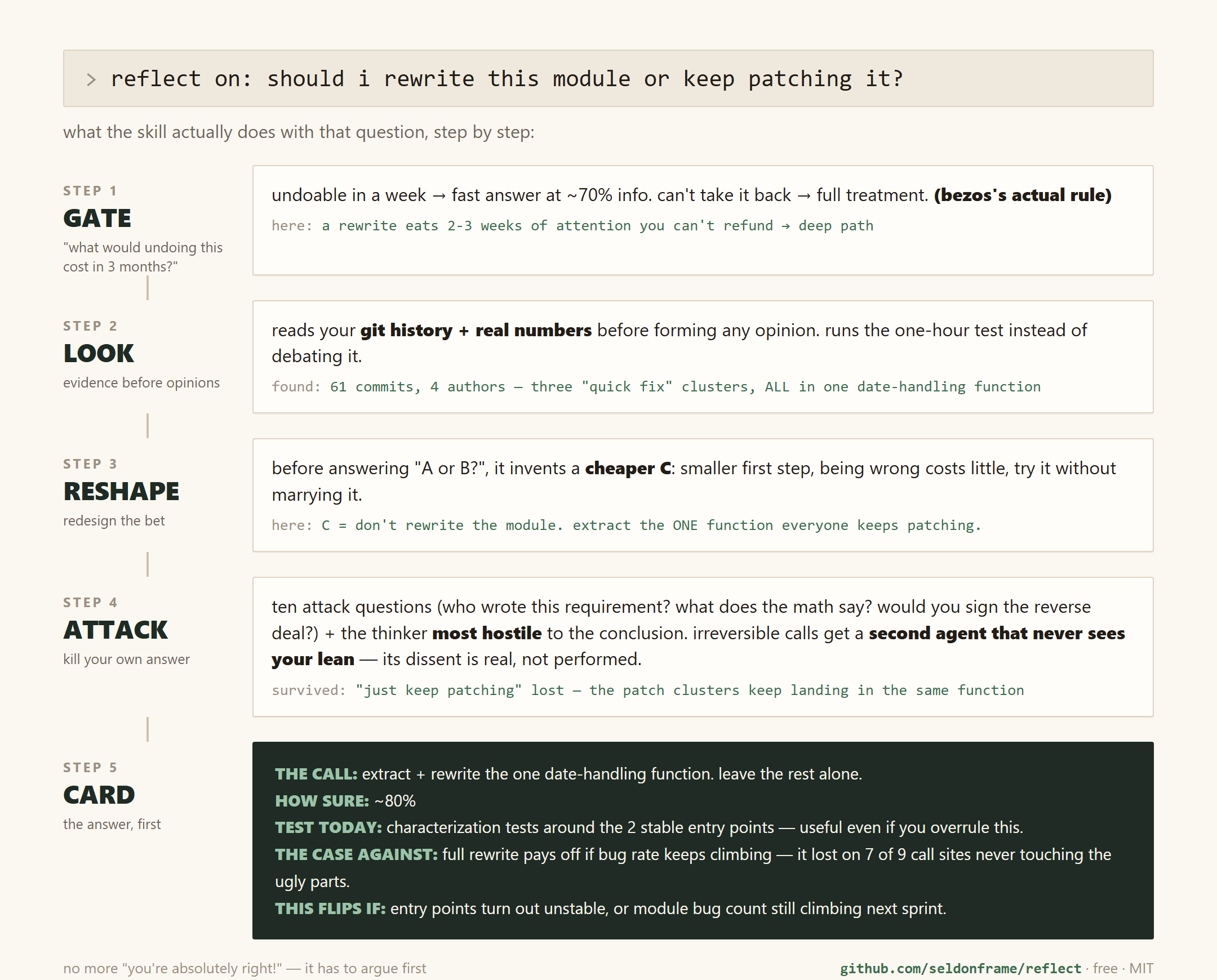
Read the same example as text (30 seconds — it shows the git-history homework and the answer card), then run your first reflect from STARTER-QUESTIONS.md — it starts with the five every builder is currently avoiding, like "should I ship this now or keep polishing?" and "which dependency would hurt most if it died tomorrow?" Want to add a thinker you trust? CONTRIBUTING.md has the lens template.
It fires itself
The skill instructs your agent to run the loop unprompted whenever the work hits a choice whose undo cost exceeds a bad day — depth allocated by the agent's own judgment, which means the skill gets better as models get smarter, not stale. "start from first principles" also triggers it, aimed at rebuilding your options from the ground up. For extra reliability in other tools, add one line to your CLAUDE.md / AGENTS.md:
When I'm visibly going back and forth on a decision (pros/cons lists,
"should we X or Y", "I can't decide"), offer to run reflect on it — once.
Make it yours (2 minutes, biggest upgrade)
Copy CONTEXT.md.example → skills/reflect/CONTEXT.md (next to SKILL.md): your settled decisions (so it never
re-argues your stack), what you usually decide on, how bold you want the
answers. Every answer lands in your project instead of generic advice.
Prior art & receipts
The sycophancy problem this attacks is well documented: claude-code#3382 · The Register on "endless sycophancy" · absolutelyright.lol · Stack Overflow on decision fatigue. Karpathy's LLM Council attacks the same failure by polling multiple models against each other; reflect is a single-model, zero-setup cousin of that idea — the adversary agent never sees your lean, so its dissent is real rather than performed.
Credits & sources
The thinking belongs to the thinkers. Every lens file links its source — most
are Farnam Street essays and Knowledge Project conversations
(read/listen to the originals; they're excellent), plus Jeff Bezos's shareholder
letters and the builders listed above. This repo is paraphrased compactions with
attribution, not copies. The loop, the routing, the scoreboard, and
reflect learn are original.
Built by the team behind SeldonFrame — an open-source platform where AI agents run your front office (calls, bookings, CRM, follow-ups). Loops like this one are how we build it.
No comments yet
Be the first to share your take.