QAMap

CI npm version License: MIT

QAMap: local PR QA design from commits and diffs

Find what a PR needs to prove before merge.

QAMap is a local-first, zero-LLM QA router. It reads commits, code diffs, repository structure, selectors, and existing tests to infer changed behavior and route evidence-backed QA scenarios.

It does not begin with "use Playwright" or "add a fixture." It first explains what changed, what should be verified, why each scenario was selected, and whether deterministic automation can compile it safely.

No cloud. No source upload. No LLM token.

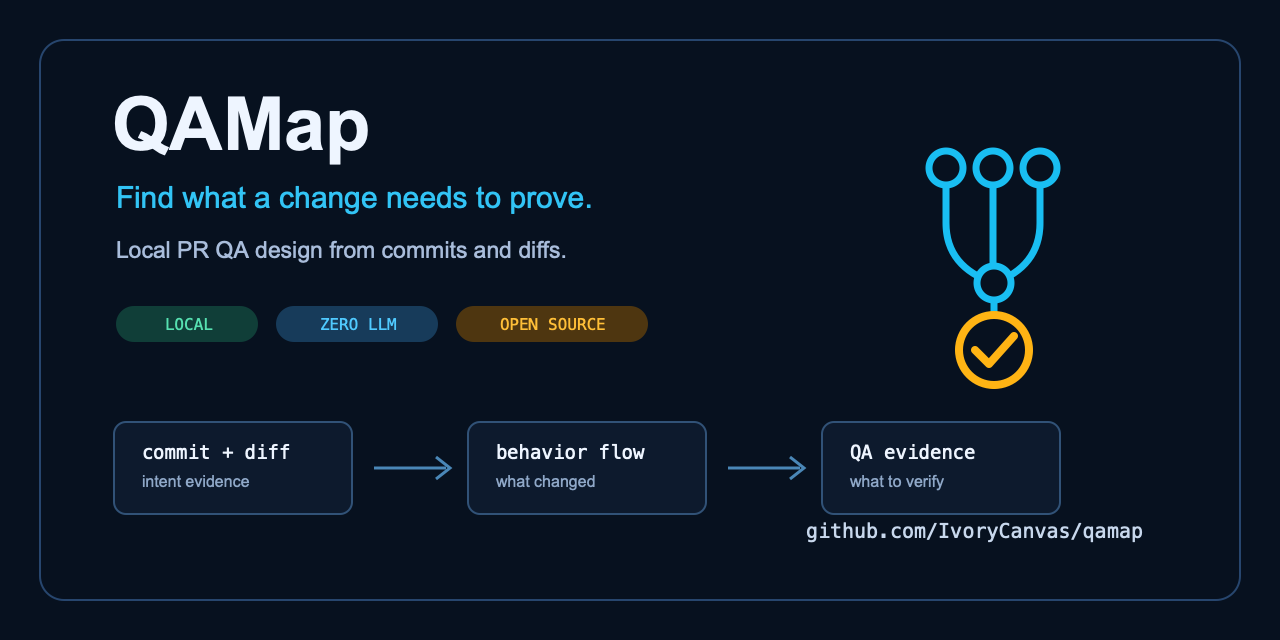
commit + diff -> behavior lifecycle -> QA routing -> QA trace -> optional automation
                 trigger / state /      required       why this     Playwright
                 outcome                recommended    scenario     Maestro
                                        review-only    exists       manual

See It Work

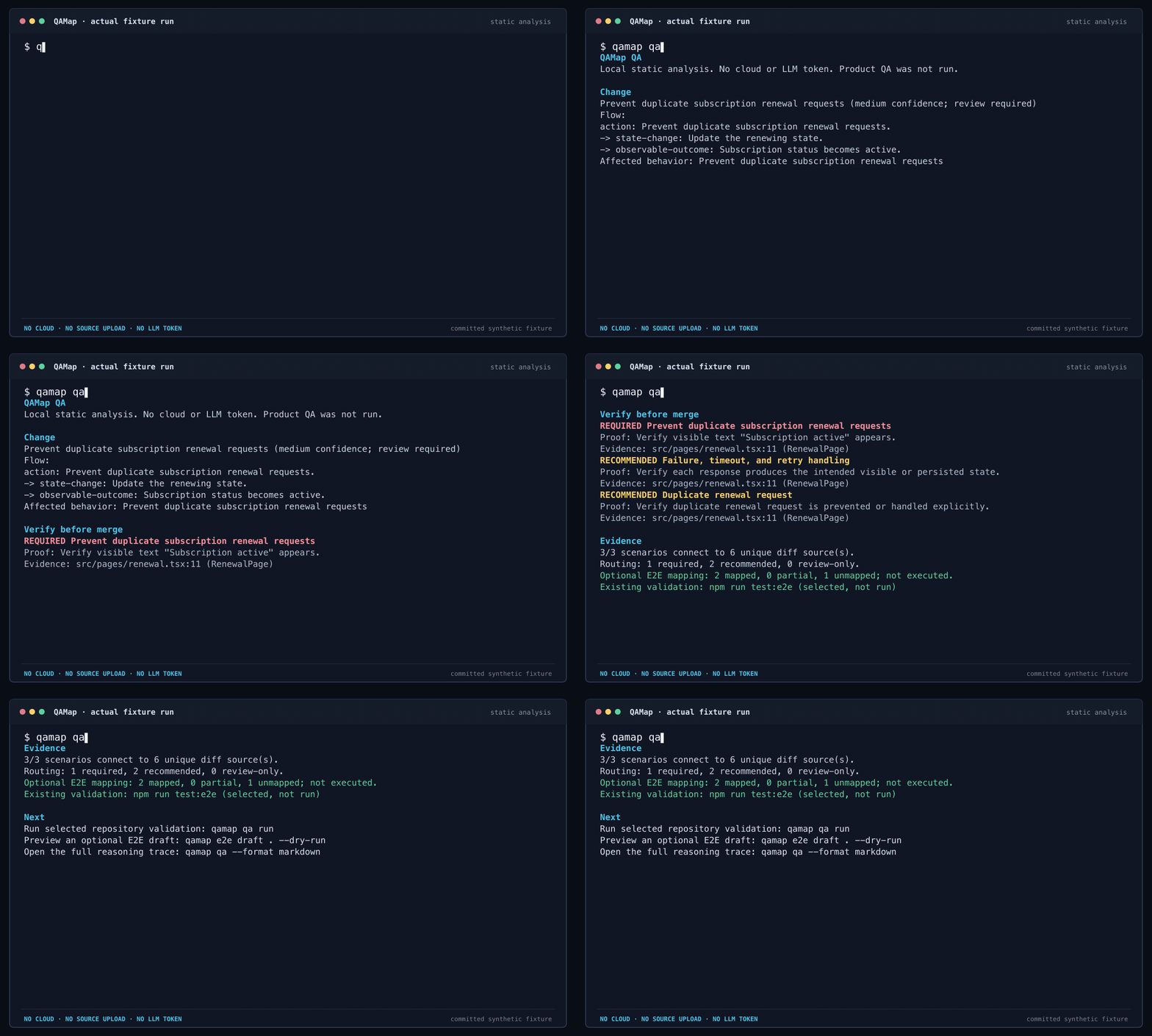
This is the current CLI running against the committed, manifest-free React state-transition fixture. The recording shows real deterministic output: QAMap identifies the change, exposes the reasoning path, and writes the Playwright draft shown at the end. It does not launch the fixture application or claim that product QA passed.

QAMap reads a PR diff, routes QA scenarios, and reports E2E automation readiness

Recorded from the current source against test/benchmarks/web-react-record-pinning; no hand-written or simulated result blocks.

Quick Start

Requires Node.js 20 or newer. Run one read-only command from a feature branch:

npx --yes @ivorycanvas/qamap@latest qa . --base origin/main --head HEAD

The base branch is inferred in standard repositories, so this is usually enough:

npx --yes @ivorycanvas/qamap@latest qa

A manifest and test runner are not required for the first run.

qa performs static analysis and draft mapping only. It does not launch the target application or claim that product QA passed.

When --base is omitted, QAMap checks CI pull-request metadata, repo-local Git configuration, and nearby long-lived branches in that order. The report always shows which base was selected and why. Use --include-working-tree to analyze the final net state from that branch to the current worktree; a file added in an earlier commit and removed locally is not reported as a current change.

For repeat use in a JavaScript repository, install QAMap once and add short package scripts:

pnpm add -D @ivorycanvas/qamap
pnpm exec qamap init --scripts

After that, the everyday workflow is deliberately small:

pnpm qa          # committed changes on the current branch
pnpm qa:local    # also include uncommitted local changes
pnpm qa:e2e      # preview an E2E draft without writing files

init --scripts detects npm, pnpm, Yarn, or Bun, preserves unrelated scripts, and never replaces a name collision unless --force is explicit. Non-JavaScript repositories keep using the universal qamap qa command directly.

What You Get

QAMap keeps QA selection and test generation as two separate decisions:

Decision Meaning
Behavior inference Connect commit intent and changed symbols into a trigger, condition, state change, side effect, and observable outcome.
Scenario routing Mark each scenario required, recommended, or review-only, with the exact diff hunk or commit that supports it.
QA reasoning trace Give every scenario a stable ID that connects diff line -> affected lifecycle -> risk -> routing decision -> optional draft, while keeping execution explicitly not-run.
Automation receipt Report whether the selected scenario is fully, partially, or not mapped into a draft, including the missing selector, fixture, entrypoint, or assertion evidence. Machine output keeps the compatible values compiled, partial, and not-compiled; none of them means a test ran or passed.

The human report preserves all important scenarios even when the repository has no test runner. It then separates Important QA And Risk Map, Executable Evidence Available Now, and Manual Or Agent QA Contracts. A static-runnable draft passed QAMap's structural self-checks, but the target application was not launched; only explicit execution can produce pass or fail evidence.

Changes limited to analyzer rules, configuration, documentation, generated artifacts, or existing tests are routed to repository validation. QAMap does not mislabel them as blocked product E2E work, and it never claims that a suggested command has already passed.

Suggested repository commands are scoped to affected workspace packages and related tests when the repo exposes enough evidence. Python projects can reuse root Compose variants and their primary application service; background workers are not selected as the default test entrypoint merely because they share an image.

Trimmed real output from the same demo:

Product QA execution: not run; static analysis and draft mapping only
Change intent: Pin a workspace record and show it first [high]
Verify before merge: does the changed flow produce visible text
  "Pinned record appears first"?
Scenario routing: 1 required, 1 recommended, 0 review-only
E2E draft mapping: 1 fully mapped, 1 not mapped; no tests executed
Reasoning trace: 2/2 scenarios traced

QA reasoning trace: trace:ab8f9b137d27 [traceable]
  Diff evidence: src/pages/records.tsx:15, symbol setPinned
  Risk: the changed behavior may not reach its intended observable outcome
  QA scenario: [required] Pin a workspace record and show it first
  Expected proof: visible text "Pinned record appears first" appears
  Optional artifact: tests/e2e/pin-a-workspace-record-and-show-it-first.spec.ts
                     fully mapped (not executed), steps 1/1, assertions 1/1
  Execution: not run

The resulting primary Playwright path is repository-backed rather than a generic body-visible smoke test:

await page.goto("/records");
await page.getByTestId("pin-record").click();
await expect(page.getByText("Pinned record appears first")).toBeVisible();

This distinction is deliberate: a scenario can deserve QA without QAMap pretending it already has enough evidence to generate a trustworthy E2E test. Static draft mapping answers whether QAMap could express the scenario; only a separate, explicit execution can produce pass or fail evidence.

From Judgment to E2E

After a reviewer accepts a routed scenario, preview an automation draft:

npx --yes @ivorycanvas/qamap@latest e2e draft . --base origin/main --head HEAD --dry-run

QAMap uses the repository's existing setup when possible. Playwright, Maestro, or manual output is an adapter chosen after QA routing, not a framework recommendation made just because a web or mobile project was detected.

Generated drafts remain review-only until their sources, selectors, fixtures, assertions, and validation command are confirmed.

Optional Team Memory

First-run inference works without configuration. If QAMap repeatedly uses the wrong product language or misses a durable flow, initialize repo-local QA memory:

npx --yes @ivorycanvas/qamap@latest manifest init

Review and commit .qamap/manifest.yaml. Future PRs reuse the team's domains, flows, checks, routes, selectors, and validation policy instead of rebuilding that context in every agent session.

For Coding Agents

Give an agent the same decisions in a versioned JSON contract under 4 KB:

npx --yes @ivorycanvas/qamap@latest qa --format agent

Install the portable project skill so compatible agents can call QAMap before review:

npx --yes skills add IvoryCanvas/QAMap --skill qamap-pr-qa

Or run qamap init --agent to add the repo instructions and packaged skill. See the agent format contract and agent skill guide.

Why QAMap

  • Evidence over guesses. Every routed scenario carries commit or line-level diff provenance.
  • Real PR regressions. Public benchmark reductions pin their PR URL, commits, license, and human QA expectation instead of relying only on invented demos.
  • Traceable consequences. The optional test draft points back to the same stable trace that explains the changed behavior and risk.
  • Judgment before generation. QAMap decides what deserves verification before choosing a runner.
  • Honest automation. Missing evidence lowers readiness instead of becoming a fake smoke test or guaranteed-failing assertion.
  • Local and deterministic. The same repository state produces the same result without uploading code or spending tokens.
  • Manifest optional. Start immediately, then promote reviewed team knowledge only when it improves future PRs.
  • Corrections compound. One reviewed manifest correction is tested against the current PR and reused on the next one without another prompt.

Positioning against recorders, LLM test generation, and impact-analysis tools: where QAMap fits.

QAMap은 PR 변경사항을 로컬에서 읽고, 이번 변경이 무엇을 증명해야 하는지 정리하는 zero-LLM QA 라우터입니다.

커밋과 diff에서 변경 의도와 기능 흐름을 추적하고, 정상·실패·경계·상태 전환 시나리오를 required, recommended, review-only로 구분합니다. 각 판단에는 실제 diff 근거가 붙으며, E2E로 안전하게 옮길 수 있는지 여부도 별도로 알려줍니다.

Playwright나 Maestro를 먼저 권하는 것이 목적이 아닙니다. 무엇을 테스트해야 하는지 먼저 판단하고, 충분한 selector, fixture, assertion, entrypoint가 있을 때만 자동화 초안으로 연결하는 것이 목표입니다.

클라우드나 LLM 토큰을 사용하지 않으며 manifest 없이 시작할 수 있습니다. 반복해서 틀리는 추천은 .qamap/manifest.yaml에 팀의 QA 언어로 보정해 이후 PR에서 재사용합니다.

Documentation

Guide What it covers
Quick start walkthrough First run and output walkthrough
Command reference Commands, formats, and E2E draft pipeline
Verification manifest Repo-local QA memory and correction loop
Adoption & rollout Local use, CI adoption, and positioning
Agent integration Skill installation and agent workflow
Benchmarking Pinned cross-framework regression cases
Architecture Behavior graph, routing, adapters, and safety
Roadmap Current limits and planned direction

Project Status

QAMap is early and pre-1.0; the public API may change. Issues and pull requests are welcome. See CONTRIBUTING.md.

QAMap does not replace human review, executable tests, or security tooling. It reduces the repeated blank-page work between receiving a PR and deciding what that PR must prove.