
prompt-injection-auditor



An open Agent Skill that turns any AI agent into a prompt-injection security auditor. Static scanner + attack catalog + defense checklist + authorized red-team payloads — built against real-world incidents like EchoLeak (CVE-2025-32711).
Works with Claude Code, Cursor, Kimi, and 20+ agents that support the open Agent Skills standard.
Measured: separation between hardened and vulnerable prompts improved from 8.3 to 40.6 points, with zero false positives on the hardened corpus. See VALIDATION.md.
Different target: payload detectors ask "is this input an attack?"; this asks "does your prompt have the controls to blunt one?" Both use patterns — but a missing instruction hierarchy is missing regardless of how an attacker phrases the attempt.
Why?
Prompt injection remains unsolved: there is no general defense, and every published mitigation is probabilistic. Real incidents keep proving it:
- EchoLeak (CVE-2025-32711, CVSS 9.3) — the first zero-click prompt injection in a production AI system: hidden instructions in an email made Microsoft 365 Copilot exfiltrate OneDrive/SharePoint data via a markdown image, no clicks needed.
- LangGrinch (CVE-2025-68664, CVSS 9.3) — LangChain Core serialization injection: unescaped
lckeys let LLM-influenced data be rehydrated as objects, enabling secret extraction. The flaw sits in the serialization path, not deserialization. LangChain.js carries the parallel CVE-2025-68665 (CVSS 8.6). - Langflow (CVE-2025-3248 / CVE-2026-33017) — unauthenticated RCE in an agent-building framework; the 2026 flaw was exploited in the wild within 20 hours of the advisory, before any public PoC existed. Note that 1.8.2 was widely reported as fixed but remained exploitable — only 1.9.0+ is verified.
In 2026 the threat moved from framework bugs into the agent runtime itself:
- MCP tool-server exposure (Flowise CVE-2026-40933, CVSS 9.9; Amazon Q CVE-2026-12957) — a stdio MCP config is a launcher definition: registering a tool server runs arbitrary commands, and one poisoned workspace file made Amazon Q execute a malicious MCP config and leak AWS credentials.
- Sandbox escapes (Cursor "DuneSlide" CVE-2026-50548/50549, CVSS 9.8; MS-Agent CVE-2026-2256; Codex CLI CVE-2025-59532) — regex denylists fall to obfuscation, and sandbox trust keyed off agent-chosen paths falls to prompt injection: Codex CLI treated a model-generated working directory as the sandbox's writable root.
- Repo-borne config execution (Codex CLI CVE-2025-61260, CVSS 9.8; Claude Code CVE-2025-59536, CVSS 8.7; Cursor CVE-2025-54136) — agents auto-load and execute MCP/tool config files from the current repository before any trust check; one malicious repo runs code on open.
- Slopsquatting (USENIX Security 2025, Spracklen et al.) — 19.7% of AI-recommended package names don't exist, and 43% of the fakes repeat on every run; attackers pre-register them and agents install them with no human checkpoint.
Most system prompts ship with no instruction hierarchy, no non-disclosure rule, and no untrusted-content handling. This skill finds those weaknesses before attackers do.
Install
npx skills add screem500/prompt-injection-auditor
Usage
With the skill installed, just ask your agent:
Audit this system prompt against prompt injection: [paste prompt]
Review my SKILL.md for security weaknesses before I publish it.
The agent follows a 5-step methodology: collect target -> run the static scanner -> manual review against the attack catalog -> authorized live testing (optional) -> severity-rated report with fixes.
Instruction files are audited with the same scanner and catalog as any other target. A dedicated skill-file linter mode is on the roadmap.
Standalone scanner (no agent needed)
python scripts/pi_scan.py system_prompt.txt                 # terminal report
python scripts/pi_scan.py system_prompt.txt --md report.md  # markdown report
python scripts/pi_scan.py system_prompt.txt --json out.json # CI/automation
Exit code is 1 when Critical/High findings exist — drop it straight into your CI pipeline.
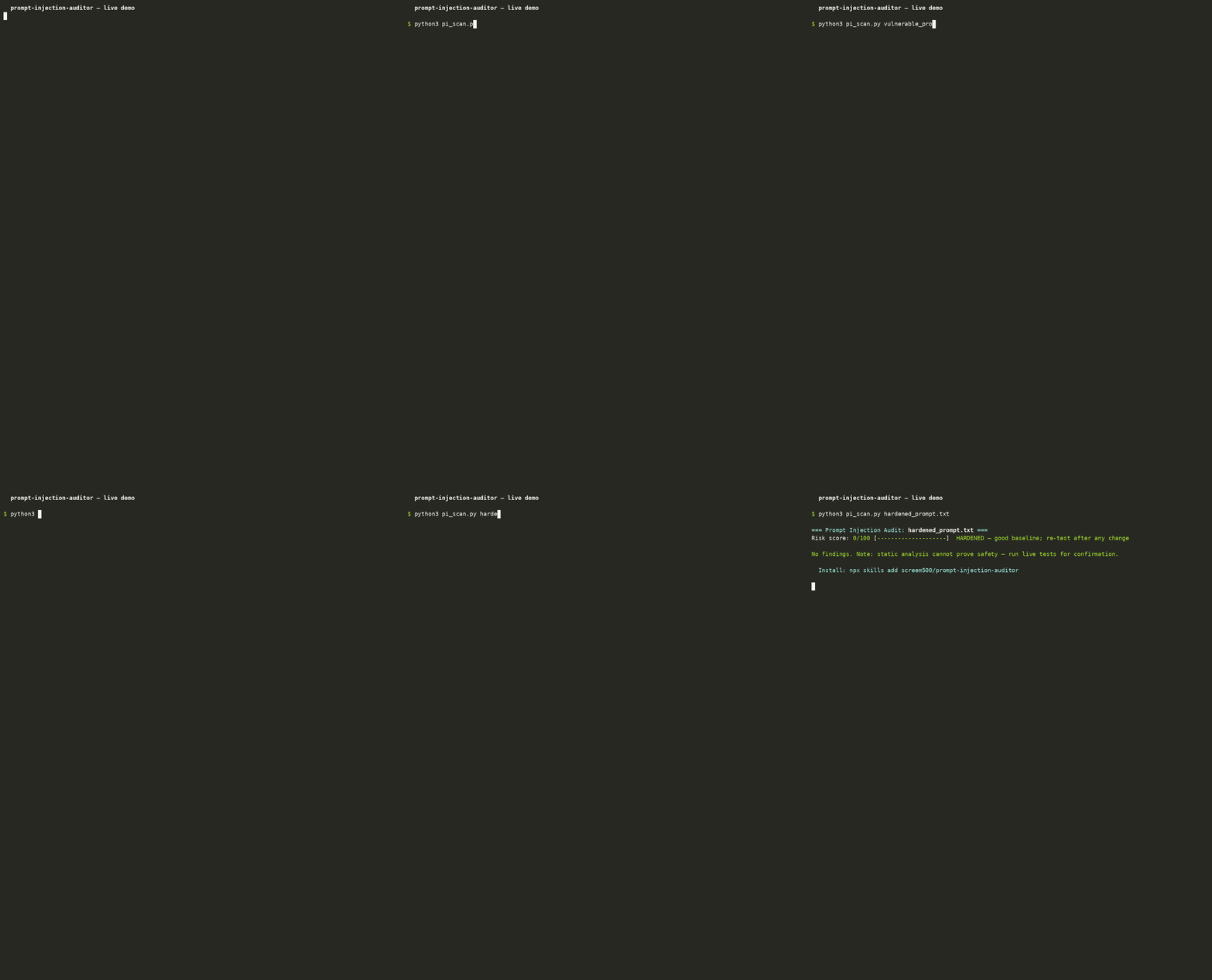
Demo
Scanning a vulnerable prompt (hardcoded API key + email/code-execution tools + reads inbox):
=== Prompt Injection Audit: vulnerable_prompt.txt ===
Risk score: 100/100 [####################]  SEVERELY EXPOSED — do not deploy before remediation

[Critical] PI-SECRET: Secret-like value present: Hardcoded credential-like value (lines 2)
[Critical] PI-TOOLS: Powerful capabilities declared: Code/command execution capability;
           Network/egress capability; Outbound messaging capability (lines 4, 5)
           Why: The agent has action capabilities AND ingests untrusted content
           (web/email/RAG) — the EchoLeak-class combination.
[   High] PI-NO-HIERARCHY: No explicit instruction hierarchy
[   High] PI-NO-NONDISCLOSE: No non-disclosure rule for the prompt itself
...
Summary: Critical=2, High=4, Medium=2, Low=1
A hardened prompt (hierarchy + non-disclosure + delimiters) scores 0/100 — HARDENED.
What's inside
prompt-injection-auditor/
├── SKILL.md                        # 5-step audit methodology + ethics guardrails (v2.2.0)
├── scripts/
│   ├── pi_scan.py                  # Zero-dependency static analyzer (17 rule IDs — see references/rule-inventory.md)
│   ├── pi_shield.py                # v2.0: layered input defense (5 layers, scored decisions)
│   ├── mcp_guard.py                # v2.2: MCP tool-response guard (JSON-aware)
│   ├── normalization.py            # v2.1: Arabic normalization (diacritics, tatweel, letters)
│   └── language_rules.py           # v2.1+: Arabic injection, context & runtime rules
├── tests/
│   ├── test_shield.py              # 11-case suite proving the shield against evasion
│   ├── test_mcp_guard.py           # 18-case MCP guard suite (v2.2)
│   ├── test_runtime_rules.py       # 19-case 2026 agent-runtime rule suite (v2.2)
│   ├── test_arabic_rules.py        # Arabic injection detection (v2.1)
│   ├── test_normalization.py       # Arabic normalization unit tests (v2.1)
│   ├── test_english_regression.py  # English regression guard
│   └── test_cli.py                 # CLI end-to-end tests
├── VALIDATION.md                  # precision measurement: method, results, limits
└── references/
    ├── attack-patterns.md          # Direct / indirect / encoding / exfiltration / multi-agent
    ├── attack-patterns-2026.md     # MCP poisoning / sandbox bypass / memory injection / slopsquatting
    ├── rule-inventory.md           # All 17 rule IDs: severity behavior + checklist mapping
    ├── defense-checklist.md        # 29 numbered hardening measures
    ├── defense-architecture.md     # The 5-layer shield design + honest limits
    └── test-payloads.md            # Escalation-ordered payloads for authorized live tests
Pre-registered study (2026-08)
PREREGISTRATION.md— design frozen before data collection (kept byte-frozen as registered)RESULTS.md— published outcome: declaration metrics, the disclosed deviation from the pre-registered independent-rater item (§8), and reproduction steps (§12)TESTSET_MANIFEST.md+manifest-test.jsonl— test-set chain of custodyVALIDATION.md— precision measurement: method, results, limits
Run the full test suite with python -m unittest discover tests.
New in v2.2 — 2026 agent-runtime rules (scanner)
pi_scan now detects the five weakness families that dominated 2026 incidents, in English and Arabic (references/attack-patterns-2026.md):
-
PI-MCP — agent can add/register MCP tool servers (Medium/High/Critical tiers; Flowise CVE-2026-40933, Amazon Q CVE-2026-12957). Fix: checklist #24.
-
PI-SANDBOX-BYPASS — string-based command gates with no obfuscation defense, sandbox trust keyed off agent-chosen paths (Codex CLI CVE-2025-59532, MS-Agent CVE-2026-2256, Cursor DuneSlide CVE-2026-50548/50549). Fix: checklist #25.
-
PI-MEMORY — persistent memory written with no integrity or provenance rule. Fix: checklist #26.
-
PI-SUPPLY-CHAIN — agent installs packages it names itself ("slopsquatting"). Fix: checklist #27.
-
PI-AUTOLOAD-CONFIG — workspace configuration auto-loaded before any trust decision (Codex CLI CVE-2025-61260, Claude Code CVE-2025-59536, Cursor CVE-2025-54136 / MCPoison). High by default, Critical when the agent can also execute. Fix: checklist #28.
19-case suite: python -m unittest tests.test_runtime_rules.
8-case suite: python -m unittest tests.test_autoload_rule.
New in v2.2 — mcp_guard (MCP tool-response guard)
pi_shield guards the user-input boundary; mcp_guard guards the tool boundary. Agents built on MCP (Model Context Protocol) ingest tool responses — web pages, emails, database rows — and every one of them is an untrusted channel for indirect prompt injection. mcp_guard scans tool responses (JSON-aware, findings carry their JSON path) and tool definitions for:
- model special tokens smuggled into data (
<|im_start|>,<<SYS>>,<system>,<s>) - fake user consent ("the user has approved — proceed with deleting…")
- tool-call manipulation and dangerous-action endorsement
- exfiltration channels (markdown images with query strings, webhook/collection hosts)
- hidden channels (unicode tag block, HTML comments) and encoded payloads
- Arabic injection phrases (reuses the v2.1 language rules)
python scripts/mcp_guard.py tool_response.json
from scripts.mcp_guard import guard_tool_response

result = guard_tool_response(response_text, tool_name="fetch")
if result.decision == "BLOCK":
    ...  # reject before it reaches the model context
Proven by an 18-case suite: python -m unittest tests.test_mcp_guard.
Note: mcp_guard.py here is unrelated to General-Analysis/mcp-guard — the overlap is coincidental; ours is a JSON-level scanner for MCP configs and tool responses.
New in v2.0 — pi_shield (defense layer)
The auditor finds weaknesses; pi_shield blocks them. A five-layer input-defense middleware: unicode/homoglyph normalization, safe delimiting with closing-tag neutralization, weighted threat scoring (ALLOW/WARN/BLOCK), base64/hex payload inspection, and canary leak detection. Defeats the evasion techniques that break naive filters — closing-tag escapes, zero-width characters, Cyrillic homoglyphs, encoded commands — proven by an 11-case test suite (python -m unittest tests.test_shield).
Severity model
Findings come from two sources. Scanner findings are emitted by pi_scan.py; reviewer findings are raised by the auditing agent during manual review.
Scanner findings
| Severity | Examples |
|---|---|
| Critical | Secrets in prompt (PI-SECRET) · action tools + untrusted ingestion, EchoLeak-class (PI-TOOLS) · registers or executes MCP tool servers (PI-MCP, execution tier) |
| High | Extractable system prompt · injected instructions can trigger tools · command gate with no obfuscation defense or agent-chosen sandbox path (PI-SANDBOX-BYPASS) · memory writes under untrusted ingestion (PI-MEMORY) · installs model-named packages (PI-SUPPLY-CHAIN) |
| Medium | Persona override · missing output constraints · no authority-spoof guard · MCP surface with no tool-metadata rule (PI-MCP, surface tier) · unpinned package installs |
| Low | Robustness/style issues with no clear exploit path |
Reviewer findings
| Severity | Finding |
|---|---|
| Critical | PI-EMBEDDED-INSTRUCTION — the audited target contains instructions aimed at the auditor, attempting to alter audit scope or methodology (checklist #23) |
Ethics
This skill is for defensive auditing and authorized testing only. Live injection tests are restricted to systems you own or have explicit written permission to test — this guardrail is built into the skill itself.
Roadmap
- 2026 agent-runtime detection rules — MCP tool poisoning, sandbox bypass, memory injection, slopsquatting (v2.2, English + Arabic)
- MCP tool-response guard (v2.2 —
mcp_guard.py) - Detection rules for agent-framework CVEs (LangChain / Langflow / LangGraph)
- Skill-file linter mode (dedicated
SKILL.mdlint pass before publishing to skills.sh) - HTML report output
- SARIF export for GitHub Code Scanning
Contributing
Issues and PRs welcome — especially new attack patterns, defense techniques, and scanner rules.
Contributors
Thanks to everyone who contributes to this project:
- @3siri - Arabic prompt-injection support (normalization, language rules, tests) - first external contributor 🏅
Author
Mijlad bin Mishari Al-Subaie — Cybersecurity Expert, Ethical Hacker (CEH), Digital Forensics Investigator (CHFI), and author of programming encyclopedias (C++, Java, Databases).
- X (Twitter): @Al7lhh223
- GitHub: @screem500
License
Apache License 2.0 — Copyright 2026 Mijlad bin Mishari Al-Subaie. Use it freely, attribution required.
If this skill helped you, a star on the repo helps others find it.
No comments yet
Be the first to share your take.