








Write what your AI agent should do, in English. Playbooks compiles it and runs it.
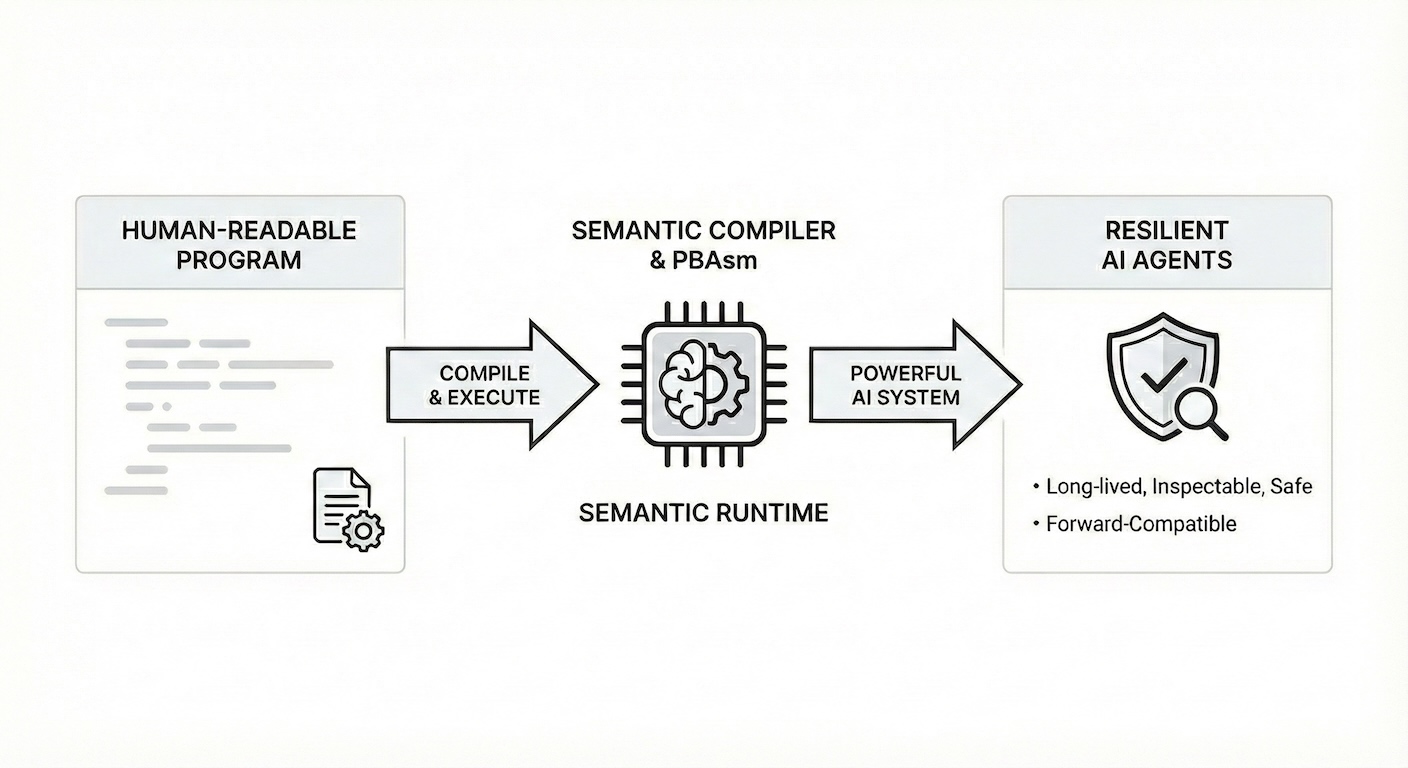
Playbooks programs are markdown. The compiler turns them into a semantic instruction set, and the runtime executes it on an LLM with a real call stack, step debugging, and control flow you can actually verify. Natural language and Python run side by side in the same program.
Hello world
Save this as hello.pb:
# Hello world
This is a hello world demo for the playbooks system

## Hello world demo
This playbooks demo prints a hello playbooks message

### Triggers
- At the beginning

### Steps
- Greet the user with a hello playbooks message
- Tell the user that this is a demo for the playbooks system
- Say goodbye to the user
- End program
Run it:
playbooks run hello.pb
That is a complete program, not pseudocode. # declares an agent, ## declares a playbook, and a playbook runs when its trigger fires.
Natural language and Python, same call stack
Playbooks get interesting when the two kinds of code call each other. Below, the Main playbook (English) calls process_countries (Python), which calls GetCountryFact (English) once per country. All three share one call stack and one set of variables.
# Country facts agent
This agent prints interesting facts about nearby countries

## Main
### Triggers
- At the beginning
### Steps
- Ask user what $country they are from
- If user did not provide a country, engage in a conversation and gently nudge them to provide a country
- List 5 $countries near $country
- Tell the user the nearby $countries
- Inform the user that you will now tell them some interesting facts about each of the countries
- process_countries($countries)
- End program

```python
from typing import List

@playbook
async def process_countries(countries: List[str]):
    for country in countries:
        # Calls the natural language playbook 'GetCountryFact' for each country
        fact = await GetCountryFact(country)
        await Say("user", f"{country}: {fact}")
```

## GetCountryFact($country)
### Steps
- Return an unusual historical fact about $country
Twenty-nine lines. The equivalent agent in a traditional framework runs 272 lines.
Notice what is not in the program: no orchestration graph, no state machine, no retry logic, no output parsers. If the user answers the country question with a joke, you do not write a branch for it. The LLM handles it and execution continues at the next step.
Get started in 10 minutes
You will need Python 3.12+ and an Anthropic API key.
Install
pip install playbooks
Set your API key
export ANTHROPIC_API_KEY=your-anthropic-api-key
You can also put it in a .env file. See .env.example for the other supported providers.
Run a program
playbooks run hello.pb
Add -v to print the session log, or --snoop=true to watch messages pass between agents.
Try the playground
playbooks playground
The playground gives you a browser interface for running programs, reading execution logs, and iterating quickly.
Step through it in VSCode
Install the Playbooks Language Support extension:
- Open Extensions (Ctrl+Shift+X / Cmd+Shift+X)
- Search for "Playbooks Language Support"
- Click Install
Now open a .pb file and set a breakpoint on an English step. You get breakpoints, a call stack, and variable inspection on a natural language program, the same way you would debug Python.
Why Playbooks?
You describe behavior, not mechanics. Say what the agent should do. The runtime handles sequencing, context, and recovery.
Edge cases do not need code. The LLM deals with the unexpected conversation turn instead of you writing a branch for it.
Anyone can read the program. The person who owns the process can read the actual logic that runs and tell you it is wrong. There is no separate spec that drifts from the implementation.
Execution is verifiable. Playbooks does not hope the LLM follows your instructions. It compiles them, executes them against a call stack, and logs what happened.
Context does not grow forever. When a playbook returns, its execution trace collapses into its return value. The caller sees the result, not the transcript.
Bigger abstractions are built in. Multi-agent meetings, event-driven triggers, agents as classes with real methods and state, and time and waiting as first-class primitives.
What is Software 3.0?
Software 1.0 is code you write. Software 2.0 is weights you train. Software 3.0 is the program written in human language and executed directly by a model acting as a semantic CPU.
Playbooks is a bet on the third one: that the specification should be the program, and that the same program should get better as models get better, without you rewriting the orchestration around it.
Documentation
Visit the documentation for guides, tutorials, and reference material.
Changelog
See CHANGELOG.md for the latest updates.
License
This project is licensed under the MIT License - see the LICENSE file for details.
Contributors
We welcome contributions! Please see CONTRIBUTING.md for details.
No comments yet
Be the first to share your take.