
 PET-P
PET-P
中文 | English

Python RPA toolkit with 80+ processors orchestrating browser automation, AI/LLM (10 providers), databases, SSH, email, and HTTP tasks. Configurable pipelines with cron scheduling and loops. Runs as wxPython GUI, headless service, or Docker container. Built-in MCP Tool Server (Streamable-HTTP) for AI agent integration.
Pipeline  1:n  Execution
Execution 1:n  Task
Task      1:1  Processor
Links: Web Intro | Web App | Changelog
Quick Start
1. Install Python 3.14
Download from python.org. On Windows, check "Add Python to PATH".
2. Install wxPython (GUI only)
The stable release (4.2.x on PyPI) does not support Python 3.14. Download a 4.3.0-alpha .whl from wxpython.org/Phoenix/snapshot-builds matching your platform:
# macOS Apple Silicon
uv pip install wxPython-4.3.0a1XXXX-cp314-cp314-macosx_11_0_arm64.whl

# Windows 64-bit
uv pip install wxPython-4.3.0a1XXXX-cp314-cp314-win_amd64.whl
Or auto-download via PETP (no wxPython needed):
python PETP_background.py --run-execution OOTB_DOWNLOAD_LATEST_WXPYTHON_mac_arm
For Python 3.12/3.13: pip install wxPython
3. Install Dependencies
pip install -U uv
uv pip install -r requirements.txt        # Full (GUI)
# or: uv pip install -r requirements-nogui.txt   # Headless
# or: uv pip install -r requirements-docker.txt  # Docker
uv pip install -r requirements/core.txt -r requirements/ssh-sftp.txt -r requirements/http-client.txt
See requirements/ directory for all available groups: ai-deepseek.txt, ai-gemini.txt, ai-ollama.txt, database.txt, excel-data.txt, mcp.txt, ocr.txt, web-automation.txt, etc.
4. Run
python PETP.py          # GUI
python PETP_background.py   # Headless service (port 8866)
Screenshots
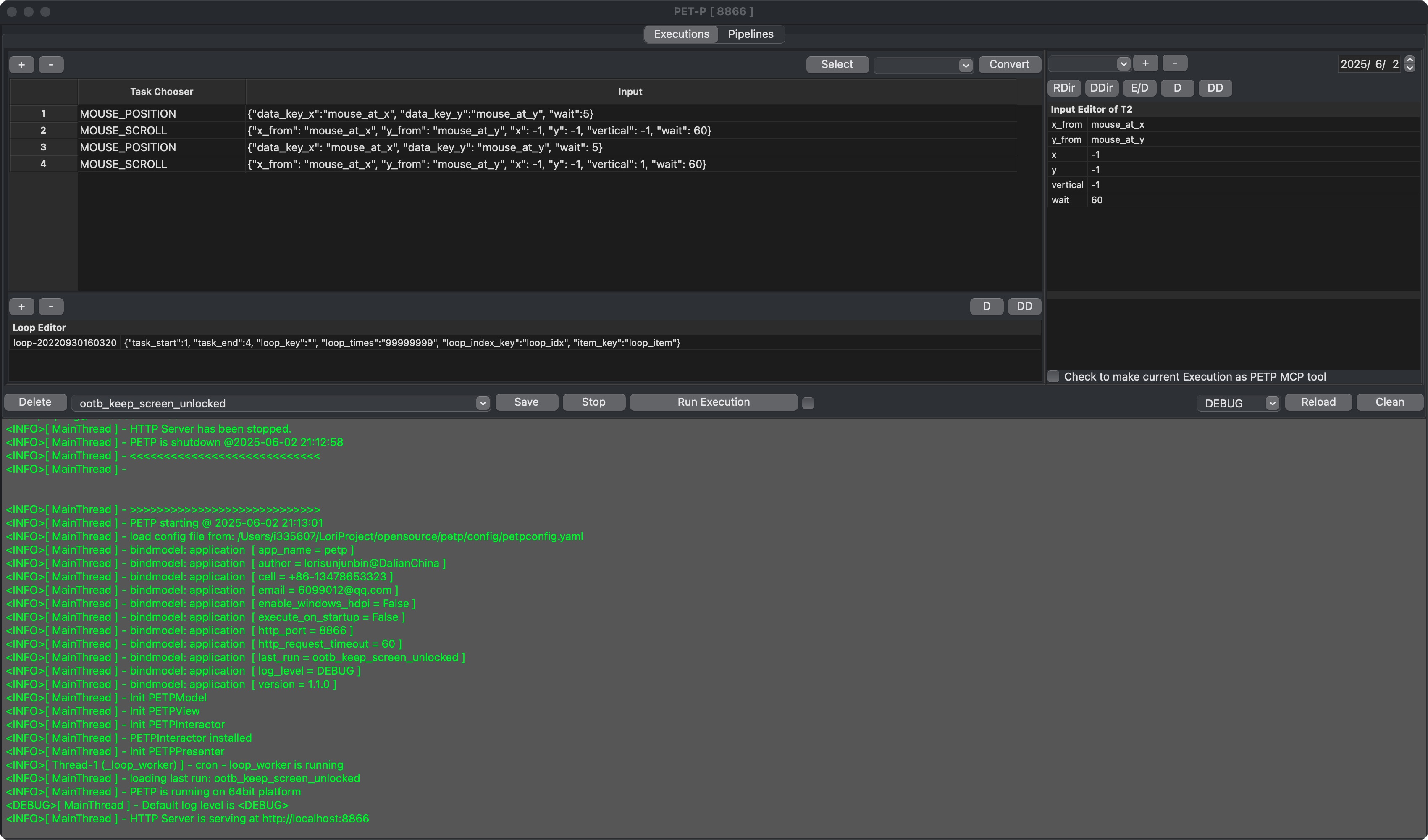
macOS
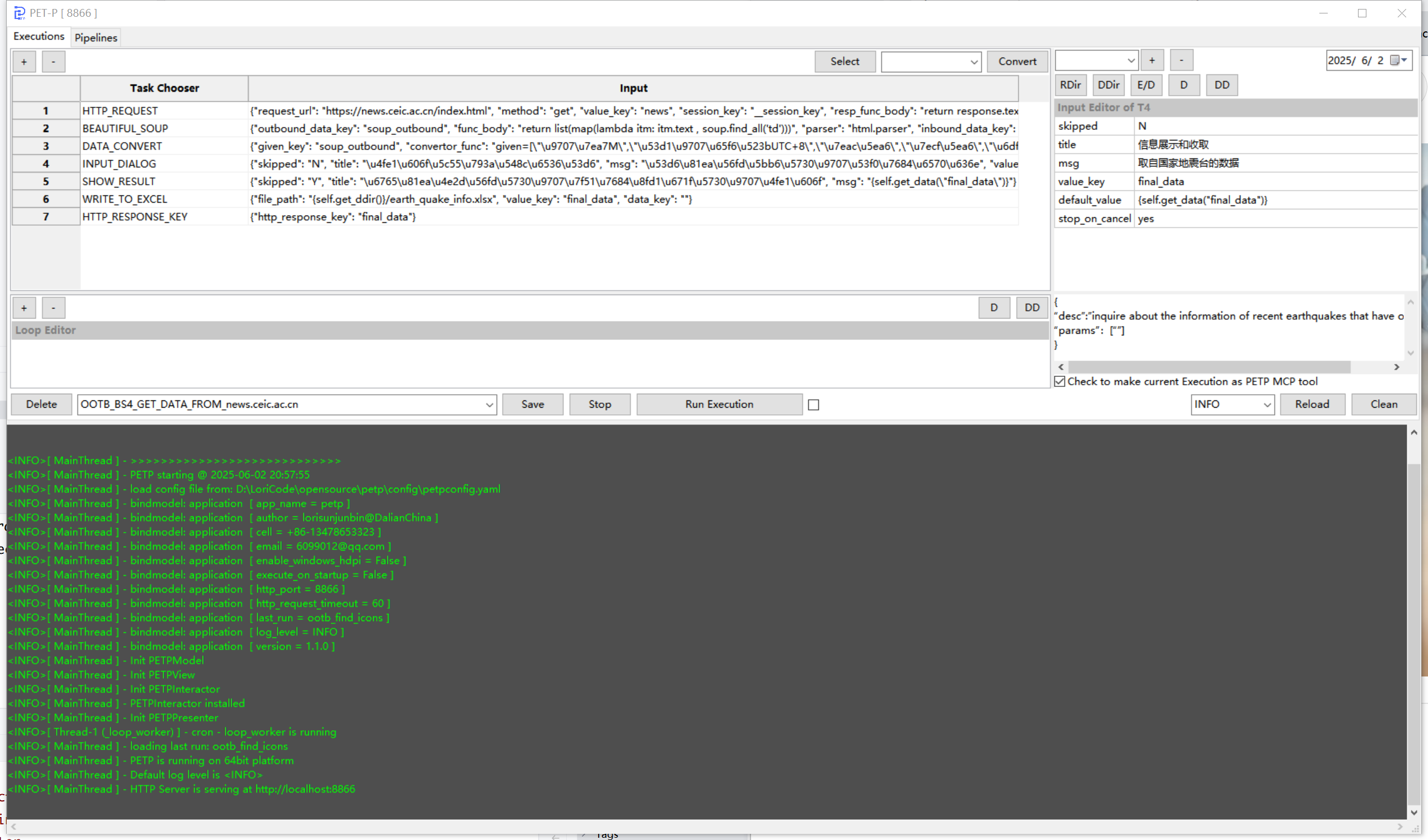
Windows
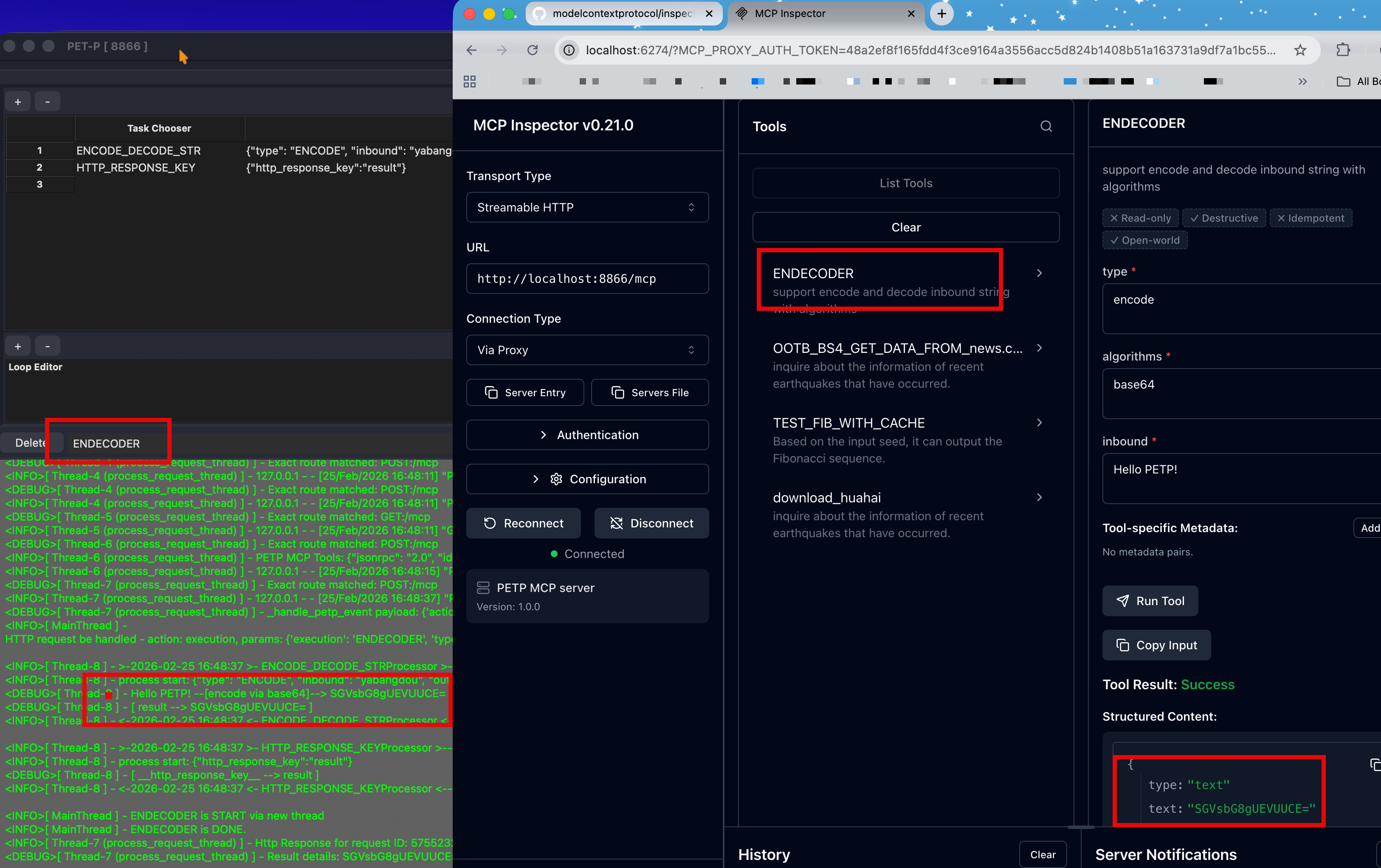
MCP Tool Server — integrate with Claude Code, Cursor, and other AI agents:
Features
| Category | Capabilities |
|---|---|
| Browser Automation (Selenium) | Navigate, click, key-in, collect, batch find, iFrame, cookies, screenshot. SAP Ariba Angular form controls: yes/no radio, cascading tree picker, single- & multi-select dropdowns, Material date picker. Chrome DevTools Recorder import. |
| SSH / SFTP (Paramiko) | SSH/SFTP sessions, remote commands, file upload/download. |
| File & Folder | Open, write, delete, read, find, watch & auto-move, ZIP/UNZIP. |
| Data & Spreadsheet | CSV/Excel read & write, collect, filter, group-by, mapping, masking, merge. Chinese almanac (CNLunar). |
| Database | MySQL, PostgreSQL, SAP HANA, SQLite — unified DB_ACCESS processor. |
| AI / LLM (10 providers) | DeepSeek, Gemini, Ollama, Zhipu, Anthropic, Qianfan, MiniMax, Doubao, Moonshot, OpenAI-compatible. Setup + Q&A + MCP tool calling. |
| AI Execution Generator | Natural language → task flow generation. Multi-turn chat, Processor browser, selective context, connection caching. |
| MCP | Standard MCP Tool Server (Streamable-HTTP). MCP client for all LLM providers. OOTB tools: weather query, daily almanac. |
| HTTP / Network | Configurable requests, response extraction, OAuth2/PKCE, Basic Auth, XSRF. |
| SMTP send (CC/BCC, HTML, attachments). IMAP receive (filter, attachment download). | |
| OCR & Captcha | Image text extraction (paddleocr/rapidocr/easyocr). Captcha solving (ddddocr). |
| Mouse & GUI (PyAutoGUI) | Click, scroll, position query. |
| Execution Control | Init params, nested execution, conditional stop/jump, IF_ELSE branching, loops, shell commands. |
| Portable Runtime | Self-contained, lightweight engine split out of PETP — runs a single Execution headless (incl. Selenium), decoupled from GUI/HTTP. Ideal for RPA: author & test in the GUI, run lightweight in portable/. cp -r into any Python project or cf push to Cloud Foundry; GUI-authored YAML runs unchanged. |
| Theme | 9 themes (System auto + 8 named) with live switching. |
🤖 AI Execution Generator
Highlight — Generate and modify PETP task flows through natural language conversation with LLM. Supports 10 LLM providers including Hyperspace, Anthropic, DeepSeek, Zhipu, Gemini, Ollama, and more.
Entry Points:
- Create Execution → "AI Generate" template
- Right-click taskGrid → "AI Assist" (modify existing) — pre-selects only the processors used in the current Execution to minimize token usage
- MCP Editor → "AI" button (auto-generate tool description)
Highlights:
- Multi-turn chat — ask questions, generate flows, modify tasks incrementally
- Processor browser — expandable TreeListCtrl with full documentation, search & filter
- Selective context — only checked Processors are sent to LLM (saves tokens)
- Connection caching — first-time validation, then instant reuse across sessions
- 10 LLM providers — minimal config: just set
ai_providerin petpconfig.yaml - 429 rate-limit defense — exponential backoff (2s / 4s / 8s), UI throttle ≥ 3s, per-call token accounting log
Token controls (new):
ai_max_response_tokens— hard upper bound on model output length (default 8192)ai_max_request_tokens— local pre-flight cap on request size (default 60000); over-limit prompts are rejected before hitting the provider
AI-Powered MCP Tool Publishing:
- One-click generation of
mcp_descJSON for exposing Executions as MCP tools - Auto-extracts input parameters from
INITIAL_PARAMSand output keys from result tasks - Generates AI-agent-friendly descriptions that help LLMs understand when to call the tool
- Smart merge — new fields are added without overwriting existing configuration
- Progress dialog with live status and preview before applying
AI Error Analysis & Auto-Fix:
- On execution failure, AI automatically analyzes the error with full context (failed task, surrounding tasks, traceback)
- Pinpoints root cause and suggests specific fixes
- One-click "Open AI Assist" pre-fills the diagnosis — continue fixing in multi-turn chat
Vision Model Support (Ollama):
AI_LLM_QANDAacceptsimage_pathparameter for multimodal prompts- Works with Ollama vision models (gemma4, llava, moondream, etc.)
- Image path supports expressions — dynamically reference files from previous tasks in
data_chain
Configuration (only ai_provider required, rest auto-fills from provider defaults):
application:
  ai_provider: zhipu              # or: deepseek, anthropic, hyperspace, gemini, ollama, etc.
  ai_model: ""                    # empty = provider default (e.g. GLM-5)
  ai_api_key: ""                  # empty = read from default env var (e.g. ZHIPU_ACCESS_KEY)
  ai_base_url: ""                 # empty = provider default URL
  ai_max_response_tokens: 8192
  ai_max_request_tokens: 60000
See Configuration Docs for full provider list and details.
Dynamic Function (_fn) & Expression Enhancements
All dynamic function parameters (_fn, _func, _func_body, lambda_*) receive the Processor instance as p, enabling full access to PETP utilities inside custom code:
# In _fn function body — p is the Processor instance
result = p.get_data("my_key")
p.populate_data("output", processed_value)
today = p.str_to_date("2026-05-11")
Available p methods in both expression and _fn contexts:
| Method | Description |
|---|---|
p.get_data(key) |
Read from data_chain |
p.get_deep_data([keys]) |
Nested data access |
p.get_data_chain() |
Get entire data_chain dict |
p.populate_data(k, v) |
Write to data_chain |
p.get_now_str() |
Current timestamp (YYYYMMDDHHmmss) |
p.get_now_in_str(fmt) |
Current time with custom format |
p.str_to_date(s, fmt) |
Parse date string to date object |
p.get_rdir() / p.get_ddir() / p.get_tdir() |
Resource/Download/Test directories |
p.expression2str(s) |
Evaluate f-string expression |
p.str2dict(s) / p.json2dict(s) |
String parsing utilities |
Edit Complex Value — Handy Tool button:
- Right-click any property → "Edit Complex Value" includes a Handy Tool button
- Automatically detects whether the parameter is an expression or
_fnfunction body - Expression context: snippets wrapped in
{p.xxx()}for f-string evaluation - Function body context: raw
p.xxx()calls plusimportstatements
Running Modes
| Mode | Command | GUI | Use Case |
|---|---|---|---|
| Desktop | python PETP.py |
Yes | Interactive development |
| Background | python PETP_background.py |
No | CLI, HTTP/MCP service |
| Docker | docker run -p 8866:8866 petp |
No | Server deployment |
| Portable | python portable/petp_run.py NAME |
No | Copy into another project / Cloud Foundry |
# Run one execution and exit
python PETP_background.py --run-execution ENDECODER --no-http

# Run execution with initial data
python PETP_background.py --run-execution MY_EXEC --init-data '{"key":"value"}' --no-http

# Run pipeline and exit
python PETP_background.py --run-pipeline DAILY_REPORT --no-http

# Run pipeline with initial data
python PETP_background.py --run-pipeline MY_PIPELINE --init-data '{"param":"value"}' --no-http

# Start HTTP/MCP service (default port 8866)
python PETP_background.py

# Custom port and auth token
python PETP_background.py --http-port 9090 --http-token my-secret-token

# Headless Selenium (Chrome without visible window)
python PETP_background.py --run-execution BROWSER_TASK --headless --no-http

# Override log level
python PETP_background.py --log-level DEBUG

# GUI-processor policy: skip (ignore) or abort (fail on GUI tasks)
python PETP_background.py --run-execution HAS_GUI_TASK --ui-policy skip --no-http
python PETP_background.py --run-execution HAS_GUI_TASK --ui-policy abort --no-http

# Stop a running background instance
python PETP_background.py --stop
| Argument | Default | Description |
|---|---|---|
--run-execution NAME |
— | Run execution on startup, then continue to HTTP or exit |
--run-pipeline NAME |
— | Run pipeline on startup (rejects if already running) |
--init-data JSON |
{} |
Inject JSON object into data_chain before run |
--no-http |
off | Exit after immediate job finishes (no HTTP server) |
--headless |
off | Headless Selenium browser (auto-enabled in Docker) |
--stop |
— | Stop running background instance (by PID) |
--http-port PORT |
8866 |
HTTP/MCP service port |
--http-token TOKEN |
from config | Bearer token for HTTP API auth |
--ui-policy {skip,abort} |
skip |
skip: silently skip GUI-only tasks; abort: fail execution |
--log-level LEVEL |
from config | DEBUG, INFO, WARNING, ERROR |
--nogui-enabled {true,false} |
true |
Set to false to disable background mode (exits immediately) |
Notes:
--run-executionand--run-pipelinecan be combined — both will run in sequence- Pipeline reentrant protection: if the same pipeline is already running, a second call returns
{"ok": false, "error": "Pipeline already running"} - Cron-enabled pipelines (
cronEnabled: truein YAML) auto-register as scheduled jobs instead of running immediately
Helper scripts for long-running sessions: see scripts/macos/start_petp.sh and scripts/windows/start_petp.ps1.
Portable Runtime
portable/ is a self-contained unit that runs a single Execution headlessly, decoupled from the GUI and HTTP layers. Copy portable/ into any Python project, or cf push it to Cloud Foundry.
from portable.petp_run import run
result = run("MY_EXECUTION", {"key": "value"})   # {"ok", "data", "error", "meta"}
Workflow: author the Execution in the desktop GUI → Ctrl+S → copy the YAML into portable/core/executions/ → python portable/petp_run.py NAME. The engine and YAML format are shared, so GUI-authored Executions run unchanged.
Chrome binaries (chrome-headless-shell + chromedriver, from Chrome for Testing) are placed under portable/webdriver/<system>/ and are not committed to git. On Cloud Foundry, manifest.yml + apt.yml (apt-buildpack) supply the required system .so libraries. See portable/README.md for full details.
MCP & AI Integration
PETP exposes executions as MCP tools via Streamable-HTTP on port 8866.
🔒 Auth is fail-closed. When
http_request_tokenis unset inpetpconfig.yaml, every protected endpoint (/petp/*,/mcp) returns501 Not Configured. Set a token before exposing the server (e.g. via Tailscale Funnel). Send it asAuthorization: Bearer <token>on every request.
🔒 Security hardening (Phase 2).
CMDprocessor: defaults toshlex.split(no shell). Setshell="yes"only for trusted commands needing pipes/redirects.- Dynamic
_fn/lambda_*parameters: run in a sandbox with__import__,open,eval,exec,compile,getattr,hasattrremoved. Whitelisted modules:re,json,datetime,math.- Encrypted password salt: override the public default by setting env
PETP_SALTor writing~/.petp/secret(POSIX mode0600). The default salt is logged with a WARNING —cryptocodeciphertext is not actually secret unless you set a custom salt.- Path traversal guard (opt-in): set
PETP_PATH_ALLOW_ROOTS=/path1:/path2to confine all file IO processors (READ_*,WRITE_*,OPEN_FILE,FILE_DELETE,UNZIP) to a whitelist of root directories. Default off — preserves existing yaml using absolute paths.- Request size limits: HTTP body capped at 4 MiB (
PETP_MAX_BODY_BYTES); JSON-RPC batch arrays capped at 64 items (PETP_MAX_BATCH_ITEMS). Both return413/400with no body parsing.- Log redaction (default on): values of sensitive keys (
api_key,password,token,authorization,secret, ...) are masked as***REDACTED***inprocess start/[Type] inputlog lines. Disable withPETP_LOG_REDACT=offfor ad-hoc debugging.
Performance (headless/Docker):
- Shared thread pool for concurrent tool calls (no per-request executor overhead)
- Static execution cache — zero filesystem I/O after startup (no stat/mtime checks)
- Processor class pre-loading on server start (eliminates cold-start latency)
- Real-time task-level SSE progress notifications during long-running
tools/call - Cached outputSchema parsing (same tool re-called without re-parsing mcp_desc JSON)
Built-in MCP Tools:
| Tool | Description | Input |
|---|---|---|
T_WEATHER_QUERY |
Query real-time weather (wttr.in) | city (e.g. "上海", "Tokyo") |
T_DAILY_ALMANAC |
Chinese almanac + holiday info (cnlunar + holiday-cn) | none (uses today) |
Claude Code / Cursor / any MCP client:
{
  "mcpServers": {
    "petp": {
      "type": "http",
      "url": "http://localhost:8866/mcp"
    }
  }
}
HTTP API (no MCP client needed):
# List tools
curl -H "Authorization: Bearer $TOKEN" http://localhost:8866/petp/tools

# Trigger execution
curl -X POST http://localhost:8866/petp/exec \
  -H "Authorization: Bearer $TOKEN" \
  -H "Content-Type: application/json" \
  -d '{"action":"execution","params":{"execution":"MY_EXEC"},"wait_for_result":"true"}'

# Trigger pipeline (sync)
curl -X POST http://localhost:8866/petp/exec \
  -H "Authorization: Bearer $TOKEN" \
  -H "Content-Type: application/json" \
  -d '{"action":"pipeline","params":{"pipeline":"MY_PIPELINE"},"wait_for_result":"true"}'

# Trigger pipeline (async — poll with /petp/result)
curl -X POST http://localhost:8866/petp/exec \
  -H "Authorization: Bearer $TOKEN" \
  -H "Content-Type: application/json" \
  -d '{"action":"pipeline","params":{"pipeline":"MY_PIPELINE"},"wait_for_result":"false"}'
| Endpoint | Description |
|---|---|
GET /health |
Health check |
GET,POST /mcp |
MCP Tool Server (Streamable-HTTP) |
GET /petp/tools |
List exposed tools |
POST /petp/exec |
Trigger execution or pipeline |
GET /petp/result?request_id=<id> |
Poll async result |
Build & Docker
# Standalone executable
python build/PETP_build.py   # → dist/PETP.app or dist/PETP.exe

# Docker — Background service (headless, port 8866)
./build/script/docker_build_bg.sh              # build + export tar
./build/script/docker_build_bg.sh --run        # build + start container
./build/script/docker_build_bg.sh --no-tar     # build only
./build/script/docker_build_bg.sh --push repo:tag  # push to registry
./build/script/docker_build_bg.sh --dirty      # use working dir (skip git archive)

# Docker — Web App (port 5555)
./build/script/docker_build_webapp.sh          # build + export tar
./build/script/docker_build_webapp.sh --run    # build + start container
./build/script/docker_build_webapp.sh --dirty  # use working dir (skip git archive)
Note: Build scripts default to
git archivemode — only git-tracked and staged files are included in the Docker context. Use--dirtyto include all working directory files (relies on.dockerignore).
Deploy to NAS
# Deploy BG image (scp + docker load + start container)
./build/script/deploy_bg_to_nas.sh
./build/script/deploy_bg_to_nas.sh --no-start   # only transfer + load
./build/script/deploy_bg_to_nas.sh --keep-tar   # don't delete remote tar

# Deploy Webapp image
./build/script/deploy_webapp_to_nas.sh

# Override NAS connection / port mapping
NAS_HOST=10.0.0.5 NAS_USER=myuser HOST_PORT=9090 ./build/script/deploy_webapp_to_nas.sh
| Environment Variable | Default | Description |
|---|---|---|
NAS_HOST |
192.168.1.100 |
NAS IP or hostname |
NAS_USER |
admin |
SSH username |
NAS_PORT |
22 |
SSH port |
NAS_DOCKER_DIR |
/tmp |
Remote temp dir for tar |
HOST_PORT |
8866 (BG) / 8088 (Webapp) |
Host port mapping |
Tailscale Funnel (run on NAS)
# Refresh funnel routes (reset + reconfigure)
sudo ./build/script/tailscale_funnel_refresh.sh

# Check current status only
./build/script/tailscale_funnel_refresh.sh --status
Routes configured:
/→localhost:8088(webapp)/mcp→localhost:8866(petp background)
Project Structure
| Directory | Description |
|---|---|
core/executions/ |
YAML execution definitions |
core/processors/ |
80+ processor implementations (one .py per task type) |
core/pipelines/ |
YAML pipeline definitions |
core/runtime/ |
Background runtime logic |
httpservice/ |
HTTP server & MCP handler |
mvp/ |
GUI layer (Model-View-Presenter, wxPython) |
config/ |
Runtime configuration (petpconfig.yaml) |
docs/ |
Detailed guides (EN / 中文) |
webapp/ |
Flask web app (docs) |
scripts/ |
macOS & Windows launcher scripts |
requirements/ |
Modular dependency groups |
build/ |
PyInstaller & Docker build scripts |
tools/ |
Maintenance scripts (migration, sync) |
testcoverage/ |
Tests and smoke scripts (incl. petp_http_endpoints.http for HTTP/MCP endpoint testing) |
Troubleshooting
| Problem | Solution |
|---|---|
ModuleNotFoundError |
Install the corresponding requirements/*.txt group |
| wxPython import error | Ensure .whl matches Python version — see snapshot builds |
| ChromeDriver mismatch | Download from Chrome for Testing |
| Port 8866 in use | Change http_port in config/petpconfig.yaml |
Documentation
| Guide | Description |
|---|---|
| Screenshots & Visual Tour | All platform screenshots with context |
| Running Modes & Scripts | Background mode, Docker, helper scripts, env vars |
| Dependencies | Modular groups, custom install, lock files |
| Configuration Reference | Config keys, CLI arguments, runtime result format |
| MCP & HTTP API | Full API reference, MCP inspector, tool schema |
| Pipeline & Cron | Cron scheduling, YAML format, examples |
| Parameter Migration | Rename guide for pre-2026-05 users |
No comments yet
Be the first to share your take.