
omnireach
English · 中文
Your agent reads Twitter. It still can't read WeChat. omnireach fixes that.
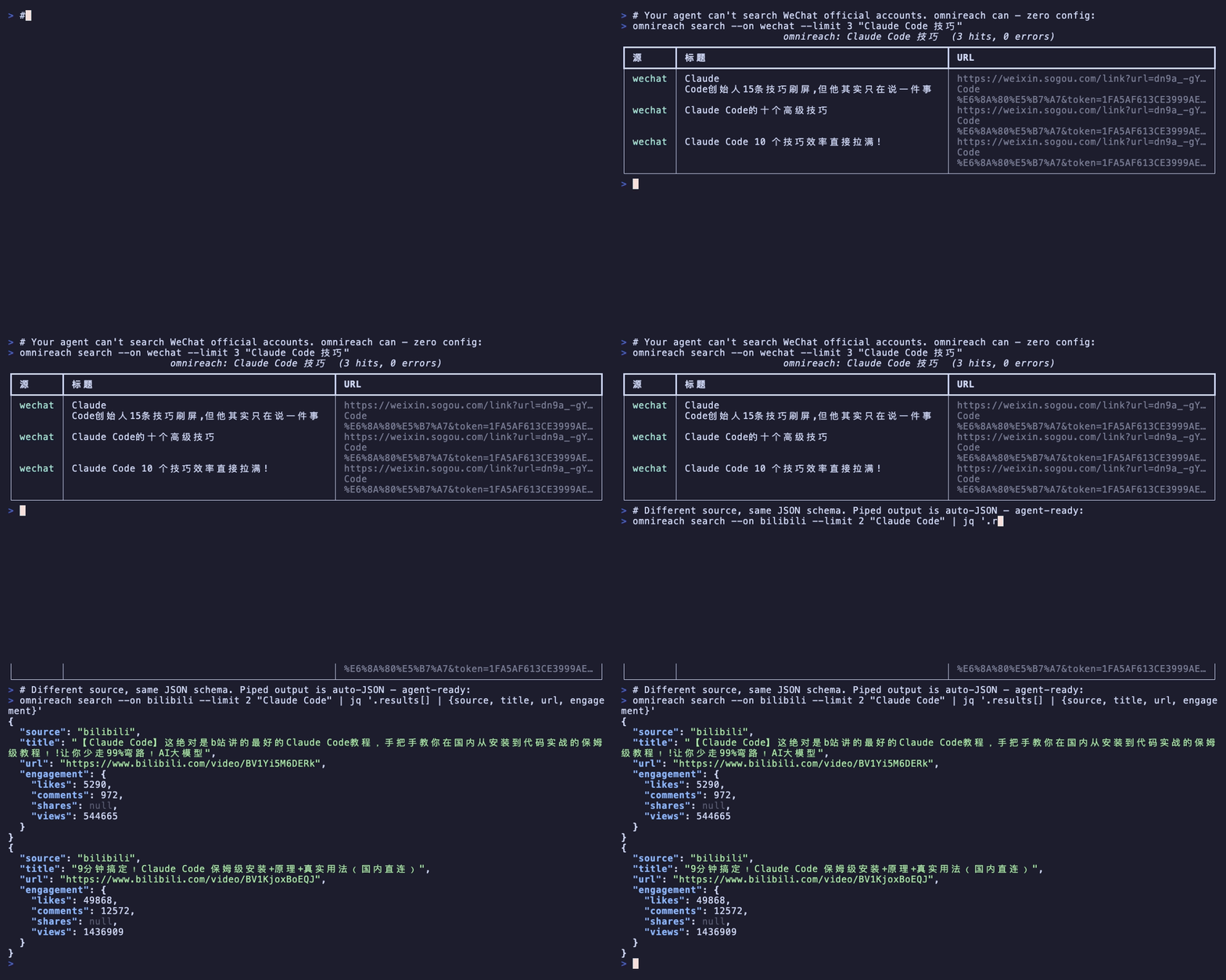
omnireach searches Google and the login-walled Chinese internet — 微信公众号 · 小红书 · 抖音 · B站 · TikTok — plus Twitter, Reddit, HN, YouTube and more. omnireach search returns normalized results, omnireach fetch returns clean Markdown, and omnireach media turns videos into bounded metadata and transcript artifacts. WeChat search works with zero config — no key, no login:
omnireach search --on wechat "Claude Code 技巧" # works 60 seconds after install
Installed as a Claude Code skill, so your agent just knows how to use it next session. No LLM inside, no per-call scraping fees — the heavy sources reuse your own browser session.
MCP before Playwright
For search, reading, media parsing, and bounded Douyin downloads, start with the four focused MCP tools instead of browser automation.
Ordinary page fetches never start Chrome. Google, Reddit, Twitter, Xiaohongshu, TikTok,
and Douyin search now use Omnireach's own small, read-only Chrome bridge first, with
OpenCLI retained as a compatibility fallback. Browser-backed calls use temporary background
tabs that close after the call, and quick mode remains browser-free. Keep Playwright for
clicks, forms, unsupported file transfer, screenshots, and visual assertions.
| Same RFC 9110 read | omnireach MCP | Playwright + headless system Chrome |
|---|---|---|
| Cold process, median of 5 | 1383.86 ms | 3749.26 ms |
| Warm runtime, median of 5 | 1311.46 ms | 1687.94 ms |
On the recorded machine, Playwright took 2.7x as long on the cold path and 1.3x as long with both runtimes warm. See the method and limitations or inspect every raw sample.



Install — just tell your agent
"Install omnireach"
Your agent runs one command. You copy nothing.
Manual fallback — paste into your terminal if you prefer:
curl -fsSL https://raw.githubusercontent.com/Daily-AC/omnireach/main/install.sh | sh
Also on PyPI: uv tool install omnireach or pip install omnireach (CLI only — the one-liner above additionally registers the Claude Code skill). Try without installing: uvx omnireach search "vibe coding".
This installs the CLI and registers the Claude Code skill (auto-discovered next session). Zero-config sources — HackerNews, RSS, 微信 (Sogou path), B站 — work immediately. Other sources open up after a one-time setup step each.
Installing the repository as a Claude Code plugin also registers the bundled MCP server. The standalone installer keeps the CLI fallback available even when the client has not loaded plugin MCP configuration.
What you get
1. Reach the unreachable. Twitter, Reddit, 小红书, 微信公众号, 抖音, B站, TikTok — login-walled vertical platforms that no agent web search reaches. omnireach reads them through your own logged-in browser session. Its native Chrome bridge handles all six browser-backed search sources, with OpenCLI retained as a compatibility fallback.
2. Stable agent contracts.
omnireach search returns normalized results, omnireach fetch returns clean Markdown, and omnireach media returns a MediaEnvelope with bounded previews plus absolute artifact paths. Long transcripts stay in local files instead of flooding model context.
3. Works even when WebSearch doesn't. On proxy / relay-station / Bedrock / Vertex-Claude-3.x setups where the built-in WebSearch server tool isn't available, omnireach gives search back — it runs entirely on the client side, bypassing both gate layers.
Agent fast path — MCP before Playwright
The plugin exposes four model-controlled tools:
omnireach_searchfor web research and platform searchomnireach_fetchfor reading an HTTP or HTTPS URL as Markdownomnireach_parse_mediafor YouTube, Bilibili, and direct-media metadata or transcriptsomnireach_download_mediafor bounded Douyin MP4 downloads with verified local artifacts
All tools are served by the dependency-free stdio command:
omnireach mcp
For MCP clients that do not load the plugin, register it with:
{
  "mcpServers": {
    "omnireach": {
      "command": "omnireach",
      "args": ["mcp"]
    }
  }
}
Use these tools before Playwright for read-only work. Ordinary page fetches do not start Chrome. Login-backed adapters may use the user's existing Chrome session through a hidden, ephemeral tab that is released after the call. Keep Playwright for clicks, forms, uploads, downloads, screenshots, visual assertions, and unsupported interactive workflows.
How is this different from Agent-Reach?
Agent-Reach (51k★) created this category and is excellent at what it does. omnireach makes different trade-offs — these are date-stamped facts, not marketing:
| omnireach | Agent-Reach (v1.5.0, as of 2026-07) | |
|---|---|---|
| 微信公众号 WeChat | ✅ zero-config search (Sogou path) + full-text fetch via your logged-in Chrome | ❌ removed 2026-06 (PR #347) after anti-bot breakage |
| 抖音 Douyin | ✅ search via logged-in Chrome + bounded MP4 download | ❌ removed 2026-06 (upstream tool archived) |
| TikTok | ✅ search | ❌ not supported |
| Output contract | one pydantic JSON schema across all 17 sources; auto-JSON when piped | no wrapper layer by design — each upstream tool's own format (YAML / plain text / subtitle files / raw JSON) |
search / fetch commands |
built-in: omnireach search, omnireach fetch <url> with host-aware routing |
no search/read commands — routes your agent to call upstream tools directly |
| Facebook · Instagram · LinkedIn · 雪球 · podcast transcription | ❌ | ✅ |
| Community | early — you found us before the crowd | 51k★, 30 contributors |
Pick Agent-Reach if you need Facebook/LinkedIn/transcription. Pick omnireach if you need the Chinese internet — WeChat above all — a machine-stable JSON contract, or a single fetch entrypoint. Both MIT; they compose fine in one agent.
Example
# Search a login-walled vertical platform
omnireach search --on xiaohongshu --json "Claude Code 使用技巧"

# Fetch a WeChat article — login-walled, via your session
omnireach fetch --json "https://mp.weixin.qq.com/s/<token>"

# Parse captions without downloading the full YouTube video
omnireach media parse --language en --json "https://www.youtube.com/watch?v=<id>"

# Bilibili captions can require an explicitly selected logged-in Chrome profile
omnireach media parse --cookies-from-browser "chrome:Profile 1" \
  --language zh-Hans --json "https://www.bilibili.com/video/<BV-id>"

# Douyin currently requires fresh browser cookies; output includes path, bytes, and SHA-256
omnireach media download --cookies-from-browser "chrome:Profile 1" \
  --max-size-mb 500 --json "https://www.douyin.com/video/<id>"

# Full pipeline: search → fetch all results
omnireach search --on wechat --json "claude 4.7" \
  | jq -r '.results[].url' \
  | xargs -I{} omnireach fetch --json {}
Commands
| Command | What it does |
|---|---|
omnireach search "<query>" |
Search; a connected native bridge or OpenCLI automatically adds Google + Twitter |
omnireach search --on twitter,reddit "..." |
Target specific sources |
omnireach search --sources twitter,reddit "..." |
Alias for --on, matching the MCP argument name |
omnireach search --profile <name> "..." |
Select an OpenCLI Browser Bridge profile for this search |
omnireach search --timeout 90 "..." |
Override every source timeout; browser-backed heavy sources default to 60 seconds |
omnireach search --mode quick "..." |
Quick mode — HN only, no browser-backed sources |
omnireach search --mode deep "..." |
Deep mode — all ready sources |
omnireach search --json "..." |
Explicit JSON output |
omnireach fetch <url> |
URL → full markdown — mp.weixin.qq.com uses OpenCLI logged-in Chrome; other hosts use built-in HTTP → Jina fallback |
omnireach fetch <url> --backend http |
Force the built-in browserless HTTP extractor |
omnireach fetch <url> --backend jina |
Force Jina Reader SaaS (zero local deps) |
omnireach fetch <url> --backend crwl |
Explicitly opt into local Crawl4AI |
omnireach fetch <url> --backend opencli |
Force OpenCLI wechat logged-in path (v0.10.1+) |
omnireach media inspect <url> |
Inspect normalized metadata and subtitle tracks without writing files |
omnireach media parse <url> --language en |
Materialize metadata, selected captions, transcript JSON/Markdown, and a manifest |
omnireach media parse <media-url> --subtitle-url <vtt> |
Parse a direct audio/video URL with a sidecar VTT/SRT/JSON3 subtitle |
omnireach media parse <url> --cookies-from-browser "chrome:Profile 1" |
Explicitly reuse that browser profile when Bilibili captions require login |
omnireach media parse <url> --no-cache --max-duration 3600 |
Bypass verified artifact reuse and reject media longer than one hour |
omnireach media download <douyin-url> --cookies-from-browser "chrome:Profile 1" |
Download a bounded H.264 MP4 by default and return a hash-verified local artifact |
omnireach media download <douyin-url> --quality small --max-size-mb 100 |
Prefer the smallest combined MP4 and reject formats over 100 MiB |
omnireach mcp |
Serve search, fetch, media parsing, and bounded Douyin download over MCP stdio |
omnireach init |
Write default ~/.omnireach/preferences.toml |
omnireach sources |
List all sources + tier status |
omnireach setup <source> |
Guided setup for a 🟡 / 🔴 source |
omnireach bridge install |
Install/update the Omnireach native Chrome extension assets |
omnireach bridge path |
Print the stable unpacked-extension directory |
omnireach bridge status --json |
Ping the installed extension through the authenticated localhost bridge |
omnireach agy configure <conversation-id> |
Configure the experimental agy grounded-search backend |
omnireach agy status --json |
Check the configured agy conversation and AgentAPI endpoint |
omnireach doctor |
Health check (sources / fetch / media / wechat backends) |
See the real Douyin download verification for the upstream format shape, authenticated download, cache, size-limit, privacy, and MCP evidence.
Sources
| Source | Tier | Dependency | Notes |
|---|---|---|---|
| hackernews | ✅ ready | none | Direct Algolia, zero-config |
| youtube | ✅ ready | yt-dlp (pip install) |
omnireach setup youtube |
| github | ✅ ready | gh CLI + gh auth login |
omnireach setup github |
| rss | ✅ ready | built-in feedparser | query must be a URL |
| 🔴 heavy | Omnireach native Chrome bridge; OpenCLI fallback | Automatically included when either transport is available; background tab | |
| 🔴 heavy | Omnireach native Chrome bridge; OpenCLI fallback | Public search works logged out; Chrome login is inherited when present | |
| 🔴 heavy | Omnireach native Chrome bridge; OpenCLI fallback | Automatically included when either transport is available; inherits Chrome login | |
| xiaohongshu | 🔴 heavy | Omnireach native Chrome bridge; OpenCLI fallback | Inherits the current Chrome login |
| tiktok | 🔴 heavy | Omnireach native Chrome bridge; OpenCLI fallback | TikTok international; real DOM result extraction |
| douyin | 🔴 heavy | Omnireach native Chrome bridge; OpenCLI fallback | Reuses the current Chrome login without invoking OpenCLI on the native path |
| agy | 🚧 experimental | authenticated agy CLI + dedicated conversation | Explicit --on agy only; reuses agy's server-side grounded WebSearch |
| 💎 tavily | booster | env TAVILY_API_KEY |
paid (v0.4) |
| 💎 brave | booster | env BRAVE_API_KEY |
paid (v0.4) |
| 💎 perplexity | booster | env PERPLEXITY_API_KEY |
paid (v0.4) |
| 💎 exa | booster | env EXA_API_KEY |
paid web search (v0.5) |
| ✅ ready | none (optional EXA_API_KEY for enhancement) |
WeChat Official Accounts — search via Sogou free path; EXA_API_KEY optionally enables semantic enhancement; v0.10.1+ omnireach fetch <wechat-url> auto-routes through OpenCLI logged-in Chrome |
|
| bilibili | ✅ ready | none (optional EXA_API_KEY for enhancement) |
B站 — v0.9+ defaults to B站 official search API; EXA_API_KEY optionally enables semantic enhancement |
Native browser sources: Run
omnireach bridge install, load the printed directory once fromchrome://extensionsas an unpacked extension, and sign in to the sites you need in that Chrome profile.autoprefers this dependency-free native path for Google, Reddit, Twitter, Xiaohongshu, TikTok, and Douyin, then falls back to OpenCLI. SetOMNIREACH_BROWSER_TRANSPORT=nativeto verify that OpenCLI is not invoked.
agy grounded search: Keep an authenticated
agyCLI process running, create a dedicated conversation, then runomnireach agy configure <conversation-id>. Verify it withomnireach agy status --jsonand search explicitly withomnireach search --on agy --json "query".
WeChat fetch: zero-config Sogou search now resolves signed result links to direct
mp.weixin.qq.comURLs in the same HTTP session. Fetch then uses the Daily-AC/OpenCLI fork (weixin download --stdout, upstream PR jackwener/OpenCLI#1770) in an explicit background, ephemeral tab and releases it after the command.
Agent calling convention
Prefer the MCP tools: call omnireach_search for research, omnireach_fetch for pages,
omnireach_parse_media for video/audio metadata or captions, and
omnireach_download_media for bounded Douyin MP4 downloads. Fall back to the CLI only when MCP is unavailable.
When using that fallback, always request JSON explicitly:
# Option 1: explicit flag per command
omnireach search --json "..."
omnireach fetch  --json "<url>"
omnireach media parse --json "<media-url>"

# Option 2: env var (recommended for agent harnesses)
export OMNIREACH_FORCE_JSON=1
The not isatty() auto-JSON added in v0.9.2 covers most cases, but some agent terminals (e.g. Antigravity) allocate a real PTY to subprocesses making isatty()=True. Explicit --json or the env var always works. When --json is present, CLI usage errors are also emitted as a JSON error envelope on stdout. Fetch rejects short verification and login-wall placeholders instead of treating any non-empty body as success; Reddit failures include a logged-in OpenCLI fallback hint.
Full skill contract: skills/omnireach/SKILL.md
Claude Code's WebSearch is a server-side server tool (web_search_20250305). Whether it actually works depends on two independent gates:
Gate 1 — client-side (WebSearchTool.isEnabled() checks getAPIProvider()):
- Default
firstParty(noCLAUDE_CODE_USE_*env var set, including the case where onlyANTHROPIC_BASE_URLis changed) → tool registered - Explicit
CLAUDE_CODE_USE_BEDROCK=1→ tool off - Explicit
CLAUDE_CODE_USE_VERTEX=1+ Claude 4+ → registered; older Claude → off - Explicit
CLAUDE_CODE_USE_FOUNDRY=1→ registered
Gate 2 — upstream server tool implementation: After the client sends the tool schema, the upstream API must have specifically implemented the web_search_20250305 server tool (receive tool call → run search → return results to client):
- Real Anthropic API (api.anthropic.com): ✓ native
- Vertex / Foundry: ✓ (each backend implements it)
- Third-party providers that specifically support Claude Code (e.g. DeepSeek's Anthropic-compat endpoint): ✓ they implemented the server tool handling, routing to their own search backend
- OpenAI-compatible relay stations (cliproxy / anyrouter etc. that simply translate Claude API → OpenAI Chat Completions): ✗ don't recognize server tool semantics
- Self-hosted gateways / most proxies: ✗ generally not implemented
Gate 2 looks at "did the upstream specifically implement Claude Code server tool support" — not at "is this real Anthropic." Providers who specifically support Claude Code implement it; pure API translators don't. (Data point: DeepSeek is not real Anthropic but WebSearch works because they explicitly implemented it.)
Root causes differ by scenario:
- DeepSeek and other Claude-Code-specific third parties: both gates pass, WebSearch ✓ — omnireach value here is supplementing vertical sources (Twitter/小红书/微信), not patching search
- OpenAI-compatible relay station users: client registers the tool, upstream doesn't handle the server tool call → failure
- Explicit Bedrock users / Vertex Claude 3.x users: client-side
isEnabledis off before the request even leaves
Even with WebSearch working, it can't reach Twitter threads, Reddit comment sections, 小红书 posts, WeChat articles, 抖音, B站 technical videos — these login-walled vertical platforms are blind spots for every hosted web search. omnireach's three value layers:
- Patch for users whose client-side gate is off
- Patch for users whose upstream doesn't implement the server tool
- Supplement for users whose WebSearch works fine but can't reach vertical platforms
omnireach = omni (all) + reach (reach). Full "reach the whole web" semantics require three capability layers, all living as sibling binaries in this repo (analogous to cargo / rustc / rustfmt in the Rust monorepo — no sister repo):
| Layer | Implementation | Responsibility | Status |
|---|---|---|---|
| search | omnireach search subcommand |
Locate across the web — returns metadata + URL, does not fetch content | ✅ v0.7+ in use |
| fetch | omnireach fetch subcommand |
Given a URL, fetch full-text markdown — built-in browserless HTTP → Jina Reader for ordinary pages; background OpenCLI for login-walled WeChat | ✅ |
| parse | (not yet implemented, future addition to this repo) | Video/audio content parsing (subtitles/STT/frame-by-frame) | 🔜 not started |
v0.10+ has omnireach covering search + fetch (subcommand form). Video parsing still uses external tools (yt-dlp / whisper); parse binary will be added to this repo when there are real user requests (YAGNI — no sister repo).
This split mirrors Anthropic's own WebSearch + WebFetch split: each layer does one thing well, search isn't slowed by parsing tasks, and agent callers can compose freely.
Note: renaming
omnireachtoomnisearchwas considered, but v0.10 landingomnireach fetchresolved the question —omnireach search(reach = find) +omnireach fetch(reach = retrieve) are both natural sub-actions of "reach," so the umbrella name fits. No rename (decided 2026-05-27).
omnireach is in alpha with frequent releases. Check and upgrade:
omnireach check-update                                                            # compare against GitHub Releases
uv tool install --force git+https://github.com/Daily-AC/omnireach.git             # pull latest
⚠️
uv tool upgrade omnireachwill not pull new commits (uv locks git-URL-installed tools to the commit at install time).--forcereinstall fetches the latest.
| Platform | Status | Notes |
|---|---|---|
| macOS | ✅ Primary dev platform | Real E2E verified for built-in HTTP, Jina, OpenCLI WeChat, Twitter, TikTok, Douyin, Sogou WeChat and Bilibili; Crawl4AI remains optional |
| Linux | 🟡 best-effort | Should work; setup flow doesn't auto-detect apt/pacman |
| WSL2 | 🟡 best-effort | Same as Linux |
| Windows (native PowerShell) | 🟡 experimental (v0.6.3+) | macOS assumptions removed: secrets.env no longer calls POSIX chmod; preferences edit falls back to notepad; setup github prompts winget install GitHub.cli; OpenCLI sources (twitter/xhs) theoretically cross-platform but untested. File an issue if you hit problems. |
Run omnireach doctor to print a platform / Python version line at the top — useful to include when filing issues.
omnireach is free by default. Configuring a paid API key improves result quality:
omnireach setup tavily       # guided key entry + writes to ~/.omnireach/secrets.env
omnireach setup brave
omnireach setup perplexity
omnireach setup exa          # added v0.5 (replaces old `web` source)
Keys are detected automatically when set. Results carry cost="paid" metadata; TTY output shows a 💎 prefix for auditability.
To disable: edit ~/.omnireach/preferences.toml and set [boosters] auto_enable = false.
~/.omnireach/preferences.toml can configure default sources, language, output format, and source_trust overrides.
omnireach preferences show     # view current config
omnireach preferences edit     # open in $EDITOR
omnireach preferences reset    # reset (backs up original to .bak)
omnireach preferences path     # print file location
omnireach is the search layer — the content field is uniformly capped at ≤ 500 characters + …. This validator runs in the contract layer (SearchResult.content pydantic field_validator) for all sources. This is intentional — full text belongs to the omnireach fetch layer (see Naming & architecture above).
For sources whose upstream returns full text (wechat / exa / tavily) or long threads (twitter), the complete raw payload is preserved in result.raw, so agents that need full text can retrieve it:
# Python (call CLI + parse JSON envelope)
import json
import subprocess

out = subprocess.run(
    ["omnireach", "search", "--json", "--on", "wechat", "claude 4.7"],
    check=True, capture_output=True, text=True,
)
env = json.loads(out.stdout)
snippet = env["results"][0]["content"]        # 500 chars + "…"
full    = env["results"][0]["raw"]["text"]    # Exa / wechat / twitter full text
# tavily uses raw["content"]
# CLI + jq
omnireach search --json --on tavily "claude 4.7" | \
  jq '.results[] | {title, snippet: .content, full: .raw.content}'
Field mapping (verified by real E2E in v0.8.1 + v0.9):
| Source | result.adapter |
result.content |
result.raw[...] for full text / raw payload |
|---|---|---|---|
| wechat (default Sogou) | sogou |
snippet (Sogou SERP summary) | raw["item_html"] (full Sogou card HTML) — for actual full text you need mp.weixin.qq.com |
| wechat (EXA_API_KEY enabled) | exa-api |
snippet | raw["text"] (Exa full text) |
| bilibili (default B站 API) | bilibili-api |
video description (≤500) | raw entire video item dict, includes desc/cover/aid/bvid |
| bilibili (EXA_API_KEY enabled) | exa-api |
snippet | raw["text"] |
| exa | exa-api |
snippet | raw["text"] |
| tavily | tavily-api |
snippet | raw["content"] |
opencli |
snippet (long threads trigger truncation) | raw["text"] |
|
| xiaohongshu | opencli |
empty — OpenCLI search results don't include body | n/a (no full text at search layer) |
The specific key names in raw[...] match upstream API schema directly — if upstream changes schema, this table needs updating. When uncertain, inspect result.raw.keys() first.
Other sources (HN / GitHub / RSS / YouTube / etc.) generally have content under 500 chars, so the validator is usually a no-op — but it's not guaranteed. For full-text fallback, check result.raw for a matching key.
For actual full text → omnireach fetch <url> (v0.10+)
omnireach fetch <url> is the official search → full-text pipeline, with host-aware backend routing:
# Any webpage → built-in HTTP extractor, then Jina fallback if blocked
omnireach fetch https://example.com/article --json

# WeChat Official Account article → automatically uses OpenCLI logged-in Chrome (v0.10.1+), bypasses CAPTCHA
omnireach fetch https://mp.weixin.qq.com/s/<token> --json

# search → fetch pipeline
omnireach search --on wechat "claude 4.7" --json \
  | jq -r '.results[].url' \
  | xargs -I{} omnireach fetch --json {}
Backend matrix:
| URL host | --backend auto routes to |
Notes |
|---|---|---|
mp.weixin.qq.com |
opencli (logged-in cookie strategy) | Runs with --window background --site-session ephemeral --keep-tab false; no visible browser window is required |
| Other hosts | http → jina | Built-in browserless extraction first; Jina Reader fallback when blocked or extraction fails |
Explicit --backend overrides auto:
| Flag | Behavior |
|---|---|
--backend http |
Force the built-in HTTP + HTML-to-Markdown extractor; no browser dependency |
--backend jina |
Force Jina Reader SaaS — zero local deps, large free tier |
--backend crwl |
Explicitly opt into local Crawl4AI for a browser-rendered page |
--backend opencli |
Force OpenCLI wechat logged-in path (only meaningful for mp.weixin.qq.com) |
CAPTCHA-shaped responses are rejected rather than returned as successful article content. Auto mode records captcha_suspected in errors[] and tries the next backend; if all backends fail, JSON is still emitted but the process exits non-zero. omnireach doctor reports both the built-in HTTP backend and whether OpenCLI supports the background-tab contract.
See docs/superpowers/specs/2026-05-25-omnireach-design.md.
MIT — see LICENSE.
No comments yet
Be the first to share your take.