
Nutrition MCP
A remote MCP server for personal nutrition tracking — log meals with calories, macros, fiber, total sugar and caffeine, log water and body weight, review nutrition history, and import an existing food diary from another app, all through conversation. Alcohol tracking is opt-in and off by default.
Help me pay for the servers on Patreon
Quick Start
Already hosted and ready to use — just connect it to your MCP client:
https://nutrition-mcp.com/mcp
On Claude.ai: Customize → Connectors → + → Add custom connector → paste the URL → Connect
On first connect you'll be asked to register with an email and password. Your data persists across reconnections.
Switching from another tracker? See the nutrition-app alternatives — how it compares to MyFitnessPal, Cronometer, Lose It!, MacroFactor, Yazio, and Lifesum. Bring your history with you: say "import my meals" and an importer opens in the chat, where you pick the CSV you exported from your old app, map its columns, and check what will be added before anything is saved. Exports from MyFitnessPal, Cronometer, Lose It! and MacroFactor are recognised automatically; any other CSV works by mapping its columns yourself. In clients that can't show in-chat panels, paste the export instead and the AI imports it for you. If your export has an alcohol column and you want it kept, turn alcohol tracking on before importing — the importer skips that column while tracking is off, and re-importing the same file later won't backfill it.
Demo
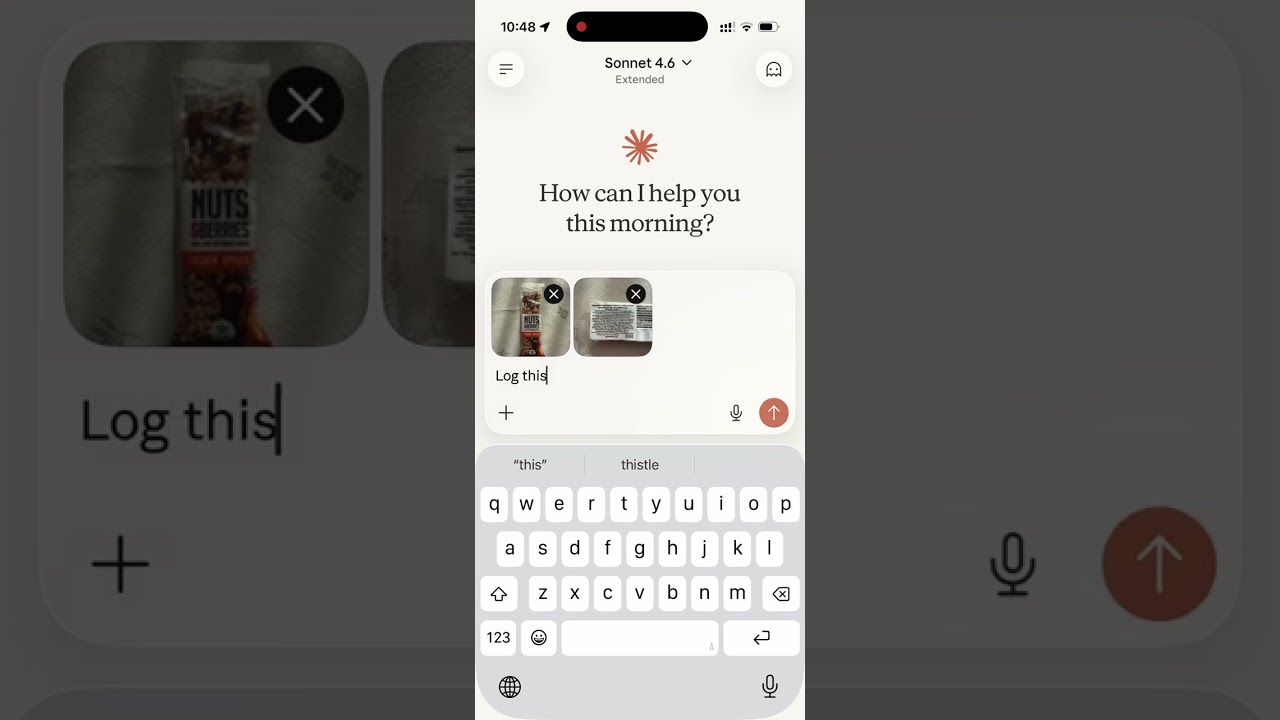
Read the story behind it: How I Replaced MyFitnessPal and Other Apps with a Single MCP Server
Tech Stack
- Bun — runtime and package manager
- Hono — HTTP framework
- MCP SDK — Model Context Protocol over Streamable HTTP
- Supabase — PostgreSQL database + user authentication
- OAuth 2.0 — authentication for Claude.ai connectors
MCP Tools
| Tool | Description |
|---|---|
log_meal |
Log a meal with description, type, calories, macros, fiber, total sugar, alcohol, caffeine (mg), notes — from text or a photo of your plate |
start_meal_import |
Open the in-chat CSV importer: pick an export from another app, map its columns, preview, confirm |
bulk_import_meals |
Write up to 50 imported rows per call — each row validated, duplicates skipped so a re-send is safe |
lookup_barcode |
Look up a packaged product's label nutrition by barcode via Open Food Facts (read from a photo or typed) |
get_meals_today |
Get all meals logged today |
get_meals_by_date |
Get meals for a specific date (YYYY-MM-DD) |
get_meals_by_date_range |
Get meals between two dates (inclusive) |
search_meals |
Search past meals by keyword, grouped into recurring variations (counts, last logged, typical macros) |
get_nutrition_summary |
Daily nutrition totals + goal progress for a date range |
update_meal |
Update any fields of an existing meal |
delete_meal |
Delete a meal by ID |
set_nutrition_goals |
Set daily calorie, macro, fiber and water targets to reach, sugar/alcohol/caffeine limits to stay under, plus an optional target weight |
get_nutrition_goals |
Get the current daily targets and limits |
get_goal_progress |
Get intake vs. targets and limits for a given day (default: today), plus latest weight vs. target |
log_water |
Log a hydration entry in milliliters |
get_water_today |
Get today's water intake total and entries |
get_water_by_date |
Get water intake for a specific date |
delete_water |
Delete a water log entry by ID |
log_weight |
Log a body-weight measurement in kg or lb (converted and stored server-side) |
get_weight_today |
Get today's weight entries |
get_weight_by_date |
Get weight entries for a specific date |
get_weight_by_date_range |
Get weight entries between two dates (inclusive), grouped by day |
get_weight_trends |
Weight trend: latest, overall change, 7/14/30-day moving averages, min/max, and goal progress |
update_weight |
Update an existing weight entry |
delete_weight |
Delete a weight entry by ID |
set_weight_unit |
Set the preferred weight unit (kg or lb; null to clear) |
get_weight_unit |
Get the preferred weight unit |
get_trends |
7/14/30-day averages, std dev, streaks, day-of-week, best/worst day |
get_meal_patterns |
Pre-aggregated behavioural patterns (breakfast effect, late dinner, weekend vs weekday, outliers) |
export_all_data |
Export every table — meals, water, weight, goals, profile — as one ZIP of CSVs plus a README, and return a 60-minute download link |
set_timezone |
Set the user's IANA timezone (e.g. America/Los_Angeles) |
get_timezone |
Get the user's configured timezone, plus their current local date and time |
get_current_time |
Get the current date and time in the user's timezone, plus the UTC instant — for hosts with no clock in context |
set_widget_display |
Enable or disable the in-chat visual widgets (dashboards, rings, charts); enabled by default |
get_widget_display |
Get whether the in-chat visual widgets are enabled |
set_alcohol_tracking |
Turn alcohol tracking on or off (off by default) and choose US standard drinks or UK units; turning it off hides alcohol rather than deleting it |
get_alcohol_tracking |
Get whether alcohol tracking is on and which standard drink it's displayed in |
delete_account |
Permanently delete account and all associated data |
MCP Resources
| URI | Description |
|---|---|
nutrition://weekly-summary |
Rolling 7-day digest (averages vs targets, best/roughest day) for proactive pulls |
Self-hosting
1. Supabase setup
-
Create a Supabase project.
-
Enable Email Auth (Authentication → Providers → Email) and disable email confirmation.
-
Apply the schema. The full schema lives in
supabase/migrations/. With the Supabase CLI:supabase link --project-ref <your-project-ref> supabase db pushThis creates every table, index, RLS policy, and foreign key the app needs. No local Postgres is involved — migrations run against your hosted project.
-
Copy the service role key from Project Settings → API and use it as
SUPABASE_SECRET_KEY.
2. Environment variables
| Variable | Description |
|---|---|
SUPABASE_URL |
Your Supabase project URL |
SUPABASE_SECRET_KEY |
Supabase service role key (bypasses RLS) |
OAUTH_CLIENT_ID |
Random string for OAuth client identification |
OAUTH_CLIENT_SECRET |
Random string for OAuth client authentication |
GOOGLE_CLIENT_ID |
(optional) Google OAuth client ID for "Sign in with Google" |
GOOGLE_CLIENT_SECRET |
(optional) Google OAuth client secret |
OFF_USER_AGENT |
Open Food Facts User-Agent for barcode lookups, in the form AppName (email) |
PORT |
Server port (default: 8080) |
Making it yours: The public site includes the maintainer's personal bits — Google Analytics, Patreon/GitHub/contact links, and the
nutrition-mcp.comdomain. Runbun run depersonalizeto strip them all in one pass (analytics + CSP, the Support/Contact sections, social links, and the domain → ayour-domain.complaceholder). Usebun run depersonalize --dryto preview without writing. Afterwards, swap in your ownpublic/og.png,favicon.ico, andapple-touch-icon.png, and replace the domain placeholder with your real domain.
Generate OAuth credentials:
openssl rand -hex 16   # use as OAUTH_CLIENT_ID
openssl rand -hex 32   # use as OAUTH_CLIENT_SECRET
3. Google sign-in (optional)
Email/password works out of the box. To also offer "Continue with Google",
follow docs/google-auth-setup.md to create a
Google OAuth client, enable the Google provider in Supabase, and set
GOOGLE_CLIENT_ID / GOOGLE_CLIENT_SECRET.
Development
bun install
cp .env.example .env   # fill in your credentials
bun run dev             # starts with hot reload on http://localhost:8080
Connect to Claude.ai
- Open Claude.ai and click Customize
- Click Connectors, then the + button
- Click Add custom connector
- Fill in:
- Name: Nutrition Tracker
- Remote MCP Server URL:
https://nutrition-mcp.com/mcp
- Click Connect — sign in or register when prompted
- After signing in, Claude can use your nutrition tools. If you reconnect later, sign in with the same email and password to keep your data.
API Endpoints
| Endpoint | Description |
|---|---|
GET /health |
Health check |
GET /.well-known/oauth-authorization-server |
OAuth metadata discovery |
POST /register |
Dynamic client registration |
GET /authorize |
OAuth authorization (shows login page) |
POST /approve |
Login/register handler |
POST /token |
Token exchange |
GET /favicon.ico |
Server icon |
ALL /mcp |
MCP endpoint (authenticated) |
Deploy
The project includes a Dockerfile for container-based deployment.
- Push your repo to a hosting provider (e.g. DigitalOcean App Platform)
- Set the environment variables listed above
- The app auto-detects the Dockerfile and deploys on port
8080 - Point your domain to the deployed URL
No comments yet
Be the first to share your take.