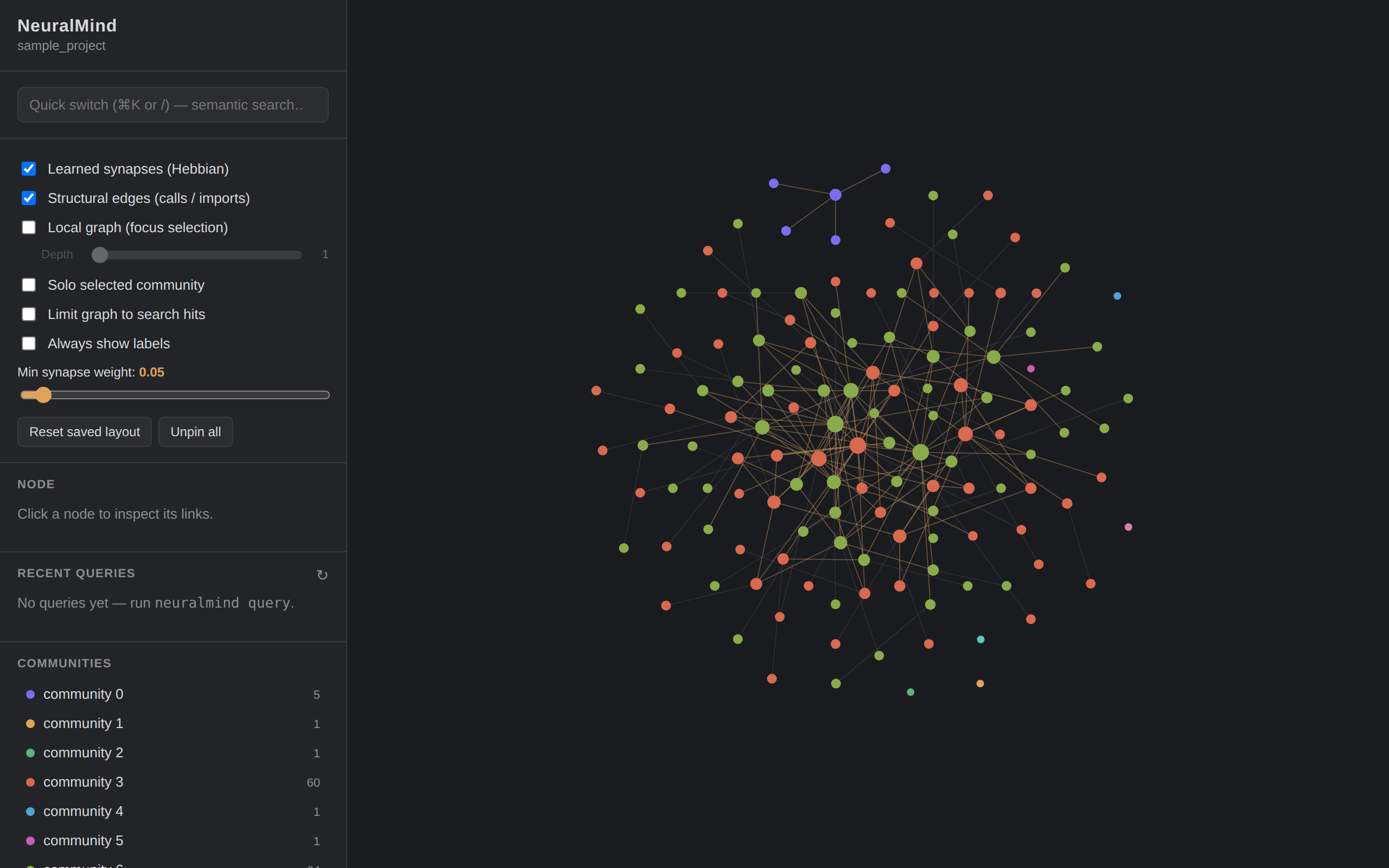
🧠 NeuralMind

PyPI version License: MIT Python 3.10+ Self-benchmark Local-First Offline

Persistent memory and context compression for AI coding agents.

After install, your agent:

  • Boots with SYNAPSE_MEMORY.md (learned associations, strongest hub files)
  • Receives PostToolUse compression automatically (Bash output → errors + signals)
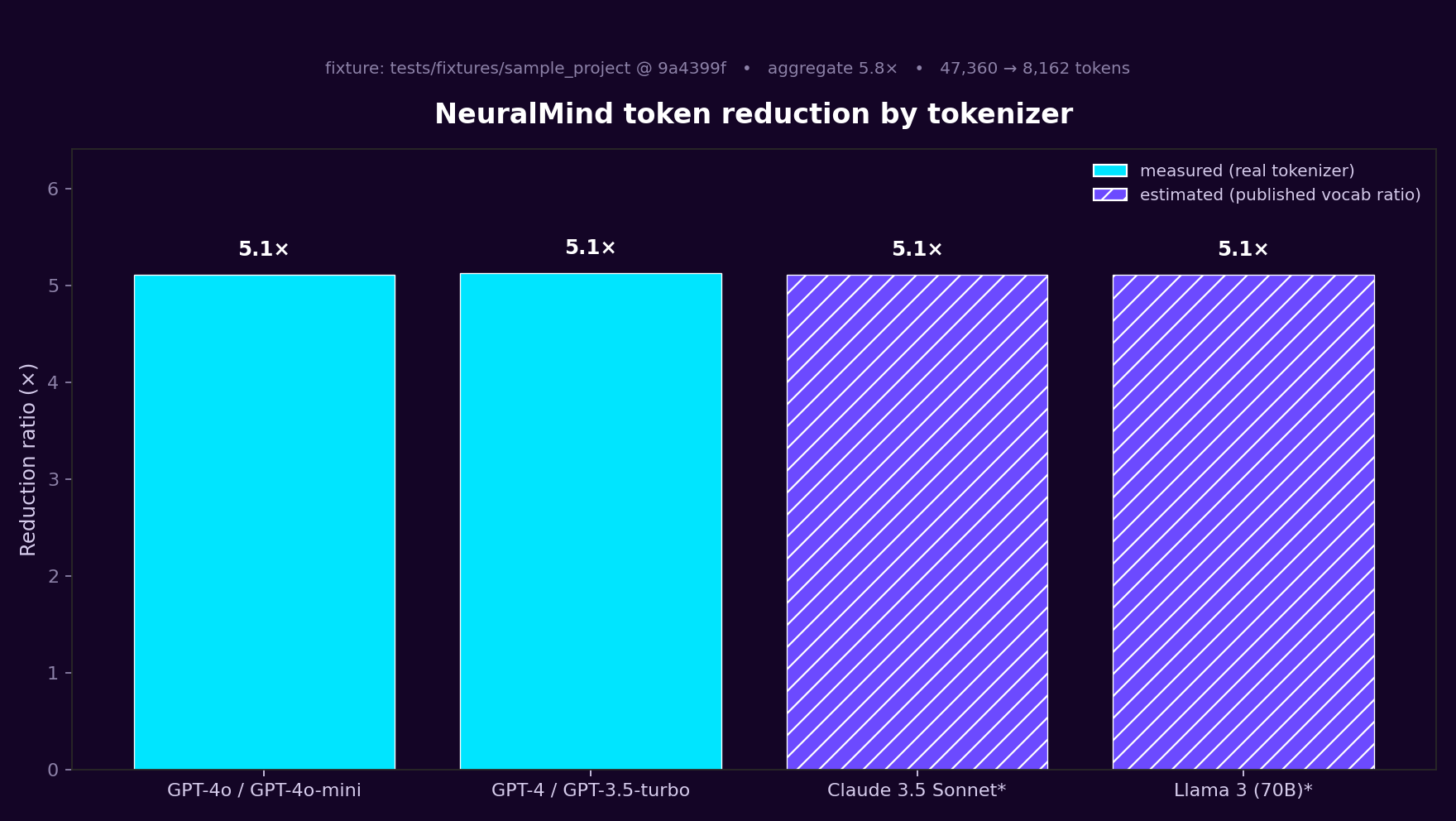
  • Queries your codebase in ~800 tokens instead of ~50,000

If you don't use Claude Code, configure: neuralmind install-mcp --all


v1.0.0 — Team tier ships (July 2026)

NeuralMind Team — $29/user/mo, annual, 5-50 seats. Governance, immutable audit log, self-hosted deployment, and seat management on top of the MIT core.

Feature What
neuralmind team governance {status,set-scope,set-weight-threshold,set-governance-enabled,list-shared,remove-edge} Team memory publishing controls — per-repo enable/disable, personal/shared/both scope, edge weight threshold
neuralmind team audit {list,export,verify} Append-only SHA-256 hash-chained audit log — tamper-evident, exportable as CSV/JSON
neuralmind team seats {list,add,remove} Seat management with soft-delete, idempotent adds, license-limit enforcement
neuralmind team license {status,activate} Ed25519-signed license validation with 30-day offline grace
neuralmind team self-hosted {init,status,validate-license} Self-hosted data-dir initialization with secure permissions (0700)
docker-compose.yml + scripts/install-team.sh One-command self-hosted deploy; data persists across restarts
neuralmind doctor Tier 2 checks additive (license health, self-hosted data dir) — MIT doctor unchanged
neuralmind --version Shows neuralmind 1.0.0 (Team, N seats) when Tier 2 active

Acceptance: 46 Tier 2 unit + integration tests pass, both e2e scripts exit 0.

Tier Price Billing Seats Status
Free $0 n/a 1 always
Team $29/user/mo Annual 5-50 v1.0.0
Enterprise $79/user/mo Annual, min 50 51+ future

Read the full plan: TIER2-BRD.md · TIER2-TRD.md · TIER2-TEST-PLAN.md · Complete changelog


v1.4.0 — Louvain modularity clustering (July 2026)

build_graph now groups files by architectural dependency, not by path. Louvain modularity over structural edges (imports/calls/inherits) replaces balanced-per-file community assignment. Deterministic, fail-open, incremental-stable.

Item What
neuralmind build Per-file adjacency from structural edges → Louvain Phase 1 (O(n·k)) → Phase 2 collapse → contiguous community IDs
Resolution _modularity_gain applies γ·Σ·k/(2m) — γ=1.0 default, tunable for larger graphs
Incremental stability Unchanged files carry their community ID byte-for-byte across builds
Fail-open Output collapses to per-file grouping when Louvain returns ≤1 community — no crash on tiny/degenerate projects

Measured on a 7-file test project: 7 per-file communities → 4 architectural-layer communities (auth, users, core, docs).

What's NOT shipping: Leiden algorithm (requires python-igraph C dep), multilevel Phase 2 repetition, community quality metric Q. All documented in docs/specs/G3-TRD.md §8 as future work.


v0.52.0 — The impact tool ships (July 2026)

v0.52.0 gives a capability we've had since v0.42.0 a name an agent would actually reach for. What shipped in v0.52.0:

vert What
neuralmind impact <symbol> --depth N Reverse-dependency blast-radius lookup with per-dependent hop + relation attribution (calls/inherits/imports_from/implements) and resolution transparency (exact/semantic/none). MCP: neuralmind_impact()
structural --blast-radius Stays byte-identical — now a one-line wrapper over the same blast_radius_detail(). One traversal implementation, not two.

Read the full plan: docs/FUTURE-PROOFING-PLAN.md · Handoff v2→v0.48.0 · Complete changelog


Why NeuralMind — four benefits, each backed by an eval you can run

NeuralMind is more than token reduction. Every claim below ships with a reproducible eval — run python -m evals.public.run yourself; the raw per-query traces are committed.

Benefit Measured result Where it's measured
💸 Cheaper context 100% gold-file recall at 38–85× fewer tokens than pasting files — and beats ripgrep on both recall and cost Public benchmark, real OSS repos (requests, click)
🎯 Finds the right code, not just less of it 100% gold-file recall, MRR 0.96 — ranks the correct file at the top; beats the incumbent codebase-memory-mcp on retrieval ranking (0.96 vs 0.23) Same public benchmark, real repos
🧠 Learns how you work A Hebbian synapse layer that learns co-edited files lifts top-k retrieval hit-rate +11.7 points (71.7%→83.3%), budget-neutral (no extra tokens) Synapse A/B eval (reference fixture)
🔬 Better-grounded answers At a matched token budget, its context carries more of the gold facts than naive truncation: faithfulness +0.143, grounding 1.00 Faithfulness/parity gate (reference fixture)

Honest scope: the cost and accuracy rows run on real, pinned OSS repos (fully reproducible — methodology); the learning and grounding rows are measured in committed A/Bs on the bundled reference fixture, so they're real but smaller-scope. We report where NeuralMind doesn't win too — a well-tuned vector RAG ties it on pure findability and is cheaper on raw tokens; that's in the benchmark table.

🆕 New in v0.47.0 — Impact: blast radius under a name you'd actually reach for. A Reddit comparison against GitNexus flagged "no impact tool" as a gap — not quite right (structural --blast-radius has answered "what depends on this?" since v0.42.0), but the naming critique landed: nobody finds a boolean flag on a differently-named command when they're looking for "impact analysis." neuralmind impact <symbol> --depth N is the same structural-index traversal under a name that matches the question, with richer output — each dependent row now carries its hop and its relation (calls/inherits/imports_from/implements), not just a bare id, plus resolution transparency (exact/semantic/none). Nothing about the underlying traversal changed — structural --blast-radius stays byte-identical, now implemented as a one-line wrapper over the same blast_radius_detail() this release adds, so there's exactly one traversal, not two drifting in parallel. MCP tool: neuralmind_impact(project_path, symbol, depth). Release notes

v0.45.0 — The token receipt gets a price tag. neuralmind savings has always verified the 40-70x token claim against your own logged usage; v0.45.0 converts that into the number stakeholders actually ask for: dollars. neuralmind savings --cost appends a dollar-savings block — cost without NeuralMind, cost with it, amount saved, and a labeled daily/monthly projection — priced on input tokens (NeuralMind is a retrieval layer; it only ever decides which input tokens ship, so output pricing never enters the math). --model picks from a built-in input-price table (Claude Fable 5 / Opus 4.8 / Sonnet 5 / Haiku 4.5, GPT-5.1/mini, Gemini 2.5 Pro/Flash — snapshot 2026-07), --queries-per-day tunes the projection, and --json adds a machine-readable dollar_savings block for dashboards. The math is deliberately boring: totals come straight from the token totals at the price per MTok, projections scale the observed per-event average — every assumption printed where you can see it. Release notes 🌐 Visit the landing page • 📖 Read the About page • ⚖️ Not affiliated with NeuralMind.ai


🧠 What changes when an agent has memory

🆕 New in v0.45.0 — The token receipt gets a price tag. neuralmind savings has always verified the 40-70x token claim against your own logged usage; v0.45.0 converts that into the number stakeholders actually ask for: dollars. neuralmind savings --cost appends a dollar-savings block — cost without NeuralMind, cost with it, amount saved, and a labeled daily/monthly projection — priced on input tokens (NeuralMind is a retrieval layer; it only ever decides which input tokens ship, so output pricing never enters the math). --model picks from a built-in input-price table (Claude Fable 5 / Opus 4.8 / Sonnet 5 / Haiku 4.5, GPT-5.1/mini, Gemini 2.5 Pro/Flash — snapshot 2026-07), --queries-per-day tunes the projection, and --json adds a machine-readable dollar_savings block for dashboards. The math is deliberately boring: totals come straight from the token totals at the price per MTok, projections scale the observed per-event average — every assumption printed where you can see it. Release notes

v0.44.0 — the odd one out, and the coverage that lies. The other two halves of "Surface what you can't see." (1) Cohesion outlier detection — the odd one out. When ten handlers route orgId through resolveOrgId and one skips it, NEURALMIND_SYNAPSE_OUTLIERS=1 flags the member that breaks the cluster's shared pattern — the "handler #11" a flat recall list can't distinguish. (2) neuralmind gaps — the coverage that lies. Classifies endpoints as live-covered / mock-only / untested, so a route that's "green" only under a mocked store (the P2003 shape) stops reading as tested. Release notes

v0.43.0The codebase remembers why, not just what. Every other NeuralMind memory is derived — embeddings from code, synapse weights from co-activation. This release adds the one memory only a human can author and the graph couldn't hold: decision rationale. Add a Decision: trailer to a commit ("resolveOrgId is per-handler — avoids Prisma on /health, keeps tests simple") and it becomes a subject-keyed, recallable memory. Ask neuralmind why "why is resolveOrgId per-handler?" and get the rationale back with its commit SHA; at prompt time the why is injected alongside synapse recall the moment its symbols light up (NEURALMIND_PROVENANCE_INJECT, on by default, fails open). The design win: git history is the store — the trailer is the persistence, so there's no database to build or drift, and it works retroactively on commits you've already made. Release notes

v0.42.0The code graph learns to answer "what does this touch?" NeuralMind's recall has always run on two soft signals — semantic similarity and the learned synapse graph. This release adds the hard one the graph carried all along: how the code is actually wired. graphify already extracts typed structural edges (calls, inherits, imports_from) into every graph.json; until now they were dead weight. v0.42.0 turns them into an agent-visible capability — a new neuralmind_structural_neighbors MCP tool and neuralmind structural <symbol> CLI return a symbol's callers, callees, base/sub classes, and importers, and --blast-radius gives the transitive set of code a change would affect. Precise and available day one — the complement to the learned synapse layer: structure says what can be related; synapses say what actually gets used together. Folding structural neighbors into L3 retrieval is opt-in (NEURALMIND_STRUCTURAL_RECALL=1) so default retrieval stays byte-identical; the whole layer is killable with NEURALMIND_STRUCTURAL=0. Release notes

v0.41.0The feedback loop closes; the relevance signal goes on the wire. Two features that make NeuralMind's half of a modular agent stack real. (1) Reuse-vs-rewrite feedback: a new Edit/Write PostToolUse hook (edit-activity) detects when freshly-written code reaches for symbols already defined elsewhere in the graph and feeds that reuse signal back into the synapse layer — so future retrieval surfaces the helpers and modules you've actually been reusing, not just what scores well semantically. This is the implicit counterpart to v0.38.0's explicit neuralmind_feedback tool: the agent doesn't have to say anything, NeuralMind learns from the edit it already made. Language-agnostic (normalizes graph labels like login_endpoint() to match bare tokens), a pure side effect that never forces a build, off-switch NEURALMIND_REUSE_FEEDBACK=0. (2) Structured relevance sidecar: retrieval can now attach a machine-readable relevance block — per file, per node, the vector score, learned synapse boost, recall flag, and line spans (built from the post-boost L3 hits, so it reflects the live synapse signals) — via neuralmind_query(include_relevance=true) or neuralmind query --relevance, so a downstream compressor can protect the load-bearing spans instead of shrinking them away. Versioned and stably-keyed, so it survives reordering — order-independent by design. Both are opt-in on the wire; default retrieval is unchanged. Release notes

v0.40.0Schema artifact indexing: OpenAPI, SQL, and Protocol Buffers. NeuralMind now indexes non-code schema artifacts alongside your source, closing the most-requested documentation gap. (1) OpenAPI / AsyncAPI (.yaml/.yml with an openapi/asyncapi/swagger key) — one node per path+method (POST /payments/charge), one per schema component (schema:Payment), one per AsyncAPI channel; plain YAML config files are silently skipped. (2) SQL DDL (.sql) — one node per CREATE TABLE/VIEW/PROCEDURE/FUNCTION/TRIGGER/INDEX/TYPE. (3) Protocol Buffers (.proto) — one node per message, service, rpc, and enum. All three use the same document node type as Markdown, so neuralmind_query and neuralmind_search surface them automatically — no new tools, no config change. Schema nodes participate in incremental rebuild and the synapse layer learns cross-artifact associations (e.g. POST /payments/charge co-activated with process_payment() strengthens automatically). Honest scope: $ref resolution, SQL ALTER/SELECT, and proto import edges are not modelled; GraphQL planned for v0.42.0. Release notes

v0.39.0Trust, transparency, and quality — six improvements. (1) neuralmind build --dry-run scans your project and shows a concrete token-savings estimate before building the index — auto-detects 10+ languages, --json for CI/onboarding scripts. (2) Faster synapse decay on deletionneuralmind watch now detects deleted files immediately and calls NeuralMind.deactivate_files() to apply a targeted decay tick on every node in the removed file, so stale memory about deleted code stops surfacing in context after refactors. (3) neuralmind query --explain shows a human-readable breakdown of why each piece of context was selected (L0–L3 token budget, communities loaded, top search hits, synapses that fired) — implies --trace automatically. (4) neuralmind review runs git diff --name-only, seeds spreading activation from the changed files' graph nodes, and surfaces co-break candidates you probably forgot to touch — also available as the neuralmind_review MCP tool so agents can call it before proposing a change. (5) neuralmind savings reads the opt-in JSONL event log and shows cumulative token savings vs. estimated full-codebase cost, with per-query breakdown — verifies the 40-70× claim against your own real usage. (6) neuralmind probe now queries by rationale — the label-free self-test uses each symbol's docstring/intent as the query instead of its name, turning a string-match near-tautology (~0.95 MRR on any healthy index) into a genuine NL→code measurement (~0.79 MRR with real semantic blind spots disclosed). Release notes

v0.38.0Hybrid search, explicit feedback, and CI auto-index. Three retrieval-quality improvements in one release: (1) BM25 hybrid search — a code-aware keyword index (camelCase-split, snake_case-split) is built alongside the vector store and merged via Reciprocal Rank Fusion at query time, so "UserService" queries score exact-name matches first, not just semantically similar nodes — budget-neutral, toggle off with NEURALMIND_BM25=0. (2) neuralmind_feedback MCP tool — explicit positive/negative signal on a retrieved node that fires immediately: positive reinforces co-activation (same Hebbian update as natural co-editing, but instant); negative applies a targeted decay tick to all edges for that node (LTP-protected edges never fully removed by a single signal). (3) CI auto-index GitHub Action (.github/workflows/neuralmind-autoindex.yml) — auto-builds the index on every push to main, caches .neuralmind/, and commits the updated team memory snapshot so teammates always inherit fresh synapse intuition on their next session. No secrets needed — 100% local. Release notes

v0.37.0Multi-language: PHP. The built-in tree-sitter backend now indexes PHP (.php) out of the box — neuralmind build . works standalone on a PHP project, no graphify. class/interface/trait/enum become type nodes; methods/top-level functions become function nodes; properties ($ stripped from the label), class constants, and enum cases become symbol nodes; extends/implements resolve to inherits edges; use namespace imports resolve to imports_from edges (by class name, exactly like Java imports); and /** */ doc comments feed the rationale layer. That takes the bundled backend to ten languages — Python, TypeScript, Go, Rust, Java, C, C++, C#, Ruby, and PHP — behind the same _SUFFIX_LANG_EXTRACTORS seam, proven at parity by the CI gate (54/54 symbols, 100% structural coverage, zero dangling edges), and completing the C#/Ruby/PHP breadth tier. Calls are best-effort and disclosed honestly (no $obj->method receiver-type resolution; require/include path imports aren't modelled — use is the edge source; trait-use-inside-a-class-body isn't modelled as inheritance). Release notes

v0.36.0Multi-language: Ruby. The built-in tree-sitter backend now indexes Ruby (.rb) out of the box — neuralmind build . works standalone on a Ruby project, no graphify. class/module become type nodes; def/def self. methods become function nodes; constant assignments (e.g. ATTEMPTS = 3) become symbol nodes; class Foo < Bar resolves to inherits edges; require_relative resolves to imports_from edges (relative-path resolved); and # doc comments feed the rationale layer. That takes the bundled backend to nine languages — Python, TypeScript, Go, Rust, Java, C, C++, C#, and Ruby — behind the same _SUFFIX_LANG_EXTRACTORS seam, proven at parity by the CI gate (46/46 symbols, 100% structural coverage, zero dangling edges). Ruby is dynamic, so calls are best-effort and disclosed honestly (no receiver-type resolution; mixins via include/extend aren't modelled as inheritance; attr_accessor accessors/ivars aren't emitted as fields — constants are the symbol layer). Release notes

v0.35.0Multi-language: C#. The built-in tree-sitter backend now indexes C# (.cs) out of the box — neuralmind build . works standalone on a C# project, no graphify. class/interface/struct/record/enum become type nodes; methods/constructors become function nodes; fields, properties, and enum members become symbol nodes; base_list resolves to inherits edges; using directives resolve to imports_from edges; and /// doc comments feed the rationale layer. That takes the bundled backend to eight languages — Python, TypeScript, Go, Rust, Java, C, C++, and C# — behind the same _SUFFIX_LANG_EXTRACTORS seam, proven at parity by the CI gate (52/52 symbols, 100% structural coverage, zero dangling edges). C# maps almost 1:1 onto the proven Java extractor, so it rides a proven shape at the smallest risk. Release notes

v0.34.0Answerability, not just findability. Gold-file recall measures whether the right file lands in the window — locating, not answering. The new opt-in answerability arm (python -m evals.public.run --judge) closes that gap honestly: for each query it takes the real context each backend would put in the window (whole files for full-file/ripgrep, retrieved chunks for embedding-rag, the compact L0–L3 assembly for neuralmind), asks a pinned model (claude-opus-4-8) to answer using only that context (it must say "insufficient context" otherwise), then a separate judge call grades the answer against the same def-site gold anchor on a 0–2 scale plus a grounded flag. Why it's hard to dismiss: same prompts + same pinned model for every backend (a low-recall window scores low instead of being papered over from prior knowledge); the answerer prompt, judge rubric, model id, and every raw transcript are committed under bench/public/judge/ (re-score or swap the model yourself). Off the deterministic path: it needs ANTHROPIC_API_KEY, never runs in CI, and the recall table is byte-identical with or without --judge. Recall-at-N×-tokens stays the headline; this is a clearly-labeled secondary signal. Release notes · methodology

v0.33.0The competitor head-to-head, run for real. The public benchmark's competitor row is no longer a scaffold — it's a live, reproducible head-to-head vs. codebase-memory-mcp 0.8.1 (the obvious incumbent) on the same pinned repos, same questions, same objective def-site gold, scored by the same quality.py as every other backend. At matched retrieval depth (top-8), NeuralMind hits 100% gold-file recall and ranks the right file far higher (MRR 0.96 vs 0.23 on requests, 0.60 vs 0.50 on click) while the competitor surfaces the gold file only ~half the time — at an order of magnitude more read cost. Honest framing: this is pure retrieval ranking (no LLM agent loop on either side — same as how we test NeuralMind's own search); we used the competitor's most-favorable reproducible keyword mapping; and we cite the competitor's published LLM-agent numbers (~90% of an "Explorer" agent; C at 0.58) as-is rather than reproduce them. So the win is on reproducible retrieval ranking, not on their agent-driven published figures. Reproduce: python -m evals.public.competitor (off the default run; pip install codebase-memory-mcp==0.8.1, no API key). Release notes · methodology

v0.32.0Multi-language: C and C++. The built-in tree-sitter backend now indexes C (.c/.h) and C++ (.cpp/.cc/.cxx + .hpp/.hh/.hxx) out of the box — neuralmind build . works standalone on a C/C++ project, no graphify. Functions, struct/union/enum (+ fields and constants), typedefs, C++ classes with member methods/fields, and namespace-qualified ids become code nodes; #include "local.h" resolves to imports_from edges; C++ base classes become inherits edges; and foo.h/foo.c pair onto a shared module key so a declaration and its definition land in the same neighborhood. That takes the bundled backend to seven languages — Python, TypeScript, Go, Rust, Java, C, and C++ — behind the same SUPPORTED_SUFFIXES seam, proven at parity by the CI gate (100% symbol coverage, zero dangling edges). Honest scope: macros aren't indexed as symbols, templates aren't specialized, and #ifdef isn't evaluated — we index the parseable code at full parity and disclose what's out (a competitor advertising 158 languages scored 0.58 on C; we index what we can serve). Release notes

v0.31.0The honest public benchmark. The "40–70× fewer tokens" claim ships with reproducible evidence built to survive hostile scrutiny: neuralmind benchmark --public clones real, pinned OSS repos (requests, click) and scores cost and correctness together against strong baselines (full-file paste, ripgrep, a same-encoder vector RAG). Result: 100% gold-file recall (objective def-site oracle, no LLM judge) at 38–85× fewer tokens than pasting files, beating ripgrep on both recall and cost. Synapse injection OFF for a fixed reproducible number; forkable runner + raw data committed. Release notes · methodology

v0.30.0 (shipped within v0.31.0)Team memory: your agents inherit each other's intuition. NeuralMind's synapse layer learns what code goes with what from how you work; now a team can commit that learned signal so every teammate's agent inherits it automatically. neuralmind memory publish writes a committed .neuralmind-team-memory.json; on a teammate's next session/build it's imported once into the shared namespace (content-hash-gated, shared-only, off-switch NEURALMIND_TEAM_MEMORY=0, fail-open). A fresh git clone starts with the team's earned intuition — zero setup, 100% local, no source in the bundle. The differentiator a static code-index can't copy. Release notes

v0.29.0ChromaDB-free by default. On mainstream platforms (Linux, Apple Silicon, Windows x64), pip install neuralmind no longer pulls ChromaDB — the default is the ChromaDB-free turbovec/ONNX backend (byte-identical embeddings), removing ChromaDB's dependency tree and its recurring CVE surface from the default. The backend is platform-gated by wheel availability, so the install never breaks: platforms turbovec has no wheel for (Intel macOS, Windows ARM) auto-install ChromaDB as a transparent fallback. Retrieval is unchanged; a chroma-indexed repo auto-reindexes once into turbovec. Honest framing: ChromaDB-tree-free, not "smaller" — it trades ChromaDB's sprawl for one focused native dep (onnxruntime). Release notes

v0.28.0Multi-language: Java. The built-in tree-sitter backend indexes Java out of the box — classes, interfaces, enums, records, methods, constructors, fields, and enum constants become code nodes; extends/implementsinherits; importimports_from (by FQN); Javadoc → the rationale layer. Five bundled languages (Python/TS/Go/Rust/Java). Release notes

v0.27.0Multi-language: Rust. The built-in tree-sitter backend indexes Rust out of the box — structs, enums, traits, impl blocks, fields, and free functions become code nodes; impl Trait for Typeinherits; use paths → imports_from; //////! doc comments → the rationale layer; target/ is skipped. Release notes

v0.26.0the selector starts tuning itself. Phases 1–2 of the self-improvement engine (issue #156): NeuralMind's memory logs query and wakeup events with a session_id, and an opt-in tuner (NEURALMIND_SELECTOR_AUTOTUNE=1) reads that signal back to adjust the selector's L2 recall depth from the re-query rate, persisted in the synapse store's meta table, with a transition-margin dampener. Off by default and byte-identical to v0.25.0 when unset (zero extra hot-path I/O); bounded to [2, 6] with single-step, windowed, fail-open moves. Inspect it with the read-only neuralmind self-improve status. Release notes

v0.25.0one learning system: the synapse layer. The old learned_patterns cooccurrence reranker is removed, and neuralmind learn is now an exit-0 deprecation no-op. The Hebbian synapse layer — which already learns continuously from queries, edits, and tool calls, and lets unused edges decay — is now NeuralMind's single learning signal. This is a removal, not a regression: a 2×2 A/B on the benchmark fixture showed the reranker moved top-k hit rate by 0.0 points with synapses on or off (71.7% → 71.7% cold, 83.3% → 83.3% warm), while the synapse layer alone adds +11.6 points. The reranker was also runtime-inert on the warm path (the synapse re-sort discarded its order), needed the manual neuralmind learn step, and went stale between runs. Warm-path behavior is unchanged — recall is synapse-driven exactly as before; the only visible difference is the L3 output no longer prints (+X.XX boost) labels from the reranker (synapse labels stay). Scripts calling neuralmind learn keep working (exit 0); a stale .neuralmind/learned_patterns.json is ignored and can be deleted; NeuralMind(enable_reranking=...) is accepted and ignored. Release notes

v0.24.0memory namespaces & branch isolation. The learned synapse layer is now namespace-aware: branch:<name> / personal / shared / ephemeral memory live separately in the same store, so a feature-branch spike can't pollute what the agent learned about main. Recall stays smart by default — a transparent merged view weights the active branch at 1.0×, your long-term personal memory at 0.8×, and an imported shared team baseline at 0.5× (published constants, attributed per-namespace in query --trace). New neuralmind memory {inspect,reset,export,import} shows contribution by namespace, clears exactly one namespace, and moves memory as versioned JSON bundles (the PRD 8 team-memory on-ramp). Existing learned memory migrates in place, losslessly into personal — single-transaction rebuild, rollback on any failure, proven by a no-data-loss test. Release notes

v0.23.0versioned index contract (IR), retrieval-quality harness, debug traces, and a local daemon. Four future-proofing foundations. (PRD 1) A canonical, schema-versioned intermediate representation of your code graph, validated on every build — a new neuralmind validate command checks the contract without a vector backend; the embedder still reads graph.json unchanged (the IR round-trips back identically), so retrieval is unaffected. (PRD 2) A new neuralmind benchmark --quality mode measures whether retrieval finds the right code — precision@k / recall@k / MRR / answerability over 30 golden queries across Python/TS/Go — and fails CI on a regression. (PRD 3) neuralmind query --trace shows why a result came back — per-layer candidates, cluster scoring with vector-vs-synapse attribution, and final hits. (PRD 5) An experimental neuralmind daemon holds project state warm so repeat query/stats skip cold backend init (auto-preferred when running, transparent direct-mode fallback). Release notes

v0.22.0turbovec becomes the default (when available). import neuralmind no longer requires ChromaDB, and the default backend is now auto: prefer the ChromaDB-free turbovec path when its deps are installed, else fall back to chroma. Safe by construction — a plain pip install neuralmind is unchanged; only installs with the [turbovec] extra flip, with a one-time auto-reindex (the old ChromaDB index is left as a fallback, nothing deleted). neuralmind doctor now shows the resolved backend. The staged middle step toward retiring ChromaDB. Release notes

v0.21.0ChromaDB-free retrieval. NeuralMind can now embed and search with zero ChromaDB: the opt-in turbovec backend pairs Google Research's TurboQuant compressed index (8–16× smaller vectors) with a bundled OnnxMiniLMEmbedder that produces vectors byte-identical to ChromaDB's (all-MiniLM-L6-v2 on just onnxruntime + tokenizers). At/above retrieval parity on the gold set (fact-recall 0.744→0.800). Enable with backend: turbovec in neuralmind-backend.yaml. This retires the dependency behind the recurring CVE-2026-45829 advisory. Release notes

v0.20.0Measure the onboarding lift. neuralmind eval --onboarding turns NeuralMind's headline differentiator into a number: does an agent that inherits a committed team memory retrieve better on its first queries than a cold agent with none? The headline is the top-k module hit-rate lift (a deterministic +6.5 points on the reference fixture), with fact-recall + grounding as honest secondaries; budget-neutral by design, gated in CI at lift ≥ 0. Release notes

v0.19.0One-command MCP setup. neuralmind install-mcp --all auto-detects your installed agents — Claude Code, Cursor, Cline, Claude Desktop — and registers NeuralMind's MCP server with each (non-destructive merge, idempotent). The agent then onboards onto your codebase through NeuralMind's tools instead of grepping cold. Distribution is half the moat; the learned synapse layer (usage memory) is the other half. Release notes

v0.18.0Incremental updates. Re-index just the file you edited, not the whole repo: neuralmind watch --reindex re-parses each changed file and re-embeds only its nodes (unchanged files stay byte-for-byte identical, so the embedder skips them). Your index stays fresh as you type. Release notes

v0.17.0Optional SCIP precision. Set NEURALMIND_PRECISION=1 with a SCIP index (scip-python/scip-typescript/scip-go) and NeuralMind folds in compiler-accurate calls/inherits edges, replacing the heuristic ones for covered files. Off by default, dependency-free, proven by a precision check in the CI gate. Release notes

v0.16.0Multi-language: TypeScript + Go. The built-in tree-sitter backend now indexes Python, TypeScript, and Go out of the box — neuralmind build . works standalone on a TS or Go repo, no graphify. Proven at parity per language by the CI gate (100% symbol coverage vs graphify). Release notes

v0.15.0No graphify needed. A built-in tree-sitter graph backend, so pip install neuralmind && neuralmind build . just works — no second, external tool. graphify still takes priority where present. Proven at parity by a CI gate (reduction + faithfulness within tolerance). Release notes

v0.14.0Measure faithfulness. A new contributor/CI command — neuralmind eval — turns "does the memory actually help?" into a number: it scores whether NeuralMind's selected context contains more of the facts a correct answer needs than a naive baseline at the same token budget (a faithfulness delta, plus grounding and contradiction checks). 100% local by default; the LLM-as-judge is opt-in. Release notes

v0.13.0Measurement foundation. The offline faithfulness dataset + expected-fact-recall scorer and polyglot (TypeScript + Go) retrieval fixtures that neuralmind eval is built on. Release notes

v0.12.0Install Doctor. One command — neuralmind doctor — inspects your setup (code graph, semantic index, synapse memory, MCP server, Claude Code hooks, query-memory consent) and prints each piece with a status and the exact command to fix it. Exits non-zero on a real failure so you can gate CI or an agent's setup step on it; --json gives a stable machine-readable snapshot. Release notes

v0.11.0Directional Synapses. The brain-like layer now learns what comes next, not just what goes together. A new `synap