
Music Composition Agent Skill




A modular knowledge and workflow skill for an AI music-composition assistant.
This repository is designed to help an agent turn vague creative requests — “make the chorus hit harder,” “give me a darker K-pop bridge,” “reharmonize this like jazz but not too dense,” “find reference tracks for my playlist” — into concrete musical decisions: chords, melody shapes, grooves, forms, arrangement moves, diagnostic feedback, and research workflows.
Current release: v1.0
Release date: 2026-04-27
Installation
The simplest way is via the skills CLI (requires Node.js):
npx skills add SJY051/music-composition
This installs to your current project's agent directory (e.g., .claude/skills/). Add -g for user-level (global) install, or --all -y to skip prompts.
For a manual install, clone the repository and point your agent at it (or copy SKILL.md and the relevant subdirectories into your agent's skill folder, such as ~/.claude/skills/ or .claude/skills/ in a project):
git clone https://github.com/SJY051/music-composition.git
Compatibility
The skill follows the open Agent Skills standard — the SKILL.md + YAML frontmatter format used by both Claude (Claude Code, Claude Agent SDK, Claude.ai skills) and OpenAI (Responses API tools[].environment.skills). It works on any harness that reads this format.
Does it work?
Two benchmarks ship with v1.0:
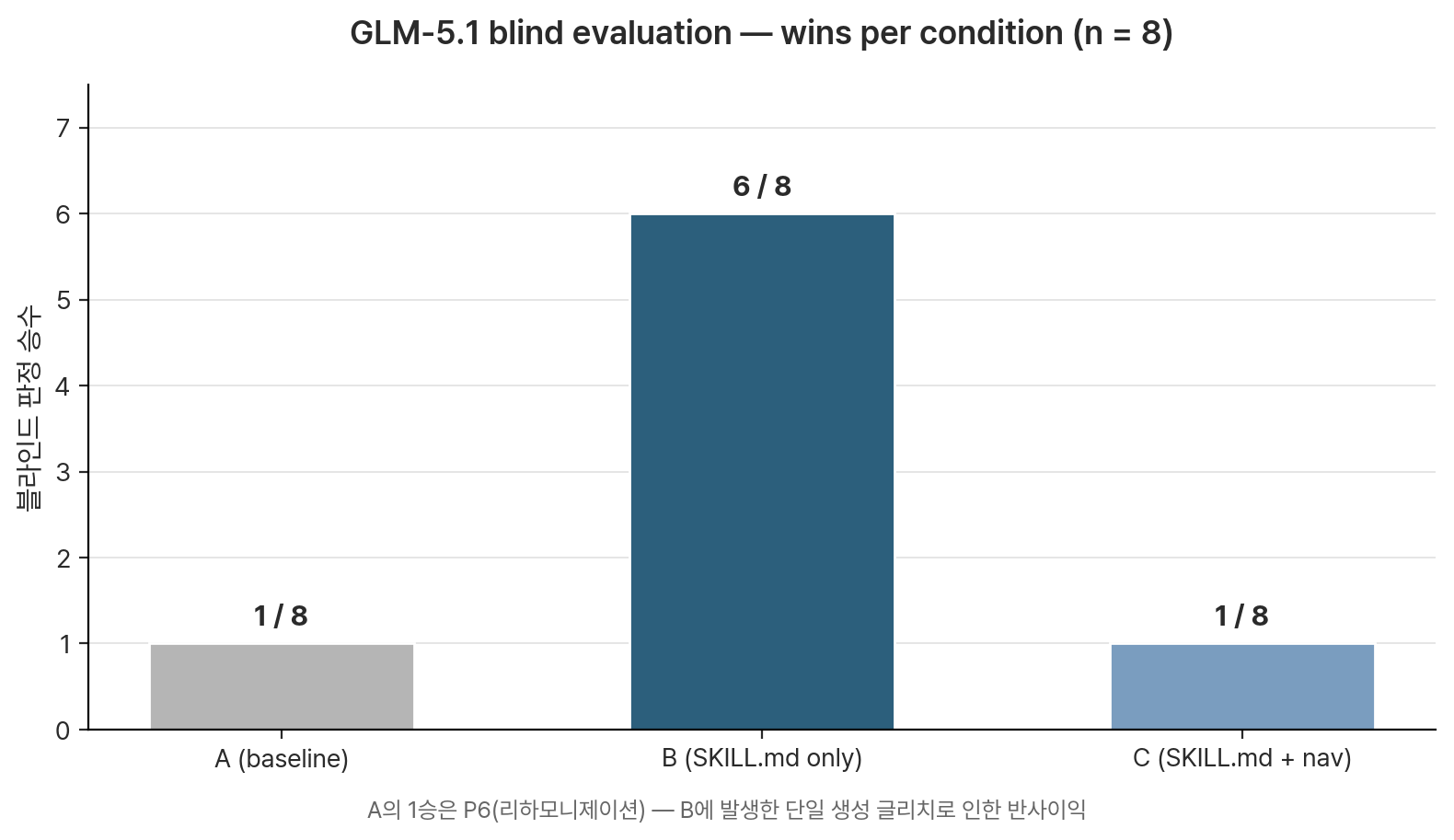
Approach 1 (system-prompt injection, GLM-5.1, blind eval). With SKILL.md prepended to the system prompt, the skill version wins 6 of 8 representative composition prompts in an author-bias-controlled blind comparison. The strongest signal is the boundary test (P8) — the skill version explicitly declines an out-of-scope mixing question while the baseline answers freely.
Approach 2 (native lazy loading, Claude Opus 4.7). With the skill installed via Claude Desktop's Skills feature, the model reads references on demand. Most striking: pansori OST advice cites yoseong, toeseong, chuseong with cents-and-milliseconds implementation values that exist only inside references/genres/korean-traditional.md — direct evidence the model used the skill's full content, not just SKILL.md.
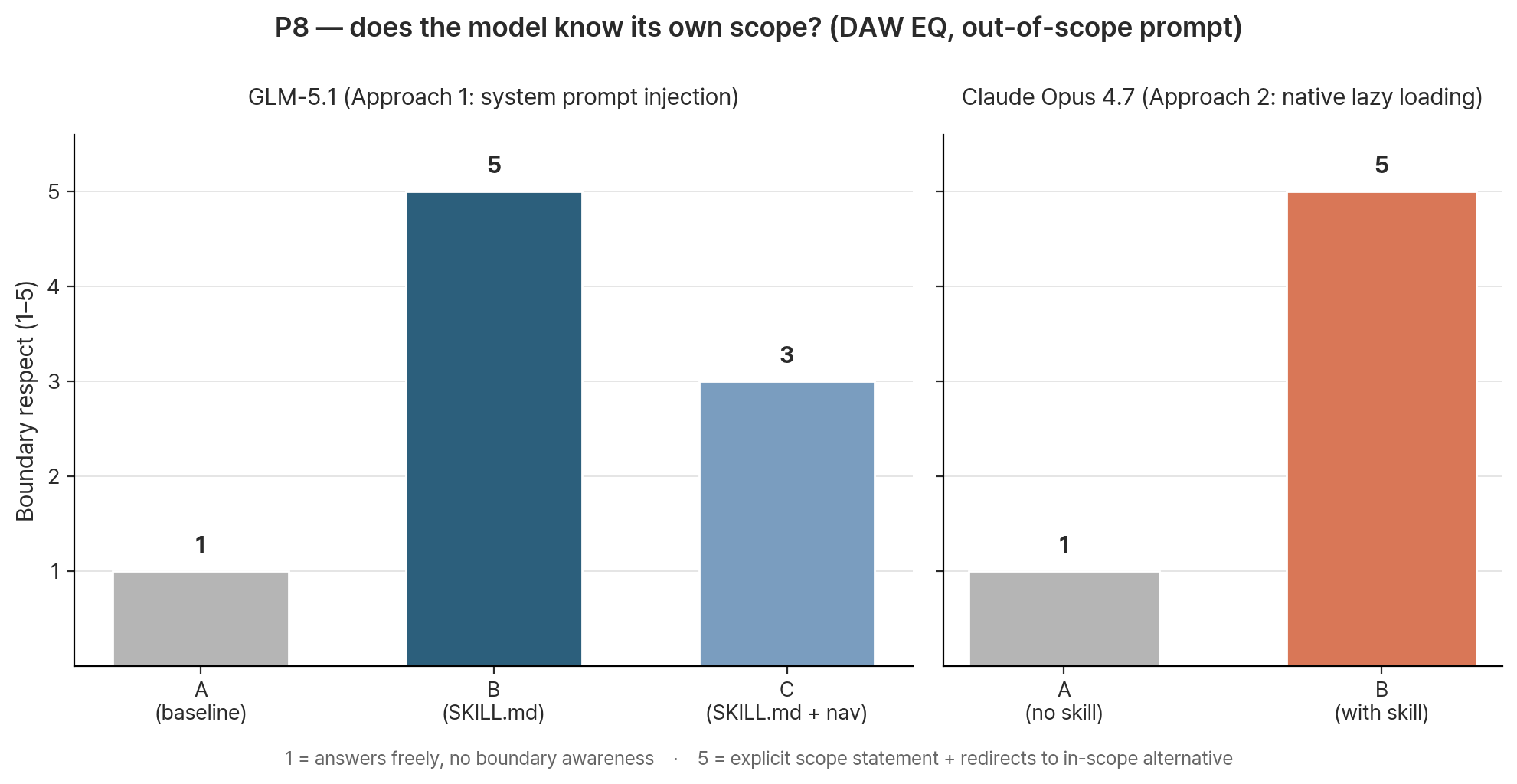
Together: the skill content shapes behavior even on weaker setups, and content depth unlocks on stronger setups. Full methodology and per-prompt analysis: benchmarks/v1.0-eval.md, benchmarks/v1.0-claude.md.
What this skill is for
Use this skill when an AI agent needs to help with:
- composition brainstorming
- chord progressions and harmonic direction
- melody, motif, phrase, and topline writing
- song forms, transitions, and narrative structure
- rhythm, groove, meter, and feel
- orchestration, arrangement, voicing, and instrument idiom
- genre-aware writing across pop, jazz, classical, game, media, regional, traditional, and hybrid styles
- critique and revision of a work in progress
- teaching music concepts in a practical composition-first way
- current music trend research and reference-track digging
- user-agent collaborative workflows across multiple turns
The skill is not a DAW, audio engine, MIDI generator, transcription engine, legal service, or substitute for a human specialist in culturally specific traditions. It is a structured reference and workflow layer for an AI assistant.
Core design philosophy
The skill is built around a few practical principles:
-
Composition is decision-making, not rule-following.
Music theory is treated as a map of possible effects, not a list of commandments. -
Give playable, actionable output.
Prefer concrete examples such as chord charts, scale-degree melodies, groove sketches, voicing suggestions, and revision blocks. -
Preserve user agency.
Offer options, explain tradeoffs, and let the user choose a direction. -
Use only the references needed.
The agent should usually start withSKILL.md, route throughreferences/00-navigation.md, and load only the most relevant 1–3 files. -
Treat current music trends as research tasks.
Static genre files provide stable craft conventions. Recent artists, charts, platform norms, and scene-specific references should be checked through active web research. -
Avoid shallow cultural shortcuts.
Tradition-specific and region-specific music should not be reduced to generic “flavor.” The skill encourages naming the source tradition, function, language, rhythm system, instrumentation, and collaboration needs.
Repository structure
.
├── SKILL.md
├── MAINTENANCE.md
├── RELEASE-ROADMAP.md
├── KNOWN-LIMITATIONS.md
├── RELEASE-NOTES-v1.0.md
├── VALIDATION-v1.0.md
├── assets/
├── references/
│   ├── 00-navigation.md
│   ├── creative-workflows/
│   ├── form/
│   ├── fundamentals/
│   ├── genres/
│   ├── harmony/
│   ├── instrument-idiom/
│   ├── melody/
│   ├── orchestration/
│   ├── production-aware/
│   ├── research/
│   ├── rhythm-groove/
│   ├── songwriting/
│   ├── techniques/
│   └── validation/
└── scripts/
    └── music_theory_sanity_check.py
Important files
| File | Purpose |
|---|---|
SKILL.md |
Root operating instructions for the agent. Start here. |
references/00-navigation.md |
Routing map for choosing the right reference files. |
assets/ |
Short cheat sheets and response templates for quick use. |
references/creative-workflows/ |
Brainstorming, revision, answer calibration, and user-agent collaboration. |
references/research/ |
Web trend research, reference-track digging, streaming-service-aware research, and style/copyright guardrails. |
references/genres/ |
Genre and regional starter guides. |
references/instrument-idiom/ |
Composition-facing playability and idiomatic writing guides. |
references/validation/ |
Release readiness, smoke tests, correctness passes, and packaging checklists. |
scripts/music_theory_sanity_check.py |
Regression checker for links, known theory errors, risky terminology, snapshot notes, and required files. |
Suggested agent workflow
For most user requests:
1. Read SKILL.md.
2. Use references/00-navigation.md to identify the smallest useful document set.
3. Load only the relevant reference files, usually 1–3.
4. Generate concrete musical output.
5. Explain why the choices work.
6. Offer a small number of next-step options.
For example:
| User request | Likely routing |
|---|---|
| “Give me a sad but not cliché progression.” | harmony/functional-harmony.md, harmony/modal-harmony.md, assets/progressions-catalog.md |
| “The chorus does not hit.” | assets/diagnostic-checklists.md, songwriting/hooks-and-memorability.md, production-aware/energy-and-dynamics.md |
| “Make this more playable on guitar.” | instrument-idiom/guitar.md, plus the relevant harmony or arrangement file |
| “Brainstorm three directions.” | creative-workflows/musical-brainstorming.md, assets/musical-brainstorming-cards.md |
| “Find current J-pop references.” | research/web-music-trend-research.md, research/reference-track-digging.md, assets/web-search-cheatsheet.md |
| “Use my playlist as a reference.” | research/user-listening-context-and-streaming-services.md, assets/trend-and-reference-matrices.md |
Currentness policy
Some files include a snapshot note. These files contain information that can become outdated, especially around:
- current genre trends
- charts and streaming-platform behavior
- artist references
- regional scenes
- AI-assisted music tools
- copyright and policy developments
The snapshot note does not mean the file is permanently current. It means the file was last reviewed as of that snapshot date. For fresh claims, use the research documents and verify current sources.
Useful research files:
references/research/web-music-trend-research.md
references/research/reference-track-digging.md
references/research/user-listening-context-and-streaming-services.md
references/research/regional-trend-evolution-analysis.md
references/research/style-reference-and-copyright.md
assets/web-search-cheatsheet.md
Style, originality, and copyright guardrails
This skill is intended to help generate original musical ideas. It should not be used to copy protected expression from existing songs or artists.
When a user asks for a specific artist or song style, the agent should translate the reference into craft variables such as:
- tempo range
- groove type
- harmonic density
- form
- vocal range and phrasing style
- arrangement density
- instrumentation
- energy curve
- production-era cues
The agent should avoid reproducing or imitating protected elements such as:
- melody
- lyrics
- distinctive riffs
- samples
- signature producer tags
- highly specific vocal identity
- recognizable arrangement sequences from a particular recording
See:
references/research/style-reference-and-copyright.md
KNOWN-LIMITATIONS.md
Cultural and regional specificity
The skill contains guides for traditional, regional, and hybrid styles. These are composition-facing starter references, not replacements for cultural expertise, native-language knowledge, or practitioner collaboration.
When working with culturally specific material, prefer:
specific tradition / region / language / function / rhythm / instrument idiom / performance context
Instead of vague labels such as:
generic world flavor / ethnic color / Asian flavor / Middle Eastern flavor
Relevant files include:
references/genres/korean-traditional.md
references/genres/folk-roots-and-traditions.md
references/genres/mena-pop.md
references/genres/south-asian-film-pop.md
references/genres/regional-scene-starters.md
references/research/regional-trend-evolution-analysis.md
Validation
The v1.0 package passed the release validation recorded in:
VALIDATION-v1.0.md
references/validation/first-release-readiness.md
references/validation/phase-b-correctness-pass.md
references/validation/phase-c-smoke-test-results.md
To run the sanity checker:
python scripts/music_theory_sanity_check.py
The checker looks for issues such as:
- broken internal Markdown references
- known high-risk music-theory regressions
- risky cultural shortcut terminology
- missing snapshot notes in current-sensitive files
- required release and validation files
- selected interval, mode, chord-symbol, and altered-dominant sanity checks
This checker is a regression tool, not a complete proof of musical correctness.
Maintenance
Before changing the repository:
- Read
MAINTENANCE.md. - Update
references/00-navigation.mdwhen adding or moving files. - Keep high-use assets concise and accurate.
- Use snapshot notes for current-sensitive files.
- Run
scripts/music_theory_sanity_check.py. - Record substantial validation work in the relevant validation document.
Recommended versioning:
| Change type | Suggested version |
|---|---|
| Typo, link, or small validation-script fix | v1.0.x |
| P0/P1 correctness hotfix | v1.0.x hotfix |
| New genre, workflow, or research documents | v1.1 |
| Larger parser/evaluation harness improvements | v1.1 or v1.2 |
| Major structure change or file reorganization | v2.0 candidate |
Known limitations
See KNOWN-LIMITATIONS.md for the full list.
In brief, this skill does not directly provide:
- audio transcription
- DAW control
- MIDI export
- audio mixing or mastering
- legal advice
- guaranteed current trend knowledge without web research
- exhaustive expertise in every local or traditional music practice
License
This repository uses a split license:
- Skill documents, references, assets, release notes, and validation documents are licensed under Creative Commons Attribution 4.0 International (CC BY 4.0).
- Code in
scripts/is licensed under the MIT License.
See LICENSE.md for details.
No comments yet
Be the first to share your take.