
Persistent Graph Memory for Multi-Agent AI Systems





A public-safe case study for the Guild I actually run day to day: one orchestrator, a handful of specialist agents, and a graph memory layer that keeps each lane useful without mixing everything together.
In plain English: each specialist agent gets its own memory lane, its own rules, and its own way of finding past context without stepping on the other agents.
Status: documentation-first case study with sanitized examples and utility scripts. It intentionally does not include private prompts, real chat IDs, secrets, production logs, or personal memory data.
Architecture
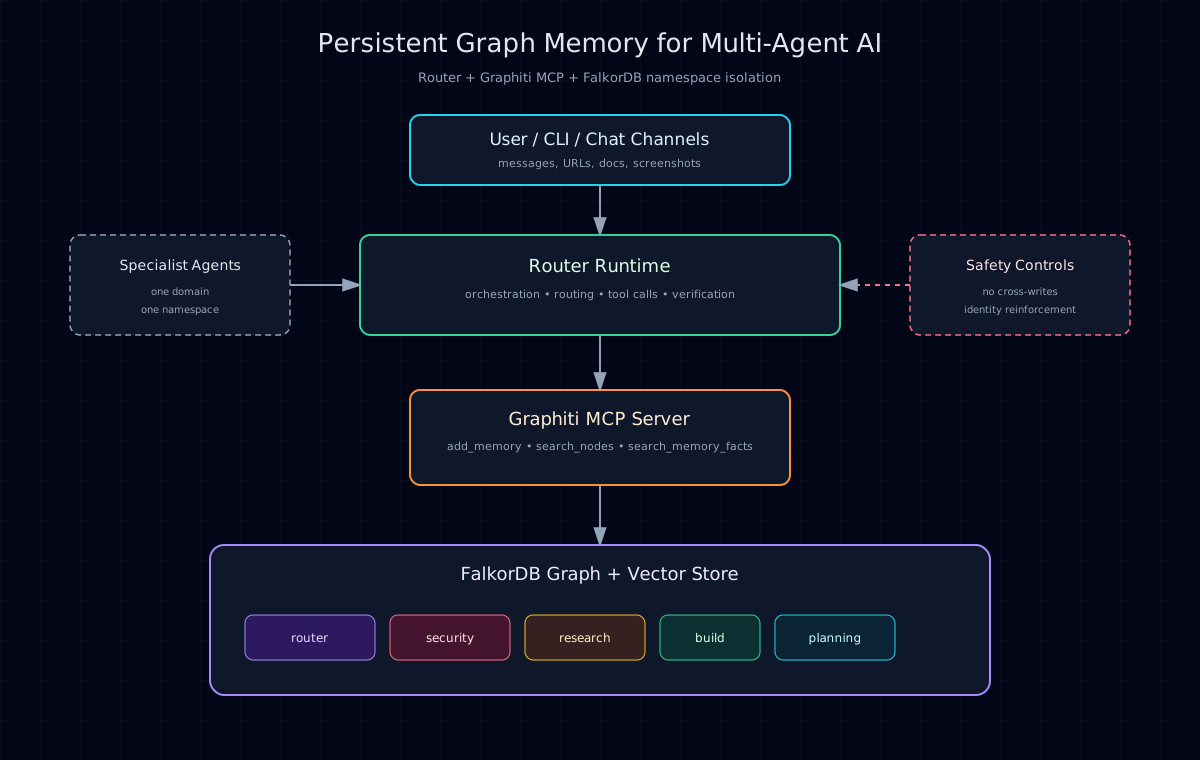
User / Chat Channels / CLI
        |
        v
Router runtime
        |
        | MCP tools over Streamable HTTP
        v
Graphiti MCP Server
        |
        | graph + vector operations
        v
FalkorDB
        |
        +-- graph: router        # orchestrator memory
        +-- graph: security      # defensive security lane memory
        +-- graph: research      # market research lane memory
        +-- graph: planning      # planning / follow-up lane memory
        +-- graph: build         # development lane memory
Each agent has a namespace. Agents search and write only inside their namespace. The orchestrator routes incoming content to the correct agent and memory space.
Why this matters
Most agent demos are stateless. They answer the current prompt, maybe use a scratchpad, and forget the rest.
That works for a toy demo. It breaks down once the system has to remember decisions, avoid repetition, and stay useful after a restart. The real Guild has to survive restarts, handoffs, and the usual chaos of daily life.
A useful long-running agent system needs:
- Persistent memory across sessions
- Domain-specific memory boundaries
- Verifiable ingestion and retrieval
- Guardrails against cross-agent identity drift
- Operational checks that prove memory is actually usable at runtime
This repo captures a working pattern for that.
Core design principles
- Memory isolation beats one giant shared memory.
- Retrieval must be verified through the same MCP path agents use.
- A successful write is not the same as a usable memory.
- Agent identity has to be reinforced when graph context mentions other agents.
- Public artifacts should mirror the real operating model, but with names, IDs, paths, and logs stripped out.
- If the docs feel too robotic, they probably need a human pass.
Live agent model, sanitized
This is the real lane structure I use, just without the private stuff.
| Namespace | Agent | Domain |
|---|---|---|
router |
Router | Orchestration, routing, continuity, memory hygiene |
security |
Security lane | Defensive security, hardening, audit findings |
research |
Research lane | Market research, risk notes, catalysts |
planning |
Planning lane | Second-angle review, reminders, proactive context |
build |
Build lane | Development, dashboards, APIs, engineering decisions |
Quick start
Prerequisites
- Docker & Docker Compose
- An OpenAI-compatible API key (Graphiti uses an LLM for entity extraction)
1. Spin up the stack
git clone https://github.com/sadbeto/multi-agent-graph-memory.git
cd multi-agent-graph-memory

# Set your LLM key
export OPENAI_API_KEY=your-key

# Start FalkorDB + Graphiti MCP
docker compose -f examples/docker-compose.example.yml up -d
2. Check health
./scripts/check_graphiti_health.sh http://localhost:8000/mcp/
3. Seed a sanitized agent memory
python3 scripts/seed_agent_memory.py \
  --url http://localhost:8000/mcp/ \
  --group-id security \
  --name security-seed-v1 \
  --body-file examples/seed-episode.example.json
4. Verify retrieval through MCP
python3 scripts/verify_namespace.py \
  --url http://localhost:8000/mcp/ \
  --group-id security \
  --query "security hardening"
Important Graphiti/FalkorDB lessons
group_id and group_ids are not interchangeable
In many Graphiti MCP setups:
- Write tools use
group_idas a singular string - Read/search tools use
group_idsas an array
Passing group_ids to a write call can silently fall back to the default namespace.
Avoid hyphens in namespace names
Some FalkorDB/RediSearch paths can break on hyphenated graph names. Prefer simple namespace IDs like router, security, research, planning, and build.
A successful write may only mean queued
Graphiti can process episodes asynchronously. A successful MCP response may mean the episode was accepted, not that entities and facts were extracted. Always verify retrieval after writing.
Runtime verification beats database inspection
Agents use MCP tools, not direct database queries. If direct FalkorDB shows nodes but MCP search returns empty, the agent still cannot use that memory.
What is included
.
├── README.md
├── CONTRIBUTING.md
├── docs/
│   ├── architecture.md
│   ├── namespace-design.md
│   ├── mcp-integration.md
│   ├── safety-model.md
│   ├── lessons-learned.md
│   ├── identity-drift.md
│   ├── workflows.md
│   └── roadmap.md
├── examples/
│   ├── config.example.yaml
│   ├── docker-compose.example.yml
│   ├── agent-registry.example.yaml
│   ├── seed-episode.example.json
│   └── agent-prompt-block.example.md
├── scripts/
│   ├── check_graphiti_health.sh
│   ├── seed_agent_memory.py
│   └── verify_namespace.py
└── diagrams/
    └── guild-architecture.svg
Safety and privacy
This repo is intentionally sanitized.
Do not commit:
.envfiles- API keys or tokens
- real chat IDs
- personal memory episodes
- raw logs
- SQLite/state databases
- production prompts with private details
- local absolute paths from a private system
See docs/safety-model.md for the full public-release model.
What this repo is really showing
This project demonstrates the live operating model, only sanitized:
- Multi-agent architecture that feels operational, not hypothetical
- MCP-based tool integration
- Persistent graph memory
- Verification discipline for memory that may process asynchronously
- Agent identity and memory-isolation design
- Public-safe documentation of a private production system
It is not trying to look fancy. It is trying to show what was actually built, what broke, and what had to be learned the hard way.
Related
- Graphiti — temporal graph memory for AI agents
- FalkorDB — graph database powering the namespace store
- Model Context Protocol (MCP) — the tool protocol this system uses
Contributing
See CONTRIBUTING.md.
License
MIT. See LICENSE.
No comments yet
Be the first to share your take.