Memnex
The local-first memory system that learns how you work — not just what you said. Persistent, local memory for AI coding agents: Claude Code, Codex CLI, Cursor, any MCP client. Temporal knowledge graph · procedural memory · AST codebase ingest · cross-project analogy · 3D WebGL visualization.
This repository was previously published under the local/package name
total-agent-memory. The codebase and project are the same; Memnex is now the
canonical repository name. Existing package, CLI, import, and data-directory
names remain available for compatibility.
Why this, not mem0 / Letta / Zep / Supermemory / Cognee? → docs/vs-competitors.md
v12.6.0 - Visual memory workspace and recall-chain hardening (2026-07-16)
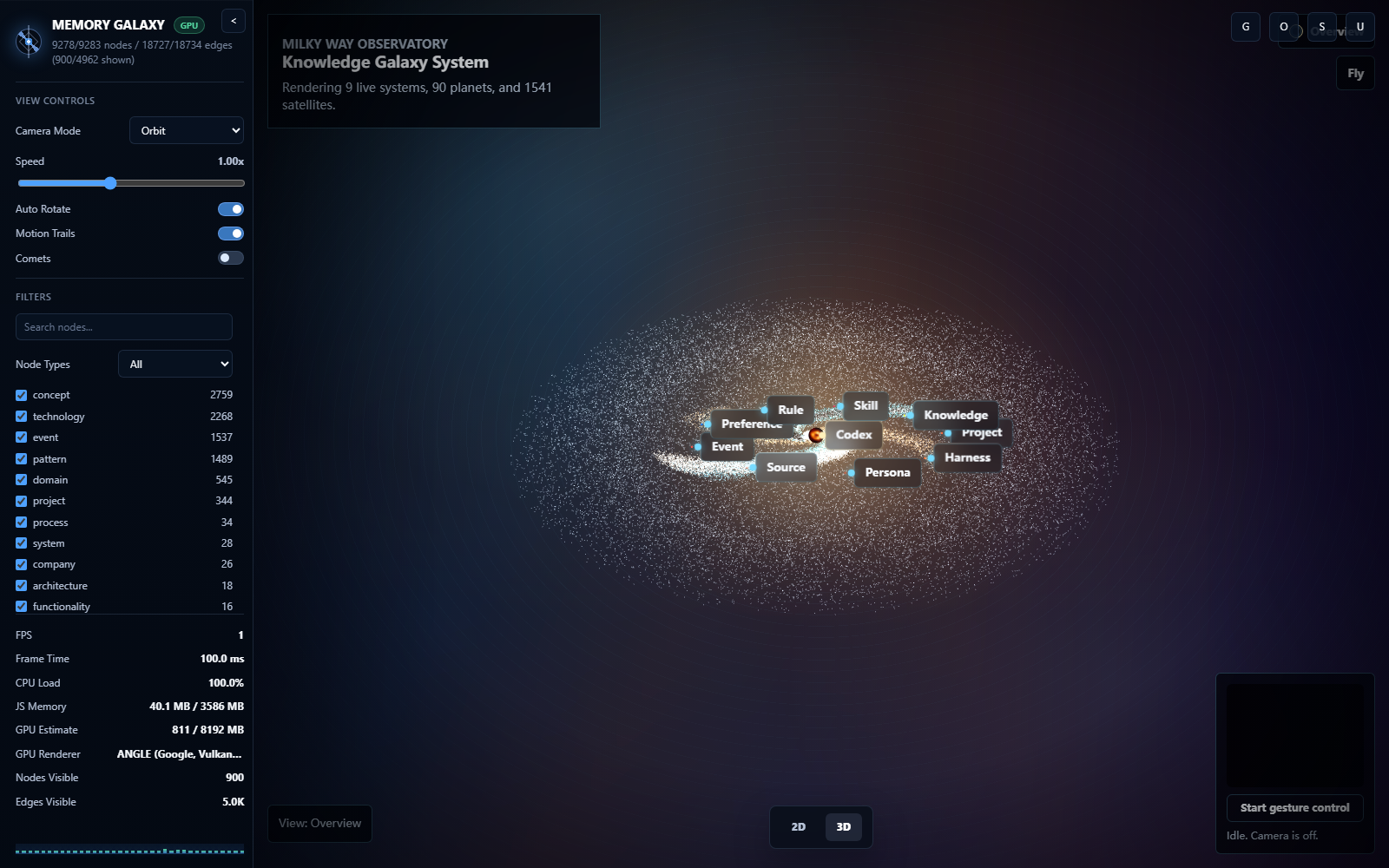
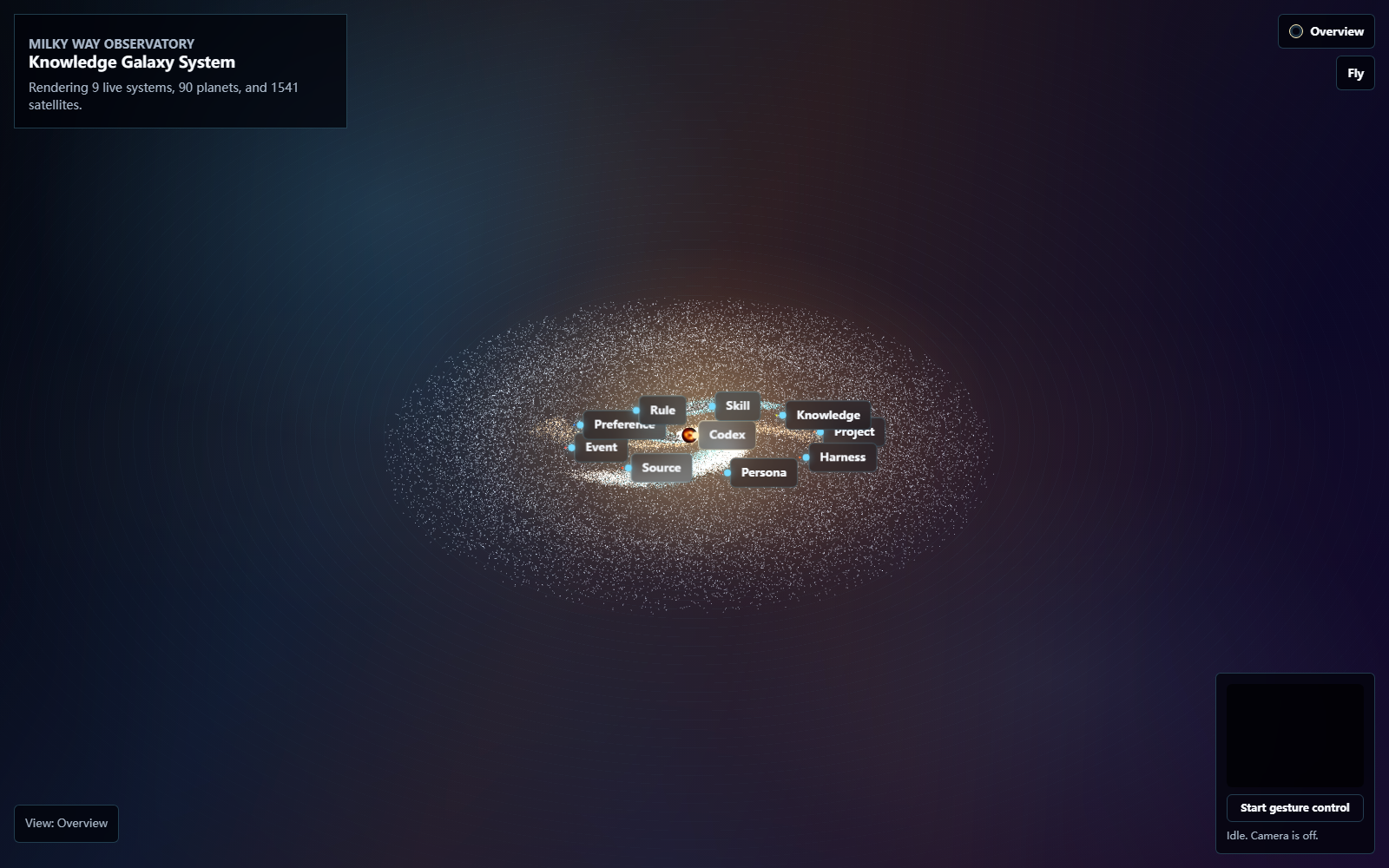
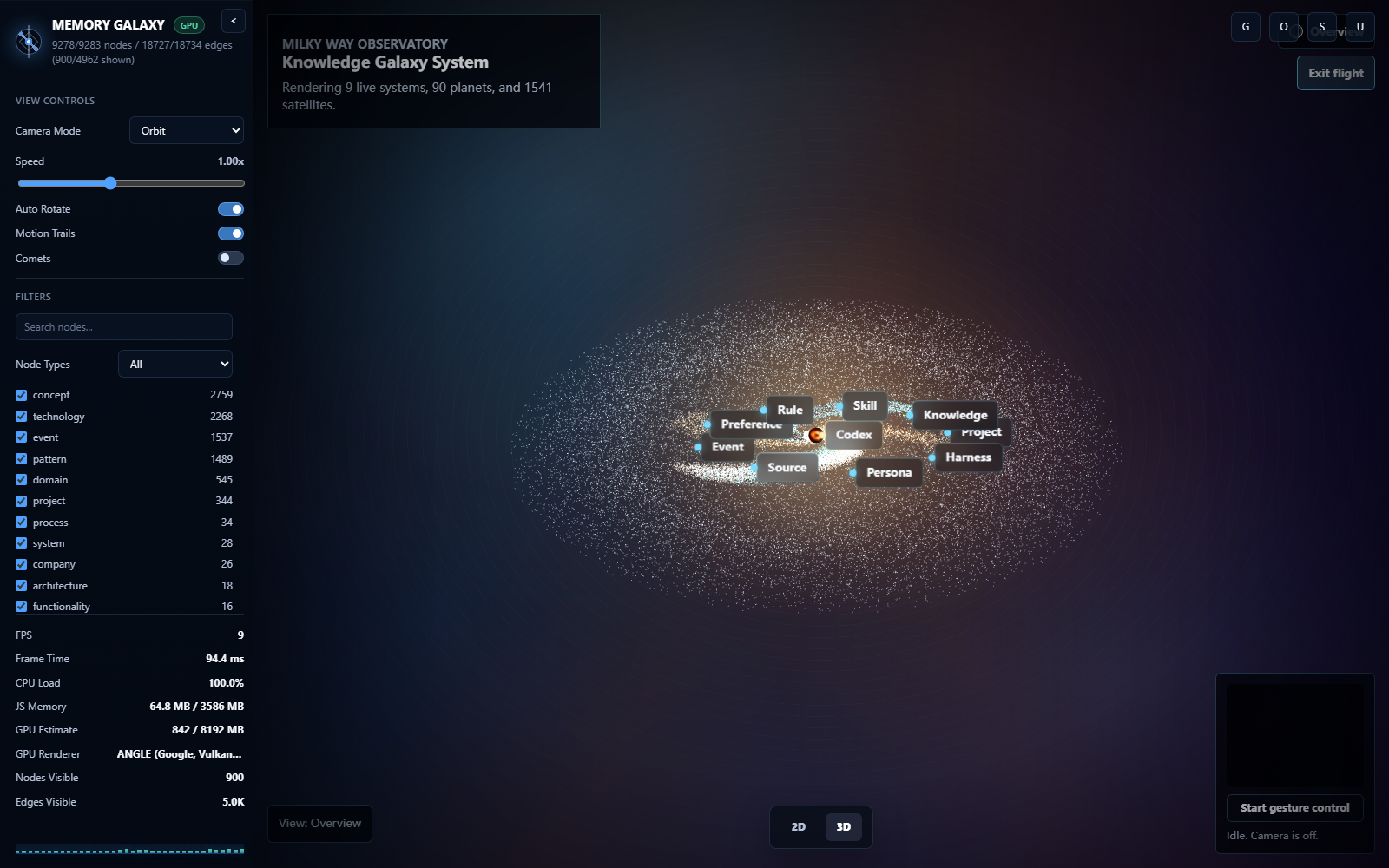
This release combines the new 2D/3D Memory Galaxy workspace with a set of write, recall, and rules-layer repairs. The viewer now connects the existing 2D graph surface to a Knowledge Solar System 3D route, while the memory engine keeps project and agent boundaries intact across save, retrieval, graph expansion, multi-representation search, and phase-scoped rules.


Read the complete v12.6.0 Memnex release guide for the CodeGraph chain map, panel reference, operation guide, gesture map, Memnex comparison, privacy boundary, and known limitations.
v12.5.0 - Memory graph visualization (2026-06-22)
This release adds a local Cytoscape.js memory graph viewer export. It turns the existing graph tables into a static browser workspace with 2D and 3D views, node type counts, weighted edges, and linked knowledge summaries.
The export tool opens the SQLite memory database in read-only mode and writes viewer files only to the output directory you choose. The repository release contains system files only; live memory databases, logs, transcripts, raw captures, backups, and generated private graph exports stay out of Git.
python src/tools/memory_graph_viewer_export.py --output /tmp/tam-graph-viewer
Open index.html from the output directory. Use --max-nodes, --max-edges,
and --min-edge-weight when a large graph needs a smaller browser-friendly
view. Full notes in
docs/v12.5.0-memory-graph-viewer.md.
v12.1.0 — Claude Code v2.1.145 subagent lineage (2026-05-20)
Claude Code v2.1.139+ emits subagent IDs on every API request
(x-claude-code-agent-id / x-claude-code-parent-agent-id HTTP headers,
plus the same fields as agent_id / parent_agent_id attributes on the
claude_code.tool and claude_code.llm_request OTEL spans). v12.1 wires
these through end-to-end:
- Schema (migration
028_agent_lineage.sql) — nullableagent_idandparent_agent_idcolumns onknowledge, partial indexes (WHERE … IS NOT NULL) so lineage filters are free. - MCP tools —
memory_saveandmemory_save_fastaccept two new optional inputs:agent_idandparent_agent_id. Old callers see no behaviour change. extract_transcript.py— readsagent_id/agentId/parent_agent_id/parentAgentIdfrom.jsonlwhen Claude Code writes them, and falls back toisSidechain=trueas a proxy: sessions with any sidechain activity getagent_id = "session-<id>"plus ahas-subagent-worktag on their auto-extracted rows.- KG fact
spawned_by— whenmemory_savecarries both ids, the store auto-recordsTemporalKG.add_fact(agent, "spawned_by", parent, source="agent-lineage", invalidate_previous=False). Idempotent.kg_at(timestamp)andkg_timeline()can now reconstruct the subagent lineage tree at any past moment.
A reconnect of the MCP memory server is required for clients to see the
updated inputSchema. Full notes in CHANGELOG.md.
v12.0.0 — rebrand to total-agent-memory (2026-05-16)
The project was renamed from claude-total-memory to total-agent-memory to
reflect that it works with every MCP client, not just Claude Code (Cursor,
Codex CLI, Cline, Continue, Aider, Windsurf, Gemini CLI, OpenCode — all
covered).
Nothing breaks. The old PyPI package (claude-total-memory==11.3.0) is now a
deprecation shim that auto-resolves to total-agent-memory>=12.0.0. Legacy
imports, CLI binaries, env vars, and the ~/.claude-memory/ directory keep
working through automatic migration:
| Old | New | Backward-compat |
|---|---|---|
pip install claude-total-memory |
pip install total-agent-memory |
old name still works (shim + warning) |
from claude_total_memory import … |
from total_agent_memory import … |
old import still works (sys.modules alias + warning) |
claude-total-memory CLI |
total-agent-memory (alias tam) |
old CLI still ships in v12 wheel |
CLAUDE_MEMORY_DIR env |
TAM_MEMORY_DIR env |
old env still respected (deprecation warning) |
~/.claude-memory/ dir |
~/.tam/ dir |
auto-migrated on first run; ~/.claude-memory becomes a symlink to ~/.tam/ so pinned scripts keep working |
Six install paths — pick one:
npx -y total-agent-memory connect claude-code # Node, zero-install
uvx total-agent-memory # Python via uv (fast)
pipx install total-agent-memory # Python via pipx (isolated)
brew install vbcherepanov/tap/total-memory # Homebrew (macOS / Linuxbrew)
docker run -p 37737:37737 -v ~/.tam:/data \
ghcr.io/vbcherepanov/total-agent-memory:12.5.0 # Docker (multi-arch amd64+arm64)
git clone https://github.com/LLK-LL/Memnex \
~/total-agent-memory && cd ~/total-agent-memory && ./install.sh # manual
The npx path also wires the MCP entry into the IDE you pass to connect <ide>:
claude-code, codex, cursor, cline, continue, aider, windsurf,
gemini-cli, opencode.
Project URLs: Memnex · PyPI compatibility package · npm compatibility package · GitHub Release
Full migration notes (Docker volume names kept for backward-compat, brew formula
changes, etc.) live in CHANGELOG.md. The historical sections
below (v11.1, v11.0, …) are preserved for reference.
v11.1 — graph dedup + proactive save nudges
Two client-reported bugs fixed (2026-05-14):
Bug #1 — orphan + duplicate graph_nodes. The graph accumulated
case-variant duplicates (Vue / vue / VUE) and type-collision
duplicates (vue/concept vs vue/technology created by different
extractors), plus orphan nodes when an edge insert failed after both
nodes were already committed. Fixed by migration 026_graph_nodes_dedup
(name_norm column, triggers, indexes), a case-insensitive UPSERT
rewrite of add_node with type-collision detection, a new atomic
GraphStore.link_pair() helper, and a one-shot cleanup tool
src/tools/merge_duplicate_nodes.py (dry-run by default).
# After upgrade migration 026 applies automatically. Then optionally:
.venv/bin/python src/tools/merge_duplicate_nodes.py --dry-run
.venv/bin/python src/tools/merge_duplicate_nodes.py --apply --add-unique
Verified on a real production DB (8304 nodes): 102 duplicates merged, 1472 stale edges cleaned, UNIQUE constraint installed.
Bug #2 — model never calls memory_save on its own. Sonnet/Haiku
skip the priority-10 save rule when SessionStart context fades. v11.1
adds in-session nudges: a counter in ~/.claude-memory/state/
tracks writes-vs-saves per session, and hooks/post-tool-use.{sh,ps1}
emits a stdout line that Claude reads as system context on the next
turn. Soft nudge at 3 edits with 0 saves, hard at 7, and a
MEMORY_FINAL_WARNING on session stop. A new priority-10 rule
instructs the model to treat MEMORY_NUDGE as an immediate command.
Tunables: MEMORY_NUDGE_DISABLE=1 to silence; MEMORY_NUDGE_SOFT /
_HARD / _STEP to retune (defaults 3 / 7 / 3).
Test coverage: +24 graph tests, +12 nudge tests. Full details in
CHANGELOG.md.
v11.0 — production memory engine
v11.0 = production memory engine: fast deterministic memory core + async AI enrichment layer. Default mode is fast: zero LLM, zero Ollama, zero network in the save/search/recall hot path.
The codebase is now split into two layers:
src/memory_core/*— deterministic facade modules (storage, embeddings, vector_store, classifier, chunker, dedup, cache, graph_links, telemetry, health, embedding_spaces). No LLM imports allowed. Enforced bytests/test_no_llm_hot_path.py.src/ai_layer/*— every LLM-touching path (enrichment_worker, summarizer, keyword_extractor, question_generator, relation_extractor, contradiction_detector, reflection, self_improve, plus thin shims for quality_gate / coref_resolver / reranker / query_rewriter). Off-limits to memory_core.
Architecture details and full hot-path audit: docs/v11/audit.md.
Modes
MEMORY_MODE selects the runtime profile. Default is fast.
| Mode | Hot-path LLM | Async enrichment | Reranker | Embed fallback | Use when |
|---|---|---|---|---|---|
ultrafast |
off | off | off | FastEmbed only (vector index off, FTS-only) | Throughput stress / CI |
fast (default) |
off | off | off | FastEmbed only, Ollama fallback gated | Production coding-agent loop |
balanced |
off (sync) | on | off | FastEmbed only | You want LLM-derived facets, but never on the critical path |
deep |
on (sync) | on | on (when rerank=true) |
FastEmbed → Ollama ladder | v10.5 behaviour: quality gate / contradiction / coref / HyDE inline |
deep mode reproduces v10.5.0 defaults exactly. Set MEMORY_MODE=deep if you depended on synchronous quality_gate, contradiction_detector, or coref. balanced keeps the same ergonomics but moves enrichment off-thread.
Migration from v10.5: docs/v11/MIGRATION-FROM-V10.md.
v11.0 hot-path benchmark
Warm, in-memory SQLite, MacBook M-series, MEMORY_MODE=fast, MEMORY_ALLOW_OLLAMA_IN_HOT_PATH=false:
| metric | p50 | p95 | p99 |
|---|---|---|---|
save_fast |
6.5 | 9.0 | 27.8 |
save_fast cached |
0.3 | 0.4 | 1.1 |
search_fast |
3.7 | 4.0 | 6.2 |
cached_search |
0.0 | 0.0 | 0.0 |
llm_calls = 0, network_calls = 0 across the entire hot path. Reproduce: bin/memory-bench. CI gate: bin/memory-perf-gate. Raw artifact: docs/v11/benchmark.md.
v10.5 → v11.0 — same workload, same script
The v10.5 native bench (benchmarks/v10_5_latency.py) re-run on v11 fast against the recorded v10.5 baseline (benchmarks/results/v10_5_latency.json):
| metric | v10.5 sync (with LLM) | v11.0 fast | speedup |
|---|---|---|---|
| save p95 | 2150.51 ms | 8.51 ms | 252× |
| save p99 | 2178.98 ms | 11.09 ms | 196× |
| recall p95 | 1424.26 ms | 5.81 ms | 245× |
| recall p99 | 1771.70 ms | 6.75 ms | 262× |
| LLM calls / save | 2-4 | 0 | gate |
| Network calls / save | 1-3 | 0 | gate |
Even versus v10.5 without LLM (23.3 ms p95), v11 fast is 2.7× faster — the deterministic-only stages (quality_gate probe, contradiction candidate fetch, episodic event creation, project_wiki refresh) are now fully bypassed in fast mode and queued only when MEMORY_ENRICHMENT_ENABLED=true.
Recall quality is preserved: LongMemEval R@5 = 100% on a 30-question sample; hybrid retrieval (FTS5 + dense + RRF + base graph) is identical to v10.5 except for HyDE / analyze_query LLM expansion which is opt-in via MEMORY_MODE=deep. See docs/v11/benchmark.md for the full table including LoCoMo and per-space embedding load characteristics.
New MCP tools in v11.0
memory_save_fast · memory_search_fast · memory_explain_search · memory_warmup · memory_perf_report · memory_rebuild_fts · memory_rebuild_embeddings · memory_eval_locomo · memory_eval_recall · memory_eval_temporal · memory_eval_entity_consistency · memory_eval_contradictions · memory_eval_long_context
All previous tool names (memory_save, memory_recall, ...) continue to work unchanged.
Multi-embedding-space contract
Every vector row now records embedding_provider / embedding_model / embedding_dimension / embedding_space / content_type / language. Spaces: text / code / log / config. Single Chroma backend; per-space model swap is one env flip:
MEMORY_TEXT_EMBED_MODEL=sentence-transformers/paraphrase-multilingual-MiniLM-L12-v2
MEMORY_CODE_EMBED_MODEL=jinaai/jina-embeddings-v2-base-code # optional
MEMORY_LOG_EMBED_MODEL= # falls back to TEXT
MEMORY_CONFIG_EMBED_MODEL= # falls back to TEXT
Old chunks stay searchable in their space; new chunks pick up the swapped model. Backfill one space at a time via memory_rebuild_embeddings.
v10.x sections below are preserved as legacy v10.5 behaviour — still available via
MEMORY_MODE=deep. The numbers, screenshots, and benchmark blocks dated 2026-04-19 / 2026-04-25 / 2026-04-27 (v10) describe the deep-mode pipeline. v11 replaces defaults, not capabilities.
Table of contents
- v11.1 — graph dedup + proactive save nudges
- v11.0 — production memory engine
- The problem it solves
- 60-second demo
- Benchmarks — how it compares
- Competitor comparison
- What you get
- Architecture
- Install
- Quick start
- CLI:
lookup-memoryfor sub-agents - MCP tools reference
- TypeScript SDK
- Dashboard
- Update
- Upgrading from v8.x to v9.0
- Upgrading from v7.x to v8.0
- Ollama setup
- Configuration
- Performance tuning
- Roadmap
- Support the project
- Philosophy & license
The problem it solves
AI coding agents have amnesia. Every new Claude Code / Codex / Cursor session starts from zero. Yesterday's architectural decisions, bug fixes, stack choices, and hard-won lessons vanish the moment you close the terminal. You re-explain the same things, re-discover the same solutions, paste the same context into every new chat.
total-agent-memory gives the agent a persistent brain — on your machine, not in someone else's cloud.
Every decision, solution, error, fact, file change, and session summary is:
- Captured — explicitly via
memory_saveor implicitly via hooks on file edits / bash errors / session end - Linked — automatically extracted into a knowledge graph (entities, relations, temporal facts)
- Searchable — 6-stage hybrid retrieval (BM25 + dense + graph + CrossEncoder + MMR + RRF fusion), 96.2% R@5 on public LongMemEval
- Private — 100% local. SQLite + FastEmbed + optional Ollama. No data leaves your machine.
60-second demo
You: "remember we picked pgvector over ChromaDB because of multi-tenant RLS"
Claude: ✓ memory_save(type=decision, content="Chose pgvector over ChromaDB",
context="WHY: single Postgres, per-tenant RLS")
[3 days later, different session, possibly different project directory:]
You: "why did we pick pgvector again?"
Claude: ✓ memory_recall(query="vector database choice")
→ "Chose pgvector over ChromaDB for multi-tenant RLS. Single DB
instance, row-level security per tenant."
It's not just retrieval. It's procedural too:
You: "migrate auth middleware to JWT-only session tokens"
Claude: ✓ workflow_predict(task_description="migrate auth middleware...")
→ confidence 0.82, predicted steps:
1. read src/auth/middleware.go + tests
2. update session fixtures in tests/
3. run migration 0042
4. regenerate OpenAPI spec
similar past: wf#118 (success), wf#93 (success)
Benchmarks — how it compares
Public LongMemEval benchmark (xiaowu0162/longmemeval-cleaned, 470 questions, the dataset everyone publishes against):
R@5 (recall_any) on public LongMemEval
─────────────────────────────────────────
100% ─┤
│
96.2% ┤ ████ ← total-agent-memory v7.0 (LOCAL, 38.8 ms, MIT)
95.0% ┤ ████ ← Mastra "Observational" (cloud)
│ ████
│ ████
85.4% ┤ ████ ← Supermemory (cloud, $0.01/1k tok)
│ ████
│ ████
│ ████
80% ┤ ████
└──────────────────────────────────────────
Reproducible: evals/longmemeval-2026-04-17.json · Runner: benchmarks/longmemeval_bench.py
Per-question-type breakdown (R@5 recall_any)
| Question type | Count | Our R@5 |
|---|---|---|
| knowledge-update | 72 | 100.0% |
| single-session-user | 64 | 100.0% |
| multi-session | 121 | 96.7% |
| single-session-assistant | 56 | 96.4% |
| temporal-reasoning | 127 | 95.3% ← bi-temporal KG pays off |
| single-session-preference | 30 | 80.0% ← weakest spot |
| TOTAL | 470 | 96.2% |
LoCoMo benchmark (new in v9)
Public LoCoMo benchmark (snap-research/locomo, 1986 QA across 10 long-running conversations, the dataset Mem0 / Memobase / Zep / MemMachine publish against):
LoCoMo Acc (overall, no adversarial)
─────────────────────────────────────
85% ─┤ ████ ← MemMachine (commercial)
│ ████
80% ┤ ████
│ ████
75% ┤ ████ ← Memobase
│ ████ ← Zep / Graphiti
│ ████
70% ┤ ████
│ ████
67% ┤ ████ ← Mem0
│ ████
│ ████ ← total-agent-memory v9.0 (LOCAL, MIT, gpt-4o-mini)
60% ┤ ████
59% ┤ ████ ← total-agent-memory (0.596)
│ ████ ← LangMem (0.581)
55% ┤ ████
└──────────────────────────────────────────
| Rank | System | Overall (no adv) | License |
|---|---|---|---|
| 1 | MemMachine | 0.849 | Commercial |
| 2 | Memobase | 0.758 | Apache-2.0 |
| 3 | Zep / Graphiti | 0.751 | Apache-2.0 |
| 4 | Mem0 | 0.669 | Apache-2.0 |
| 5 | total-agent-memory v9.0 | 0.596 | MIT |
| 6 | LangMem | 0.581 | MIT |
Per-category breakdown (v9.0, gpt-4o-mini gen + judge):
| Category | N | Acc | R@5 |
|---|---|---|---|
| 1 — single-hop | 282 | 0.443 | 0.514 |
| 2 — temporal | 321 | 0.564 | 0.717 |
| 3 — multi-hop | 96 | 0.490 | 0.385 |
| 4 — open-domain | 841 | 0.661 | 0.601 |
| 5 — adversarial | 446 | 0.998 ← we lead | 0.421 |
| Overall (no adv) | 1540 | 0.596 | 0.622 |
We lead on adversarial (0.998 vs Memobase 0.90) thanks to judge-weighted ensemble + abstain logic. Top-3 leaders win on cat 1/2 via subject-aware profile retrieval — that's our v10 target.
Reproducible: benchmarks/results/v9_diag_v1_*.json · Runner: benchmarks/locomo_bench_llm.py (15 ablation flags). Cost on gpt-4o-mini: ~$5 for full 1986 QA run with ensemble=3.
Latency profile
p50 (warm) ▌ 0.065 ms
p95 (warm) ▌▌ 2.97 ms
LongMemEval ▌▌▌▌▌ 38.8 ms/query ← includes embedding + CrossEncoder rerank
p50 (cold) ▌▌▌▌▌▌▌▌▌▌▌▌▌▌▌▌▌▌▌▌▌▌▌▌▌▌▌▌▌▌▌▌▌▌▌▌▌▌▌▌▌▌ 1333 ms ← first query after process start
Warm / cold reproducible from evals/results-2026-04-17.json.
Competitor comparison
We're not replacing chatbot memory — we're occupying the coding-agent + MCP + local niche.
| mem0 | Letta | Zep | Supermemory | Cognee | LangMem | total-agent-memory | |
|---|---|---|---|---|---|---|---|
| Funding / status | $24M YC | $10M seed | $12M seed | $2.6M seed | $7.5M seed | in LangChain | self-funded OSS |
| Runs 100% local | 🟡 | ✅ | 🟡 | ❌ | 🟡 | 🟡 | ✅ |
| MCP-native | via SDK | ❌ | 🟡 Graphiti | 🟡 | ❌ | ❌ | ✅ 60+ tools |
| Knowledge graph | 🔒 $249/mo | ❌ | ✅ | ✅ | ✅ | ❌ | ✅ |
Temporal facts (kg_at) |
❌ | ❌ | ✅ | ❌ | 🟡 | ❌ | ✅ |
| Procedural memory | ❌ | ❌ | ❌ | ❌ | ❌ | 🟡 | ✅ workflow_predict |
| Cross-project analogy | ❌ | ❌ | ❌ | ❌ | ❌ | ❌ | ✅ analogize |
| Self-improving rules | ❌ | ❌ | ❌ | ❌ | 🟡 | ❌ | ✅ learn_error |
| AST codebase ingest | ❌ | ❌ | ❌ | ❌ | 🟡 | ❌ | ✅ tree-sitter 9 lang |
| Pre-edit risk warnings | ❌ | ❌ | ❌ | ❌ | ❌ | ❌ | ✅ file_context |
| 3D WebGL graph viewer | ❌ | ❌ | 🟡 | ✅ | ❌ | ❌ | ✅ |
| Price for graph features | $249/mo | free | cloud | usage | free | free | free |
Full side-by-side with pricing, latency, accuracy, "when to pick each" → docs/vs-competitors.md.
What you get
Eight capabilities nobody else ships
| Capability | Tool | One-liner |
|---|---|---|
| 🧠 Procedural memory | workflow_predict / workflow_track |
"How did I solve this last time?" — predicts steps with confidence |
| 🔗 Cross-project analogy | analogize |
"Was there something like this in another repo?" — Jaccard + Dempster-Shafer |
| ⚠️ Pre-edit risk warnings | file_context |
Surfaces past errors / hot spots on the file you're about to edit |
| 🛡 Self-improving rules | learn_error + self_rules_context |
Bash failures → patterns → auto-consolidated behavioral rules at N≥3 |
| 🕰 Temporal facts | kg_add_fact / kg_at |
Append-only KG with valid_from/valid_to — query what was true at any point |
| 🎯 Task workflow phases | classify_task / phase_transition |
Automatic L1-L4 complexity classification, state machine across van/plan/creative/build/reflect/archive |
| 🧩 Structured decisions | save_decision |
Options + criteria matrix + rationale + discarded → searchable decision records with per-criterion embeddings |
| 💸 Token-efficient retrieval | memory_recall(mode="index") + memory_get |
3-layer workflow: compact IDs → timeline → batched full fetch. ~83% token saving on typical queries |
Plus the basics done well
- 6-stage hybrid retrieval (BM25 + dense + fuzzy + graph + CrossEncoder + MMR, RRF fusion) — 96.2% R@5 public
- Multi-representation embeddings — each record embedded as raw + summary + keywords + questions + compressed
- AST codebase ingest — tree-sitter across 9 languages (Python, TS/JS, Go, Rust, Java, C/C++, Ruby, C#)
- Auto-reflection pipeline —
memory_save→ LaunchAgent file-watch → graph edges appear ~30 s later - rtk-style content filters — strip noise from pytest / cargo / git / docker logs while preserving URLs, paths, code
- 3D WebGL knowledge graph viewer — 3,500+ nodes, 120,000+ edges, click-to-focus, filters
- Hive plot & adjacency matrix — alternate graph views sorted by node type
- A2A protocol — memory shared between multiple agents (backend + frontend + mobile in a team)
design-exploreskill — drop-in Claude Code skill that walks L3-L4 tasks through options → criteria matrix →save_decisionbefore code (seeexamples/skills/design-explore/SKILL.md)<private>...</private>inline redaction in any saved content- Cloud LLM/embed providers with per-phase routing (OpenAI / Anthropic / OpenRouter / Together / Groq / Cohere / any OpenAI-compat)
activeContext.mdObsidian projection for human-readable session state- Phase-scoped rules (
self_rules_context(phase="build")) — ~70% token reduction
Architecture
┌─────────────────────────────────────────────────┐
│ Your AI coding agent │
│ (Claude Code · Codex CLI · Cursor · any MCP) │
└──────────────────────┬──────────────────────────┘
│ MCP (stdio or HTTP)
│ 60+ tools
┌──────────────────────▼──────────────────────────┐
│ total-agent-memory server │
│ ┌──────────────┐ ┌────────────────────┐ │
│ │ memory_save │ │ memory_recall │ │
│ │ memory_upd │ │ 6-stage pipeline: │ │
│ │ kg_add_fact │ │ BM25 (FTS5) │ │
│ │ learn_error │ │ + dense (FastEmbed)│ │
│ │ file_context │ │ + fuzzy │ │
│ │ workflow_* │ │ + graph expansion │ │
│ │ analogize │ │ + CrossEncoder † │ │
│ │ ingest_code │ │ + MMR diversity † │ │
│ └──────┬───────┘ │ → RRF fusion │ │
│ │ └──────────┬──────────┘ │
└───────────┼─────────────────────┼────────────────┘
│ │
┌───────────▼─────────────────────▼────────────────┐
│ Storage │
│ ┌────────────┐ ┌────────────┐ ┌─────────────┐ │
│ │ SQLite │ │ FastEmbed │ │ Ollama │ │
│ │ + FTS5 │ │ HNSW │ │ (optional) │ │
│ │ + KG tbls │ │ binary-q │ │ qwen2.5-7b │ │
│ └────────────┘ └────────────┘ └─────────────┘ │
└───────────────────────────────────────────────────┘
│
│ file-watch + debounce
┌───────────▼────────────────────────────────────┐
│ Auto-reflection pipeline (LaunchAgent) │
│ triple_extraction → deep_enrichment → reprs │
│ (async, 10s debounce, drains in background) │
└─────────────────────────────────────────────────┘
│
┌───────────▼─────────────────────────────────────┐
│ Dashboard (localhost:37737) │
│ / - stats, savings, queue depths │
│ /graph/live - 3D WebGL force-graph │
│ /graph/hive - D3 hive plot │
│ /graph/matrix - adjacency matrix │
└─────────────────────────────────────────────────┘
† CrossEncoder + MMR are on-demand via `rerank=true` / `diverse=true`
Install
Quickstart — pick one (v12.5.0)
| Channel | Command | What it does |
|---|---|---|
| npx (Node) | npx -y total-agent-memory connect claude-code |
Zero-install. Bootstraps a Python venv in ~/.tam/.venv via uv (or python3 fallback), pulls the PyPI server, wires the MCP entry into your IDE. Replace claude-code with codex / cursor / cline / continue / aider / windsurf / gemini-cli / opencode. |
| uvx (Python via uv) | uvx total-agent-memory |
One-off run with no install. Best for trying without commitment. |
| pipx (Python isolated) | pipx install total-agent-memory |
Installs the total-agent-memory, tam, tam-lookup, lookup-memory binaries on PATH in an isolated venv. |
| brew (macOS / Linuxbrew) | brew install vbcherepanov/tap/total-memory |
Bottle-style install with tam and legacy claude-total-memory symlinks. |
| Docker (multi-arch) | docker run -p 37737:37737 -v ~/.tam:/data ghcr.io/vbcherepanov/total-agent-memory:12.5.0 |
Containerized (linux/amd64 + linux/arm64). Dashboard on :37737. |
| Manual clone | git clone https://github.com/LLK-LL/Memnex ~/Memnex && cd ~/Memnex && ./install.sh --ide claude-code |
Full control. Lets you hack on the server, run benchmarks, and pick which background services to enable. Detailed walkthrough below. |
All six channels land at the same MCP server. The npx and ./install.sh paths
additionally configure IDE-specific MCP entries and hooks. Other channels start
the server bare — you wire the IDE afterwards (see docs/installation.md).
Upgrade from v11.x? Whatever channel you pick will auto-migrate
~/.claude-memory/ → ~/.tam/ on first run and keep a symlink for backward
compat. No manual data move required.
Detailed paths (manual / Docker / per-IDE)
Two manual paths. Same 60+ tools, same dashboard, different deployment shapes.
IDE matrix (v10.5)
The same MCP server, same tools, same protocol — different installation
locations and hook wiring per IDE. The installer (install.sh --ide <name>)
automates all of it.
| IDE | Skill API | Hook API | Sub-agents | Install command |
|---|---|---|---|---|
| Claude Code | ✅ | ✅ full | ✅ | ./install.sh --ide claude-code |
| Codex CLI | ✅ | ✅ | ❌ | ./install.sh --ide codex |
| Cursor | rules-pane | ❌ | composer | ./install.sh --ide cursor |
| Cline (VS Code) | .clinerules/ |
❌ | ❌ | ./install.sh --ide cline |
| Continue | rules file | ❌ | ❌ | ./install.sh --ide continue |
| Aider | .aider.conf.yml read |
❌ ¹ | ❌ | ./install.sh --ide aider |
| Windsurf | .windsurfrules |
❌ | cascade | ./install.sh --ide windsurf |
| Gemini CLI | .gemini/rules/ |
⚠️ partial | ❌ | ./install.sh --ide gemini-cli |
| OpenCode | .opencode/skills/ |
✅ | custom | ./install.sh --ide opencode |
¹ Aider has no MCP yet — the bridge is via lookup_memory.sh /
save_memory.sh shell scripts.
Full per-IDE setup, manual fallbacks, and template snippets:
skills/memory-protocol/references/ide-setup.md.
Platform matrix
| OS | Command | Background services |
|---|---|---|
| macOS 10.15+ | ./install.sh --ide claude-code |
LaunchAgents (launchctl) |
| Linux (Ubuntu 22.04+, Debian 12+, Fedora 38+) | ./install.sh --ide claude-code |
systemd --user |
| WSL2 (Windows 11 + Ubuntu/Debian) | ./install.sh --ide claude-code |
systemd --user — requires /etc/wsl.conf with [boot] systemd=true; otherwise falls back to shell-loop autostart |
| Windows 10/11 native | .\install.ps1 -Ide claude-code |
Task Scheduler |
Full per-platform walkthrough, WSL2 Windows-host-vs-WSL IDE nuances, the
wsl -e MCP-command pattern, IDE coverage matrix, and uninstall/diagnostic
flows: docs/installation.md.
Path A — native (macOS / Linux / WSL2)
git clone https://github.com/LLK-LL/Memnex.git ~/Memnex
cd ~/Memnex
bash install.sh --ide claude-code # or: cursor | gemini-cli | opencode | codex
The installer:
- Clones + creates
~/total-agent-memory/.venv/ - Installs deps from
requirements.txtandrequirements-dev.txt - Pre-downloads the FastEmbed multilingual MiniLM model
- Registers the MCP server via
claude mcp add-json memory ...(stored in~/.claude.json, the canonical store Claude Code actually reads) - Copies all hooks (
session-*,user-prompt-submit.sh,post-tool-use.sh,pre-edit.sh,on-bash-error.sh, etc.) into~/.claude/hooks/and registers them in~/.claude/settings.json - Grants
permissions.allowfor 20+mcp__memory__*tools so hook-driven calls don't prompt for confirmation - Installs background services for the current OS:
- macOS — 4 LaunchAgents (
reflection,orphan-backfill,check-updates,dashboard) under~/Library/LaunchAgents/ - Linux / WSL2 — 7 systemd
--userunits (*.service,*.timer,*.path) under~/.config/systemd/user/; gracefully degrades ifsystemd --useris unavailable (WSL without/etc/wsl.conf)
- macOS — 4 LaunchAgents (
- Applies all migrations to a fresh
memory.db - Starts the dashboard at
http://127.0.0.1:37737
Restart Claude Code → /mcp → memory should show Connected with 60+ tools.
Path A — native (Windows 10/11)
git clone https://github.com/LLK-LL/Memnex.git $HOME\Memnex
cd $HOME\Memnex
powershell -ExecutionPolicy Bypass -File install.ps1 -Ide claude-code
Same 9 steps as Unix, but:
- MCP config path is
%USERPROFILE%\.claude\settings.json(or.cursor\mcp.json, etc.) - Hooks copied to
%USERPROFILE%\.claude\hooks\—.ps1versions (auto-capture, memory-trigger, user-prompt-submit, post-tool-use, pre-edit, on-bash-error, session-start/end, on-stop, codex-notify) - Background services via Task Scheduler:
total-agent-memory-reflection— every 5 min (no native FileSystemWatcher equivalent)total-agent-memory-orphan-backfill— daily 00:00 + 6h repetitiontotal-agent-memory-check-updates— weekly Mon 09:00TotalAgentMemoryDashboard— AtLogon
Uninstall
All installers preserve ~/.tam/memory.db (legacy installs: ~/.claude-memory/memory.db) and your config files; only services + hook registrations are removed.
./install.sh --uninstall # macOS/Linux/WSL2 — removes LaunchAgents OR systemd units
.\install.ps1 -Uninstall # Windows — unregisters Scheduled Tasks + cleans settings.json
Diagnose
One-shot health check — prints ✓/✗ for each subsystem (OS detect, venv, MCP import, services, dashboard HTTP, Ollama, DB migrations):
bash scripts/diagnose.sh # macOS / Linux / WSL2
.\scripts\diagnose.ps1 # Windows
Exit code 0 = all green, 1 = something broken.
Path B — Docker (everything containerized, cross-platform)
git clone https://github.com/LLK-LL/Memnex.git
cd Memnex
bash install-docker.sh --with-compose
Brings up 5 services:
| Service | Role | Exposed |
|---|---|---|
mcp |
MCP server (HTTP transport) | 127.0.0.1:3737/mcp |
dashboard |
Web UI | 127.0.0.1:37737 |
ollama |
Local LLM runtime | 127.0.0.1:11434 |
reflection |
File-watch queue drainer | internal |
scheduler |
Ofelia cron (backfill + update check) | internal |
First run pulls qwen2.5-coder:7b (~4.7 GB) + nomic-embed-text (~275 MB) — 5–10 min cold start.
GPU note: Docker Desktop on macOS doesn't forward Metal. Native install is faster on Mac. On Linux with NVIDIA Container Toolkit, uncomment the deploy.resources.reservations.devices block in docker-compose.yml.
Verify (both paths)
memory_save(content="install works", type="fact")
memory_stats()
Open http://127.0.0.1:37737/ — dashboard, knowledge graph, token savings.
Quick start
v11 default is
MEMORY_MODE=fast. No LLM, no Ollama, no network in the save/search/recall hot path. To restore v10.5 synchronous-LLM behaviour setexport MEMORY_MODE=deep. Mode switching:LAUNCH.md§ Tuning.
Once installed, in any Claude Code / Codex CLI / Cursor session:
1. Resume where you left off (auto on session start, but you can also invoke)
session_init(project="my-api")
→ {summary: "yesterday: migrated auth middleware to JWT",
next_steps: ["update OpenAPI spec", "notify frontend team"],
pitfalls: ["don't revert migration 0042 — dev DB already migrated"]}
2. Save a decision (agent does this automatically after hooks are registered)
memory_save(
type="decision",
content="Chose pgvector over ChromaDB for multi-tenant RLS",
context="WHY: single Postgres instance, per-tenant row-level security",
project="my-api",
tags=["database", "multi-tenant"],
)
3. Recall across sessions / projects
memory_recall(query="vector database choice", project="my-api", limit=5)
→ RRF-fused results from 6 retrieval tiers
4. Predict approach before starting a task
workflow_predict(task_description="migrate auth middleware to JWT-only")
→ {confidence: 0.82, predicted_steps: [...], similar_past: [...]}
5. Check a file's risk before editing (auto via hook, also manual)
file_context(path="/Users/me/my-api/src/auth/middleware.go")
→ {risk_score: 0.71, warnings: ["last 3 edits caused test failures in ..."], hot_spots: [...]}
6. Get full stats
memory_stats()
→ {sessions: 515, knowledge: {active: 1859, ...}, storage_mb: 119.5, ...}
No comments yet
Be the first to share your take.