
MCP Infrastructure Suite
The missing infrastructure layer for Model Context Protocol ecosystems.








flowchart LR
    Shared["@oaslananka/shared"]
    Forge["@oaslananka/forge"]
    Sentinel["@oaslananka/sentinel"]
    Atlas["@oaslananka/atlas"]
    Composer["@oaslananka/composer"]
    Bridge["@oaslananka/bridge"]
    Observatory["@oaslananka/observatory"]
    Lab["@oaslananka/lab"]

    Shared --> Forge
    Shared --> Sentinel
    Shared --> Atlas
    Shared --> Composer
    Shared --> Bridge
    Shared --> Observatory
    Shared --> Lab

    Clients["IDE / Agent / SDK clients"] --> Sentinel
    Clients --> Composer
    Composer --> Backends["Backend MCP servers"]
    Sentinel --> Backends
    Forge --> Composer
    Forge --> Sentinel
    Atlas --> Clients
    Observatory --> Sentinel
    Observatory --> Forge
    Lab --> Composer
Why mcp-suite?
Most MCP projects stop at the server boundary. mcp-suite focuses on the harder production layer around it: transport compatibility, trust boundaries, orchestration, discovery, observability, and operator workflows. That makes it useful once you move past a single local demo and start running MCP in teams, CI, or internal platforms.
The suite is built for guarded GitHub-hosted release automation, with every publishable package prepared for public npm publishing under the @oaslananka scope. The monorepo stays strict TypeScript, Turborepo, pnpm, and release-please manifest based.
Compared with one-off MCP utilities, the packages here are designed to compose: shared defines the protocol/runtime baseline, sentinel and composer control traffic, forge orchestrates work, atlas catalogs capability, bridge generates servers, observatory closes the feedback loop, and lab gives contributors a desktop workbench.
Packages
| Package | What it does | Docs |
|---|---|---|
@oaslananka/shared |
Shared MCP protocol, transports, auth, retry, telemetry, and testing primitives | Shared docs |
@oaslananka/forge |
Pipeline engine for orchestrating MCP tools and external steps | Forge docs |
@oaslananka/sentinel |
Zero-trust security proxy with audit, approval, and PII controls | Sentinel docs |
@oaslananka/atlas |
Registry API and catalog UI for discovering MCP servers | Atlas docs |
@oaslananka/composer |
Aggregation proxy for multiple backend MCP servers | Composer docs |
@oaslananka/bridge |
OpenAPI and schema-first MCP server generation | Bridge docs |
@oaslananka/observatory |
Metrics, traces, anomaly detection, alerting, and dashboard UI | Observatory docs |
@oaslananka/lab |
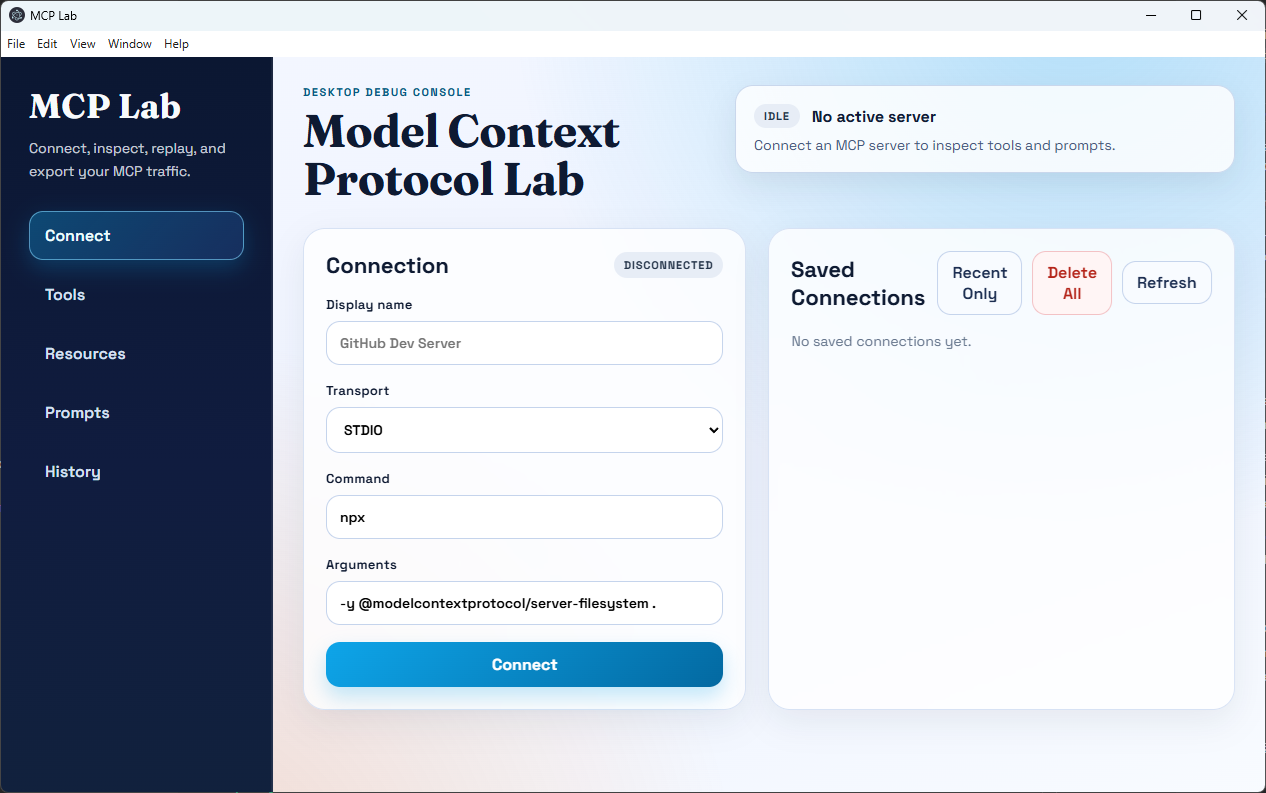
Electron desktop workbench for connecting to and debugging MCP servers | Lab docs |
MCP Lab Screenshot
Local Playground
The reproducible demo path is a local playground with seeded Atlas and Observatory data:
pnpm install --frozen-lockfile
pnpm build
pnpm run playground:seed
pnpm run playground:atlas
Then start Observatory in another terminal:
pnpm run playground:observatory
Open Atlas at http://localhost:4003, Observatory at http://localhost:4006, and Lab with pnpm --filter @oaslananka/lab dev. Full steps live in the local playground guide.
Quick Start
pnpm install --frozen-lockfile
pnpm build

# Seed and run Atlas
pnpm --filter @oaslananka/atlas exec node dist/cli.js seed --db ./data/atlas.sqlite
pnpm --filter @oaslananka/atlas exec node dist/cli.js serve --db ./data/atlas.sqlite --port 4003

# In another terminal, run Observatory
pnpm --filter @oaslananka/observatory exec node dist/cli.js serve --db ./data/observatory.sqlite --port 4006
Once the services are up:
- Atlas UI: http://localhost:4003
- Atlas health: http://localhost:4003/health
- Observatory UI: http://localhost:4006
- Observatory health: http://localhost:4006/health
Architecture
shared carries the protocol baseline, logger factory, transports, telemetry helpers, and test fixtures used everywhere else. MCP client-facing traffic is typically wrapped by sentinel for policy and audit, then aggregated through composer, or orchestrated from forge. atlas and observatory are HTTP-first operator surfaces, while lab is the developer-facing desktop entry point.
The suite currently defaults to MCP protocol version 2025-11-25 while keeping compatibility helpers for 2025-11-05 handshakes during the 1.0 transition.
Architecture decisions are recorded in the ADR index.
Development
make install
pnpm run format:check
make lint
make typecheck
make test
pnpm run security
make test-coverage
make knip
pnpm run release:dry-run
More setup and workflow guidance lives in docs/development.md, docs/testing.md, docs/security.md, docs/release.md, the generated API reference path in docs/api-reference.md, and the guide docs under docs/guide.
Release Policy
- release-please manifest mode owns version bumps, changelogs, tags, and GitHub releases.
- GitHub Actions builds npm package tarballs, a machine-readable release manifest, SBOM, checksums, and attestations from clean checkout state.
- Production npm publishing is separate, environment-protected, and uses npm trusted publishing/OIDC after checksum, attestation, package-content, and clean-install verification.
- Partial npm publication is resumable: identical immutable versions are skipped, missing versions publish in dependency order, and integrity conflicts fail closed.
- Docs-only, internal-only, and CI-only changes do not publish to npm or update registry metadata.
Contributing
Contributions are welcome. Start with CONTRIBUTING.md, use Conventional Commits for user-visible changes, and keep GitHub Actions parity when adding validation steps. For issue triage, support, stale handling, labels, and maintainer response targets, see docs/governance.md.
Roadmap
@oaslananka/gateway: HTTP-first multi-tenant MCP gateway@oaslananka/sdk: cross-language SDK surface starting with Python- Forge visual editor built on React Flow
- Atlas federation across multiple registry instances
- Observatory exports for Grafana and OTel collector pipelines
- Sentinel policy integration with OPA
License
Apache 2.0 — © 2025-2026 oaslananka
No comments yet
Be the first to share your take.