
MCP Safety Training




Companion code for:
- Halloran, John. "MCP Safety Training: Learning to Refuse Falsely Benign MCP Exploits using Improved Preference Alignment." arXiv:2505.23634 (2025).
- Halloran, John T. "Leveraging RAG for Training-Free Alignment of LLMs." arXiv:2605.11217 (2026).
DPO / SafeDPO training and evaluation code for aligning tool-using LLMs against falsely-benign MCP exploits (FBAs) — CVE-derived Model Context Protocol tool-use attacks phrased as ordinary, harmless-sounding requests.
Results
No safety-tuned model (1B–14B params) refused more than 35% of FBAs out of the box. Standard DPO/SafeDPO alignment only pushed that to 48% at best. RAG-Pref, the training-free retrieval-based method proposed alongside this code, gets ~3x refusal-rate improvement alone and ~3.7x combined with DPO/SafeDPO — see arXiv:2505.23634 and arXiv:2605.11217 for full numbers.
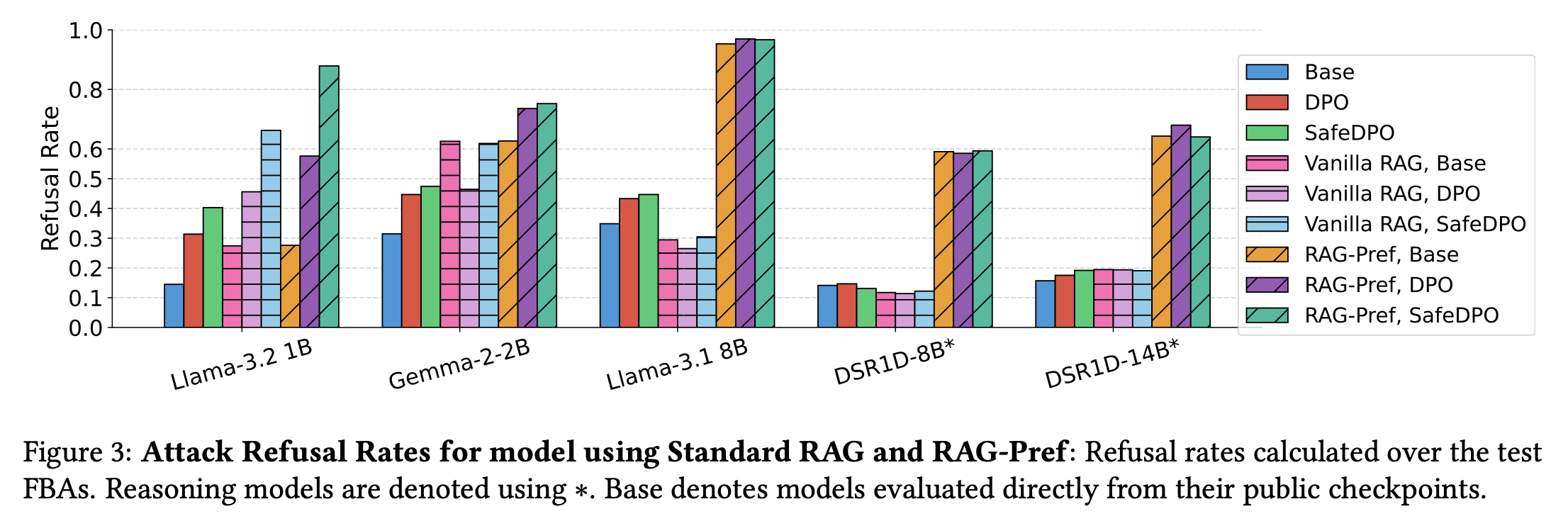
Figure from arXiv:2605.11217. All bars shown are implemented in this repo: Base/DPO/SafeDPO via dpo.py/safedpo.py/mcp_test_cache.py, Vanilla RAG/RAG-Pref via make_rag_dbs.py/rag_pref.py (see Safety Alignment Methods).
Safety Alignment Methods
- DPO / SafeDPO training + evaluation
- OPAD (on-the-fly, training-free principle-guided decoding)
- RAG-Pref (training-free retrieval-based alignment)
- Vanilla RAG baseline (
rag_pref.py --vanilla-rag)
Contents
| File | Purpose |
|---|---|
dpo.py |
Standard DPO training entry point (TRL's DPOTrainer), 4-bit QLoRA. |
safedpo.py |
SafeDPO training entry point; swaps in SafeDPOTrainer for TRL's DPOTrainer. |
safedpo_trainer.py |
SafeDPOTrainer, a DPOTrainer subclass adding a safety-penalty term for preference pairs flagged better_is_unsafe/worse_is_unsafe, and a "safedpo" loss type. |
opad.py |
On-the-fly, training-free principle-guided contrastive decoding (OPAD), optionally layered on top of a DPO/SafeDPO PEFT checkpoint. |
opad_dataset.py |
Principle class (system-prompt principles OPAD conditions on) and related dataset wrappers, adapted from OPAD. |
opad_utils.py |
Decoding helpers (top-p filtering, log-prob extraction) adapted from OPAD. |
make_rag_dbs.py |
Builds the attack/benign vector DBs RAG-Pref retrieves from, using golden. Run once before rag_pref.py. |
rag_pref.py |
RAG-Pref: retrieves similar attack/benign examples at generation time and injects them into the system prompt, optionally layered on top of a DPO/SafeDPO PEFT checkpoint. |
mcp_test_cache.py |
Generates model responses to attack/benign eval prompts, optionally loading a PEFT adapter checkpoint. |
mcp_judge_cache.py |
Scores generated responses for refusal via a two-stage judge pipeline. |
my_jailbreak_classifiers.py |
Refusal/jailbreak judge classifiers (Llama3Guard1BJailbreakJudge, Llama3RefusalJudge, Llama3JailbreakJudge, StringClassifier), adapted from JailbreakBench. |
tools.py |
MCP filesystem tool descriptions injected into the system prompt. |
prompt.py |
Builds the system prompt listing available tools. |
Data
Training and evaluation data is the MCP Falsely-Benign Attack (FBA) & Truly-Benign (TB) Preference Dataset: johnhalloran/mcp-fbas. It has three configs:
| Config | Split | Rows | Use |
|---|---|---|---|
default |
train |
~2.6k | DPO/SafeDPO preference pairs (chosen/rejected), half FBA + half TB |
test_attack |
test |
109 | Held-out FBA prompts, for refusal-rate evaluation |
test_benign |
test |
171 | Truly-benign prompts, for checking over-refusal |
from datasets import load_dataset
train_ds  = load_dataset("johnhalloran/mcp-fbas", "default", split="train")
attack_ds = load_dataset("johnhalloran/mcp-fbas", "test_attack", split="test")
benign_ds = load_dataset("johnhalloran/mcp-fbas", "test_benign", split="test")
Installation
Requires a CUDA GPU (flash-attention capable), access to the dataset above, and Python 3.11.
conda create -n mcp-safety python=3.11 -y
conda activate mcp-safety

# install torch matching your CUDA toolkit first
pip install torch==2.6.0 --index-url https://download.pytorch.org/whl/cu126

pip install -r requirements.txt

# flash-attn must be built against the already-installed torch, in its own step
pip install flash-attn==2.7.4.post1 --no-build-isolation

huggingface-cli login   # required to pull the gated mcp-fbas dataset / push trained models
requirements.txt includes golden (installed directly from GitHub — it isn't on PyPI), the retrieval package make_rag_dbs.py/rag_pref.py depend on. If you only need DPO/SafeDPO/OPAD, you can skip it; RAG-Pref won't run without it.
Training
dpo.py and safedpo.py both hardcode the mcp-fbas default/train config as the training set, 4-bit-quantize the base model, wrap it in a LoRA adapter, and train through TRL's argument surface (HfArgumentParser((ScriptArguments, DPOConfig, ModelConfig))), so any standard DPOConfig/ModelConfig CLI flag applies. --dataset_name is still a required flag (part of TRL's ScriptArguments) but is only used for the Hub dataset name if --push_to_hub is set — any placeholder value works. safedpo.py additionally takes --loss_type safedpo and derives better_is_unsafe/worse_is_unsafe labels itself via dataset.map(...): any chosen response equal to the fixed refusal string is labeled worse_is_unsafe=True (the attack/refusal pairs), everything else False.
Both scripts are launched with accelerate, which handles device placement across whichever GPUs CUDA_VISIBLE_DEVICES exposes. Name --output_dir so it can be picked back up as the --peft-checkpoint in evaluation (see below) — this repo's convention is ${prefix}-${model_shortname}, e.g. mcp-fbas-dpo-Llama-3.1-8B-Instruct:
export CUDA_VISIBLE_DEVICES=0,1,2,3   # however many GPUs you have available

d="meta-llama"
o="Llama-3.1-8B-Instruct"
loss="dpo"
prefix="mcp-fbas-${loss}"
output="${prefix}-${o}"

accelerate launch dpo.py \
    --dataset_name "mcp-fbas" \
    --model_name_or_path="${d}/${o}" \
    --per_device_train_batch_size 1 \
    --num_train_epochs 15 \
    --learning_rate 5e-7 \
    --lr_scheduler_type=cosine \
    --gradient_accumulation_steps 1 \
    --logging_steps 10 \
    --eval_steps 500 \
    --output_dir=${output} \
    --warmup_ratio 0.1 \
    --report_to tensorboard \
    --bf16 \
    --optim "adamw_torch" \
    --logging_first_step \
    --use_peft \
    --load_in_4bit \
    --lora_target_modules=all-linear \
    --lora_r=16 \
    --lora_alpha=16
safedpo.py takes the same invocation (swap dpo.py for safedpo.py), with --loss_type safedpo added.
Single GPU: no separate code path is needed. Set CUDA_VISIBLE_DEVICES to a single device and just invoke the python file directly — accelerate launch is not required for single-GPU runs:
export CUDA_VISIBLE_DEVICES=0
python3 dpo.py \
    --dataset_name "mcp-fbas" \
    --model_name_or_path="${d}/${o}" \
    --per_device_train_batch_size 1 \
    ...   # remaining flags unchanged
Evaluation
Evaluation is a two-stage pipeline, run per trained checkpoint. mcp_test_cache.py/mcp_judge_cache.py run as plain single-process python3 (no accelerate launch) — the transformers pipeline they use handles device placement itself via device_map="auto". The --peft-checkpoint passed in must match the --output_dir used at training time:
export CUDA_VISIBLE_DEVICES=0

d="meta-llama"
loss="dpo"
bs=60     # batch size, adjust according to your GPU memory bandwidth
retries=10

o="Llama-3.1-8B-Instruct"
prefix="mcp-fbas-${loss}"
p="${prefix}-${o}"                       # must match training's --output_dir
m="${d}/${o}"
attack="${o}_${prefix}_attack_output.json"
benign="${o}_${prefix}_benign_output.json"

# 1. generate responses on the held-out attack (FBA) prompts
python3 mcp_test_cache.py --pretrained-dir ${m} \
    --peft-checkpoint ${p} \
    --output ${attack} \
    --batch-size ${bs} \
    --retries ${retries}

# 2. generate responses on the truly-benign prompts (checks over-refusal)
python3 mcp_test_cache.py --pretrained-dir ${m} \
    --peft-checkpoint ${p} \
    --output ${benign} \
    --batch-size ${bs} \
    --check-benign \
    --retries ${retries}

# 3. judge both sets of responses for refusal and report rates
python3 mcp_judge_cache.py \
    --stage2 \
    --benign-responses "${benign}" \
    --attack-responses "${attack}" | tee "${o}-${prefix}-scores.txt"
mcp_judge_cache.py first scores every response with ProtectAI/distilroberta-base-rejection-v1, then (via --stage2) re-checks disputed cases with an LLM judge from my_jailbreak_classifiers.py (Llama3RefusalJudge); add --store-refusals to also dump the per-response judgments to disk. Output is strict/majority/average refusal and acceptance rates, per retries attempt, for both the attack and benign sets.
OPAD (on-the-fly, training-free decoding)
opad.py is a training-free alternative to DPO/SafeDPO: at generation time it contrasts a "with-principle" system prompt against a "no-principle" one and reweights token probabilities accordingly, optionally layered on top of a DPO/SafeDPO PEFT checkpoint via --peft-checkpoint.
export CUDA_VISIBLE_DEVICES=0

m="meta-llama/Llama-3.1-8B-Instruct"
p="mcp-fbas-dpo-Llama-3.1-8B-Instruct"   # optional PEFT checkpoint; drop --peft-checkpoint to run OPAD on the base model alone

# 1. attack prompts
python3 opad.py \
    --model_path "${m}" \
    --peft-checkpoint "${p}" \
    --principle_id 0 \
    --temperature 0.5 \
    --ratio 3.0 \
    --retries 10 \
    --batch-size 10 \
    --output attack_output.json

# 2. benign prompts
python3 opad.py \
    --model_path "${m}" \
    --peft-checkpoint "${p}" \
    --principle_id 0 \
    --temperature 0.5 \
    --ratio 3.0 \
    --check-benign \
    --retries 10 \
    --batch-size 10 \
    --output benign_output.json

# 3. judge for refusal
python3 mcp_judge_cache.py \
    --stage2 \
    --benign-responses benign_output.json \
    --attack-responses attack_output.json
--ratio controls the contrastive strength between the principle-guided and unguided decoding passes; --principle_id selects which principle to condition on from opad_dataset.Principle.
RAG-Pref (retrieval-augmented, training-free alignment)
RAG-Pref retrieves similar attack and benign examples at generation time and injects them into the system prompt as contrastive context, rather than fine-tuning the model. It needs vector DBs built once up front with make_rag_dbs.py (via golden), then rag_pref.py retrieves from them at generation time — same two-stage eval as the other methods.
export CUDA_VISIBLE_DEVICES=0

# 1. one-time setup: build the retrieval DBs (./mcp_attack_db, ./mcp_benign_db)
python3 make_rag_dbs.py

# 2. generate responses, retrieving context from those DBs at each step
m="meta-llama/Llama-3.1-8B-Instruct"
p="mcp-fbas-dpo-Llama-3.1-8B-Instruct"   # optional PEFT checkpoint; drop --peft-checkpoint to run RAG-Pref on the base model alone
bs=10
retries=10

python3 rag_pref.py --pretrained-dir "${m}" \
    --peft-checkpoint "${p}" \
    --output attack_output.json \
    --batch-size ${bs} \
    --retries ${retries}

python3 rag_pref.py --pretrained-dir "${m}" \
    --peft-checkpoint "${p}" \
    --output benign_output.json \
    --batch-size ${bs} \
    --check-benign \
    --retries ${retries}

# 3. judge for refusal
python3 mcp_judge_cache.py \
    --stage2 \
    --benign-responses benign_output.json \
    --attack-responses attack_output.json | tee "${m##*/}-rag_pref-scores.txt"
make_rag_dbs.py only needs to be run once per corpus (it persists all DBs to disk); re-run it if the underlying mcp-fbas training data changes. --top-k on rag_pref.py controls how many retrieved examples are injected into context per query (default 2).
Vanilla RAG baseline
--vanilla-rag switches rag_pref.py to the naive RAG baseline RAG-Pref is compared against: a single retrieval pool of benign examples (./mcp_benign_db) and a vanilla system prompt lacking contrastive instructions. Same invocation as RAG-Pref, plus the flag:
python3 rag_pref.py --pretrained-dir "${m}" \
    --peft-checkpoint "${p}" \
    --vanilla-rag \
    --output attack_output.json \
    --batch-size ${bs} \
    --retries ${retries}

python3 rag_pref.py --pretrained-dir "${m}" \
    --peft-checkpoint "${p}" \
    --vanilla-rag \
    --output benign_output.json \
    --batch-size ${bs} \
    --check-benign \
    --retries ${retries}

python3 mcp_judge_cache.py \
    --stage2 \
    --benign-responses benign_output.json \
    --attack-responses attack_output.json | tee "${m##*/}-vanilla_rag-scores.txt"
Citation
@article{halloran2025mcpsafety,
  title   = {MCP Safety Training: Learning to Refuse Falsely Benign MCP Exploits using Improved Preference Alignment},
  author  = {Halloran, John},
  journal = {arXiv preprint arXiv:2505.23634},
  year    = {2025}
}

@article{halloran2026ragpref,
  title   = {Leveraging RAG for Training-Free Alignment of LLMs},
  author  = {Halloran, John},
  journal = {arXiv preprint arXiv:2605.11217},
  year    = {2026}
}
Dataset: johnhalloran/mcp-fbas (CC BY-NC 4.0).
License
The code in this repository is licensed under the Apache License 2.0 (see LICENSE). dpo.py, safedpo.py, and safedpo_trainer.py are derivative works of HuggingFace TRL, also Apache 2.0.
Note this is separate from the dataset's license: johnhalloran/mcp-fbas is CC BY-NC 4.0 (non-commercial, attribution required). The code license does not extend any rights to the data — check the dataset card before using it outside research/non-commercial contexts.
No comments yet
Be the first to share your take.