
MCP-HUB-LITE






A lightweight MCP management platform designed for independent developers, providing MCP server gateway, grouping, fuzzy search, and MCP HttpStream protocol interface.
Overview
MCP-HUB-LITE is an MCP server gateway designed specifically for independent developers. It acts as a proxy between your frontend and multiple backend MCP servers, providing a unified access interface with support for the MCP JSON-RPC 2.0 protocol.
Core Features
- MCP Gateway Service: Unified proxy interface for multiple backend MCP servers
- MCP CLI Tool: Command-line tool for listing and calling MCP tools across servers
- Server Management: Manage multiple MCP servers through a web interface
- Tool Search: Search and tool discovery across all servers with aggregation
- Process Management: Launch and manage MCP server processes via npx/uvx
- Dual-Mode Session: Stateful (session persistence, SSE, notifications) and stateless (per-request) modes, with UA / header / config priority switching
- MCP Notification Push: Push
notifications/tools/list_changedandnotifications/resources/list_changedto connected clients - Multi-Instance Support: Run multiple instances of the same MCP server with load balancing
- Instance Selection Strategies: Support random, round-robin, and unique-by-tag selection
- Tag System: Organize multiple MCP servers by environment, category, function, etc.
- Fault Tolerance: System continues to operate when individual servers fail
- Bilingual Interface: Support for Chinese/English interface switching
- Configuration Management: Support for hot-reloading and maintenance of
.mcp-hub.json - MCP Native Resources: Forward resource calls to backend MCP servers
- Security: Mask sensitive values in config change logs
Quick Start
System Requirements
- Node.js 22.x or higher
- npm or yarn
- Windows, macOS, or Linux
Installation
Install from npm
# Install from npm
npm install -g @loop_ouroboros/mcp-hub-lite
# Start the service
mcp-hub-lite start
# Open UI
mcp-hub-lite ui
Build from source
# Install dependencies
npm install
# Run in development mode (frontend and backend hot reload)
npm run dev
# Build production version
npm run build
# Full check (build + tests + code check)
npm run full:check
# Run production version
npm start
# Check status
mcp-hub-lite status
# Open UI interface
mcp-hub-lite ui
The server will start at http://localhost:7788.
Server Management
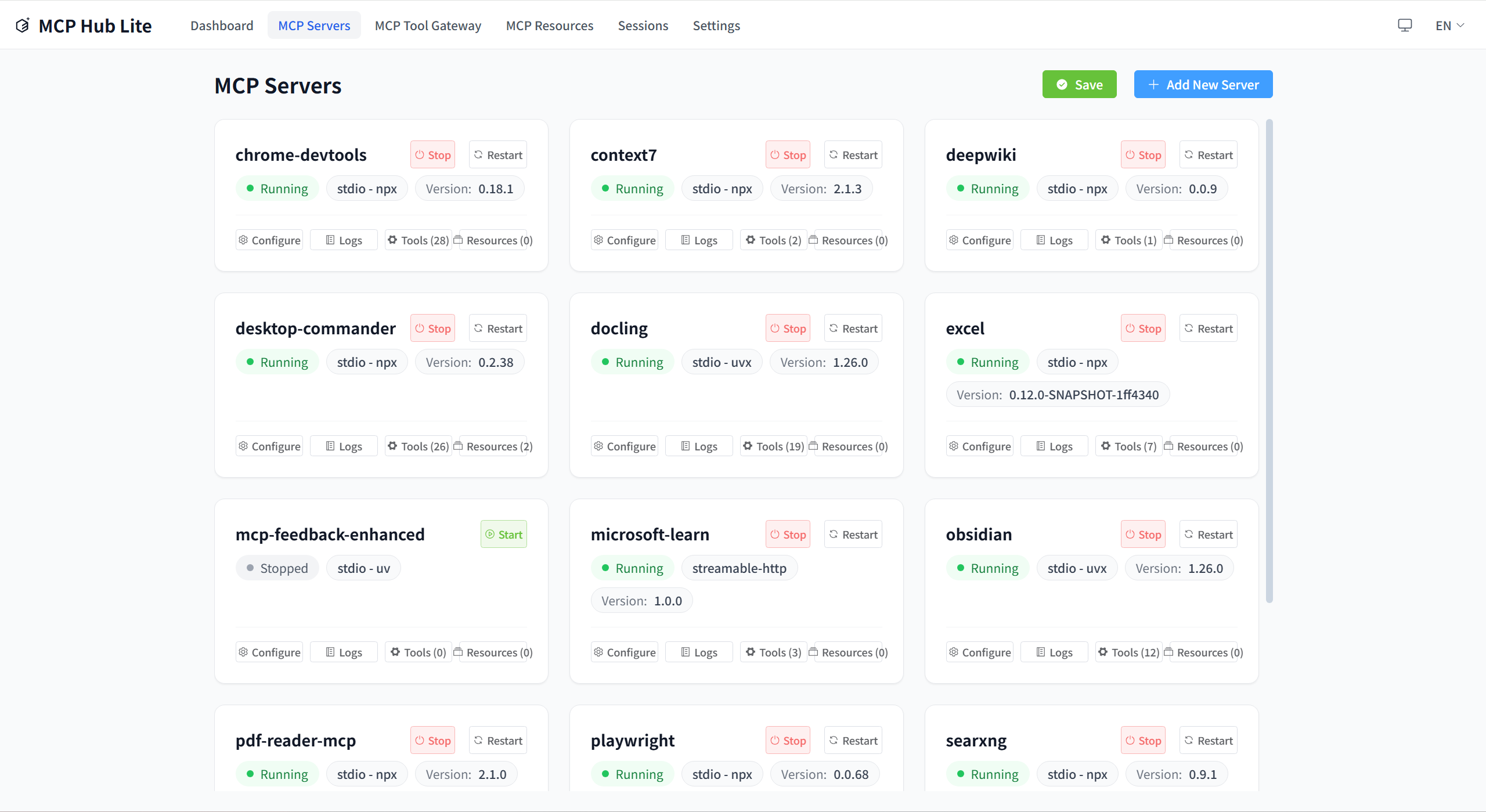
Manage all your MCP servers in one place. Add, edit, delete, connect, and disconnect servers through the intuitive web interface.
Gateway & Tools
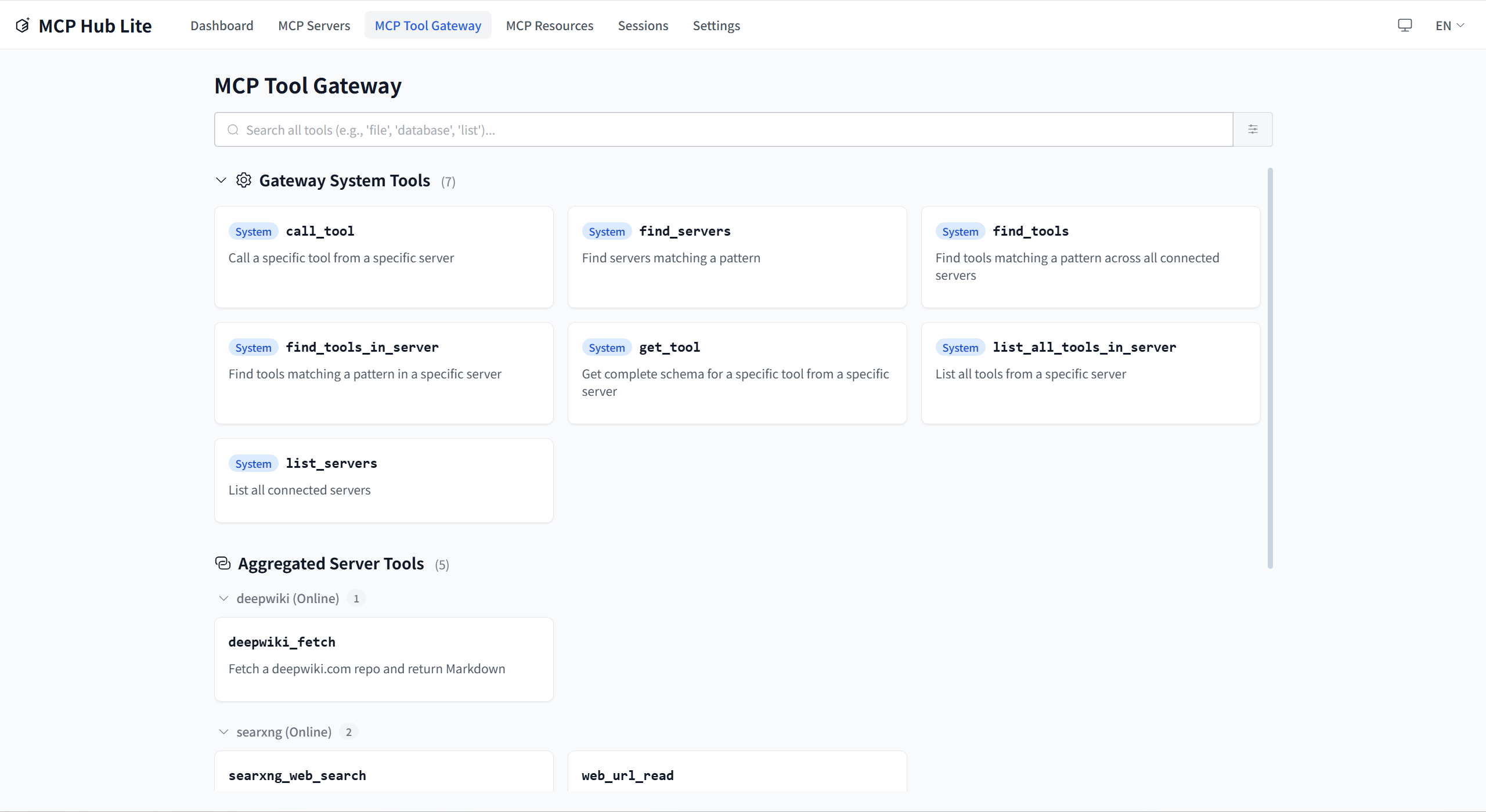
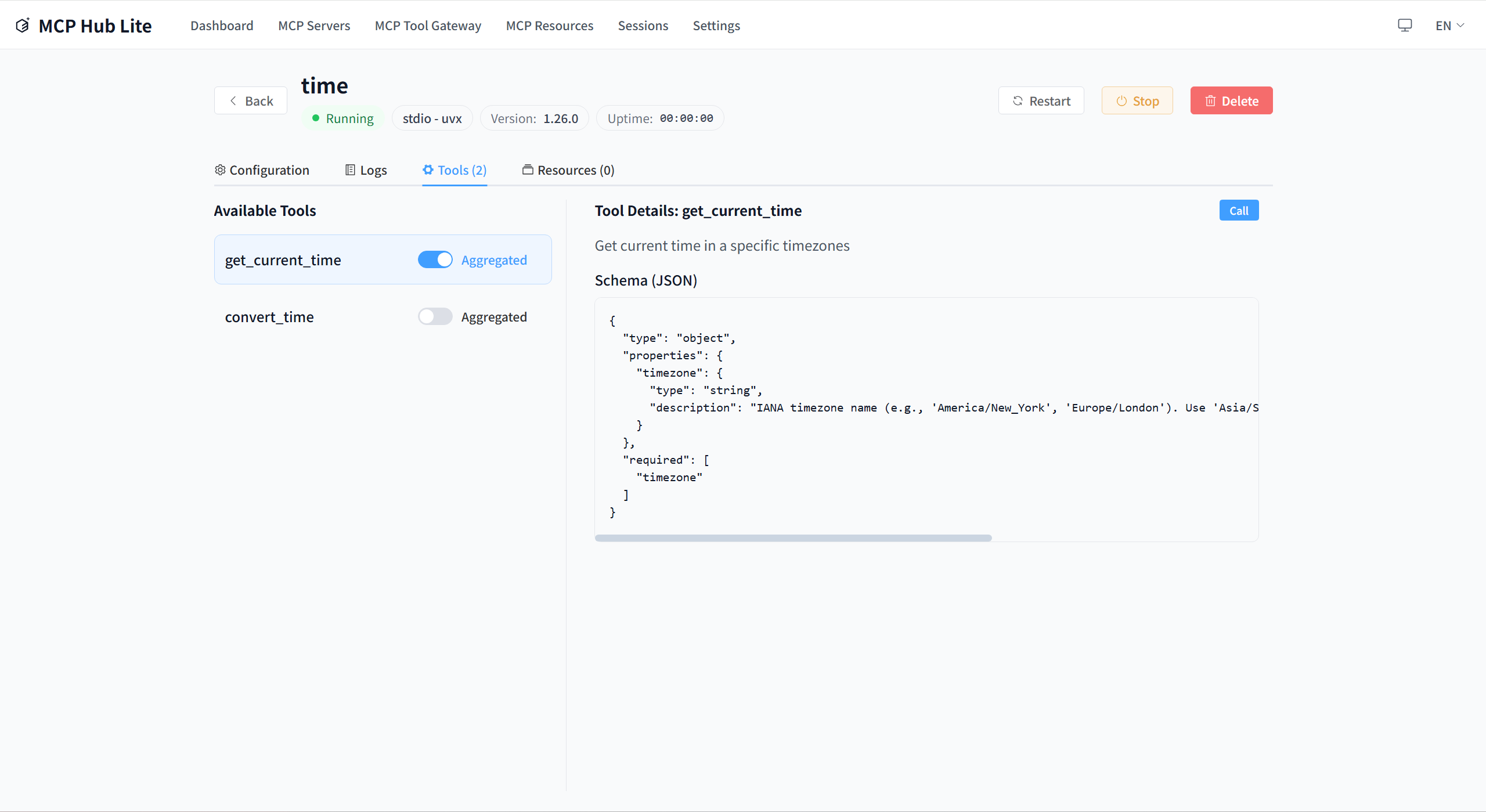
Discover and call tools from all connected MCP servers through the unified gateway interface. The aggregated tools view provides a single place to search and use all available tools.
Resources
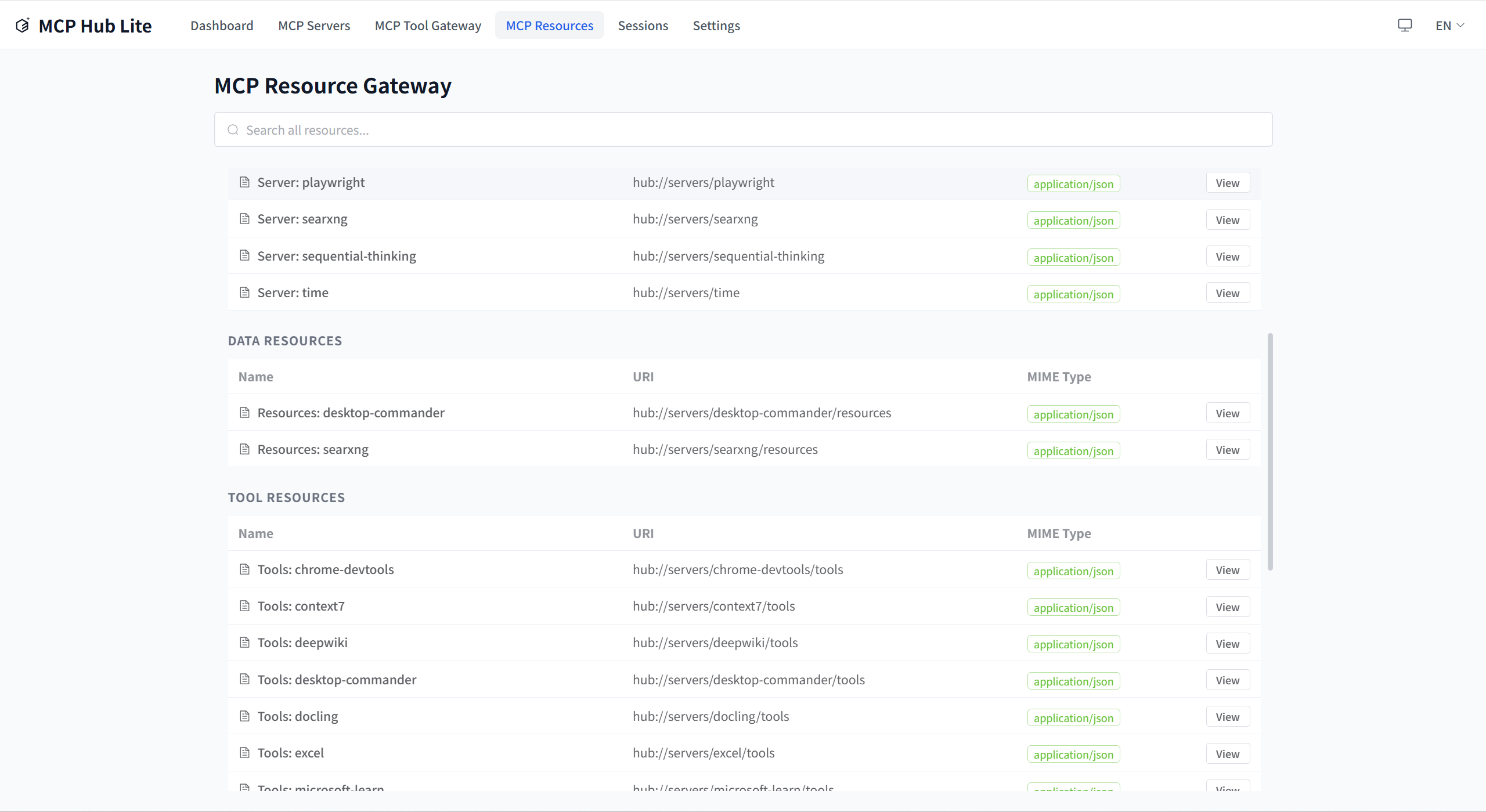
Browse and manage MCP resources from all connected servers.
Testing
# Run all tests
npm test
# Backend tests
npm run test:backend
# Frontend tests
npm run test:frontend
CLI Commands
MCP-HUB-LITE provides a command-line interface for managing the service.
# Start the service
npm start
# or
mcp-hub-lite start
# Check status
mcp-hub-lite status
# List all servers
mcp-hub-lite list
# Open web interface
mcp-hub-lite ui
# Help
mcp-hub-lite --help
Tool Use Command
The tool-use command provides MCP server tool operations:
# List system tools (default server: mcp-hub-lite)
mcp-hub-lite tool-use list-tools
# List tools from a specific server
mcp-hub-lite tool-use list-tools --server baidu-search
# Get tool schema
mcp-hub-lite tool-use get-tool --tool list_tools
# Call a system tool
mcp-hub-lite tool-use call-tool --tool list_tools --args '{}'
# Call a server tool
mcp-hub-lite tool-use call-tool --server baidu-search --tool search --args '{"query":"hello"}'
Configuration
MCP-HUB-LITE uses a .mcp-hub.json file for configuration. Configuration lookup priority:
- Environment variable
MCP_HUB_CONFIG_PATH ~/.mcp-hub-lite/config/.mcp-hub.json(hidden folder in user home directory)
Configuration Example
{
"version": "1.1.0",
"servers": [
{
"id": "server-1",
"name": "My MCP Server",
"description": "Example server",
"transport": "streamable-http",
"endpoint": "http://localhost:8080",
"tags": {
"env": "development",
"category": "api-server",
"function": "http-api",
"priority": "medium"
},
"allowedTools": [],
"instances": [
{
"index": 0,
"displayName": "Instance 1",
"enabled": true,
"env": {}
}
],
"managedProcess": {
"command": "npx my-mcp-server",
"managedMode": "npx",
"processType": "streamable-http"
}
}
],
"settings": {
"language": {
"current": "en-US",
"autoDetect": true,
"fallback": "en-US"
},
"logging": {
"level": "info"
}
},
"system": {
"session": {
"defaultSessionMode": "stateful",
"sessionModeRules": {
"stateful": ["Claude"],
"stateless": ["CherryStudio"]
}
}
},
"gateway": {
"proxyTimeout": 30000,
"rateLimit": {
"enabled": true,
"maxRequests": 100,
"windowMs": 60000
}
}
}
Client Configuration
To connect your MCP client to MCP-HUB-LITE, add the following to your client's MCP configuration:
{
  "mcpServers": {
    "mcp-hub-lite": {
      "type": "http",
      "url": "http://localhost:7788/mcp"
    }
  }
}
Stateful mode provides session persistence, SSE streaming, and real-time notifications. UA matching is NOT automatic — it requires manually adding "ClaudeCode" to system.session.sessionModeRules.stateful in .mcp-hub.json. Standard MCP clients like Claude Code work with the default stateful mode without extra configuration.
{
  "mcpServers": {
    "mcp-hub-lite": {
      "type": "http",
      "url": "http://localhost:7788/mcp",
      "headers": {
        "x-mcp-session-mode": "stateless"
      }
    }
  }
}
CherryStudio requires the x-mcp-session-mode: stateless header to use stateless mode. UA matching is NOT automatic — it requires manually adding "CherryStudio" to system.session.sessionModeRules.stateless in .mcp-hub.json. The header approach is the recommended way and takes highest priority.
Stateless mode uses per-request transport — each POST creates an independent transport, no session persistence, GET returns 405.
Add the x-mcp-session-mode header to force a specific mode:
{
  "mcpServers": {
    "mcp-hub-lite": {
      "type": "http",
      "url": "http://localhost:7788/mcp",
      "headers": {
        "x-mcp-session-mode": "stateful"
      }
    }
  }
}
Valid values: "stateful" or "stateless". Header takes highest priority over UA matching and config defaults.
Usage Guide
Adding MCP Servers
Through the web interface:
- Open http://localhost:7788
- Navigate to the "Servers" page
- Click "Add Server"
- Fill in server details and save
Process Management
MCP-HUB-LITE supports launching and managing MCP servers using your local environment:
Supported Launch Methods
- Node.js (npx):
npx package-name - Python (uvx):
uvx package-name - Direct Command: Custom startup command
Process Management Features
- Start/stop/restart MCP servers
- Monitor CPU and memory usage
- Crash detection and automatic restart
- PID tracking and health checks
Development Guide
Project Structure
src/
├── api/              # API implementations
│   ├── mcp/          # MCP protocol handlers
│   ├── web/          # Web API routes (includes sessions.ts)
│   └── ws/           # WebSocket routes
├── models/           # Data models
├── services/         # Core business logic
│   ├── gateway/      # MCP gateway service
│   ├── connection/   # Connection management
│   └── hub-tools/    # Hub tools service
├── utils/            # Utility functions
│   ├── logger/       # Logging utilities
│   └── transports/   # MCP transport implementations
├── config/           # Configuration
├── cli/              # CLI commands
│   └── commands/     # CLI command implementations
├── pid/              # Process ID management
└── server/           # Server runtime

frontend/
├── src/
│   ├── components/   # Reusable UI components
│   ├── views/        # Page view components
│   ├── stores/       # Pinia state management
│   ├── composables/  # Vue composables
│   ├── router/       # Vue Router configuration
│   ├── i18n/         # Internationalization
│   └── types/        # Frontend type definitions

shared/
├── models/           # Shared models
└── types/           # Shared types

tests/
├── unit/            # Unit tests
├── integration/     # Integration tests
├── contract/        # Contract tests
├── helpers/         # Test helpers
└── types/          # Test types
Adding New Features
- Create models (models/)
- Implement services (services/)
- Add API routes (api/)
- Write tests (tests/)
- Update configuration files
Detailed Technical Documentation
Complete project architecture, constraints, and design decisions can be found in:
- CLAUDE.md - Project AI context and module documentation
License
MIT
Contributing
Pull Requests and Issues are welcome!
Community
Thanks to the LinuxDo (linux.do) community for the discussions, sharing, and feedback.
No comments yet
Be the first to share your take.