
MAMA OS




Right now, you read every channel yourself so nothing slips past you. MAMA reads them instead, and sends you the few things that need you. Every claim links to its source.
MAMA OS is an always-on agent server. You install it on your own machine, and it
stays running around the clock — like Home Assistant or Plex, but its job is your work
channels. mama start brings it up. Its Viewer lives at localhost:3847. Its
reports arrive in your chat app.
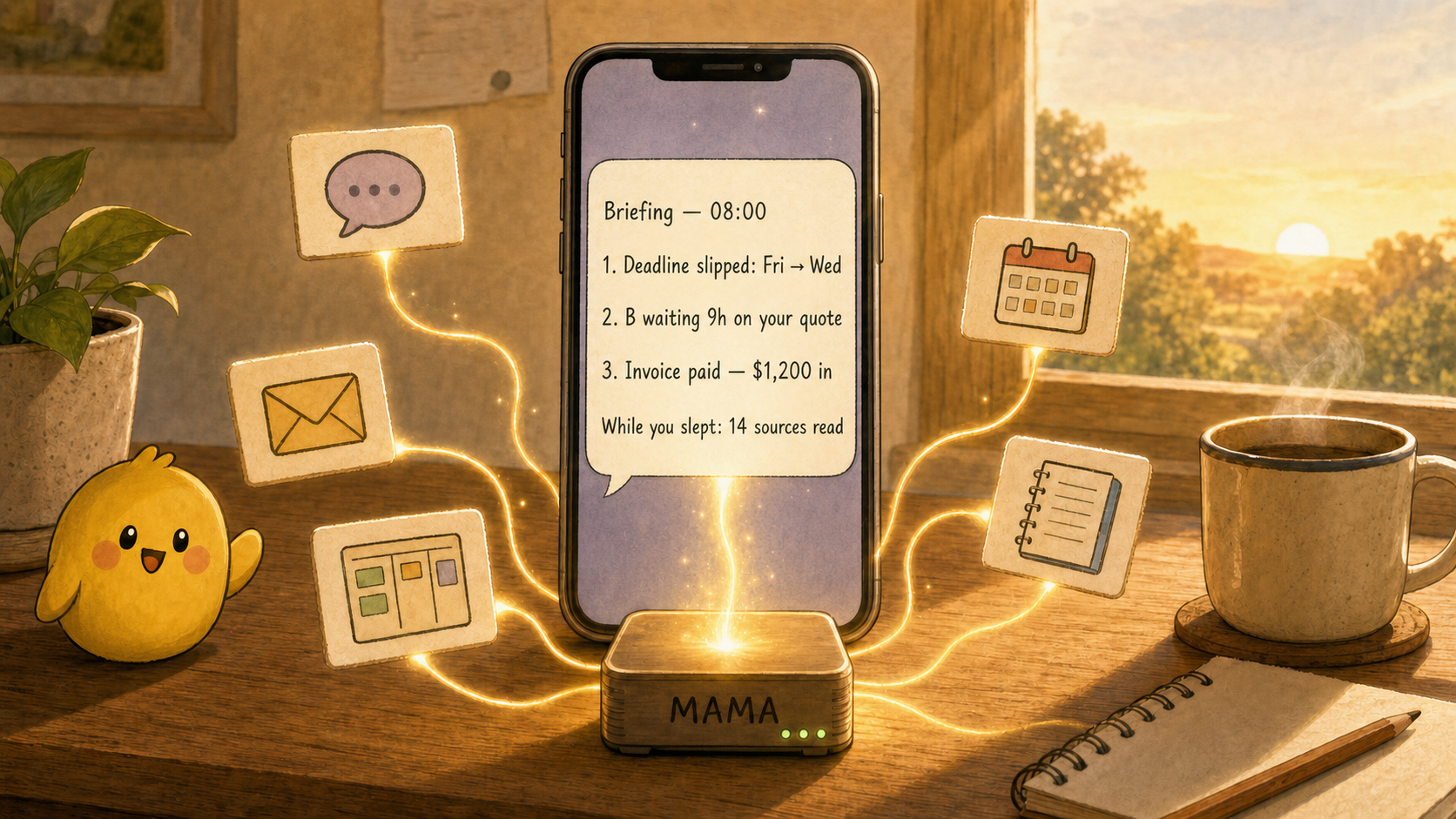
The product is a message that arrives
You pick the hours. At those hours, in Telegram, Slack, or Discord:
■ Briefing — Wed 08:00
1. The #alpha deadline slipped: Friday → Wednesday            → source
2. B has waited 9 hours for your quote                        → source
3. Client A paid the invoice — $1,200 came in                 → source

■ Needs your action
- Approve the revised scope before the 11:00 call             → thread

■ Recorded yesterday
- Decision: rotate the staging API keys weekly                → source
The names are made up. The format is exactly what it sends.
Nobody asked for that message. Overnight, the MAMA server on your machine read 14 sources: Slack, Telegram, Gmail, Trello, Sheets, an Obsidian vault, and more. It decided what needed you, and wrote it down with links.
It also did the small work already — done by a standing roster of workers, not one giant bot: a board keeper that files tasks from conversations, a wiki writer that keeps the daily page, a deadline watcher that rechecks dates, and a memory curator that decides what deserves to be remembered. Each one leaves receipts you can open.
What that replaces
- The morning scan across channels that mostly did not change.
- Scrolling back to find out when that deadline moved, and who said so.
- The handoff note you have to write before you step away.
And three things it is not:
- Not a chatbot with good memory. It is a server that runs while nobody is talking to it.
- Not a memory database. Storage is the input; the report is the product.
- Not a hosted service. There is no MAMA account and no MAMA server. It runs on the logins you already have.
Why not a task agent, or your chat app's AI?
Both exist and both are good. They just answer a different question.
- A task coworker finishes work you already know about. You still have to notice that the deadline moved before you can delegate it. MAMA's job is to notice for you.
- A chat integration reads Slack when you ask. But your clients are on Chatwork, iMessage, and Telegram DMs. MAMA reads fourteen sources, including the messy ones where the money actually talks.
- Both start from zero every time. MAMA keeps a record on your disk and answers from it, with the source message linked. It does not run a new search that forgets everything afterwards.
- Neither can say "still unanswered after three days." To say that, you must remember yesterday. MAMA remembers. A scheduled summary starts fresh every time and has nothing to compare against.
Built to be checked, not believed
A system that acts on its own must be easy to check afterwards.
- No source, no claim. Every change MAMA makes is saved together with the events that caused it. If it cannot name a cause, the change is saved as unattributed. The database rejects any row that fakes a cause.
- It drafts; you send. An agent can write the customer reply from the evidence, but sending requires an explicit permission for that destination. Memory writes refuse anything shaped like a secret. The system interrupts you for approvals and operational alarms such as stale claims, exhausted retries, or unresolved effects; everything else waits for the next report.
- Your record stays on your machine. The databases are local SQLite and the
embeddings are computed locally. Network traffic goes to two places only: the
services you connected (Slack, Gmail, and so on) and your AI provider, through
the official
claudeorcodexCLI you already logged into. Nothing is ever uploaded to a MAMA server, because there is none. - Search shows its work. Strict mode drops a semantic match that has no text or entity evidence behind it. A wrong answer that merely sounds right gets rejected, not displayed.
More detail: Architecture · Security guide
Quick start
The server — the full product. Install once; it keeps running until you stop it:
claude auth login            # or: codex login — your existing CLI auth is reused
npx @jungjaehoon/mama-os init
mama start                   # daemon at localhost:3847
Operator board at http://localhost:3847/viewer: live report slots, the trigger
library, and a task board fed from your channels. Chat surfaces: Discord,
Slack, Telegram. Requires Node >= 22 and an authenticated
Claude Code or
Codex CLI.
Claude Code plugin — decision memory for coding sessions. It works without the daemon; one hook (conversation ingestion at compaction) uses the daemon when it is running, and skips quietly when it is not:
/plugin install mama
/mama:search "authentication strategy"
MCP server — Claude Desktop or any MCP client:
{ "mcpServers": { "mama": { "command": "npx", "args": ["@jungjaehoon/mama-server"] } } }
The pieces
| Package | What it is | You run it? |
|---|---|---|
| mama-os 0.36.0 | The always-on server: connectors, trigger loop, reports, task board, web UI. 92k lines. "MAMA" means this. | mama start |
| mama-core 2.2.0 | The library underneath: memory, provenance, graph, embeddings. Everything imports it; it imports nothing here. | No binary |
| mama-server 1.15.0 | A deliberately thin MCP adapter over the core — 3.7k lines, no logic of its own. | As an MCP server |
| plugin 1.11.0 | Claude Code hooks + slash commands. No background process. | Installed, not run |
| memorybench 1.0.0 | The benchmark harness behind the retrieval numbers. | To reproduce a score |
Dependency direction is one-way: nothing depends on the daemon.
Our numbers, including the bad ones
- 93.0% on a 100-question LongMemEval tool-use sample (Sonnet 4.6, fully local) — above SuperMemory (81.6%), below Mastra (94.87%). Reproduce it.
- 84% of trigger-authoring passes create nothing. A duplicate gate rejects near-copies of triggers that already exist. That is correct, but a loop this idle should at least say why it declined.
- Cache reuse is 15.9x per built context, against 144.8x for a comparable system on the same machine. This is our biggest known cost problem.
- Attribution is wired end-to-end, and the ratio is still low. Every change now
carries a cause KIND (
event/owner_message/clock/card_transition- the DB rejects a kind that disagrees with its ids), and judgment runs receive their event batch from the host. But most changes are still clock-born: the conductor that turns channel batches into attributed judgments ships dark behindconductor.enabled. The ratio rises when it flips, not before. We plan to raise it, not excuse it.
Roadmap
| Done (v0.15–v0.29) | Search overhaul → connector framework → operator runtime → owner console → durable workorder pipeline → evidence & effects. Full history in the CHANGELOG. |
| Done (v0.30–v0.32) | Conductor foundations (durable inbox, judgment session - dark behind conductor.enabled) → causes wired not relabeled, failures carry the thrower's code, a silent leg pages the owner, memory reads follow the channel grant → persistent Code-Act processes follow the active principal and do not replay completed mutations. |
| Now | v1.0 Phase 1 — sender authentication at every chat ingress: owners are admitted, external senders are diverted, and addressed Telegram group messages enter an isolated public lane. The gate every team feature stands on. |
| Next | Unpacked below. |
| v1.0 | The brain of a team, not just its owner. The owner registers members and sets each one's level: what they can read, which agents they can use. Shared, scoped knowledge — an owner's private record stays private. Member agents ship behind owner approval. One owner, always; multi-organization stays out until v2. |
Each "Next" item comes from a measurement, or from a competitor doing it better:
- Stable prompt prefixes for the autonomous lanes. Cache reuse is 15.9x against a comparable system's 144.8x. One prompt cut (231 KB → 57 KB) already halved per-call cost. The same discipline applies to the report and board lanes.
- Zero-yield authoring that says why. 84% of authoring passes create nothing. A pass that declines should record what it rejected, and a near-duplicate should strengthen the existing trigger instead of vanishing.
- A surface that can only answer "nothing" fails the build. Two shipped APIs turned out to be permanently empty. The drift guard that now covers the tool catalog generalizes to every advertised surface.
- Reports that state their own arithmetic. The daily report should end with what it handled for you — tasks filed, dates rechecked, questions closed — in counts, so the time it returns is a number, not a feeling.
- An approval inbox. Taken from OpenWorker: when the owner is away, the system queues the decision instead of raising its own authority.
- Permissions you can explain in one sentence. Also from OpenWorker: label every action as read, write-local, or external-send. And state the standing rule up front: external sends never happen without explicit permission, by design.
- A first briefing in the first five minutes. Taken from Claude's Slack integration: one connector, first poll, first report. The product should prove itself before anyone has to believe anything.
Development
git clone https://github.com/jungjaehoon-lifegamez/MAMA.git
cd MAMA && pnpm install && pnpm build
pnpm test     # 5,859 tests across five packages
Guidelines in CLAUDE.md. Last updated: 2026-08-13
License
MIT
No comments yet
Be the first to share your take.