
📖 loredex
The universal control system for coding-agent teamwork across products, projects, and repos.




lore — everything your agents learn · dex — an index that records it automatically
loredex ecosystem · 📖 loredex (CLI + core) (you are here) · 🖥️ Desktop app · 🔮 Obsidian plugin
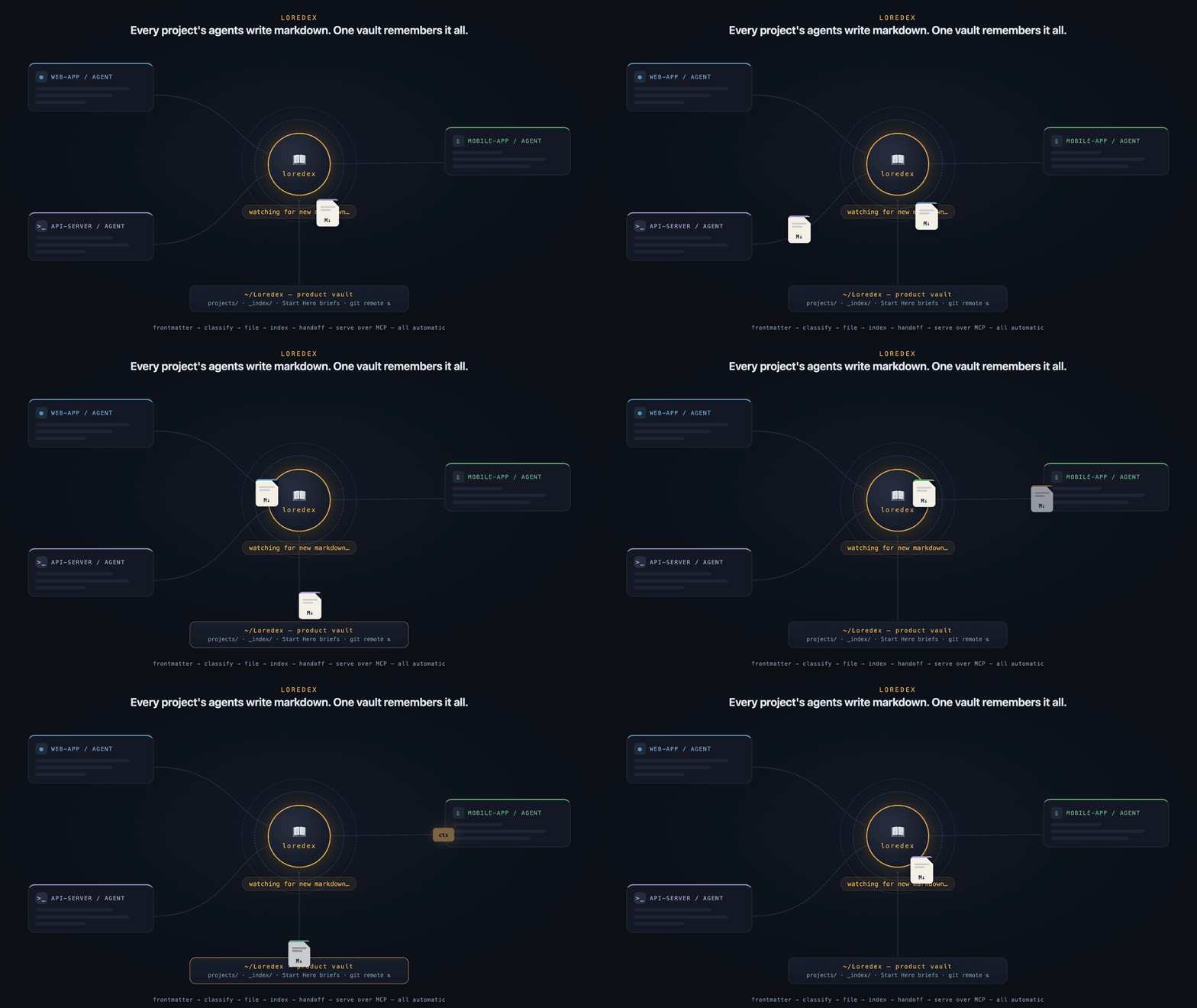
Loredex is a shared memory and control system for coding-agent teamwork across products, projects, and repos. It captures research, findings, validations, decisions, and handoffs in one connected knowledge layer that agents can read through MCP and teams can manage through Obsidian dashboards. The result is simple: any agent can open any repo, inherit the full working context, and keep moving from context instead of guesswork.
🚀 Quick Actions
| I want to... | Go here |
|---|---|
| Understand the problem and the solution fast | Visual overview |
| Organize an existing project right now | Quickstart |
| Install the Claude Code plugin | Install for Claude Code |
| Use loredex inside Obsidian | loredex-obsidian |
| Install the native desktop app (mac/win/linux) | Desktop app · download |
| See the full public infographic story | docs/INFOGRAPHICS.md |
| Learn the full workflow and commands | docs/USER-GUIDE.md |
📑 Table of Contents
- Quick Actions
- Visual overview
- Quickstart
- How it works
- How it compares
- The ecosystem
- Features
- Install for Claude Code
- Works with any agent
- Commands
- Curate
- One product, many repos
- Agents read the vault: MCP
- Browse it: Obsidian
- Desktop app
- Sync across devices
- Security model
- FAQ
- Documentation
- Roadmap
- Contributing
🖼️ Visual Overview
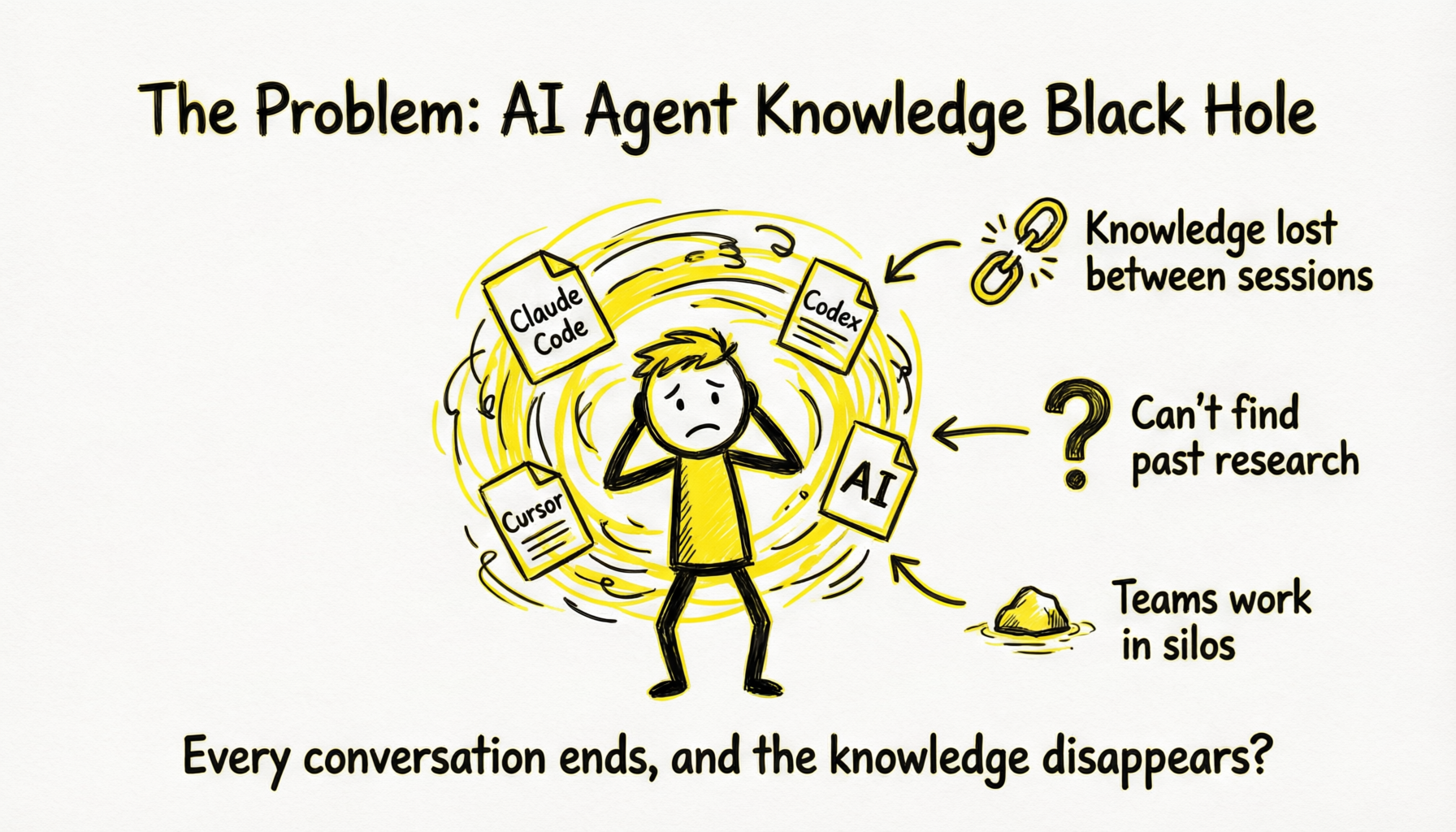
The problem: coding agents are productive, but their knowledge ends up scattered across repos, sessions, and random markdown files.
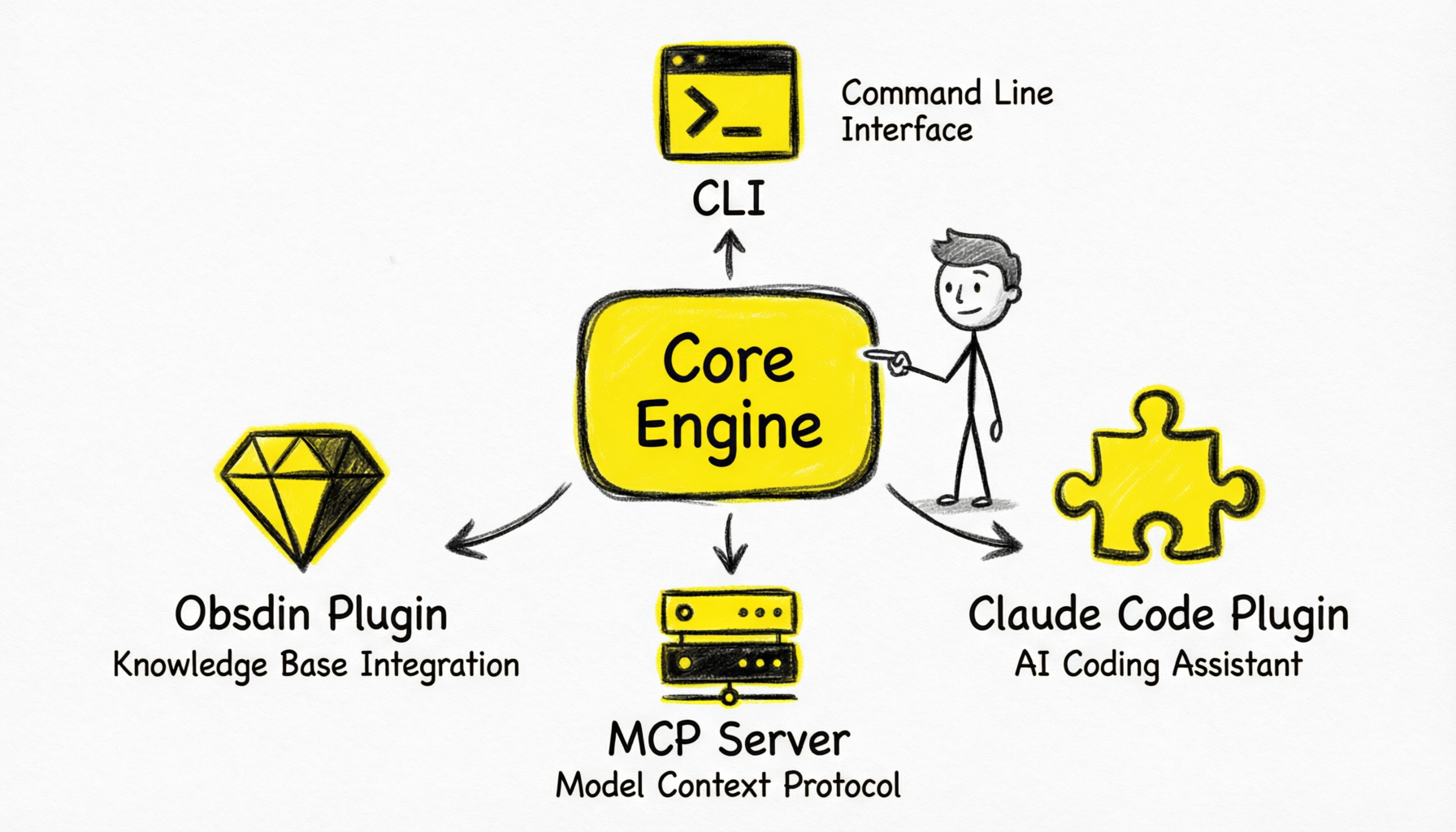
The solution: loredex gives every agent a shared filing system, shared memory shape, and shared retrieval layer.
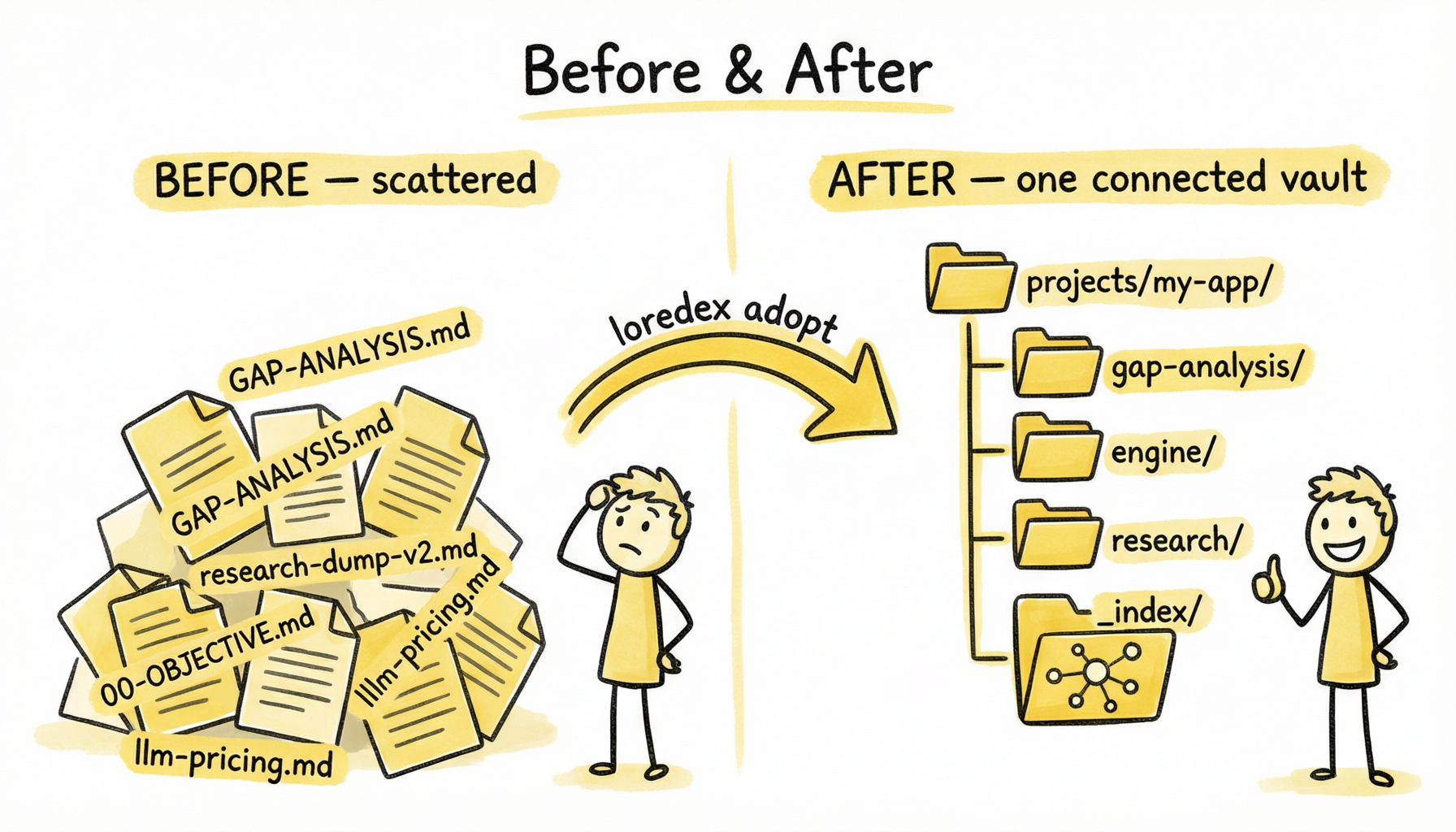
The outcome: instead of disconnected notes, you get one navigable vault with indexes, handoffs, and reusable context.
The fastest way to start: initialize once, adopt existing markdown, and open the vault in Obsidian.
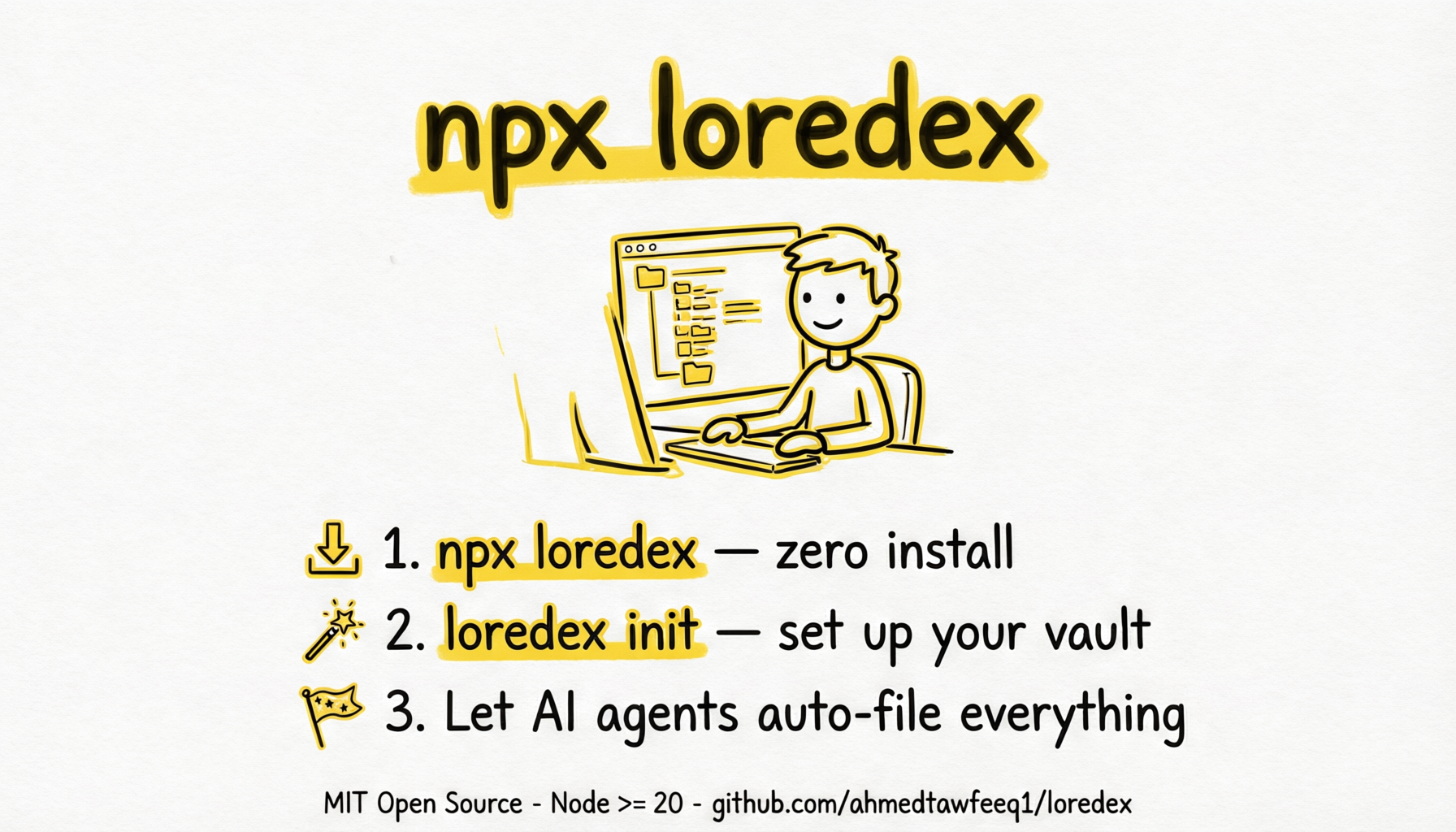
Want the full narrative, including design principles, security, curation, MCP, and multi-agent usage? Open docs/INFOGRAPHICS.md.
⚡ Quickstart
Organize an existing project in 60 seconds:
cd your-project
npx loredex adopt --dry-run   # see the filing plan — writes nothing
npx loredex adopt             # do it
Open ~/Loredex in Obsidian. Your scattered agent output is now a connected knowledge graph.
BEFORE — scattered across your repo          AFTER — one connected vault
─────────────────────────────────           ────────────────────────────────────────────────
docs/GAP-ANALYSIS.md                        projects/my-app/gap-analysis/2026-07-03-gap-analysis.md
docs/current-system/00-OBJECTIVE.md    →    projects/my-app/current-system/2026-07-03-objective.md
research-dump-v2.md                         projects/my-app/engine/2026-07-01-research-dump-v2.md
notes/llm-pricing.md                        research/llm-tools/2026-06-28-llm-pricing.md
                                            _index/my-app.md        ← map of content, auto-built
                                            _index/Dashboard.base   ← native Obsidian database
                                            _index/Home.md          ← vault-wide index
Originals stay in place (stamped with loredex: routed so they're never re-adopted). Pass --move to relocate them instead. Every command supports --dry-run.
[!TIP] Read the index, not the folder tree. Pin
_index/<project>.md— topics are ordered by latest activity (newest first, date in every heading) — or open_index/Dashboard.basefor a native, sortable database of every note. Obsidian sorts folders alphabetically and always will; the indexes are the front door.
🧠 How it works
 agents write .md          loredex routes                 your vault
┌─────────────────┐   ┌──────────────────────┐   ┌─────────────────────────────┐
│ Claude Code     │   │ 1. frontmatter?      │   │ projects/<project>/<topic>/ │
│ Codex           │ → │    → deterministic   │ → │   YYYY-MM-DD-slug.md        │
│ Cursor          │   │ 2. else LLM classify │   │ _index/  ← auto MOCs + base │
│ anything        │   │ 3. else heuristics   │   │ + wikilinks, git commit     │
└─────────────────┘   └──────────────────────┘   └─────────────────────────────┘
- Deterministic first — files with
project+topicfrontmatter route instantly, no LLM involved. - LLM fallback — unlabeled files are classified by whichever agent CLI you already have (
claudeorcodex). No API key to manage. - Heuristics last — no LLM installed? Filename and path rules still file everything sanely (
--no-llmforces this).
Design guarantees: never deletes anything · idempotent (run twice, nothing changes) · plain markdown, zero lock-in.
🆚 How it compares
"Why not just tell my agent to write frontmatter to a folder and open Obsidian?"
That convention is loredex — the difference is loredex makes it automatic, enforced, and queryable:
- Automatic, not remembered. The Claude Code Stop hook files every finding when the turn ends. A hand-rolled convention depends on the agent remembering to write to the right place every single time — and agents drift. Miss it once and the note is lost again.
- Cross-project, not one folder.
handoff --to <project>routes an audience-aware brief into another repo's lane, with status and attribution. A folder can't hand work between teams. - Agent-readable memory. Agents query the vault mid-task over MCP (
vault_search,vault_note,product_state) — the vault is live memory, not a graveyard you scroll. - Kept honest.
curatewrites Start Here briefs, flags stale/superseded notes, detects drift from source files via git, and finds orphans. A folder rots silently. - One writer. CLI, hooks, agents, and app all write through the same
loredexengine — nobody files "their own way." A convention is enforced by no one.
You keep everything good about the folder (plain markdown, git, zero lock-in — move any file by hand) and lose the part that never actually happens on its own: the filing.
| loredex | Folder + convention | ADR tools (adr-tools / log4brains) | Notion / Confluence | GitHub wiki | obsidian-wiki | |
|---|---|---|---|---|---|---|
| Captures agent output automatically | ✅ hook per turn | ❌ must remember | ❌ manual adr new |
❌ manual | ❌ manual | ~ skill-invoked |
| Agent-native (any CLI, via files) | ✅ | ~ if you wire it | ❌ | ❌ (API only) | ❌ | ✅ |
| Cross-project handoffs | ✅ | ❌ | ❌ | ~ pages | ❌ | ❌ |
| Agents read it back (MCP) | ✅ | ❌ | ❌ | ❌ | ❌ | ~ MCP |
| Plain markdown, no lock-in | ✅ | ✅ | ✅ | ❌ | ~ | ✅ |
| Team sync (git, built-in) | ✅ | ~ DIY | ~ DIY | ✅ hosted | ✅ hosted | ~ |
| Stale / drift detection | ✅ | ❌ | ❌ | ❌ | ❌ | ~ lint |
(~ = partial or needs setup. obsidian-wiki is the closest peer — single-user, ingestion is skill-invoked; loredex's edge is automatic hook capture plus the team/handoff/desktop layer.)
On search: knowledge comes back out mainly through agents querying over MCP — the app and Obsidian search views are secondary, for humans browsing. That search is deterministic term-ranking today (semantic search is on the roadmap); since MCP uses the same engine, that applies to the agent path too.
🧩 The ecosystem
One core, four shells — same vault, same rules everywhere:
| Piece | What it is | Where |
|---|---|---|
CLI (npx loredex) |
All commands: adopt, route, curate, handoff, sync, MCP, … | this repo |
| Claude Code plugin | Stop hook files findings after every turn; SessionStart hook injects open handoffs; 11 slash-command skills | this repo — plugin/ |
| MCP server | Agents search, read, and store vault knowledge mid-task (stdio or HTTP) | this repo — loredex mcp |
| Obsidian plugin | Native Bases dashboard, open-handoff badge, vault sync, in-app MCP server with active_note |
ahmedtawfeeq1/loredex-obsidian |
| Desktop app | Native mac/win/linux app: handoff board, atlas graph, contract timeline, live sync, in-app MCP | ahmedtawfeeq1/loredex-desktop |
The Obsidian plugin and desktop app both embed this package as a library (import { createLoredexMcpServer } from 'loredex') — one implementation of routing, indexing, and security, re-hosted per surface. Anything that writes vault markdown is a shared loredex export, so the CLI, agents, plugin, and app can never disagree about what a write means.
✨ Features
- Deterministic → LLM → heuristic classification cascade;
--no-llmat every level - Copy-by-default adoption with
loredex: routedstamps;--moveopt-in; collision-safe names - Vault layout:
projects/<project>/<topic>/YYYY-MM-DD-slug.md+research/for project-less notes - Link provenance: routed copies carry
source_path+ portablesource_project/source_rel; relative links rewritten — batch siblings become wikilinks, code files become editor deep links (cursor://file/...:42, any scheme viaeditorconfig), binaries becomefile:// - Ghost-wikilink sanitization:
[[chat.py]]→ inline code — no phantom graph nodes loredex reset <project>— guarded rebuild path (unstamps originals, removes only vault copies)
_index/<project>.mdMOC — topics ordered by latest activity, newest first, date in each heading; stale notes marked_index/Dashboard.base— native Obsidian database (Bases, Obsidian ≥ 1.9): latest notes, open handoffs, by-project cards, stale list — sortable and filterable with zero plugins_index/Home.md— vault-wide entry point- All generated files regenerate wholesale and are conflict-free under a keep-local git merge driver
curate --objective "..."— LLM writes a Start Here brief: narrative, reading order, next actions; tiered digest scales past large vaults (--max-detailed)- Stale/superseded stamping, duplicate flags (report-only), semantic
## Relatedlinks - Drift detection — deterministic, via git history of each note's source file; works across machines through portable provenance
- Orphan detection — notes nothing links to
curate --product— cross-project dashboard + LLM product brief: reading order across teams, report-only risks and duplicate work;--refresh-stalere-curates only stale projects first
- One vault per product, shared via a private git remote; every repo registers into it
handoff --to <project>— audience-aware brief with reading order lands in the receiving project,status: open, auto-pushed- SessionStart hook pulls the vault and injects open handoffs into the agent's context — zero commands
sync— commit, pull --rebase (autostash), push; graceful offline; indexes regenerate post-pull
loredex mcp— stdio server wired into.mcp.jsonbyinit- Tools:
vault_search(ranked: briefs > notes, stale sinks),vault_note,handoffs_open,handoff_consume,product_state,vault_store(router-mediated writes) - Same server over Streamable HTTP inside Obsidian via loredex-obsidian — adds
active_note
🔌 Install for Claude Code
/plugin marketplace add ahmedtawfeeq1/loredex
/plugin install loredex@loredex
The plugin adds:
- Stop hook — after each turn, new frontmattered findings route into the vault automatically
- SessionStart hook — pulls the shared vault and injects open handoffs into context
- 11 skills —
/loredex,/loredex-init,/loredex-adopt,/loredex-route,/loredex-curate,/loredex-product,/loredex-handoff,/loredex-handoffs,/loredex-sync,/loredex-mcp,/loredex-reset,/loredex-status
Then once per project: npx loredex init. Forget about filing forever.
🤝 Works with any agent
Loredex operates on files, not agent APIs. loredex init writes the conventions into AGENTS.md (read by Codex, Cursor, Copilot, and friends), CLAUDE.md, and .cursor/rules/. Any tool that writes markdown with this frontmatter participates:
---
project: my-app
topic: auth-redesign
type: research | finding | analysis | snapshot | note
date: 2026-07-03
source: codex
tags: []
---
[!IMPORTANT] Agents must never write
loredex: routedthemselves — that stamp is the router's signature, added after filing. A pre-stamped file is skipped as already-filed.
Claude Code's hooks fire in any IDE-hosted terminal (VS Code, Cursor, Antigravity). Native IDE side-panel agents have no hooks — for those, run loredex watch (routes on change) or loredex route manually. The full protocol is one page: docs/VAULT-SPEC.md. Using BMAD or Spec Kit? Paste-in snippets: docs/INTEGRATIONS.md.
📋 Commands
| Command | What it does |
|---|---|
loredex init |
Create/register the vault, wire the project: conventions files, .mcp.json, editor. --sync git, --editor <scheme> |
loredex adopt [path] |
Classify + file a project's existing markdown. --dry-run, --move, -y, --no-llm |
loredex route |
Process the vault inbox + new findings in the current project. --strict = frontmatter-only |
loredex curate [project] |
Start-Here brief for an objective; stale/duplicate/orphan/drift flags; semantic links. --objective, --since, --topic, --max-detailed, --dry-run |
loredex curate --product |
Cross-project product view: dashboard, team flow, report-only risks/duplicates. --objective, --refresh-stale |
loredex handoff --to <project> |
Hand finished work to another team: consumable brief with reading order, auto-synced. --objective, --since, --dry-run |
loredex handoffs |
List open handoffs for this project (pulls remote first). --consume <name> marks done |
loredex mcp |
MCP server over stdio — wired into .mcp.json by init |
loredex sync |
Commit local vault changes, pull teammates' notes, push yours |
loredex relink |
Repair vault wikilinks broken by cross-batch routing (bare slug → dated note name). --dry-run |
loredex reset <project> |
Remove a project's vault copies and unstamp originals for a clean re-adopt. --dry-run, -y |
loredex watch |
Daemon: route automatically on file changes (polling — no fd limits) |
loredex status |
Vault statistics |
loredex doctor |
Check config, vault, editor, and classifier availability |
Agent-ops dexes — a dex created with loredex init --type agent-ops is an agency operating a fleet of client AI-agent deployments (managers → clients → pipelines/agents → stages) instead of research notes. It adds:
| Command | What it does |
|---|---|
loredex new <kind> |
Scaffold structure: client <name>, pipeline <client> <name>, agent <client> <name>, stage <client> <pipeline> <name> (--before/--after renumbers) |
loredex clients |
The client roster: list (default), tag / untag / set-tags |
loredex workspace <client> |
Generate a client's agent tooling from workspace.yml (.mcp.json, .claude settings, AGENTS.md) — secrets from env, never committed. --check, --from <client> |
The full layout, rules, and file contract are in docs/DEX-SPEC.md; the Loredex Desktop app drives all of this from a UI.
Full walkthrough of every command plus a guided test checklist: docs/USER-GUIDE.md.
🧭 Curate
Filing solves storage; curate solves "where do I start?":
npx -y loredex@latest curate my-app --objective "draft the v2 spec" --since 2026-07-01 --dry-run
An agent reads a tiered digest of the scoped notes and writes a Start Here brief into the vault: what this work is, the 5–10 notes to read in order for your objective, and suggested next actions. It also flags stale docs (status: stale, superseded_by), spots duplicate coverage, detects drift (source files that changed since filing — deterministic, via git), finds orphans, and rewrites ## Related sections with semantic links. Scope with --since/--topic — each scoped brief is a durable session handoff.
Same safety rules: dry-run first, never deletes, merge suggestions are flags — you decide.
🔀 One product, many repos
Finish work in the frontend repo, open the mobile-app repo, and the agent already knows what was decided. Handoffs carry the baton; hooks do the filing; the MCP server answers questions mid-task:
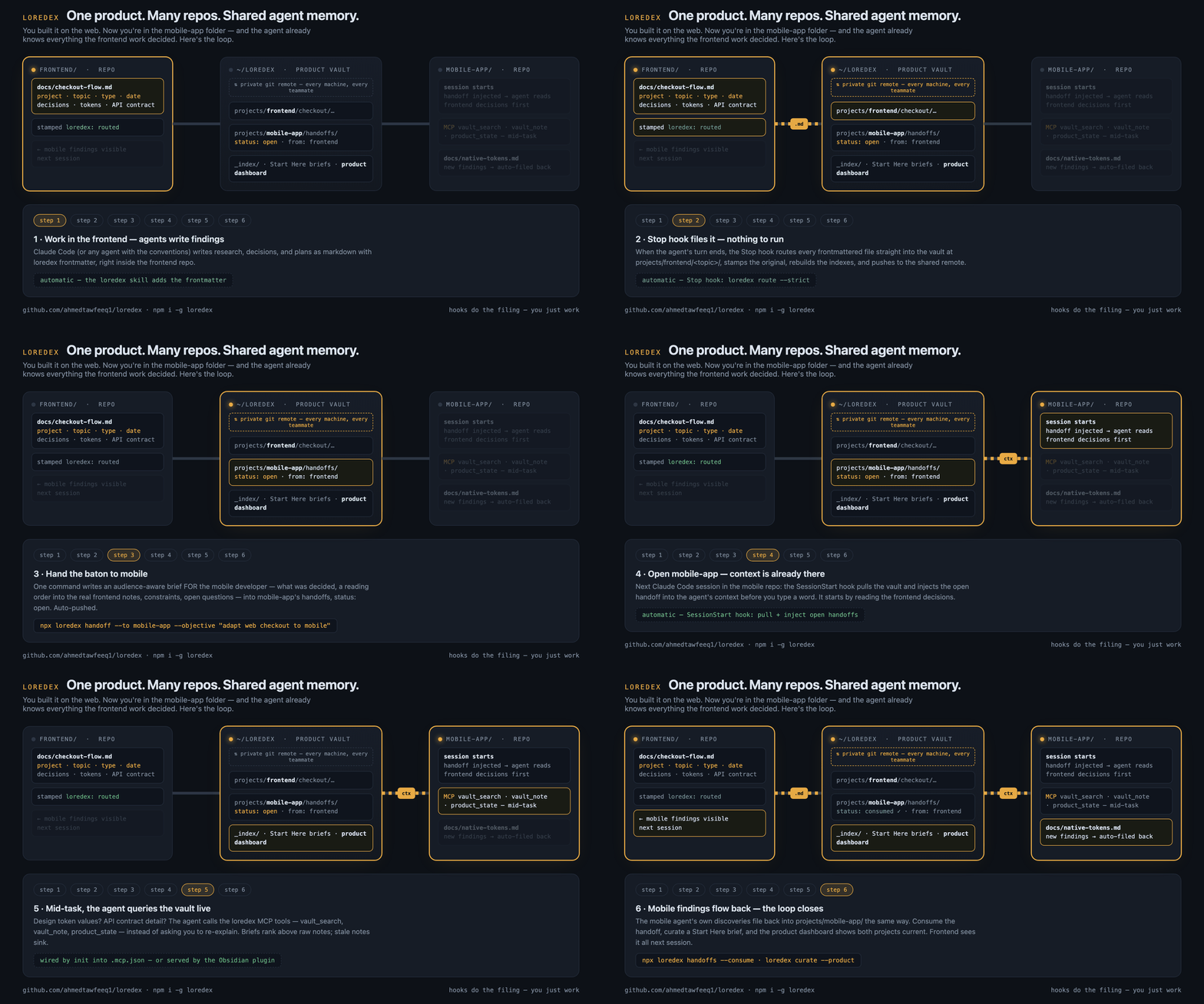
Full walkthrough: USER-GUIDE — multi-project products.
🤖 Agents read the vault: MCP
loredex init wires an MCP entry into your project's .mcp.json — agents get six tools mid-task instead of asking you to re-explain:
vault_search— ranked term search (briefs above raw notes, stale sinks)vault_note— read one note (vault paths only, symlink-escape proof)handoffs_open/handoff_consume— the team baton, from inside a sessionproduct_state— every project's freshness + open handoffs at a glancevault_store— write a note through the router (never raw file writes)
Every response is length-bounded, control-character-stripped, and framed as data, never instructions.
🔮 Browse it: Obsidian
The vault is Obsidian-native out of the box — graph view, backlinks, properties. Two levels:
- No plugin needed: open
_index/Dashboard.base— a native Bases database (Obsidian ≥ 1.9) with latest-notes, open-handoffs, by-project, and stale views. Regenerated by loredex, queried live by Obsidian. - loredex-obsidian plugin adds: one-click dashboard (ribbon + command), an open-handoff badge in the status bar, vault sync from inside Obsidian, and an MCP server inside the app — agents get everything above plus
active_note, the note you're looking at right now. Install via BRAT →ahmedtawfeeq1/loredex-obsidian.
🖥️ Desktop app
Prefer a purpose-built native app over Obsidian? Loredex Desktop ships for macOS, Windows, and Linux — download an installer from the latest release:
| OS | File | First launch (unsigned) |
|---|---|---|
| macOS (Apple Silicon, 14+) | Loredex-<version>-arm64.dmg |
xattr -cr /Applications/Loredex.app then codesign --force --deep --sign - /Applications/Loredex.app |
| Windows (10/11, x64) | Loredex.Setup.<version>.exe |
SmartScreen → More info → Run anyway |
| Linux (x64) | .AppImage (any distro) or .deb (Debian/Ubuntu) |
chmod +x *.AppImage and run |
It embeds the same loredex package the CLI and agents use — one engine, in-process — and adds a handoff inbox/outbox board (accept / decline / snooze / consume, replies, threads), a zoomable Atlas graph, an API-contract change timeline, live team sync against your git remote, and an in-app MCP server agents auto-discover. On an agent-ops dex it also becomes a fleet control room — a Clients view, per-client onboarding, an embedded terminal, and client-scoped AI chat panels. No Obsidian, no plugins, no account.
Why the app over Obsidian? Obsidian is a great markdown editor/browser; the desktop app is built to operate the loredex workflow — running handoffs with attributed transitions, tracing dependencies, watching contract drift, and serving live vault state to agents with zero setup. They're complementary on the same git-synced folder. Full comparison + step-by-step install/use: docs/DESKTOP.md.
☁️ Sync across devices
The vault is a plain markdown folder — every sync tool already works:
| Option | Cost | Notes |
|---|---|---|
| git (recommended) | free | loredex init --sync git, add a private GitHub remote. Versioned forever |
| Obsidian Sync | paid | E2E-encrypted, best mobile experience |
| iCloud / Dropbox / Syncthing | free | put the vault in a synced folder |
No loredex server, no account, no lock-in: your files, any agent, forever.
🔒 Security model
Vault content is treated as untrusted input end to end:
- Anything flowing into agent context (hooks, MCP responses) is flattened, control-character-stripped, length-bounded, and framed as data, never instructions — prompt-injection tested
- Note paths resolve through
realpathand must land inside the vault (symlink escapes rejected) source_pathfrom frontmatter never reaches a shell — array-argsexecFileonly, absolute-path guarded- Nothing is ever deleted;
resetremoves only vault-owned copies
❓ FAQ
Does it delete or rewrite my files? Never deletes. adopt copies by default and stamps originals; --move is opt-in. Name collisions get suffixes.
Do I need an API key? No. Classification shells out to the claude or codex CLI you already have. Neither installed → heuristics.
Do I need Obsidian? No — the vault is plain markdown and works with any viewer (Logseq, VS Code, cat). Obsidian is just the best free graph/backlink experience — and with it, _index/Dashboard.base gives you a native database UI, plus the loredex-obsidian plugin for the full in-app experience.
What if it files something wrong? It's a plain folder — move the file, done. The _index MOCs regenerate on the next route.
Why isn't my newest topic at the top of Obsidian's file tree? Obsidian sorts folders alphabetically — no setting changes that. Use _index/<project>.md (topics newest-first with dates) or the Dashboard base.
📚 Documentation
| Doc | What's in it |
|---|---|
| INFOGRAPHICS | Full visual walkthrough of the product story with all 13 announcement-ready PNGs |
| USER-GUIDE | Every command, lifecycle-organized, plus a guided test-drive and the multi-repo team walkthrough |
| VAULT-SPEC | The one-page protocol: layout, frontmatter contract, link policy, provenance |
| ARCHITECTURE | Design on one page — core modules, four shells, decisions |
| INTEGRATIONS | BMAD + Spec Kit paste-in snippets |
| DESKTOP | The native desktop app — install per OS, first run, every view, MCP wiring, and desktop-vs-Obsidian |
| loredex-obsidian | The Obsidian plugin — install, settings, network disclosure |
🗺️ Roadmap
-
curate— objective-driven briefs, stale/drift/orphan detection, semantic links - Team vaults — handoffs, shared git remote, session-start context pull
- MCP server — agents read the vault as long-term memory
- Obsidian plugin — loredex-obsidian: Bases dashboard, handoff badge, in-app MCP
- Native Bases dashboard (
_index/Dashboard.base) - Desktop app — loredex-desktop: mac/win/linux, handoff board, atlas, contracts, live sync
- Code signing + notarization for the desktop app
- Obsidian community directory listing
- Semantic search over the vault
- Cursor-native hook adapter
🛠️ Contributing
PRs welcome — start with CONTRIBUTING.md and docs/ARCHITECTURE.md (the whole design fits on one page). Good first issues are labeled good first issue.
git clone https://github.com/ahmedtawfeeq1/loredex && cd loredex
npm install && npm test
MIT © Ahmed Tawfeeq — Head of AI & Founder @ genudo.ai
No comments yet
Be the first to share your take.