
A local-first execution wrapper and control plane that adds deterministic routing, approval gates, execution records, and rollback capabilities to Claude, Codex, and other CLI coding agents. It runs on your machine and keeps remote execution opt-in, giving teams policy enforcement and evidence tracking without changing their agent interface.
Local-first policy, evidence, memory, and recovery controls for Claude, Codex, Hermes, and other CLI coding agents.
290Stars
35Forks
0Open issues
1Watching
Shell MIT v0.6.0 Updated 1 month ago
At a glance
Shell Actively maintained Commercial OK
README
LACP
Local policy, evidence, and recovery controls for coding agents.
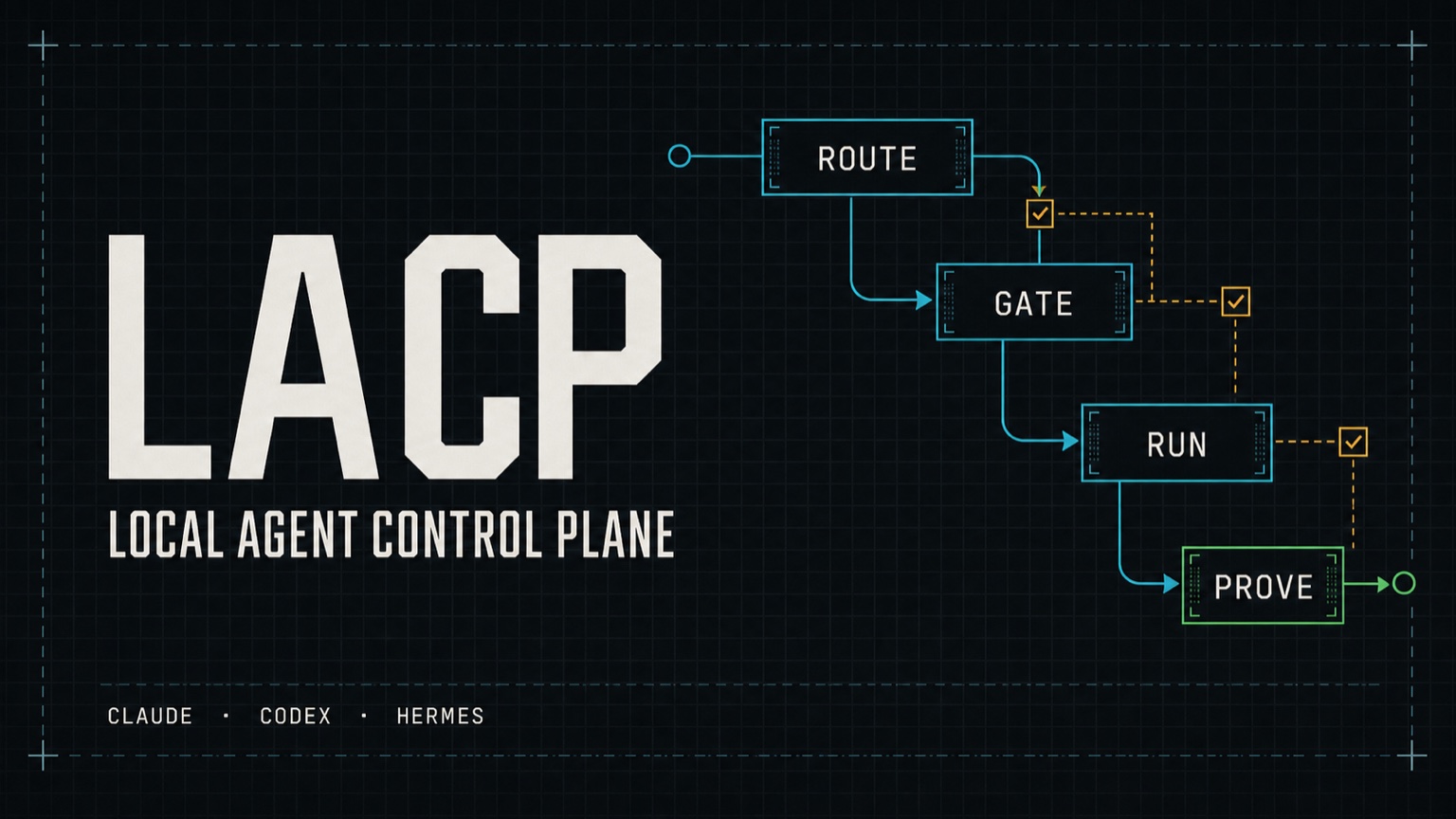
LACP wraps Claude, Codex, Hermes, and other CLI agents with deterministic routing, approval gates, execution records, memory controls, and rollback paths. It runs on your machine and keeps remote execution opt-in.





Development status:
mainreports version 0.10.0. The latest published GitHub and Homebrew release is v0.6.0. Main includes unreleased changes and may alter commands or configuration before the next release. Use the Homebrew package when you need the published release; use--HEADonly when you want current development code.
Contents
- Quick Start
- Why teams adopt LACP
- Use-case recipes
- Documentation
- Architecture
- Features
- Prerequisites
- Install Options
- Who It's For
- Testing
- Security
- Contributing
What LACP controls
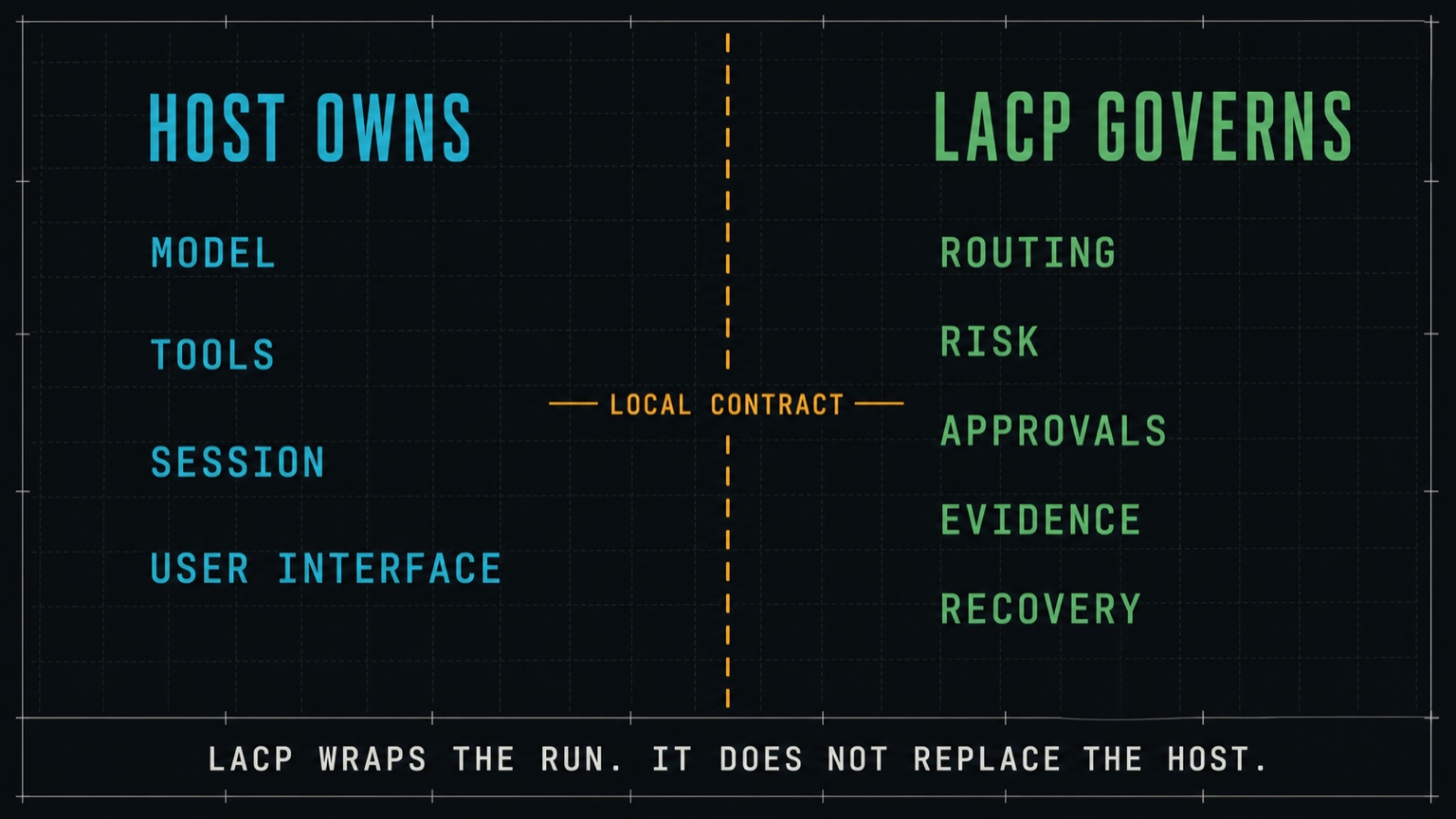
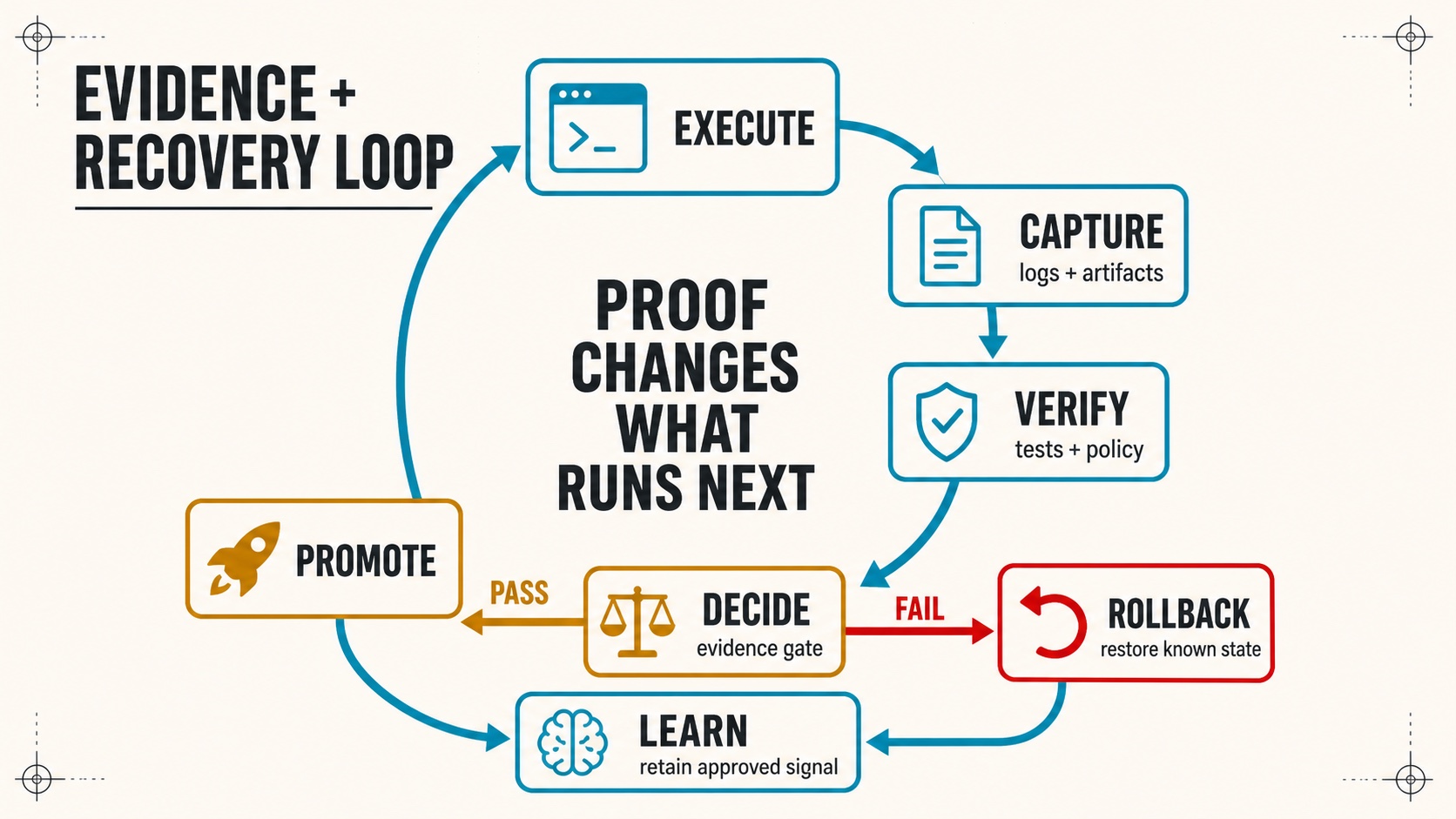
LACP is a local execution wrapper and control plane. The coding-agent host still owns its model, tools, session, and interface. LACP owns the contract around a run: where it may execute, which risk tier applies, when approval is required, what evidence must be kept, and how a failed change is recovered.
Quick start
Install
# Homebrew (recommended)
brew tap 0xNyk/lacp && brew install lacp

# or inspect and run the bootstrap at a published tag
curl -fsSLo /tmp/lacp-install.sh \
  https://raw.githubusercontent.com/0xNyk/lacp/v0.6.0/install.sh
LACP_REF=v0.6.0 bash /tmp/lacp-install.sh
Bootstrap and verify
lacp bootstrap-system --profile starter --with-verify
lacp doctor --json | jq '.ok,.summary'
After bootstrap: .env is created, dependencies installed, directories scaffolded, Obsidian vault wired, and verification artifacts produced.
For the full setup and daily operator flow, start with the Runbook and Local Dev Loop.
First gated command
# Route a task through LACP policy gates
lacp run --task "hello world" --repo-trust trusted -- echo "LACP is working"

# Make claude/codex/hermes default to LACP routing (reversible)
lacp adopt-local --json | jq
Why teams adopt LACP
- Route commands through explicit policy and budget gates.
- Keep evidence, provenance, and verification results with each run.
- Leave remote execution disabled until an operator enables it.
- Isolate parallel agents with sessions and Git worktrees.
Use-case recipes
1) Harden local agent usage in under 5 minutes
lacp bootstrap-system --profile starter --with-verify
lacp adopt-local --json | jq
lacp posture --strict
2) Run one risky command with explicit policy controls
lacp run \
  --task "dependency update with tests" \
  --repo-trust trusted \
  --context-profile default \
  -- pnpm up && pnpm test
3) Generate PR-ready evidence before opening a PR
lacp e2e smoke --workdir . --init-template --command "npx playwright test --grep @smoke"
lacp api-e2e smoke --workdir . --init-template --command "npx schemathesis run --checks all"
lacp pr-preflight --changed-files ./changed-files.txt --checks-json ./checks.json
4) Run parallel agents safely on isolated worktrees
lacp worktree create --repo-root . --name feature-a --base HEAD
lacp up --session feature-a --instances 3 --command "claude"
lacp swarm launch --manifest ./swarm.json
Documentation
| Guide | What You'll Learn |
|---|---|
| Runbook | Daily operator workflow, command map, troubleshooting entry points |
| Local Dev Loop | Fast build/test/verify loop for contributors |
| Framework Scope | What LACP is, what it is not, and design boundaries |
| Implementation Path | Step-by-step rollout plan for full control-plane adoption |
| Memory Quality Workflow | How memory ingestion, expansion, and validation are run safely |
| Incident Response | Triage and recovery flow when policy gates fail |
| Release Checklist | Pre-release, release, and post-release controls |
| Troubleshooting | Common errors, doctor diagnostics, fix hints |
Project health files
- CONTRIBUTING.md - contribution and PR expectations
- SECURITY.md - vulnerability disclosure process
- CHANGELOG.md - release history
- LICENSE - MIT
Architecture
lacp/
├── bin/                    # CLI commands (lacp <command>)
│   ├── lacp                # Top-level dispatcher
│   ├── lacp-bootstrap-system
│   ├── lacp-doctor         # Diagnostics (--json, --fix-hints)
│   ├── lacp-route          # Policy-driven tier/provider routing
│   ├── lacp-sandbox-run    # Gated execution with artifact logging
│   ├── lacp-brain-*        # Memory stack (ingest, expand, doctor, stack)
│   ├── lacp-obsidian       # Vault config management
│   ├── lacp-up             # Multi-instance agent sessions
│   ├── lacp-swarm          # Batch orchestration
│   └── lacp-claude-hooks   # Hook profile management
├── config/
│   ├── sandbox-policy.json     # Routing + cost ceilings
│   ├── risk-policy-contract.json
│   ├── obsidian/               # Vault manifest + optimization profiles
│   └── harness/                # Task schemas, sandbox profiles, verification policies
├── hooks/                  # Python hook pipeline for Claude Code
├── scripts/
│   ├── ci/                 # Test suites
│   └── runners/            # Daytona/E2B execution adapters
└── docs/                   # Guides and reference docs
Control Flow
Agent invocation
  → lacp route (risk tier + provider selection)
    → context contract validation
      → budget gate check
        → session fingerprint verification
          → sandbox-run (dispatch + artifact logging)
Features
Policy-Gated Execution
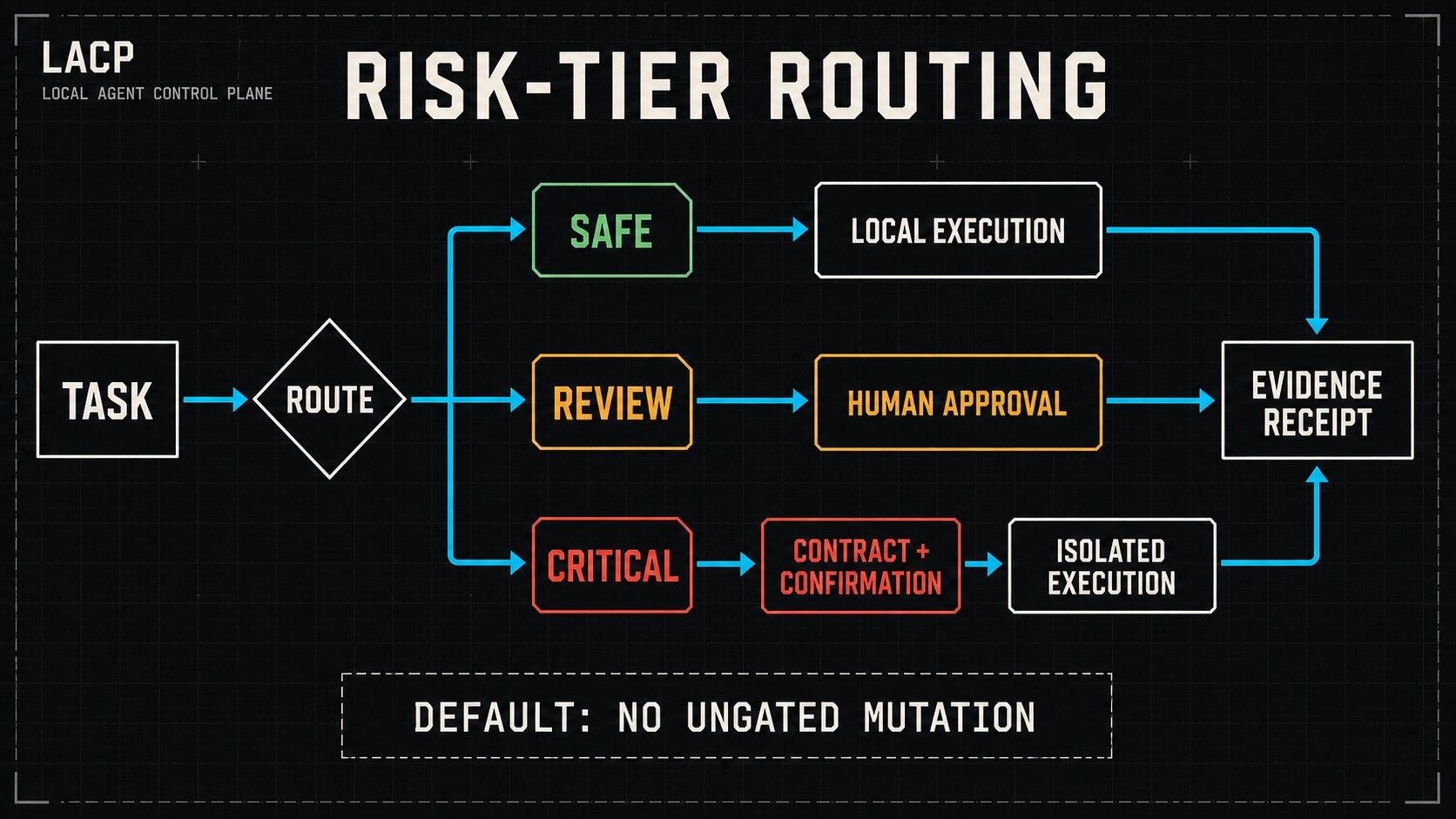
Every command routes through risk tiers (safe → review → critical), budget ceilings per tier, and context contracts that validate host, working directory, git branch, and remote targets before execution.
5-Layer Memory Stack
| Layer | Purpose |
|---|---|
| Session memory | Per-project scaffolding under ~/.claude/projects/ |
| Knowledge graph | Obsidian vault with MCP wiring (smart-connections, QMD, ori-mnemos) |
| Ingestion pipeline | brain-ingest converts text/audio/video/URLs into structured notes |
| Code intelligence | GitNexus AST-level knowledge graph via MCP (optional) |
| Agent identity | Persistent IDs per (hostname, project) + SHA-256 hash-chained provenance |
lacp brain-stack init --json | jq          # Bootstrap all layers
lacp brain-ingest --url "https://..." --apply --json | jq
lacp brain-expand --apply --json | jq      # Full expansion loop
Hook Pipeline for Claude Code
Modular Python hooks enforcing quality at every session stage:
| Hook | Event | Purpose |
|---|---|---|
session_start.py |
SessionStart | Git context injection, test command caching |
pretool_guard.py |
PreToolUse | Block dangerous operations (publish, chmod 777, fork bombs, secrets) |
write_validate.py |
PostToolUse | YAML frontmatter schema validation |
stop_quality_gate.py |
Stop | 3-tier eval: heuristics, test verification, local LLM rationalization detection |
Profiles: minimal-stop, balanced, hardened-exec, quality-gate-v2. Apply with lacp claude-hooks apply-profile <profile>.
Mycelium Network Memory
Biologically-inspired memory consolidation modeled on fungal networks:
| Mechanism | Description |
|---|---|
| Adaptive path reinforcement | Frequently-traversed edges strengthen (like mycelium hyphae) |
| Self-healing | Pruned nodes trigger reconnection of orphaned neighbors |
| Exploratory tendrils | Frontier nodes in active categories shielded from pruning |
| Flow scoring | Betweenness centrality identifies critical knowledge hubs |
| Temporal decay | FSRS dual-strength model with forgetting curve |
Multi-Agent Orchestration
# dmux-style multi-instance launch
lacp up --session dev --instances 3 --command "claude"

# Git worktree isolation
lacp worktree create --repo-root . --name "feature-a" --base HEAD

# Batch swarm execution
lacp swarm launch --manifest ./swarm.json
Evidence Pipelines
Generate machine-verifiable evidence for PR gates:
lacp e2e smoke --workdir . --init-template --command "npx playwright test --grep @smoke"
lacp api-e2e smoke --workdir . --init-template --command "npx schemathesis run --checks all"
lacp contract-e2e smoke --workdir . --init-template --command "forge test -vv"
lacp pr-preflight --changed-files ./changed-files.txt --checks-json ./checks.json
Prerequisites
| Required | Recommended |
|---|---|
bash, python3, jq, rg (ripgrep) |
shellcheck, tmux, gh |
The installer auto-detects and installs missing dependencies on macOS via Homebrew.
Install options
Homebrew
brew tap 0xNyk/lacp
brew install lacp            # published v0.6.0 release
brew install --HEAD lacp     # current main, version 0.10.0
cURL Bootstrap
curl -fsSLo /tmp/lacp-install.sh \
  https://raw.githubusercontent.com/0xNyk/lacp/v0.6.0/install.sh
LACP_REF=v0.6.0 bash /tmp/lacp-install.sh
Change both references to main only when you intend to install unreleased development
code. The script also accepts --dir, --profile, and --with-verify; run it with
--help before installation to see the full contract.
Who it is for
LACP is for developers who need reproducible local agent runs with explicit pass/fail gates and artifacts that can be inspected after execution.
It is a poor fit when you want a managed cloud service, a chat UI, or a setup with no local policy and configuration to maintain.
Testing
lacp test --quick       # Fast smoke tests
lacp test --isolated    # Full isolated suite
lacp doctor --json      # Structured diagnostics
lacp posture --strict   # Policy compliance check
scripts/ci/test-route-policy.sh
scripts/ci/test-mode-and-gates.sh
scripts/ci/test-knowledge-doctor.sh
scripts/ci/test-ops-commands.sh
scripts/ci/test-install.sh
scripts/ci/test-system-health.sh
scripts/ci/test-obsidian-cli.sh
scripts/ci/test-brain-memory.sh
scripts/ci/smoke.sh
Core
| Command | Purpose |
|---|---|
lacp bootstrap-system |
One-command install + onboard + verify |
lacp doctor |
Structured diagnostics (--json, --fix-hints, --check-limits) |
lacp status |
Current operating state snapshot |
lacp mode |
Switch local-only / remote-enabled |
lacp run |
Single gated command execution |
lacp loop |
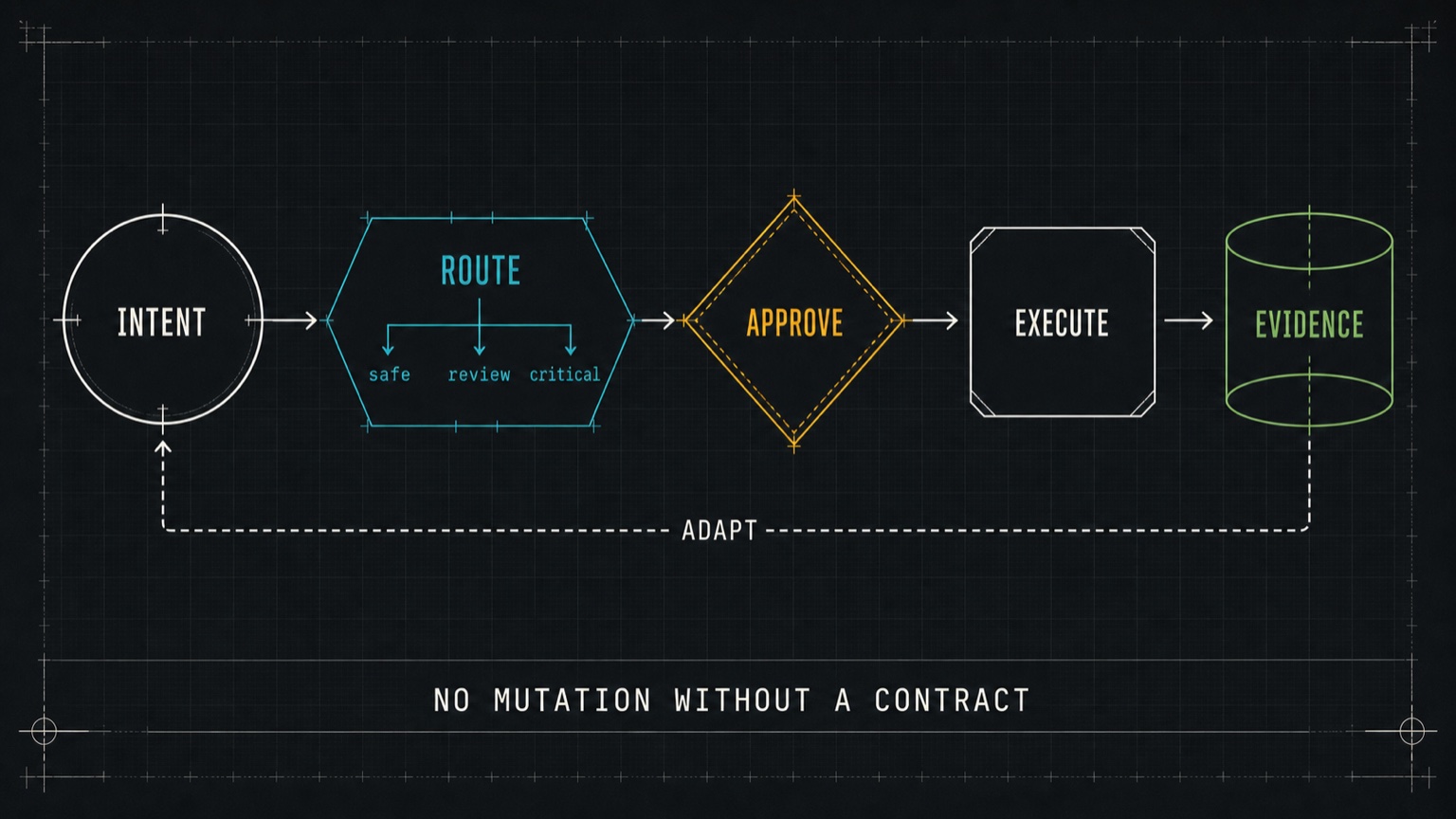
Intent → execute → observe → adapt control loop |
lacp test |
Local test suite (--quick, --isolated) |
Memory & Knowledge
| Command | Purpose |
|---|---|
lacp brain-stack |
Initialize/audit 5-layer memory stack |
lacp brain-ingest |
Ingest text/audio/video/URLs into Obsidian |
lacp brain-expand |
Full brain expansion loop |
lacp brain-doctor |
Memory-system health checks |
lacp obsidian |
Vault config management (audit/apply/optimize) |
lacp repo-research-sync |
Mirror repo research into knowledge graph |
Orchestration
| Command | Purpose |
|---|---|
lacp up |
dmux-style multi-instance launch |
lacp orchestrate |
dmux/tmux/worktree orchestration adapter |
lacp worktree |
Git worktree lifecycle management |
lacp swarm |
Batch swarm workflow (plan/launch/status) |
lacp adopt-local |
Install LACP routing wrappers for claude/codex |
Security & Policy
| Command | Purpose |
|---|---|
lacp route |
Deterministic tier/provider routing |
lacp sandbox-run |
Gated execution with artifact logging |
lacp policy-pack |
Apply policy baselines (starter/strict/enterprise) |
lacp claude-hooks |
Audit/repair/optimize hook profiles |
lacp security-hygiene |
Secret/path/workflow/.env scan |
lacp pr-preflight |
PR policy gate evaluation |
Release & Evidence
| Command | Purpose |
|---|---|
lacp release-prepare |
Pre-live discipline (gate + canary + status) |
lacp release-verify |
Release verification (checksum + archive + brew) |
lacp e2e |
Browser e2e evidence pipeline |
lacp api-e2e |
API/backend e2e evidence pipeline |
lacp contract-e2e |
Smart-contract e2e evidence pipeline |
lacp canary |
7-day promotion gate over retrieval benchmarks |
Utilities
| Command | Purpose |
|---|---|
lacp console |
Interactive slash-command shell |
lacp time |
Project/client session time tracking |
lacp agent-id |
Persistent agent identity registry |
lacp provenance |
Cryptographic session provenance chain |
lacp context-profile |
Reusable context contract templates |
lacp vendor-watch |
Monitor Claude/Codex version drift |
lacp system-health |
macOS/Apple Silicon workstation readiness |
lacp mcp-health |
Probe all configured MCP servers |
Security
- No secrets in repo config; credentials come from the environment or local
.env - Zero external CI by default (
LACP_NO_EXTERNAL_CI=true) - Remote execution disabled by default (
LACP_ALLOW_EXTERNAL_REMOTE=false) - Risk-tier gating with TTL approval tokens
- Structured input contracts for risky runs
- Artifact logs for auditable execution history
- See SECURITY.md for vulnerability reporting
Contributing
Contributions welcome. See CONTRIBUTING.md for guidelines.
Support
If LACP helps your work, sponsor its continued maintenance.
Solana: 2k1oq9U99mwy4gm8P2hXPJoZusoXQCpFs35EEf5Ve73y
Need agent infrastructure, trading systems, or Solana applications built for your team?
Builderz ships production AI systems across 32+ products in 15 countries.
Get in touch | Nyk | @nykdotdev
License
From this repo to a working agent OS
Quiet commercial paths from nyk.dev — same operator, fixed scope:
- Free checklist: https://www.nyk.dev/resources/agent-os-checklist?utm_source=github&utm_medium=readme&utm_campaign=oss_proof&utm_content=lacp
- Self-serve Production Agent OS Kit (€149 founding): https://www.nyk.dev/go/agent-os-kit?utm_source=github&utm_medium=readme&utm_campaign=oss_proof&utm_content=lacp
- Hands-on packages: https://www.nyk.dev/consulting?utm_source=github&utm_medium=readme&utm_campaign=oss_proof&utm_content=lacp#agent-os
Comments (0)
Sign in to join the discussion.
No comments yet
Be the first to share your take.