
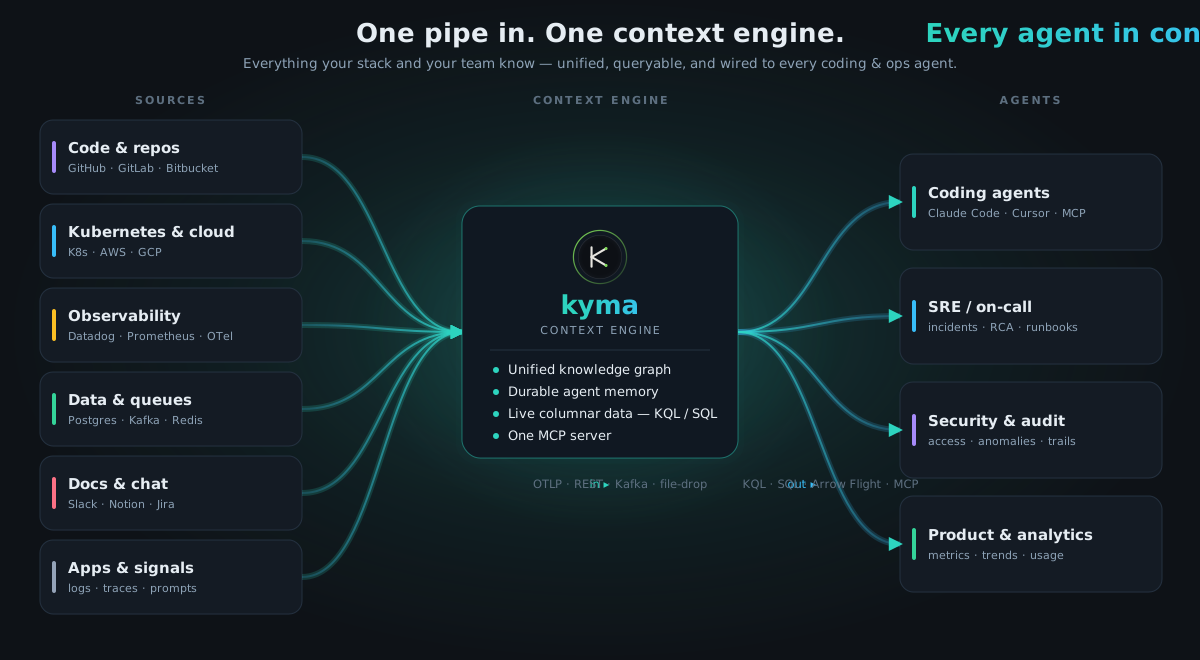
A memory store remembers what you told it. A context engine also knows your live systems and how everything connects.
Most memory tools give your agent facts. kyma gives it the facts, the live logs, traces, and code those facts are about, and the graph that ties a decision to the service it concerns — one query surface, one MCP server. Recall plus live context plus relationships, however your agent connects.
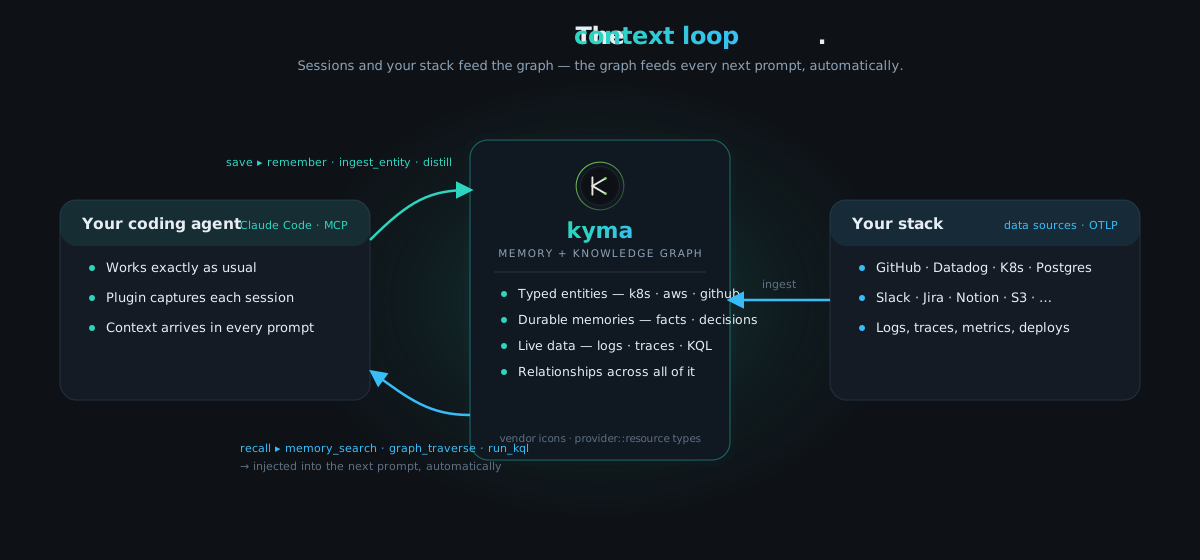
It runs as a single local binary — embedded catalog + local files, no Postgres, no Docker, no sudo — wires into your agent in one command, and syncs to a hosted control plane so memory stays coherent across your machines and team. The Claude Code plugin goes further: it captures each session and injects the right memories into every prompt automatically — not just when the agent makes a tool call.
Quickstart (local, zero infra)
One command. Installs the kyma binary, then a wizard starts the local server,
connects the CLI, and wires your coding agent. Embedded SQLite + local files, installed
to ~/.local/bin — no Postgres, no Docker, no sudo:
curl -fsSL https://raw.githubusercontent.com/shakedaskayo/kyma/main/install.sh | bash
You're now running. The wizard leaves you with:
- Web UI + API → http://localhost:7777 (Graph Explorer · Memory · KQL/SQL workbench) — your first visit creates the admin user
- the server runs as a background service (starts at login, restarts on crash) —
kyma service status - Claude Code plugin installed → restart Claude Code, run
/kyma-status - the
kymaCLI on your$PATH
Try it — a memory round-trips through the same engine the UI and your agent use:
kyma remember "payments-svc deploys behind the Aurora gateway; error budget is 0.1%."
kyma recall   "how do we deploy payments and what's the error budget?"
# → returns the memory, scored by vector + keyword + graph
Windows: install inside WSL2 — the same one-liner works in the WSL shell. Native Windows support is tracked but not there yet.
Uninstall:
curl -fsSL https://raw.githubusercontent.com/shakedaskayo/kyma/main/install.sh | bash -s -- --uninstall(add--purgeto also delete~/.kyma).
Wire any agent over MCP (zero server, zero auth — stdio):
kyma setup claude-code # or: cursor · windsurf — writes the agent's MCP config to launch `kyma mcp`
Restart the agent and it has the full toolset (memory + data + graph).
# Scripted (skip the prompts):
curl -fsSL …/install.sh | bash -s -- --yes                    # binary only
curl -fsSL …/install.sh | bash -s -- --yes --serve --plugin   # + server + Claude Code plugin

# From source (Rust toolchain + pnpm; the CLI embeds the web UI, so build it first):
git clone https://github.com/shakedaskayo/kyma && cd kyma
pnpm -C web build && cargo install --path crates/kyma-cli   # installs `kyma-cli`; symlink to `kyma` if you like

# Stay current (the web UI ships inside the binary — updating one updates both):
kyma update          # grab the latest release + restart on the new UI
kyma update --check  # just tell me if I'm behind
kyma version / kyma serve also nudge once a day when a newer release exists
(KYMA_NO_UPDATE_CHECK=1 to opt out).
Want it server-side for a team, with data sources and continuous ingestion? See Two tiers.
What your agent gets
The whole context engine — not just recall — reachable however your agent connects. Plugin slash commands, the CLI, or MCP tools all hit the same engine:
| Tools | What it does | |
|---|---|---|
| 🧠 Memory | memory_search · recall_memory · save_memory · list_memories |
Graph-aware hybrid recall (vector + keyword + graph), durable across sessions/machines. |
| 🕸️ Graph | ingest_entity · link_memory_to_entity · graph_traverse · find_references_to |
Mint virtual resources, wire them to memories and real resources, walk the graph. |
| 📊 Live data | run_kql · run_sql · explore_schema · describe_table · sample_rows · list_databases |
Query logs, traces, data-source tables, the catalog — in KQL or SQL, sub-second. |
| 🛠️ Curation | update_memory_status · update_memory_importance · memory_compare · memory_judge · memory_session_summary |
Re-weight, archive, resolve conflicts, record session recaps. |
Call
memory_searchfirst when a question may depend on prior context, then follow thelinkedresources withgraph_traversefor a deeper subgraph — so answers are grounded in what you've actually decided and how your systems actually look.
Three ways to connect, same engine underneath:
- Claude Code plugin (
kyma install-plugin) — automatic. Hooks inject the most relevant memories into every prompt with no tool call, plus/kyma-recall,/kyma-remember,/kyma-ask,/kyma-ingest,/kyma-status. The "it just remembers" path. - CLI, for any agent (
kyma recall "…"·kyma query "…") — Cursor, Aider, Continue, or any shell-tool agent shells out;kyma install-skillteaches it when to reach for kyma. - MCP — stdio (
kyma setup <agent>) or HTTP (/mcp/v1) for native MCP clients.
The numbers
"Live data" isn't a toy key-value store — it's a ground-up Rust columnar engine (Kusto-style KQL/SQL over Arrow on object storage). That's what lets an agent ask twenty exploratory questions per prompt without melting a card. Measured on a dev-build laptop:
| Metric | Result |
|---|---|
| Sustained ingest | 66K rows/s (8 workers, 0 errors, p99 52 ms) · ~200K peak single-request |
| Query latency | 1–3 ms small result · ~150 ms for a 50K-row cold scan |
| Index pruning | 10×–∞× fewer extents touched — equality + time-range + text-token, composed |
| Crash durability | 100% — zero loss or corruption across hard kills |
| Multi-node consistency | Zero loss at 100 concurrent ingests / 2 nodes (207 CAS conflicts resolved) |
Dev build, single laptop, over loopback — representative for relative comparison, not an absolute ceiling (release + LTO is typically +30–50%). Full methodology and an honest head-to-head against Loki / ClickHouse / Elasticsearch / ADX: docs/benchmarks.md. Memory recall is hybrid + graph by design; a named recall-accuracy benchmark is on the roadmap, not yet published.
Why kyma
kyma's memory layer synthesizes the strongest open-source patterns and runs them over its own columnar engine, so recall is near-realtime at scale — then it adds the half no memory tool has: your live data and the graph linking it.
| memory-only tools | kyma | |
|---|---|---|
| Local single binary, zero infra | ✅ | ✅ |
stdio MCP, agent-agnostic setup <agent> |
✅ | ✅ |
| Retrieval | keyword / vector | vector + keyword + graph + RRF + native ANN |
| Temporal model | soft-delete / review | bi-temporal + point-in-time |
| Knowledge graph | pairs / tags | real edges + cross-graph to live resources |
| Live data (logs / traces / SQL / KQL) | ❌ | ✅ the same engine |
| Control-plane sync | varies | ✅ bidirectional |
What makes the recall best-in-class:
- Graph-aware hybrid retrieval — semantic (vector
cosine_distance) + keyword, fused with Reciprocal Rank Fusion, then expanded 1–2 hops over the memory graph into a contextual subgraph. No LLM on the hot path. - Native columnar ANN — each extent carries a centroid + radius; recall pushes a distance bound into the scan to prune extents (provably no false negatives).
- Bi-temporal knowledge graph —
valid_at/invalid_at; contradictions are invalidated, not deleted, so history and point-in-time recall survive. - Cross-graph links — memories resolve to the real catalog nodes they're about (a repo, a service, a table, a trace) — the "+ graph" that makes it a context engine.
- LLM extraction + automated A.U.D.N. —
ADD / UPDATE / NOOP / INVALIDATEconflict resolution; falls back to deterministic summaries when no engine is configured. - Deterministic topic-key upsert — a stable
topic_keyupdates a memory in place (no LLM, no duplicates), complementing the LLM path. - Provenance categories — synthetic / extracted / data-source-derived, so housekeeping scores and relevance-checks by source.
- Privacy —
<private>…</private>is stripped before anything is embedded or stored.
See Agentic Memory for the full design.
How it works
Most agent-memory tools sit on SQLite or a vector DB. kyma's live-data half is a columnar engine in the spirit of Azure Data Explorer (Kusto) — built so agents can query in bursts:
- Ingests every signal your stack emits — logs, traces, metrics, tool calls, prompt / response bodies, deploy events, config diffs — via OTLP, REST, Kafka, or file-drop, plus scheduled data sources (GitHub / GitLab / Bitbucket / Prometheus / Postgres / S3 / Notion / Slack / Jira / Confluence / Gmail / Drive).
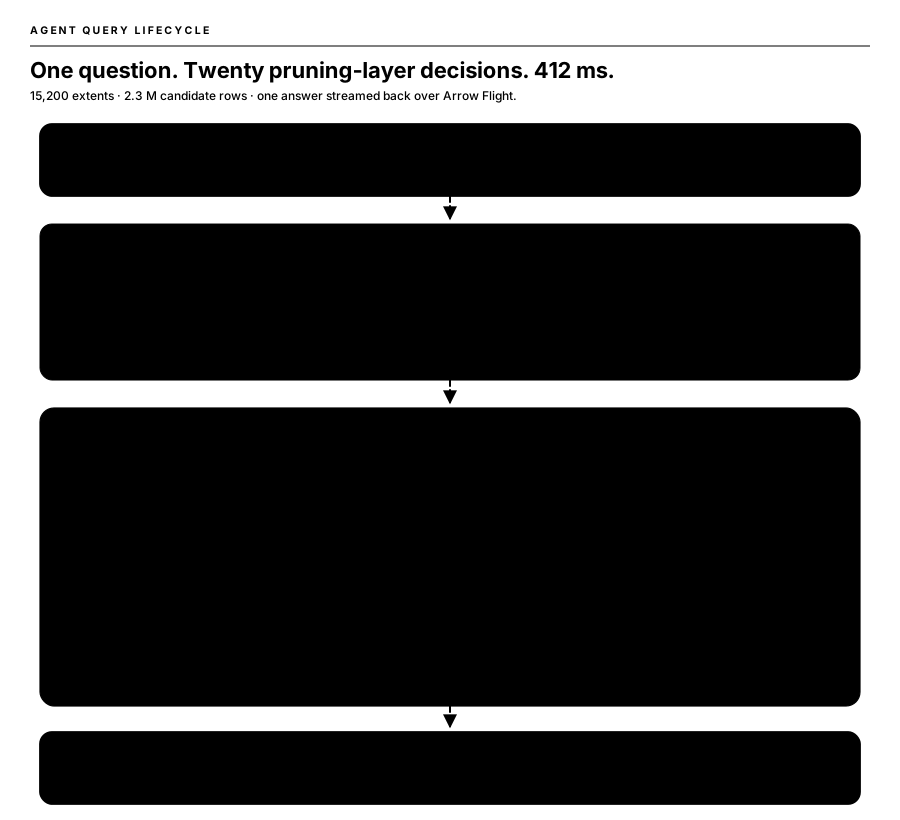
- Stores columnar Arrow on object storage you own, with per-extent stats + token indices so a query skips 99%+ of data via a three-level pruning cascade.
- Answers in KQL, SQL, or PromQL over Arrow Flight gRPC — exact rows, streamed zero-copy.
- Scales from one binary to many nodes without a rewrite: object storage is the source of truth, compute is stateless, the catalog is externalized.
// "What error signatures started appearing after the payments deploy at 14:23?"
otel_logs
| where service.name == "payments-svc" and severity_text == "ERROR"
| summarize first_seen = min(timestamp), n = count() by error_code = tostring(attributes["error.code"])
| where first_seen > datetime(2026-04-20 14:23)
| order by n desc
// "Which services called billing during the 02:17 spike, ranked by error rate?"
otel_traces
| where timestamp between (datetime(2026-04-20 02:15) .. datetime(2026-04-20 02:25))
| where tostring(attributes["peer.service"]) == "billing"
| summarize calls = count(), errs = sum(iff(status_code >= 500, 1, 0)) by caller = service.name
| extend err_rate = errs * 1.0 / calls
| order by err_rate desc
The dynamic column takes llm.model, tool.name, whole prompt bodies natively; a token
index makes "every session that called send_email with draft:true last Tuesday"
sub-second — not a support ticket.
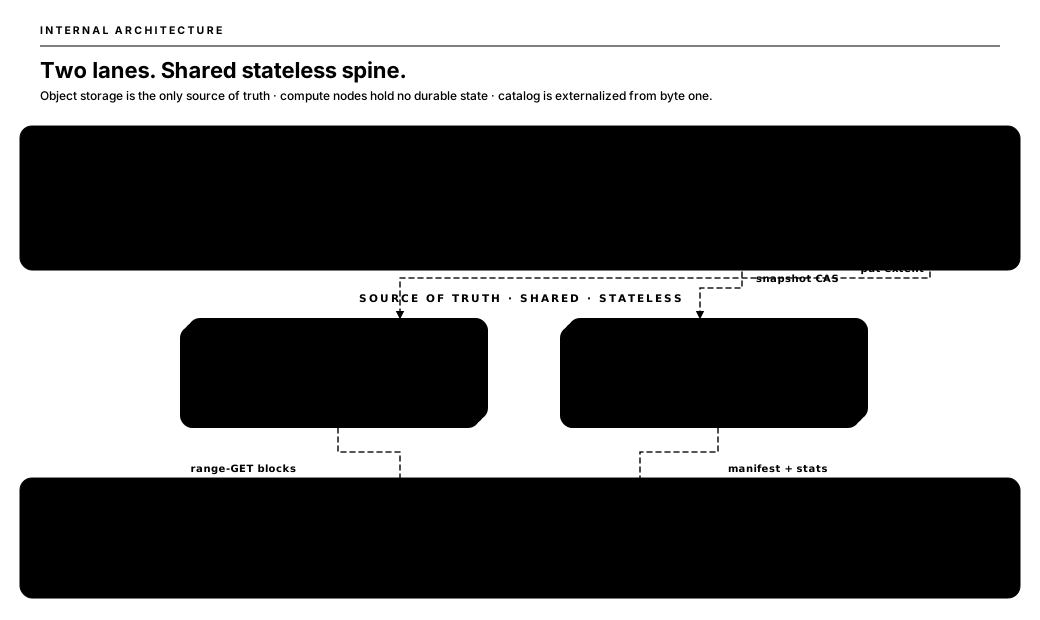
Two lanes (ingest and query) share a stateless spine: object storage (the only source of
truth) and a catalog (Iceberg-style manifests, per-column stats, CAS commits) — Postgres
on the server, embedded SQLite in local mode. Five invariants — object storage is the only
source of truth, compute is stateless, catalog is externalized, format is pluggable, parser
is pluggable — are enforced by architectural tests. See docs/architecture.md.
Your data stays yours. Extents live on your object store, memory in your catalog. Local-first, sync opt-in. Agents ask in bursts — one prompt → twenty queries — and kyma's Flight gRPC is streaming and Arrow-native, priced at your object-storage cost, not per-query vendor fees.
Two tiers: local binary ↔ control plane
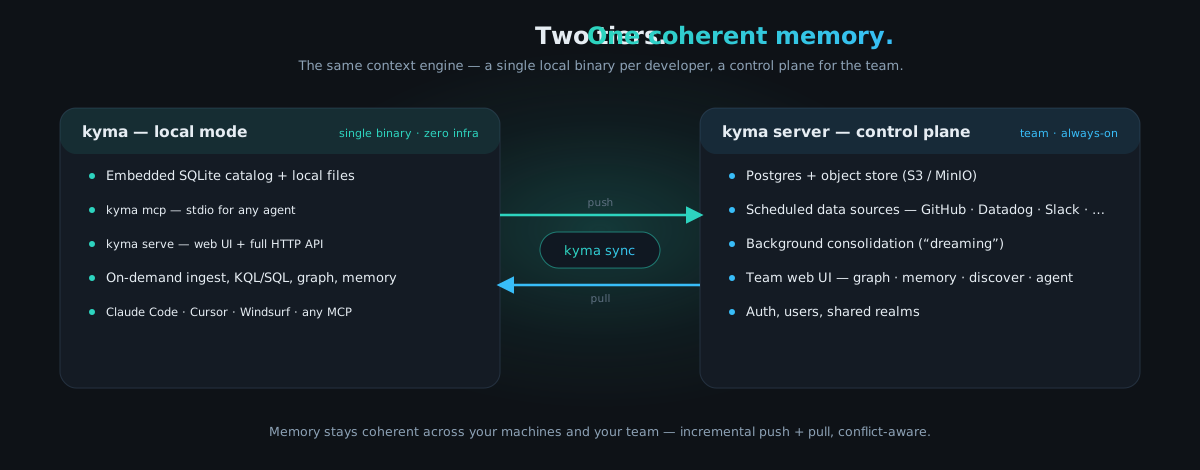
The same context engine, two ways to run it — pick per machine; memory stays coherent across both via sync.
kyma (local mode) |
kyma server (control plane) | |
|---|---|---|
| Infra | none — embedded SQLite + local files | Postgres + object store (S3/MinIO) |
| Use | per-developer, offline, instant | team, always-on, shared |
| Memory | ✅ save / recall / graph | ✅ + background consolidation ("dreaming") |
| Live data | ✅ on-demand ingest + query | ✅ + data sources (GitHub, Prometheus, …) on a schedule |
| Web UI | ✅ kyma serve |
✅ Graph Explorer · Memory · Discover · Agent |
| Sync | ✅ kyma sync → control plane |
✅ receives + reconciles |
# Keep a machine's memory coherent with the team's control plane (push + pull, incremental)
KYMA_CLOUD_URL=https://kyma.your-co.dev KYMA_CLOUD_TOKEN=… kyma sync
See it
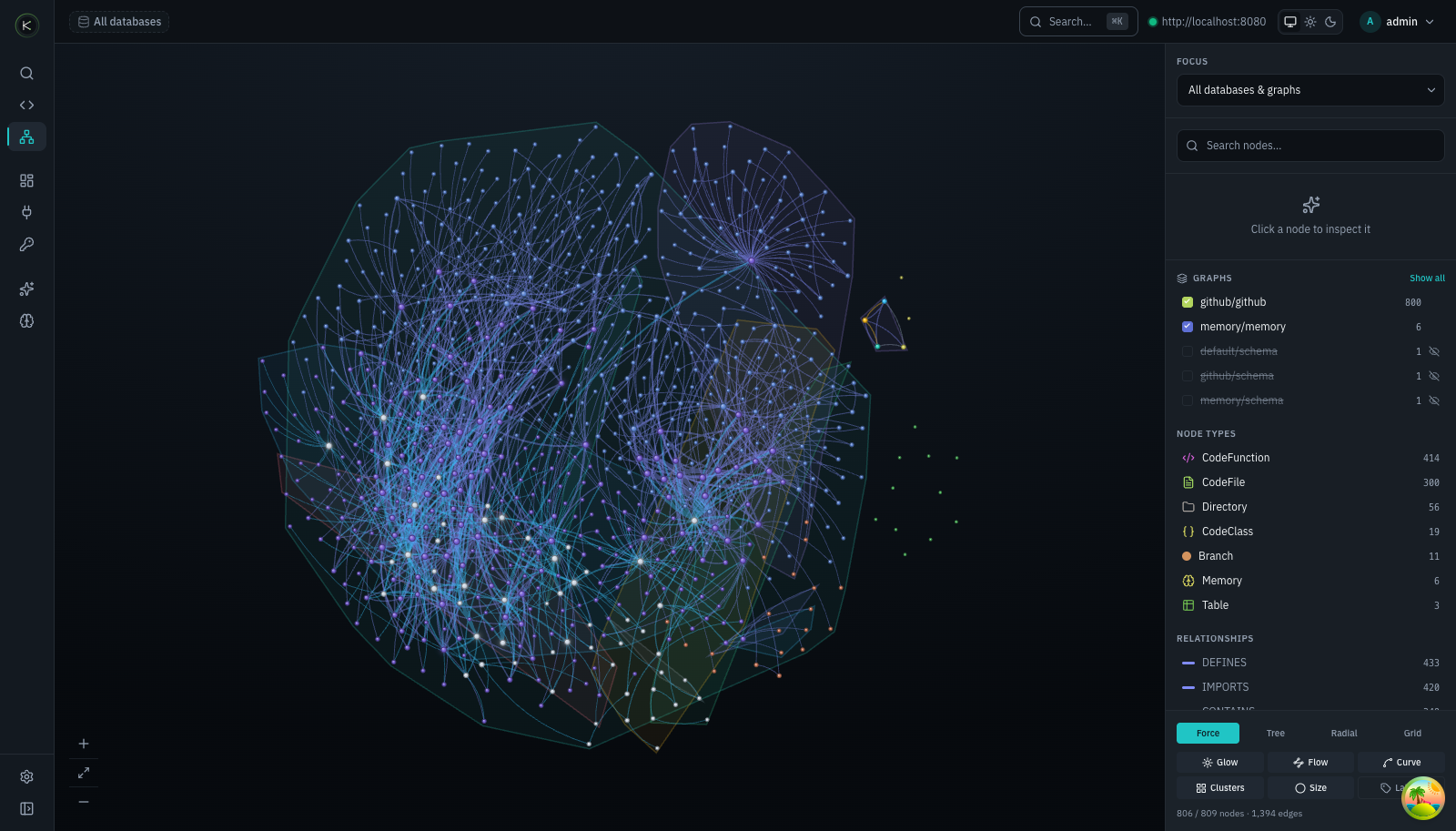
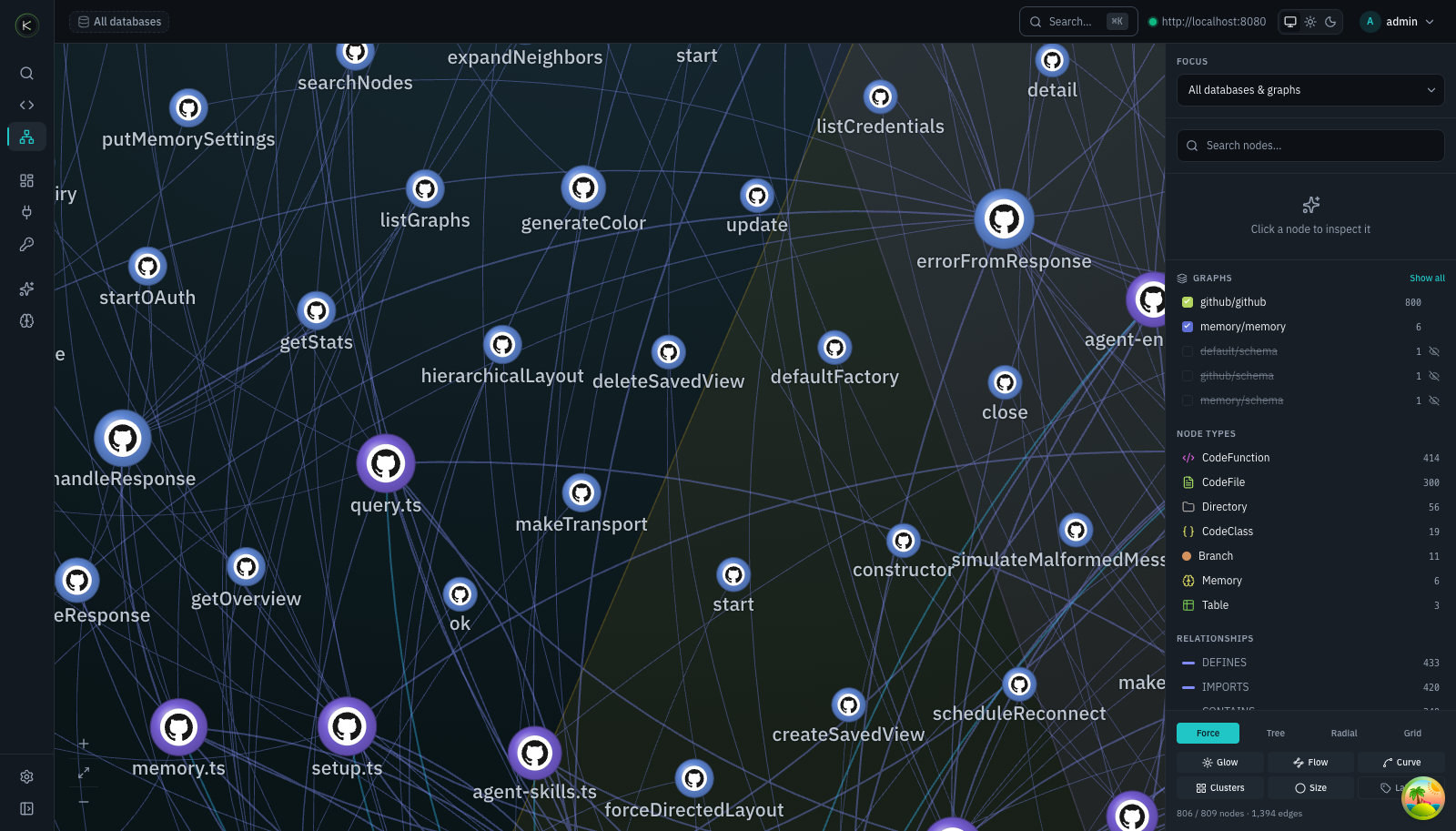
A WebGL canvas renders every property graph from every database on one surface — your
repos and services and the memories and entities they link to. Nodes are color-coded by
type, sized by connectivity, and carry real vendor brand marks (GitHub, Datadog, Kubernetes,
AWS, GCP, Postgres, Redis, Kafka, Slack, PagerDuty, …) plus provider::resource types like
kubernetes::pod and aws::ec2::instance. Edges are colored by relationship family,
communities are detected and shaded, and the focused neighbourhood lights up with animated flow.
The web app (hosted server, or kyma serve) has four first-class surfaces:
/graph— the cross-database unified graph: every property graph merged onto one canvas, with typed brand-marked nodes, force/tree/radial/grid layouts, search, namespace + relationship filters, community clustering, and a per-node inspector with one-hop expansion./memory— interactive recall with scores, validity intervals, the graph path each result arrived by, connected resources, and live consolidation runs./explore— a KQL/SQL workbench with a streaming results grid and histogram timeline./agent— pick an LLM (Anthropic / OpenAI / Ollama / your local Claude Code OAuth) and ask production questions in English.
Status
Pre-alpha. The design is stable; the surface is not — expect schema churn and API breaks.
Shipping today: local mode in the kyma CLI (mcp · serve · setup · sync), the
agentic-memory stack (hybrid + graph recall, bi-temporal, A.U.D.N., topic-key upsert, conflict
tools, provenance, export/import), the MCP server (stdio + HTTP), REST/OTLP/Kafka/file-drop
ingest, scheduled data sources, KQL + SQL over Arrow Flight, the 3-level pruning cascade, the web
app, compaction/retention/GC, and bidirectional memory sync. Next: PromQL · Flight-SQL ·
multi-node read scale-out · cross-region federation.
Fastest front door: the local quickstart above, or the
docker-compose dev stack (docker compose up -d) for the full server tier.
crates/
  kyma-core/            traits + types; the architectural contract
  kyma-catalog/         Postgres-backed catalog (Iceberg-mirroring metadata)
  kyma-catalog-sqlite/  embedded SQLite catalog (powers local mode)
  kyma-storage/         object_store wrapper + local-FS auto-select
  kyma-format-tlm/      telemetry storage format (Arrow + stats + token index)
  kyma-ingest-*/        staging/commit write path + REST/OTLP/Kafka/file-drop frontends
  kyma-kql/ kyma-plan/ kyma-exec/   KQL → unified plan → DataFusion execution
  kyma-memory/          agentic memory: schema, writer, hybrid+graph recall
  kyma-mcp/             MCP server — stdio + HTTP transports, shared dispatch
  kyma-server/          HTTP + Flight gRPC API, agent surface, auth, web UI
  kyma-datasources/     data source framework (GitHub, Prometheus, SaaS, …)
  kyma-compaction/      background compaction, retention, physical GC
  kyma-local/           local-engine library behind `kyma` mcp · serve · setup · sync
  kyma-cli/             the `kyma` CLI — client + admin + local engine (one binary)
  kyma-bin/             the full server binary (the docker/control-plane tier)
Full docs at the kyma docs site.
License & contributing
MIT. See CONTRIBUTING.md; for security issues follow SECURITY.md rather than the public tracker.
No comments yet
Be the first to share your take.