
Kybernetes
Kybernetes is an open-source, runtime-adaptive steering layer and portable control contract for hard agentic work. It sits above capable native harnesses when ambiguity, consequence, coordination, continuity, or delayed feedback exceeds one execution loop.
It helps agents hold durable goals, choose proportionate control, preserve state when needed, bound delegation, verify completion with rejection-capable evidence, recover across turns and runtimes, and return consequential decisions to an accountable human.
The current implementation is a loop governor plus bounded helper skills for loop architecture, independent verification, learning promotion, and closeout. The governor remains the only canonical controller.
Origin essay: The Word That Stopped the Video
Why
Agents lose the goal, over-plan small tasks, under-check risky tasks, confuse worker boundaries, and say "done" before the work is actually verified. Kybernetes gives the lead agent a small cybernetic control system: hold a setpoint, sense the gap, choose whether to stay, go down, go up, stack, or stop, then act, measure, correct, and learn.
Why The Name Kybernetes
Yes, it sounds like Kubernetes. Same Greek root: kybernetes, meaning steersman, pilot, or governor. Different problem.
It is also the root lineage behind cybernetics: systems that steer through control, communication, and feedback.
That is the product metaphor. Kybernetes is not meant to be another checklist. It is the steersman for agentic work: it holds the goal, senses drift, chooses the right amount of machinery, coordinates workers, asks for human steering when needed, and corrects course until the work is verified.
The name also keeps the project independent from any one runtime or knowledge system. Specific tools can wrap it later through adapters, but Kybernetes should remain useful across skill-compatible agents.
Current Status
The v0.1 runtime-adaptive harness includes:
kybernetes:loop-governor: the canonical controller and lean routing kernel.kybernetes:loop-architect: dynamic independent lenses and execution-contract design.kybernetes:loop-closeout: checkpoint, handoff, workstream, and program retirement.kybernetes:verify-run: independent rejection-capable verification.kybernetes:capture-learning: evidence-gated reusable constraint proposals.
Evidence maturity
The shipped product is an instruction package plus portable file conventions, examples, pressure scenarios, and deterministic structural validators. Those checks establish packaging and contract consistency; they do not yet establish comparative outcome improvement, runtime enforcement, token/time overhead, or broad external-user validation. Native runtime behavior remains capability-dependent and should be probed before consequential use.
Significant new behavior is governed by the evidence-gated release policy: the exact candidate is evaluated privately, independently reviewed, and represented publicly only by a signed privacy-safe attestation.
v0.1 Control Contract
- One canonical governor; helpers cannot mutate parent lifecycle state.
- Readiness comes first: objective, DONE, admissible verifier, actuators, state, stop condition, and boundary.
- Tool permission does not authorize unbounded information release; external release requires a bounded destination, purpose, minimum payload, exclusions, handling decision, approval evidence, and fail-closed fallback.
- Durable runs use a trust pair:
control.mdis current truth, andverification.mdis evidence truth. - Passing evidence is not an owner verdict. Work crossing a dependent-system,
policy, publication, or external-effect boundary records the accountable
owner, accepted scope, rationale, and wrongness response in
control.md. stackmeans bounded child loops with owner, boundary, admissible verifier, and return path. In Codex this can bind to subagents, sibling threads, cloud tasks, or worktrees.- Repeated failures should become durable constraints before they become another reminder.
- Recurring automations require explicit objective, cadence/event, state, verifier, safety boundary, notification/manual checkpoint, budget, idempotency, retirement, and activation approval.
- Runtime goals, tasks, workers, hooks, schedules, and UI state are advisory.
- Recoverable human, time, and event waits never become native terminal blocked.
Control Model
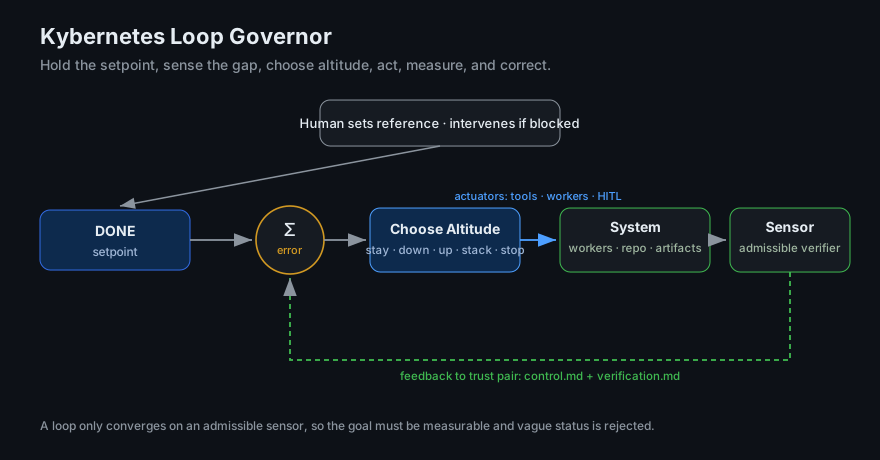
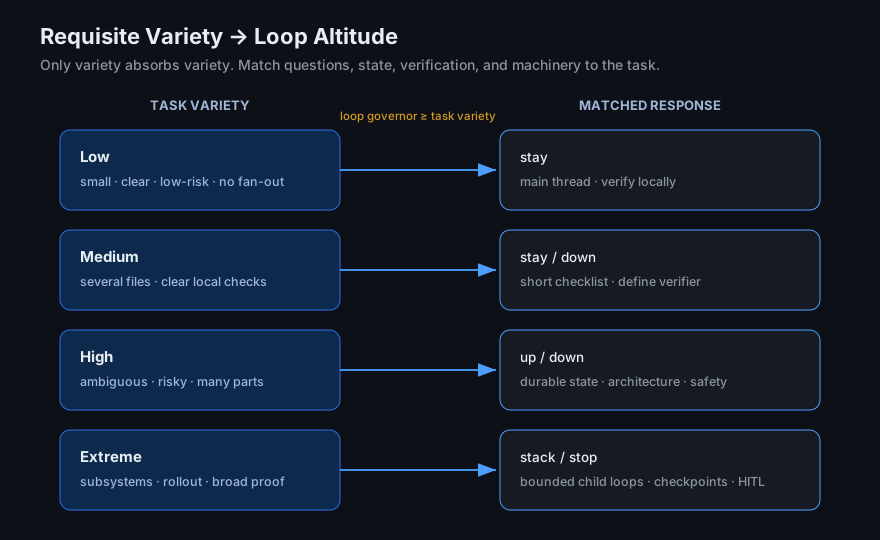
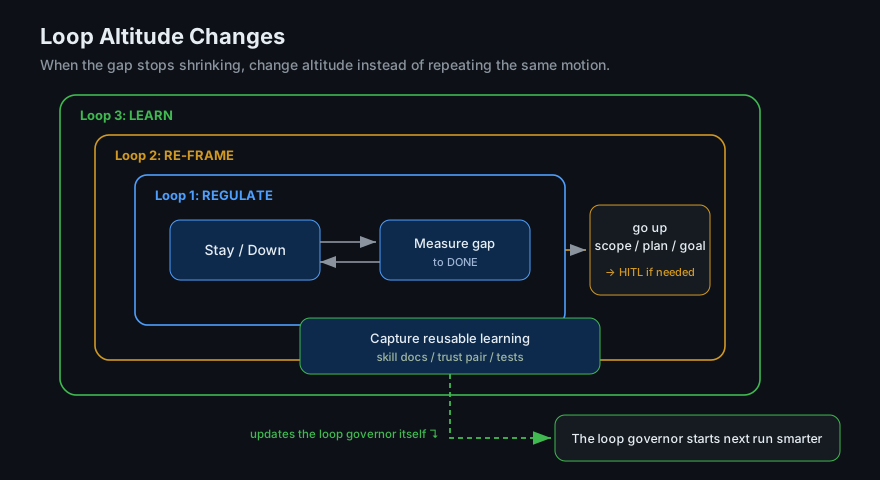
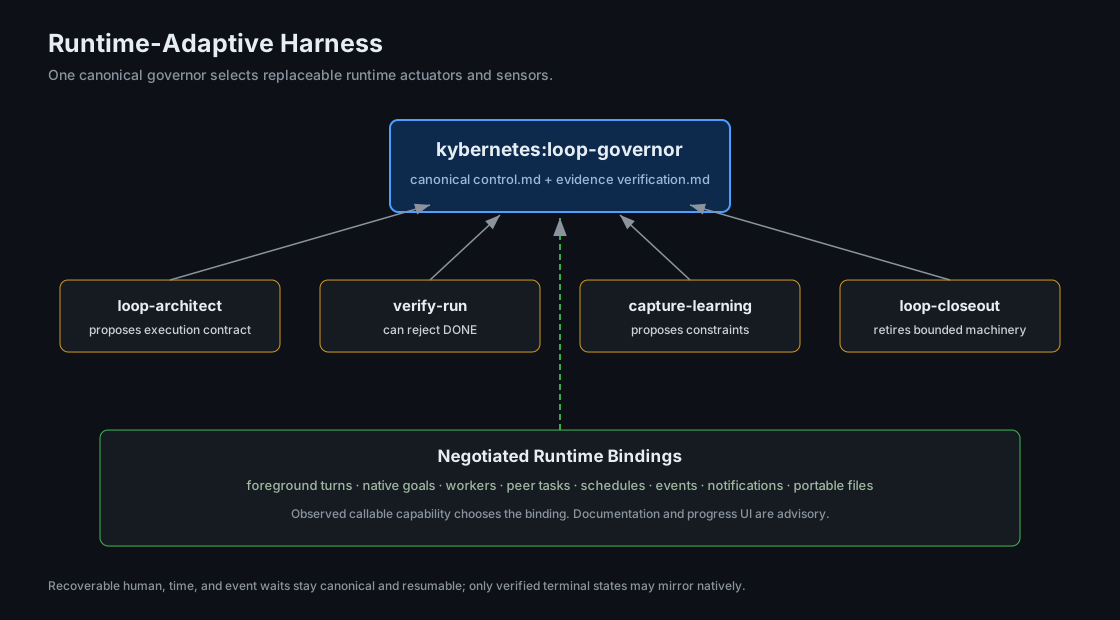
The deeper rationale is in INSPIRATION.md.
Repository Shape
skills/
  kybernetes-loop-governor/
  kybernetes-loop-architect/
  kybernetes-loop-closeout/
  kybernetes-verify-run/
  kybernetes-capture-learning/

docs/
  product/
  architecture/

examples/
  codex-goal-run/
  portable-run/
  portable-workgraph/
  runtime-adaptive-program/

tests/
  pressure-scenarios/
Remaining planned runtime wrappers are documented in docs/architecture/planned-skills.md.
Contributors: the runtime layer legend is in docs/architecture/layered-runtime-substrate.md.
Install
Use the skills CLI to install from GitHub.
List available Kybernetes skills:
npx skills add pariyar07/kybernetes --list
Install the governor globally for all supported agents:
npx skills add pariyar07/kybernetes \
  --global \
  --agent '*' \
  --skill 'kybernetes:loop-governor' \
  --copy \
  --yes
For project-local installation, omit --global.
Then invoke it as $kybernetes:loop-governor or ask your agent to use the Kybernetes loop governor skill.
Install a helper explicitly when useful by replacing the --skill value with
kybernetes:loop-architect, kybernetes:loop-closeout,
kybernetes:verify-run, or kybernetes:capture-learning. The governor also has
portable in-kernel fallbacks when a helper is unavailable.
Public Guardrails
- Public defaults must be generic. Maintainer-specific workflows belong in private notes or optional adapters.
- New
SKILL.mdfiles require pressure scenarios first. - Runtime-specific assumptions belong in runtime bindings, not generic loop-governor behavior.
- Irreversible actions, secrets, publishing, deploys, and external communications require explicit human approval.
License
MIT. See LICENSE.
No comments yet
Be the first to share your take.