
What is KubeSphere
English | 中文
KubeSphere is a distributed operating system for cloud-native application management, using Kubernetes as its kernel. It provides a plug-and-play architecture, allowing third-party applications to be seamlessly integrated into its ecosystem. KubeSphere is also a multi-tenant container platform with full-stack automated IT operation and streamlined DevOps workflows. It provides developer-friendly wizard web UI, helping enterprises to build out a more robust and feature-rich platform, which includes most common functionalities needed for enterprise Kubernetes strategy, see Feature List for details.
The following screenshots give a close insight into KubeSphere. Please check What is KubeSphere for further information.
Demo environment
🎮 KubeSphere Lite provides you with free, stable, and out-of-the-box managed cluster service. After registration and login, you can easily create a K8s cluster with KubeSphere installed in only 5 seconds and experience feature-rich KubeSphere.
🖥 You can view the Demo Video to get started with KubeSphere.
Features
Architecture
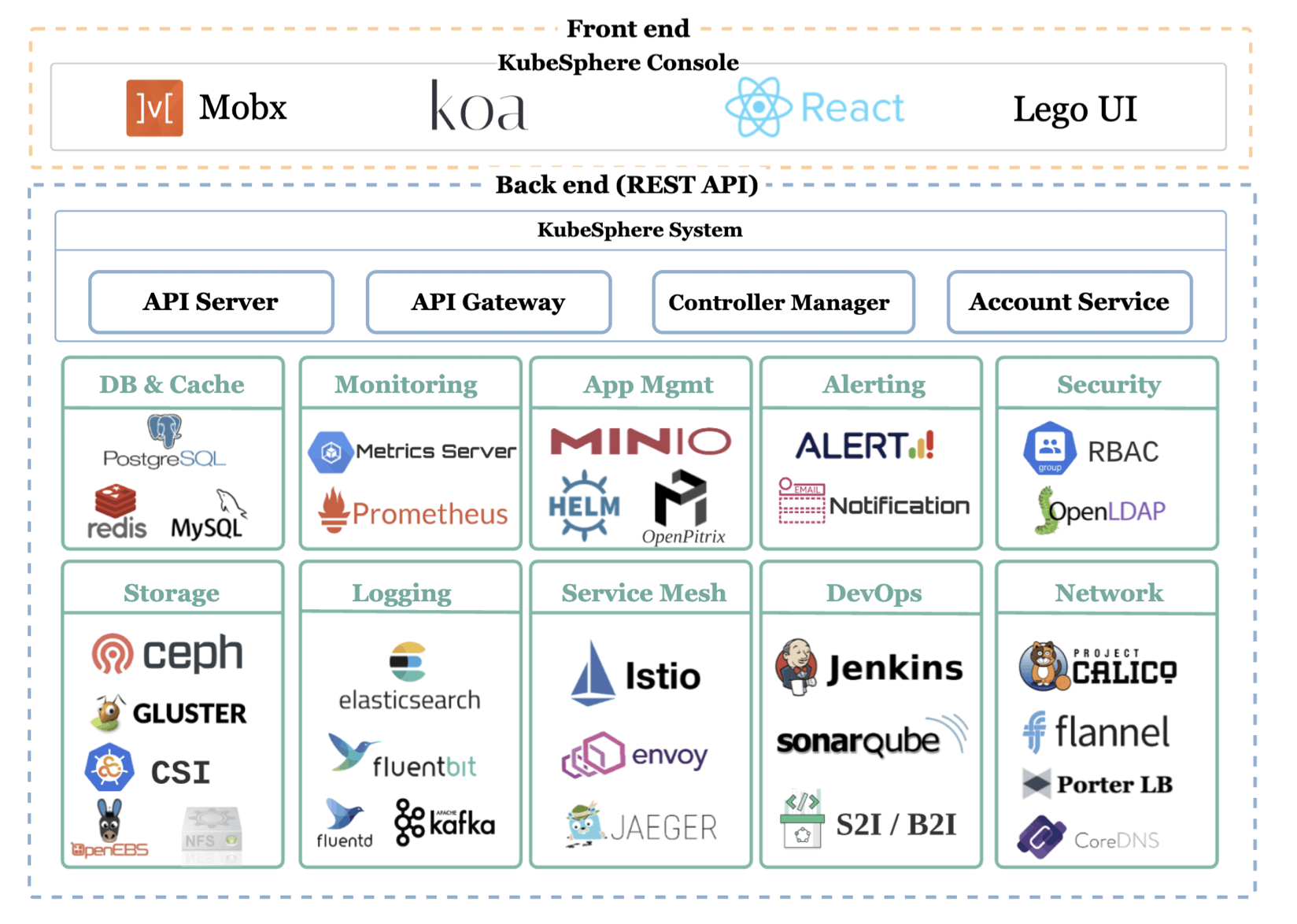
KubeSphere 4.x adopts a microkernel + extension components architecture (codename LuBan). The core part (KubeSphere Core) only includes the essential basic functions required for system operation, with independent functional modules split and provided in the form of extension components. Users can dynamically manage the extension components during system operation. With the extension capabilities, KubeSphere can support more application scenarios and meet the needs of different users.
Latest release
🎉 KubeSphere v4.1.2 was released! It brings enhancements and better user experience, see the Release Notes For 4.1.2 for the updates.
Installation
KubeSphere can run anywhere from on-premise datacenter to any cloud to edge. In addition, it can be deployed on any version-compatible Kubernetes cluster. KubeSphere consumes very few resources, and you can optionally install additional extensions after installation.
Quick start
Installing on K8s
Run the following commands to install KubeSphere on an existing Kubernetes cluster:
helm upgrade --install -n kubesphere-system --create-namespace ks-core https://charts.kubesphere.io/main/ks-core-1.1.3.tgz --debug --wait
KubeSphere for hosted Kubernetes services
KubeSphere is hosted on the following cloud providers, and you can try KubeSphere by one-click installation on their hosted Kubernetes services.
- KubeSphere for Amazon EKS
- KubeSphere for Azure AKS
- KubeSphere for DigitalOcean Kubernetes
- KubeSphere on QingCloud AppCenter(QKE)
You can also install KubeSphere on other hosted Kubernetes services within minutes, see the step-by-step guides to get started.
👨💻 No internet access? Refer to the Air-gapped Installation.
Guidance, discussion, contribution, and support
You can reach the KubeSphere community and developers via the following channels:
:hugs: Please submit any KubeSphere bugs, issues, and feature requests to KubeSphere GitHub Issue.
:heart_decoration: The KubeSphere team also provides efficient official ticket support to respond in hours. For more information, click KubeSphere Online Support.
Contribution
- KubeSphere Development Guide explains how to build and develop KubeSphere.
- KubeSphere Extension Development Guide explains how to develop KubeSphere extensions.
Code of conduct
Participation in the KubeSphere community is governed by the Code of Conduct.
Security
The security process for reporting vulnerabilities is described in SECURITY.md.
Who are using KubeSphere
The user case studies page includes the user list of the project. You can leave a comment to let us know your use case.
No comments yet
Be the first to share your take.