
hermes-dreaming

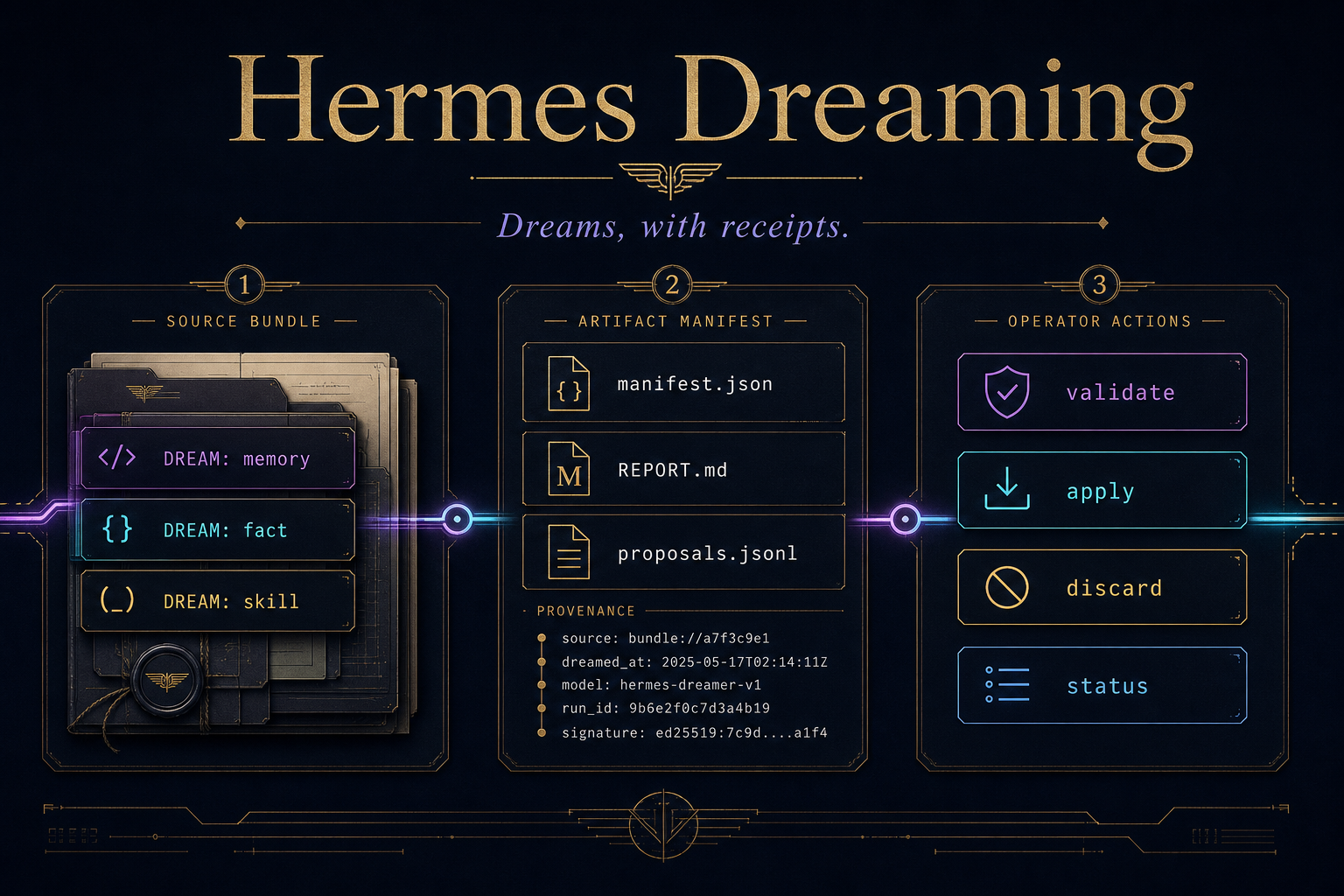
A standalone, open-source staged self-improvement engine for Hermes-style memory, user, skill, and fact updates. It scans explicit source inputs, stages proposed changes in a reviewable artifact directory, and only writes to live state after an explicit apply step.
Hermes plugin
This repo now ships as a proper Hermes plugin too.
Install from GitHub with:
hermes plugins install asimons81/hermes-dreaming --enable
For a local checkout during development:
hermes plugins install file:///path/to/hermes-dreaming --enable
Once installed, use:
hermes dreaming review --help
Update the installed checkout with:
hermes dreaming update
Use hermes dreaming update --check if you only want the status check.
The plugin also bundles a Hermes skill named dreaming. Load that bare name inside Hermes if you want the guided staged workflow.
Onboarding docs
docs/onboarding.mdis the shortest path from "what is this" to the full loop.docs/install-update.mdcovers plugin install and safe fast-forward updates.docs/quickstart.mdis the copy/paste offline demo.docs/personas.mdshows how different operators use the same loop.docs/safety.mdspells out what Dreaming can and cannot mutate.
Current status
- Full feature set: create, review/open, summarize, approve, reject, diff, validate, apply, discard, compact, report-card, install-cron, status, update, all implemented
- Live memory mutation with score gating, idempotence, backups, and capacity enforcement
- Run ledger + DREAMS.md diary for auditability
- Hermes-native plugin: install once, use everywhere
- Recent-session reader with fallback chain (SessionDB → SQLite → pointer-log)
- Cron installer for nightly dry-run review
- Test suite passes locally
Install
For end-user installs, use the plugin path in docs/install-update.md. For local development:
python -m pip install -e .[dev]
If you want the optional OpenAI-compatible provider:
python -m pip install -e .[llm]
CLI
# Create an artifact from sources

dreaming create --live-root ./live --artifact-root ./artifacts --source ./sources

# Review: create and validate without applying

dreaming review --live-root ./live --artifact-root ./artifacts --source ./sources

# Open an existing artifact and print next steps

dreaming review --open ./artifacts/<artifact-id>

dreaming summarize ./artifacts/<artifact-id>
dreaming approve ./artifacts/<artifact-id> all
dreaming reject ./artifacts/<artifact-id> <proposal-id> --reason "too broad"

# Inspect an artifact

dreaming diff ./artifacts/<artifact-id> --live-root ./live

# Validate a staged artifact

dreaming validate ./artifacts/<artifact-id> --live-root ./live

# Apply approved changes

dreaming apply ./artifacts/<artifact-id> --live-root ./live --backup-root ./backups
# Preview the apply without writing live state or creating backups
dreaming apply ./artifacts/<artifact-id> --live-root ./live --backup-root ./backups --dry-run
# Apply only high-priority memory and user updates, skip skills and facts
dreaming apply ./artifacts/<artifact-id> --live-root ./live --backup-root ./backups --priority high --target-kind memory,user
# Undo an apply: restore live files from the recorded backups
dreaming revert ./artifacts/<artifact-id> --live-root ./live --backup-root ./backups --yes
# Discard a staged artifact
dreaming discard ./artifacts/<artifact-id> --archive-root ./archive
# Show artifacts that are approved and ready to apply
dreaming inbox --artifact-root ./artifacts --apply-ready
# List available analysis providers
dreaming providers list
# Stage from the last 5 local sessions in one step (replaces manual harvest + create)
dreaming create --from-sessions 5 --live-root ./live --artifact-root ./artifacts

dreaming discard ./artifacts/<artifact-id> --archive-root ./archive

# Compact terminal (applied/discarded) artifacts to an archive

dreaming compact --artifact-root ./artifacts --archive-root ./archive

# Install a nightly review-only cron job

dreaming install-cron --schedule "0 3 * * *"

# Render a local operator digest

dreaming digest ./artifacts/<artifact-id> --weekly

# Show artifact status

dreaming status --artifact-root ./artifacts

# Safely update the installed checkout

dreaming update
dreaming update --check
Quickstart demo fixture
If you want the shortest path to "oh, I get it," use examples/quickstart/. It is an offline fixture, so no API key or external model access is required.
If the dreaming entrypoint is not installed yet, swap in python -m hermes_dreaming for the same commands.
- Fixture notes:
examples/quickstart/README.md - Onboarding path:
docs/onboarding.md - Install and update:
docs/install-update.md - Runnable walkthrough:
docs/quickstart.md - Persona examples:
docs/personas.md - Safety boundaries:
docs/safety.md
Command notes
report-cardrenders a redacted shareable summary from an existing artifact and can write a JSON companion with--json.digestrenders a local operator brief to stdout only. It can include--weeklyrollups, but it does not send anything to Telegram. If you want delivery later, wrap the command in a separate transport layer that consumes stdout.createandreviewaccept repeatable--source,--from-sessions N(or--recent Nalias),--from-since 7d, and--no-llm(shorthand for--provider offline-marker). Harvest stats (sessions,redactions) print to stdout before staging.review --openprints the artifact path and the next commands.applyaccepts--dry-runfor previews,--priority low,normal,highto filter proposals, and--target-kind memory,user,skill,factto filter by destination. Filters compose; filtered-out proposals stay approved so a later apply with a different filter can still land them.revertrestores live files from the recorded backups and rolls the artifact back fromappliedtoreverted. Requires--yesfor non-interactive use. Drift detection records an audit event when the live file changed after apply, but the restore still runs.inboxsupports--apply-readyto show only artifacts where every proposal is approved (or already applied) and the artifact is instaged,approved, orappliedstatus. The inbox digest also surfaces a "Ready to apply" section.providers listintrospects the three built-in providers (offline-marker, openai-compatible, ollama) without pinging external services.--no-llmis a shorthand for--provider offline-markeroncreateandreview.- OpenAI-compatible and Ollama providers fail closed on malformed output, and each proposal must carry confidence, snippet, provenance, and approved fields before it can be written.
summarizeprints a concise decision brief for an existing artifact.approveandrejectupdate artifact metadata only, they do not touch live roots.rejectrequires a non-empty--reasonat the command layer; any code path (CLI, library, plugin) is constrained by the same rule.diffaccepts optional--live-rootand renders unified diffs when the live target root is available.applyapplies already approved proposals.--approvestill works as a compatibility shortcut for recording approvals before apply.updatesupports--remote,--branch,--check, and--no-verify.
Dream markers
The offline provider looks for explicit DREAM: lines in the source bundle.
DREAM: memory: Keep updates short and concrete.
DREAM: user: Prefer concise status updates.
DREAM: fact: {"type": "preference", "key": "tone", "value": "casual"}
DREAM: skill: path=skills/review.md | Preserve review gates and backups.
Artifact layout
Each run writes a staged artifact directory containing:
manifest.jsonREPORT.mdsources.jsonlproposals.jsonlaudit.jsonl
The artifact is intentionally simple, deterministic, and easy to review on disk or in git.
Repo docs
CONTRIBUTING.mdis the contributor guide and local workflow contractSECURITY.mdcovers private vulnerability reportingCODE_OF_CONDUCT.mdsets the collaboration rulesbrief.mdhas the project brief and non-goalsspecs/mvp-implementation-plan.mddescribes the current implementation contract and package layoutdocs/release-checklist.mdis the pre-release checklistreviews/final-sanity.mdrecords the most recent QA passresearch/upstream-overlap.mdcaptures the upstream overlap notes and references
Contributing
If you want to contribute, start with CONTRIBUTING.md.
- Use the issue templates so the scope and intent are clear.
- Run
pytest -q,python -m build --wheel, andgit diff --checkbefore requesting review. - If your change touches live roots, artifact roots, or writeback behavior, state that explicitly.
- If you change release-facing text or safety rules, make sure the docs still match shipped behavior.
Development
pytest -q
python -m pip install build
python -m build --wheel
The repo is intentionally self-contained and safe for public release review.
No comments yet
Be the first to share your take.