
GSD Task Manager
A privacy-first Eisenhower matrix for deciding what to do, schedule, delegate, or eliminate.
Live app: gsd.vinny.dev Current version: 12.0.0 Current product: the v11 single-matrix shell, offline-first local storage, optional PocketBase sync, and the GSD MCP server.



What ships in v11
- A responsive four-quadrant matrix with drag-and-drop movement.
- Quick Capture, full task editing, search, keyboard navigation, and optional built-in Smart Views.
- Due dates, tags, dependency selection, and circular-dependency prevention.
- Archive, dashboard/review analytics, sync history, settings, and onboarding.
- Local IndexedDB persistence, JSON import/export, offline PWA support, and user-controlled update prompts.
- Optional multi-device PocketBase sync with Google or GitHub OAuth and realtime server-sent events.
- A separately installed MCP server with 20 task, analytics, and diagnostic tools, including validated and dry-run-aware writes.
- Light and dark Violet Frost themes with WCAG AA as the accessibility floor.
Retired v7/v8 surfaces such as selection-mode batch operations, the Quick Settings panel, and smart-view pinning shortcuts are not part of the v11 shell.
Privacy and data custody
Local-only mode is the default. Tasks are stored in the browser's IndexedDB and the core product does not require a backend. Clearing browser data can erase local tasks, so export backups regularly.
Cloud sync is explicitly optional. When enabled, task data is sent to the
configured PocketBase server; the hosted configuration uses
https://api.vinny.io. Self-hosting instructions and the encryption-at-rest
hooks live under docker/. See SECURITY.md for the
precise trust and token-storage posture.
Using the matrix
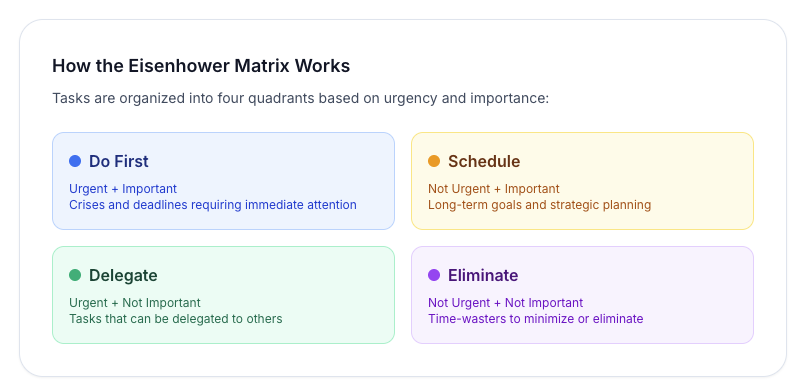
The Eisenhower matrix classifies work by urgency and importance:
- Do First — urgent and important.
- Schedule — important, not urgent.
- Delegate — urgent, not important.
- Eliminate — neither urgent nor important.
Use the Quick Capture field or press n to start a task. Use Shift+N for the
full composer, / for search, ? for help, and Option+1 through Option+4
(Alt on non-Mac keyboards) to focus a quadrant. The in-app help drawer is the
canonical shortcut ledger.
Local development
Requirements: Bun 1.3.14 and a current browser.
bun install
bun dev
Open http://localhost:3000. A fresh browser profile starts at /about; use
the Open App call to action to enter the matrix. PocketBase is not required
for local task CRUD.
Canonical checks
bun run test
bun run test -- --coverage
bun typecheck
bun lint
bun run quality:shape
bun run license:check
bun audit --audit-level=high
bun run build
bun run test:e2e
Use bun run test, not bun test; the latter invokes Bun's built-in runner
instead of Vitest. Playwright covers Chromium, Firefox, and WebKit. The optional
authenticated PocketBase harness runs with:
bun run test:system:pocketbase
Architecture
- Next.js 16 App Router static export; the application is client-side.
- React 19, TypeScript, Tailwind CSS, and the Violet Frost Inkwell tokens.
- Dexie/IndexedDB for local data and PocketBase for optional cloud sync.
- Vitest for unit/integration coverage and Playwright for browser coverage.
- Bun workspaces, including
packages/mcp-server/.
Start with ARCHITECTURE.md,
docs/security-trust-boundaries.md, and
the architecture decisions in docs/adr/.
Deployment
bun run buildcreates the static export inout/.bun run deploy:devandbun run deployuse the repository deployment scripts for the configured AWS environments.docker/Dockerfilebuilds the self-hosted Caddy and PocketBase image.cloudfront/response-headers-policy.jsonand the related scripts manage production response headers.
Uploading an artifact is not proof that the CDN or a running container serves it. Verify the deployed URL separately.
Release documentation checklist
Before changing the release version or announcing a feature:
- Compare the README version with
package.json. - Verify every feature claim in the current shell, not only in retained data models or archived ADRs.
- Run the canonical checks above and a production static build.
- Update
CHANGELOG.md,SECURITY.md, and the trust-boundary map when the release changes their claims. - Treat source, tests, build artifacts, deployment, and live runtime as separate evidence states.
Contributing and security
Read CONTRIBUTING.md before making changes. Report
vulnerabilities through the private process in SECURITY.md,
not a public issue.
No comments yet
Be the first to share your take.