
GEE MCP



An MCP server that exposes Google Earth Engine (GEE) as a set of MCP tools covering dataset discovery, metadata extraction, analysis primitives, and AI-assisted GEE Python code generation.
GEE-MCP is part of an initiative by Trillium Technologies and ESA to realize the vision of Earth system predictability (ESP). You can read about the ESP vision here.
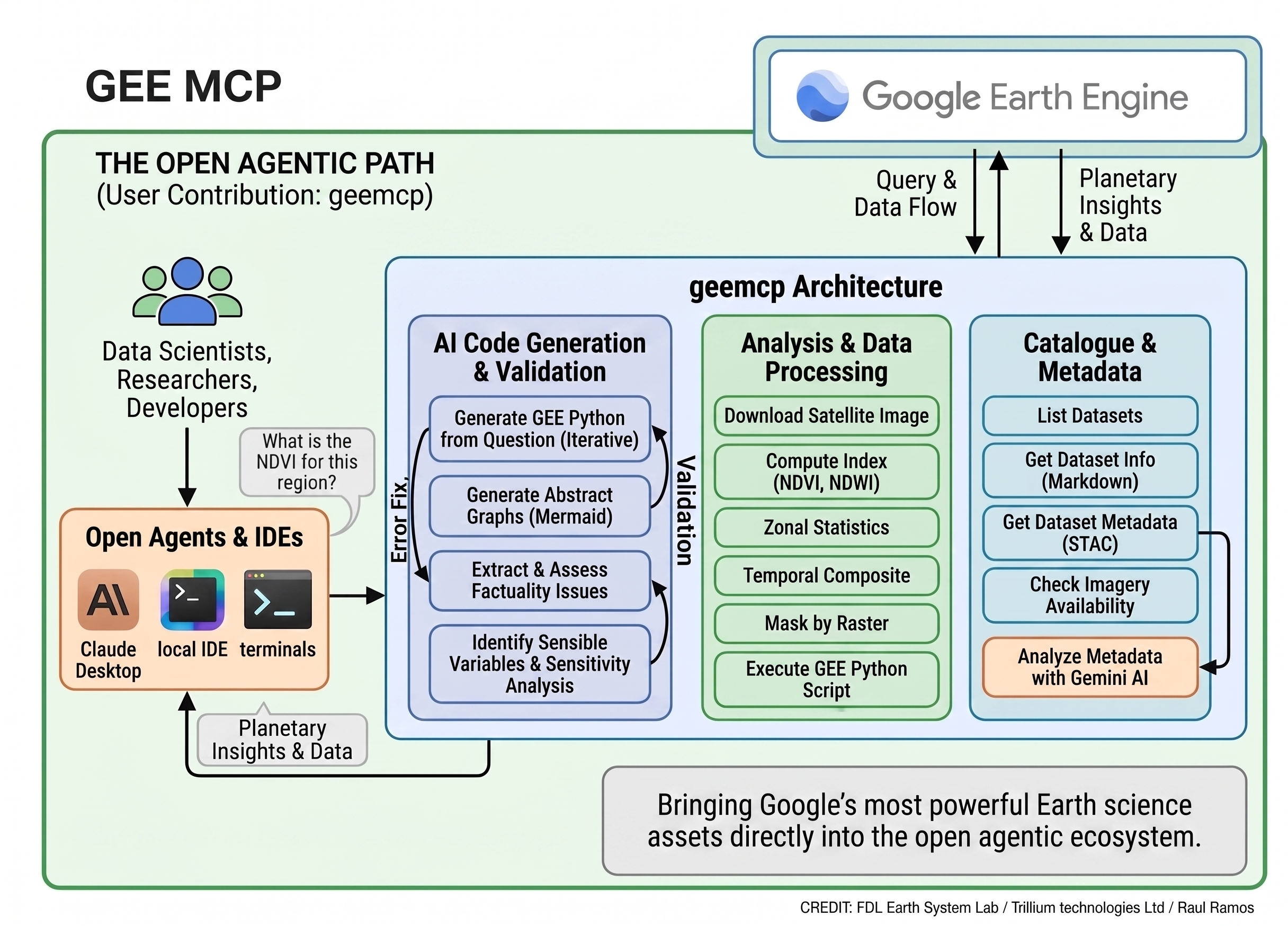
Architecture
Tools
The server registers the following MCP tools, grouped by purpose.
Catalogue & Metadata
list_datasets: list all available Google Earth Engine datasets.get_dataset_info: get detailed Markdown information about a GEE dataset.get_dataset_metadata: get structured STAC metadata (bands, temporal interval, etc.) for a dataset.check_imagery_availability: check imagery availability for a dataset within a date range and optional bounding box.extract_metadata: extract structured metadata (bands, pixel size, availability, cadence) from a dataset page.analyze_metadata: use Gemini to analyse a dataset description and extract structured metadata.
Analysis & Data Processing
download_satellite_image: download satellite images from GEE.compute_index: compute a spectral index (NDVI, NDWI, …) or a custom band-math expression over a region.zonal_statistics: compute summary statistics (mean, median, min, …) for bands or an index within a region.temporal_composite: create cloud-free temporal composites (median, mosaic, greenest, most recent).mask_by_raster: apply a value-range mask (DEM, land cover, …) to imagery and compute statistics.threshold_area: compute the area of pixels meeting a threshold condition on a band, index, or expression.multi_period_analysis: run the same analysis across multiple date ranges for temporal comparisons.execute_gee_python: execute a provided GEE Python script and return the result.
AI Code Generation & Validation
generate_python_from_question: answer an Earth Observation question by generating GEE Python code with iterative error fixing.generate_abstract_graph_from_question: generate an abstract Mermaid graph describing an EO pipeline that solves a question.generate_python_from_reasoning_steps: generate GEE Python code from a provided set of reasoning steps.generate_python_from_abstract_graph: generate GEE Python code from a provided Mermaid graph.get_datasets_locations_and_periods: determine the GEE datasets, time periods, and AOIs required to answer a question.extract_factuality_issues: analyse a GEE Python script and surface scientific assumptions worth verifying.assess_factuality_issue: produce an expert-style assessment of a factuality issue, with optional code-fix recommendations.identify_sensible_variables: identify variables and constants in the code whose values might affect the final result.sensitivity_analysis: perform sensitivity analysis by tweaking variable values and plotting the impact on the final result.
Example tool invocation
A JSON-RPC call to generate_python_from_question looks like:
{
  "method": "tools/call",
  "params": {
    "name": "generate_python_from_question",
    "arguments": {
      "question": "Calculate the average NDVI over the Amazon basin for the year 2023.",
      "fix_code": true
    }
  }
}
The response includes:
python_code: the generated GEE Python code,python_code_explanation: an explanation of the code,python_code_fix_history: the iterative fixes attempted,python_code_result: the result of executing the code.
The generated code defines gee_main() returning (result_xml, Map),
where result_xml follows a <RESULT><VARIABLE_NAME>... </VARIABLE_NAME><VALUE>...</VALUE><UNITS>...</UNITS></RESULT> shape,
and Map is a geemap.Map for notebook display.
Installation
The project uses Poetry.
git clone https://github.com/FrontierDevelopmentLab/gee-mcp.git
cd gee-mcp
poetry install
Supported Python versions: 3.11–3.14.
Configuration
You need to configure access to an LLM provider and to Google Earth
Engine via environment variables. Copy .env.example
to .env and fill in the values; python-dotenv is loaded on server
startup.
LLM provider
The server talks to an LLM through a small pluggable layer
(gee_mcp.server.llm). Pick a provider and model:
| Variable | Required | Purpose |
|---|---|---|
LLM_PROVIDER |
yes | One of google, anthropic, openai |
LLM_NAME |
yes | Model id for that provider (e.g. gemini-3.1-pro-preview, claude-opus-4-7, gpt-5) |
Then set the credentials for the provider you chose:
google — either an API key:
| Variable | Required | Purpose |
|---|---|---|
GEMINI_API_KEY |
yes | Gemini Developer API key |
GOOGLE_API_KEY is also accepted as a fallback for compatibility
with Google's official SDK convention.
…or a Vertex AI project (after running gcloud auth application-default login):
| Variable | Required | Default | Purpose |
|---|---|---|---|
VERTEXAI_PROJECT |
yes | GCP project ID for Vertex AI | |
VERTEXAI_LOCATION |
no | global |
GCP region for Vertex AI |
anthropic:
| Variable | Required | Purpose |
|---|---|---|
ANTHROPIC_API_KEY |
yes | Anthropic API key |
openai:
| Variable | Required | Purpose |
|---|---|---|
OPENAI_API_KEY |
yes | OpenAI API key |
Google Earth Engine
| Variable | Required | Purpose |
|---|---|---|
GEE_PROJECT |
yes | GEE project ID |
GOOGLE_APPLICATION_CREDENTIALS |
no | Path to a service-account JSON key file. Only needed if you have not authenticated via earthengine authenticate or gcloud. |
GEE_SKIP_AUTH |
no | Set to 1 to skip auth entirely (used by the test suite). |
Authentication is delegated to ee.Initialize, which walks the
standard Google Cloud credential chain. Either run earthengine authenticate (interactive, once per machine) or set
GOOGLE_APPLICATION_CREDENTIALS to a service-account key path. On
GCE / Cloud Run, instance metadata is picked up automatically.
Running the server
Over stdio (the standard MCP transport):
poetry run python -m gee_mcp.server
Testing with the example client
The repo includes client.py, an example MCP client that launches
the server as a subprocess.
poetry run python client.py
See example.ipynb for a notebook walk-through.
Integration
GEE MCP can be plugged into any MCP-aware agent. For example, in Gemini-CLI:
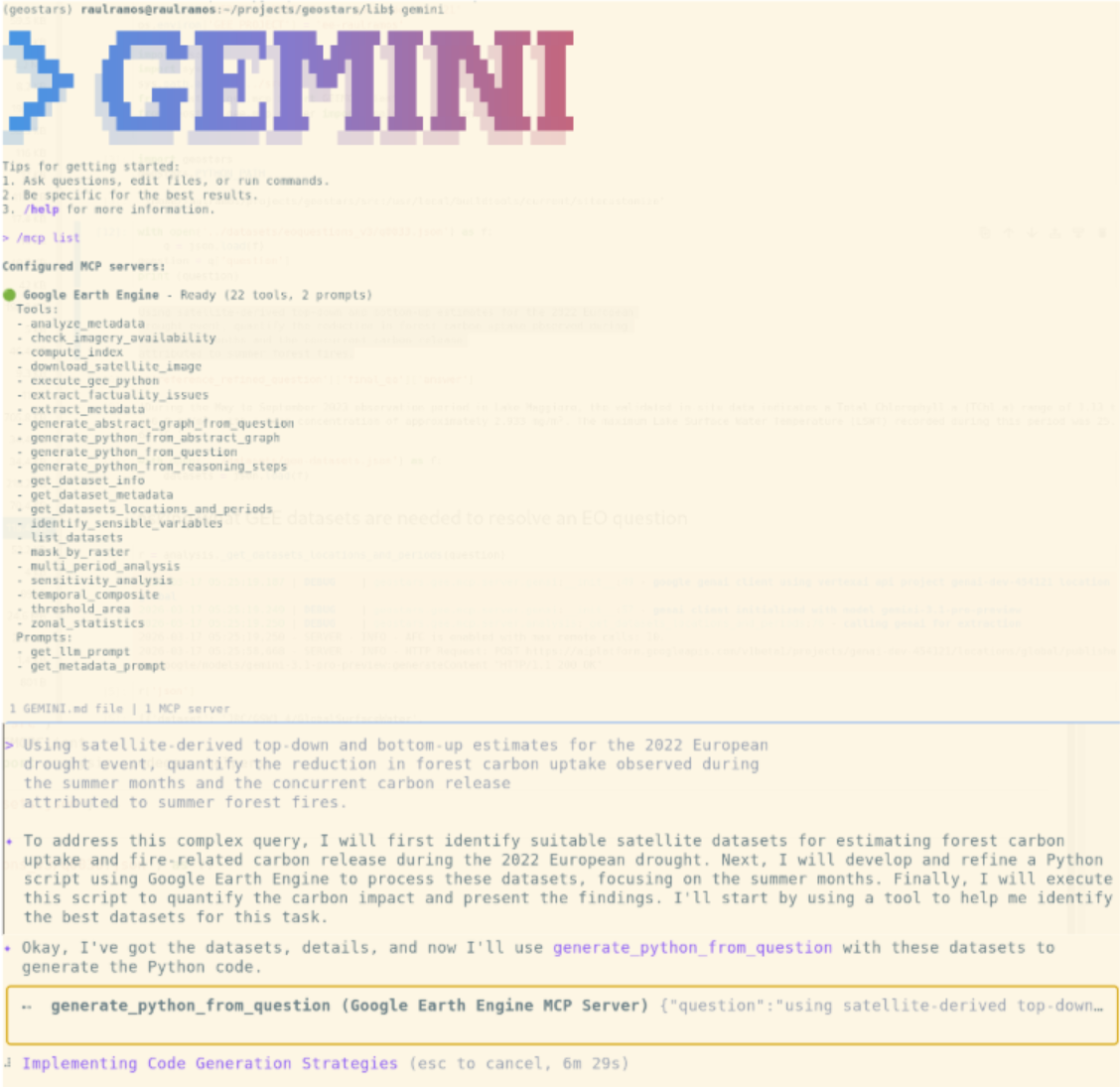
For the question:
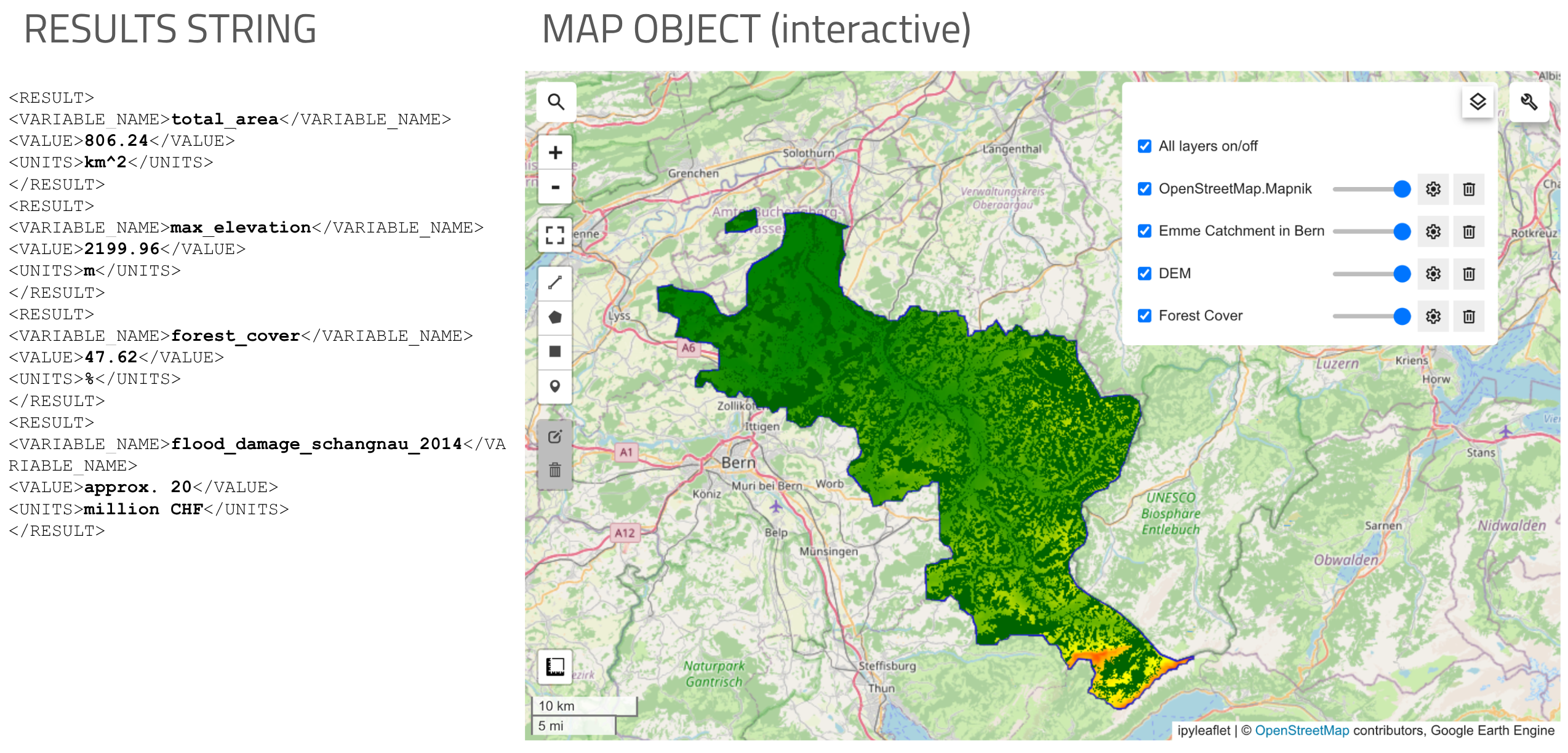
Characterize the morphometry and land cover of the Emme catchment in the Canton of Bern by determining its total area, maximum elevation, and forest cover percentage. Additionally, state the financial magnitude of the damages caused by the flash flood event in this catchment (specifically in Schangnau) during July 2014.
the generated code returns:
Development
Install the pre-commit hooks once:
poetry run pre-commit install
Run the full hook suite (detect-secrets, autoflake, black, isort, mypy, pylint, pytest+coverage):
poetry run pre-commit run --all-files
Run just the tests:
poetry run pytest
Acknowledgements
Originally created by the GeoSTARS (STARS: Scientific Testing of Agentic Reasoning) team (Raúl Ramos, James Walsh, Will Fawcett, and Russell Spiewak, Poliana Santana). Supported by the ESA Phi-Lab as part of Trillium Technologies Earth Systems Lab ESL.
License
MIT licensed. See LICENSE for the full text.
Copyright
© 2026 Trillium Technologies Ltd.
No comments yet
Be the first to share your take.