
Turn your AI coding agent into a production-focused full-stack engineer
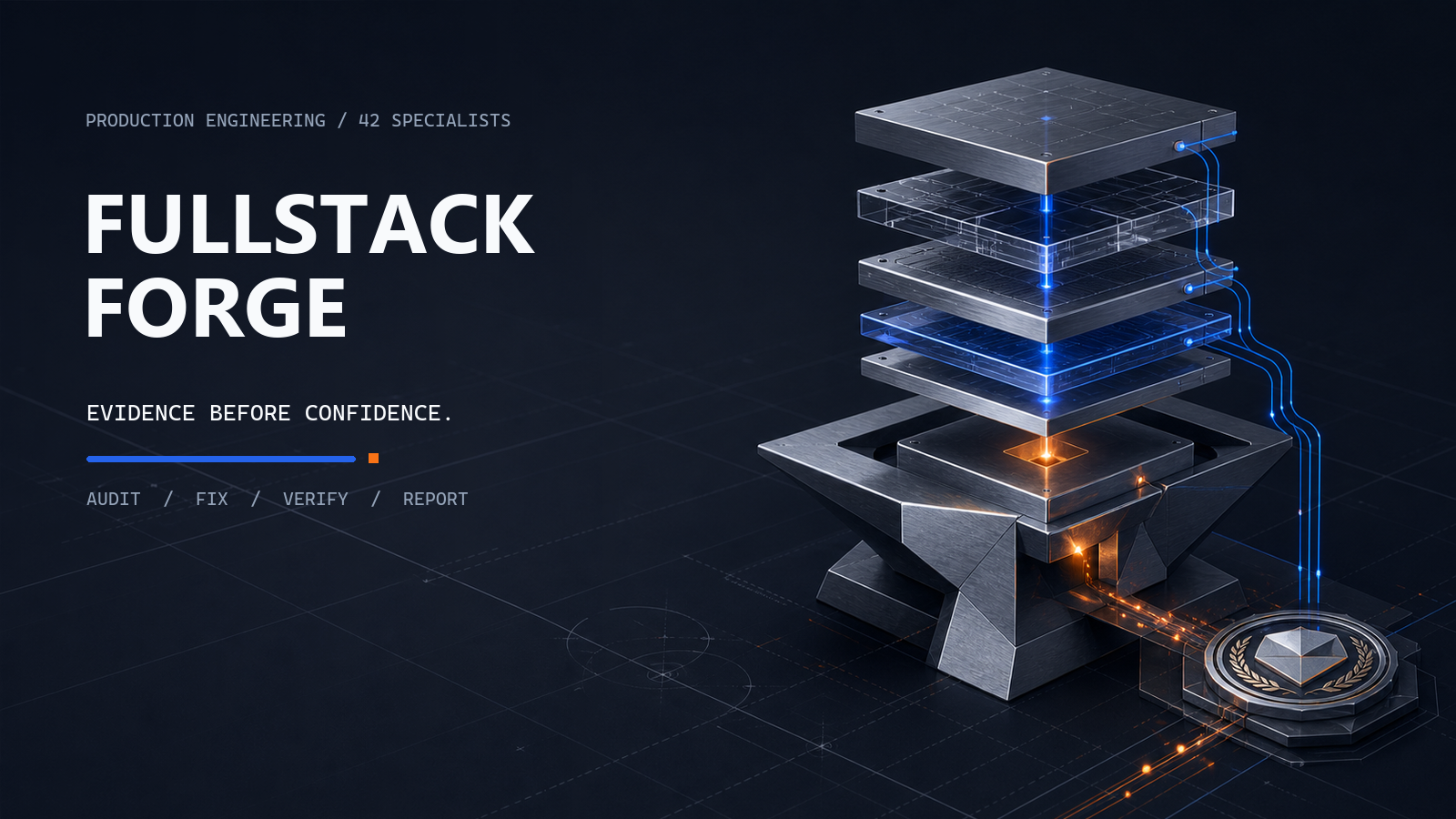
Fullstack Forge is a production-engineering orchestration and verification system that packages selected open-source specialist expertise behind one consistent workflow. It understands the repository, selects established specialist expertise, coordinates architecture, security, databases, APIs, frontend, UI, UX, testing, performance, reliability, and release readiness, resolves conflicts between them, implements safely, verifies evidence, and decides whether the result is production-ready.
Once installed, it works automatically. Continue talking to your AI agent normally. Forge is agent-guided, with deterministic CLI checks and evidence gates where supported.
You install and use one product. Forge vendors expertise from eight open-source Agent Skills projects, but you never install, invoke, update, or need to understand any of them.


Install
Requires Node.js 20.19+, 22.13+, or 24+.
Use the newest immutable release shown on the GitHub Releases page. If v0.2.2 is published there, install it with:
npm install --save-dev "https://codeload.github.com/is-bo/fullstack-forge-skill/tar.gz/refs/tags/v0.2.2"
npx forge init
npx forge doctor
Until that release exists, v0.1.0 remains the supported public release. Do not install the unpublished historical v0.2.0 tag.
Restart or reopen your AI coding agent only if it does not refresh installed project skills
automatically. forge init installs skills and ownership-managed project instructions for detected
hosts; use forge init all only when you intentionally want every bundled platform.
How to use it
Tell your AI agent what you want:
Add appointment cancellation and notify the patient.
Review the database queries and optimise anything that is actually inefficient.
Improve the mobile booking experience.
Prepare this application for release.
Forge activates automatically and loads only the relevant modules. No Forge command is required.
Optional commands
Use an explicit Forge command when you want to force or narrow a workflow:
/forge audit security
/forge audit queries
/forge audit cache
/forge frontend
/forge ui review
/forge ux review
/forge verify
/forge ship
The installed skill name is forge; host syntax differs:
Agent Skills form where supported:  $forge audit cache
Slash form where the host exposes skills as commands:  /forge audit cache
Terminal and CI:  npx forge audit cache
The terminal form is the stable executable interface. See platform support for host-specific selection forms and live-UI limitations. Explicit commands preserve the same evidence and approval rules as automatic use.
Where the expertise comes from
Forge owns the operating system: repository discovery, task interpretation, risk detection,
applicability, module selection, progressive disclosure, cross-domain coordination, conflict
resolution, approval boundaries, safe-fix policy, evidence requirements, deterministic analyzers,
the PASS / FAIL / NOT_VERIFIED / BLOCKED / NOT_APPLICABLE contract, and the fail-closed
Ship gate.
Specialist procedure comes from vendored open-source expertise. Every module says which:
Engine: Forge native
Engine: Upstream-powered — Impeccable
Engine: Hybrid — Forge + Vercel
| Provider | Licence | Powers |
|---|---|---|
| Impeccable | Apache-2.0 | reviewed UI and UX guidance |
| Addy Osmani Agent Skills | MIT | requirements, code, testing, docs, recovery, performance |
| Vercel Agent Skills | MIT | React, Next.js, React Native, and web-design guidance |
| Supabase Agent Skills | MIT | PostgreSQL practice, and Supabase where it is in use |
| Google Skills | Apache-2.0 | Well-Architected pillars, Cloud Run, Cloud SQL, GKE, Gemini |
| Cloudflare Skills | Apache-2.0 | Workers, Wrangler, Durable Objects, web performance |
| Sentry Agent Skills | MIT | issue investigation, tracing, and SDK setup |
| wshobson Agents (approved subset) | MIT | accessibility, payments, threat modelling, AI, SQL, SLOs |
Provider guidance is evidence-gated: Vercel, Supabase, Google Cloud, Cloudflare, Sentry, Stripe, and PayPal material loads only when your repository proves that provider is in use, or when you name it. A generic queue does not summon Cloudflare advice; plain PostgreSQL does not summon Supabase advice.
Upstream skills cannot activate on their own. Their content installs outside every agent-host
skill-discovery root, and each upstream SKILL.md is compiled to PLAYBOOK.md with its activation
frontmatter made inert, so it reaches the agent only when Forge selects it. When Forge and an
upstream workflow disagree, Forge wins — see
fullstack-forge/references/shared/composition-precedence.md.
Normal use is fully offline. There is no automatic upstream update check and no telemetry. Every
import is pinned to an immutable commit and checksummed. Inspect exactly what you have in
.fullstack-forge/manifests/upstream-registry.json and THIRD_PARTY_NOTICES.md.
Attribution, licences, exact commits, and the modifications Forge applies are recorded in THIRD_PARTY_NOTICES.md. The upstream maintainers do not endorse Fullstack Forge.
Forge UI
The UI and UX workflows are Forge commands:
$forge ui init | craft | document | extract | shape | critique | audit | polish | bolder |
quieter | distill | harden | onboard | animate | colorize | typeset | layout | delight |
overdrive | clarify | adapt | optimize
Earlier Forge UI commands still work as aliases (build to craft, review and verify to
audit, improve and fix to polish). Project state lives in PRODUCT.md, DESIGN.md, and
.fullstack-forge/ui/.
forge ui audit applies reviewed Impeccable guidance to evidence already available to Forge. The
Impeccable detector executable is not shipped or invoked; deterministic checks remain Forge-owned,
and subjective visual-craft results are advisories that never block Ship.
What Forge does
For a normal feature, Forge helps the agent:
- understand the existing application;
- select relevant engineering modules;
- implement through existing patterns;
- check related production concerns;
- run focused tests and tools;
- report what was verified and what remains uncertain.
Forty-two specialist modules cover foundation, frontend experience, APIs and trust boundaries, data, delivery, and capabilities such as notifications, AI, payments, realtime, and offline behavior. Natural-language routing is an initial aid: direct repository evidence determines final applicability.
Short example
User:
Add a feature that lets doctors cancel appointments and notify patients.

Agent with Fullstack Forge:
- Inspects the appointment and notification architecture.
- Selects API, database, authorization, notification, UX, and testing guidance.
- Implements status transitions and prevents unauthorized cancellation.
- Handles notification failure and adds focused tests.
- Reports the checks that passed and any proof that remains unavailable.
For a one-line visual adjustment, Forge keeps the plan and validation focused. For identity, permissions, personal data, payments, uploads, destructive operations, secrets, or tenancy, it requires stronger evidence and surfaces approval boundaries.
Supported agents
| Host | Installed project skill path | Managed automatic instruction |
|---|---|---|
| Codex, generic Agent Skills, Antigravity project | .agents/skills/ |
AGENTS.md |
| Claude Code | .claude/skills/ |
CLAUDE.md |
| Gemini CLI | .gemini/skills/ |
GEMINI.md |
| Cursor | .cursor/skills/ |
.cursor/rules/fullstack-forge.mdc |
| Windsurf | .windsurf/skills/ |
.windsurf/rules/fullstack-forge.md |
| GitHub Copilot | .github/skills/ |
.github/instructions/fullstack-forge.instructions.md |
Installation is manifest-owned, path-contained, and symlink-free. Updates preserve modified and user-authored instructions; uninstall removes only unchanged Forge-owned content. See getting started and platform support.
Evidence and limitations
Forge is not a standalone universal scanner and does not guarantee that an application is production-ready. It gives the AI agent a structured, evidence-based production-readiness workflow.
A PASS requires affirmative evidence. Applicable proof that cannot be obtained stays
NOT_VERIFIED or BLOCKED; a concern shown to be outside the affected boundary is reasoned
NOT_APPLICABLE, never a synthetic pass. Agent-authored findings bind source or runtime evidence,
revision, commands, limitations, and verification. Build state and historical reports never satisfy
the independent Ship gate.
Detailed references:
- Architecture
- Commands and CLI reference
- Finding schema and report schema
- Build mode and release workflow
Development and contributor information
Canonical skill sources live in src/fullstack-forge/. Generated platform copies must not be edited
by hand.
npm ci --ignore-scripts --no-audit --no-fund
npm run generate
npm run check
See development, contributing, and security.
Version policy
This source tree is the v0.2.2 release candidate. It becomes the current supported public release
only when its immutable GitHub Release is published and verified. v0.2.0 and v0.2.1 remain
fetchable historical tags without GitHub Releases; neither will be moved, rewritten, or republished.
Preparing to test the candidate after publication? See the v0.2.2 migration notes.
License
Apache-2.0. See LICENSE, NOTICE, and THIRD_PARTY_NOTICES.md.
No comments yet
Be the first to share your take.