
⚡ ForgeFlow
Production-grade Multi-Agent Enterprise Workflow Orchestrator
Ship a team of specialized AI agents — with human-in-the-loop approvals, full observability, real enterprise connectors, and defense-in-depth security — to production.








Quickstart · Architecture · Features · API · Deployment · Docs · Roadmap · Contributing
📖 Table of Contents
- What is ForgeFlow?
- Why ForgeFlow?
- Features
- Architecture
- Technology Stack
- Quickstart
- Configuration
- Usage Examples
- Workflows & Connectors
- API Reference
- Security
- Performance & Scalability
- Deployment
- Developer Guide
- Project Structure
- Roadmap
- Contributing
- License
🧭 What is ForgeFlow?
ForgeFlow is an open-source platform for building, running, and operating multi-agent AI workflows in the enterprise. Instead of a single monolithic prompt, ForgeFlow orchestrates a supervisor agent that routes work to a team of specialists — a researcher, an analyzer, and an executor — each grounded in real tools and real data, and gated by human approval before any high-impact side effect.
It ships three named workflow domains out of the box:
| Workflow | Pipeline | Status | Connector |
|---|---|---|---|
sales_ops |
qualify → research → analyze → propose → approve → execute | ✅ Production | HubSpot CRM (upsert-by-email, idempotent deals, 429 backoff) |
support_ops |
triage → investigate → respond → escalate → resolve | ⚠️ Template scaffold | Pairs with Jira / ServiceNow |
finance_recon |
ingest → match → flag variance → approve → post | ⚠️ Template scaffold | Pairs with QuickBooks / SAP |
support_opsandfinance_reconare honest scaffolds — they raise on.run()unlessdry_run=TrueorFORGEFLOW_ALLOW_TEMPLATE_WORKFLOWS=1is set, and the React console labels them as such. Three named templates ≠ three production workflows.sales_opsis the fully-wired reference path: follow docs/sales-ops-production.md to run it against a real HubSpot account on Fly.io in under an hour.
The problem it solves
Most "agent demos" collapse the moment they meet production reality: there's no audit trail, no cost ceiling, no way to pause for a human, secrets leak into prompts, a single flaky API takes down the whole run, and swapping a mock tool for a real one means rewriting the agent. ForgeFlow is the opinionated reference implementation of everything that sits around the LLM call to make agentic automation safe to deploy:
- Durable state — every node is checkpointed to PostgreSQL, so any worker can resume any run after a crash.
- Human-in-the-loop — workflows pause via LangGraph
interrupt_beforeand resume on an approve/reject webhook or Slack button. - Pluggable tools — agents talk to the world through the Model Context Protocol (MCP), so you swap a mock CRM for HubSpot without touching agent code.
- Defense in depth — PII redaction, prompt-injection guards, SSRF protection, untrusted-tool-output quarantine, and an outbound-email allowlist.
- Cost & resilience controls — per-run budget guard, circuit breakers, retry-with-backoff, and token-level cost tracking.
- Full observability — LangSmith / Phoenix / Langfuse tracing, Prometheus metrics, immutable audit log, and LLM-as-judge evaluation.
Who it's for
| Audience | What ForgeFlow gives you |
|---|---|
| Platform / ML engineers | A batteries-included blueprint for shipping agents with checkpointing, RBAC, observability, and connectors already wired. |
| Enterprises | Human approvals, audit trails, cost ceilings, multi-tenancy, and on-prem / air-gapped deployment paths. |
| OSS contributors | A clean, typed, well-tested (306 tests) codebase with clear extension points — connectors, MCP tools, and workflow templates. |
| Recruiters & evaluators | A demonstration of production agentic-AI engineering: LangGraph, MCP, A2A, Kubernetes, Terraform, and a polished React 19 console. |
💎 Why ForgeFlow?
- 🧠 Supervisor multi-agent orchestration — deterministic, auditable hub-and-spoke routing built on LangGraph
StateGraph. - 🔌 8 real enterprise connectors — HubSpot, Salesforce, Jira, ServiceNow, GitHub, SAP S/4HANA, QuickBooks Online, and Microsoft Graph — all behind a single resilient connector base.
- 🛡️ Security-first by design — see SECURITY_AUDIT.md for the full threat model and the fixes that close each finding.
- 🔁 Provider-agnostic — OpenAI, Anthropic Claude, or a fully local Ollama daemon (privacy / air-gapped mode).
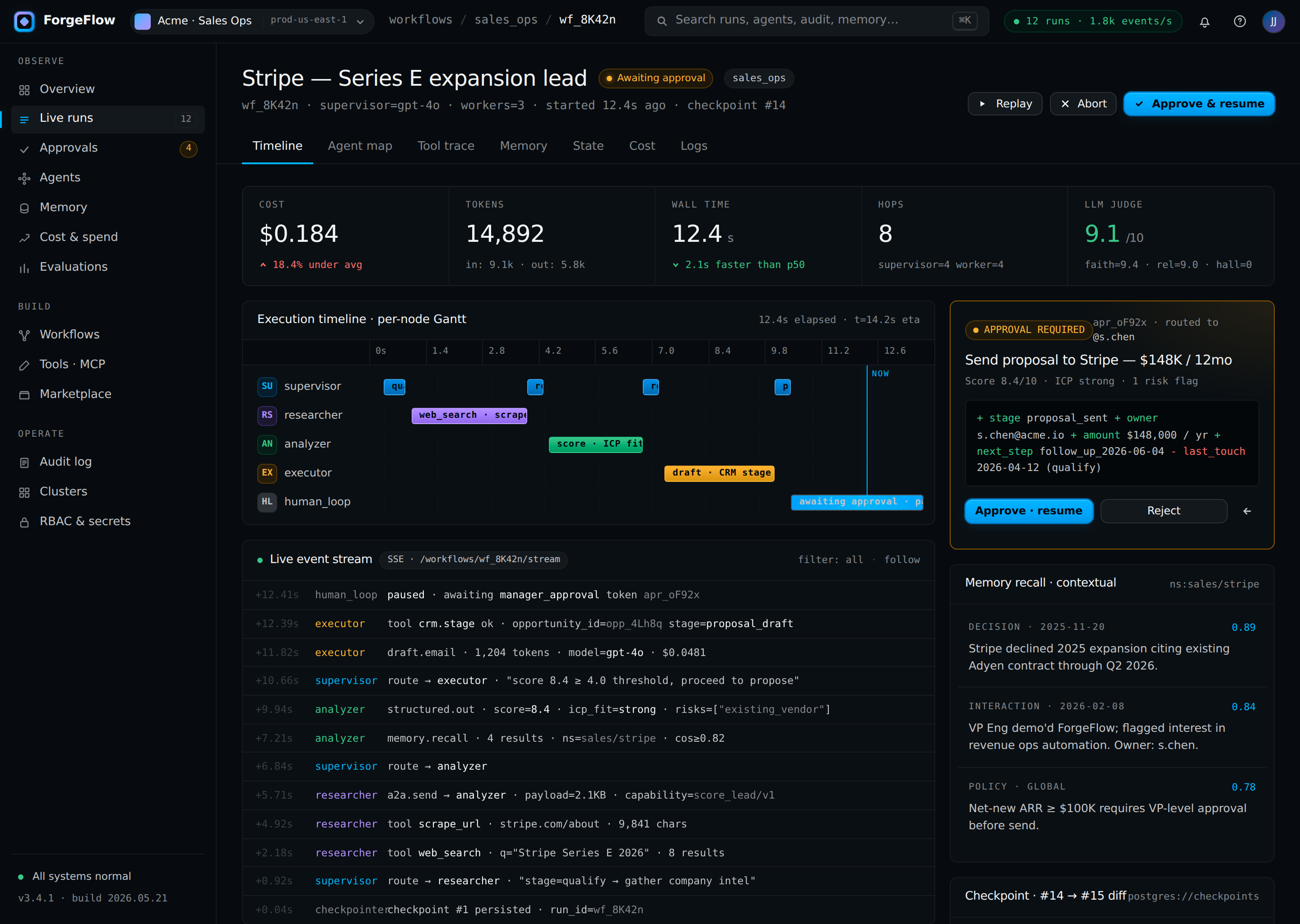
- 📊 Operate it, don't just run it — a 13-view React console for runs, approvals, cost, audit, memory, agents, and evaluations.
- 🚢 Deploy anywhere — Docker Compose, Kubernetes, Helm, Terraform (AWS), Fly.io, and an offline bundle for air-gapped sites.
✨ Features
- Supervisor agent emits a structured
RoutingDecision(never calls tools directly) so routing stays deterministic and auditable — forgeflow/agents/supervisor.py - Researcher agent — web search + URL scraping + enrichment, with SSRF-guarded fetches
- Analyzer agent — 0–10 ICP scoring with risk flags and a recommended action
- Executor agent — drafts proposals, writes to the CRM, and sends pinned-recipient email
- Pluggable LLM providers — OpenAI (default), Anthropic Claude, or local Ollama via a single
get_model()factory — forgeflow/models/provider.py - Agent-to-Agent (A2A) protocol — JSON-RPC 2.0,
AgentCardcapability discovery, and an in-workflow dispatch registry — forgeflow/a2a/
- LangGraph
StateGraphwith PostgreSQL checkpointing — every node persisted, any worker resumes anythread_id— forgeflow/graph/ - Human-in-the-loop via
interrupt_before+ approve/reject webhooks and Slack deep-link buttons — forgeflow/api/routers/approvals.py - Approval escalation — a background job ratchets stale approvals through level 1 → 2 → auto-reject — forgeflow/jobs/escalation.py
- SSE streaming — stream agent reasoning + tool calls live with
astream()overStreamingResponse - Event-driven mode — consume Redis Streams or Kafka events into a shared
EventDispatcher— forgeflow/events/ - Dry-run simulation — run the full LLM plan with all side effects (CRM writes, emails, Slack) skipped
- Workflow template marketplace — file-based registry with a
manifest.yamlschema and a CLI validator — forgeflow/marketplace/, templates/
- 306 tests across unit + integration suites — tests/
- LLM-as-judge evaluation — faithfulness, relevance, coherence, and hallucination detection in one pass — forgeflow/evaluation/judge.py
- Eval regression gate in CI —
.github/workflows/eval.ymlchecks scores against a baseline (tests/eval_baseline.json) - HubSpot pre-flight validator — probes your real CRM end-to-end before deploy — scripts/validate_hubspot.py
- Type + lint gates —
ruff(E/F/I/UP/B/SIM/ANN) andmypyenforced in CI
- PII redactor — conservative regex scrubbing of common identifiers — forgeflow/security/pii_redactor.py
- Prompt-injection guard — heuristic risk scoring on inbound text — forgeflow/security/prompt_guard.py
- SSRF guard — blocks private IPs, IMDS, and non-http(s) schemes on every agent-controlled URL — forgeflow/security/ssrf_guard.py
- Tool-output quarantine — wraps tool results in an
<UNTRUSTED_TOOL_OUTPUT>envelope to defeat 2nd-order injection — forgeflow/security/tool_output_guard.py - Outbound-email allowlist — pins recipients so an LLM can't exfiltrate via
email_send— forgeflow/security/email_allowlist.py - JWT + RBAC, immutable partitioned audit log, rate limiting, and a CORS allowlist (never
*) — forgeflow/middleware/
- Tracing — pick LangSmith, Phoenix, Langfuse, or none via
TRACING_PROVIDER; OTel auto-configures for OTLP backends — forgeflow/observability/tracing_provider.py - Prometheus —
/metrics/prometheusexposition endpoint - Cost tracking —
tiktoken-based token counting with a per-model cost table and per-agent breakdown — forgeflow/observability/cost_tracker.py - Budget guard — halts a workflow before projected spend exceeds
BUDGET_LIMIT_USD— forgeflow/resilience/budget_guard.py - Circuit breaker — CLOSED/OPEN/HALF_OPEN state machine stops cascading failures — forgeflow/resilience/circuit_breaker.py
- Opt-in anonymous telemetry — off by default, PII-clean allowlist — forgeflow/telemetry/
- Multi-tenancy —
workspacesas the tenant root with a nullableworkspace_idon every tenant-scoped row (query scoping in progress) — forgeflow/api/routers/workspaces.py - Multi-modal input — PDF text extraction + vision-LLM image description — forgeflow/multimodal/
- Semantic memory — pgvector cosine recall, namespace-scoped — forgeflow/memory/pgvector_store.py
- Deployment targets — Docker Compose, Kubernetes, Helm, Terraform (AWS), Fly.io, and an air-gapped offline bundle
🏗️ Architecture
📐 Deep dive: docs/architecture.md has the full component design, API request lifecycle, workflow execution, agent, and auth flows as Mermaid diagrams; docs/database.md has the schema + ER diagram.
ForgeFlow is a hub-and-spoke system: a FastAPI control plane drives a checkpointed LangGraph state machine, agents reach the outside world only through an MCP tool server, and a React console operates the whole thing.
graph TB
    subgraph Client["🖥️ Presentation"]
        Console["React 19 Console :8501<br/>13 views · landing · architecture"]
    end

    subgraph ControlPlane["⚙️ Control Plane — FastAPI :8000"]
        API["REST + SSE API"]
        MW["Middleware stack<br/>RBAC · RateLimit · Security · Audit"]
        Jobs["Escalation job · Event dispatcher"]
    end

    subgraph Orchestration["🧠 Orchestration — LangGraph"]
        Supervisor["Supervisor Agent<br/>structured routing"]
        Researcher["Researcher"]
        Analyzer["Analyzer"]
        Executor["Executor"]
        Human["⏸ Human Approval<br/>interrupt_before"]
    end

    subgraph Tools["🔌 MCP Tool Server :8001 — FastMCP"]
        Search["Web search"]
        Connectors["8 connectors:<br/>HubSpot · Salesforce · Jira ·<br/>ServiceNow · GitHub · SAP ·<br/>QuickBooks · MS Graph"]
        MultiModal["PDF · Image tools"]
    end

    subgraph Data["💾 State & Memory"]
        PG["PostgreSQL 16 + pgvector<br/>checkpoints · audit · memory · tenants"]
    end

    subgraph Observe["📊 Observability"]
        Trace["LangSmith / Phoenix / Langfuse"]
        Prom["Prometheus"]
    end

    Console -->|nginx proxy /api/*| API
    API --> MW --> Supervisor
    Jobs --> Supervisor
    Supervisor -->|qualify| Researcher
    Supervisor -->|analyze| Analyzer
    Supervisor -->|propose| Executor
    Supervisor -->|await| Human
    Human -->|approve| Executor
    Researcher --> Tools
    Executor --> Tools
    Connectors --> External["External SaaS APIs"]
    Orchestration -->|checkpoint every node| PG
    Researcher -->|semantic recall| PG
    API --> Observe
    Orchestration --> Observe
Data flow (the sales_ops happy path)
POST /workflows/run ─┐
                     ▼
            RBAC → RateLimit → Security → Audit middleware
                     ▼
            LangGraph compiled graph (PostgreSQL-checkpointed)
                     ▼
   QUALIFY ── Researcher ─► MCP: web_search / scrape_url (SSRF-guarded)
                     ▼
   ANALYZE ── Analyzer ──► ICP score 0–10 + risk flags
                     │  score < 4.0 ─► DISQUALIFIED
                     ▼  score ≥ 4.0
   PROPOSE ── Executor ──► draft_proposal (LLM) ─► PostgreSQL proposals
                     ▼
   APPROVE ── Human ─────► ⏸ interrupt_before → Slack card / POST /approvals/{token}/approve
                     │  rejected ─► DONE
                     ▼  approved
   EXECUTE ── Executor ──► MCP: send_email (pinned) + CRM upsert ─► mark "proposed"
                     ▼
                   DONE  (cost tracked · evaluated · audited · traced)
Key design decisions
| Decision | Choice | Why |
|---|---|---|
| Orchestration | LangGraph | Built-in interrupt_before, PostgreSQL checkpointing, and streaming — production-proven |
| Tool discovery | MCP | Swap backends without touching agent code; a fast-growing open standard |
| Agent comms | A2A (JSON-RPC 2.0) | Capability-based discovery; swappable to gRPC for scale |
| Memory | PostgreSQL + pgvector | Co-locate semantic + transactional data; one datastore to operate |
| Evaluation | LLM-as-judge | Faithfulness, relevance, coherence, and hallucination in a single pass |
| Resilience | Circuit breaker + tenacity | Stops cascading failures at the API boundary |
| Frontend | React 19 + Vite + nginx | Single-origin SPA, reverse-proxied /api/*, hand-authored CSS with oklch tokens |
🧰 Technology Stack
| Layer | Technologies |
|---|---|
| Orchestration | LangGraph · LangChain Core · langgraph-checkpoint-postgres |
| LLM providers | OpenAI · Anthropic Claude · Ollama (local) |
| Tools | MCP (FastMCP, streamable-HTTP) · langchain-mcp-adapters · Tavily |
| API | FastAPI · Uvicorn · Pydantic v2 · pydantic-settings |
| Data | PostgreSQL 16 · pgvector · asyncpg · psycopg3 · Alembic |
| Frontend | React 19 · Vite · TanStack Router + Query · TypeScript |
| Resilience | tenacity · custom circuit breaker · budget guard |
| Observability | LangSmith · OpenTelemetry · Phoenix · Langfuse · Prometheus · tiktoken |
| Security | PyJWT · custom RBAC · PII / prompt / SSRF / tool-output guards |
| Events | Redis Streams · Kafka (aiokafka) |
| Infra | Docker Compose · Kubernetes · Helm · Terraform (AWS) · Fly.io |
| Quality | pytest · pytest-asyncio · ruff · mypy |
🚀 Quickstart
For a real HubSpot pipeline on Fly.io, jump to docs/sales-ops-production.md. The runbook below is for local evaluation.
Prerequisites
- Docker + Docker Compose
- An LLM provider — one of:
- an OpenAI API key (default), or
- an Anthropic API key, or
- a local Ollama daemon (privacy / air-gapped mode)
- (Optional) a Tavily API key for real web search, and a LangSmith key for tracing
- (Optional, for the
sales_opsproduction path) a HubSpot Private App token with the 6 CRM scopes in the production runbook
1. Clone and configure
git clone https://github.com/JoelJohnsonThomas/forgeflow.git
cd forgeflow
cp .env.example .env
# Edit .env — at minimum set OPENAI_API_KEY, API_SECRET_KEY, POSTGRES_PASSWORD, DEV_LOGIN_PASSWORD
Generate a strong secret with
openssl rand -hex 32forAPI_SECRET_KEY. Startup fails fast without it.
2. Run migrations + start all services
docker compose --profile migration run --rm migrate   # apply Alembic migrations once
docker compose up                                      # start the stack
| Service | URL | Description |
|---|---|---|
| React Console | http://localhost:8501 | Landing page + 13-view operations console (nginx, proxies /api/*) |
| FastAPI | http://localhost:8000/docs | REST API + interactive OpenAPI UI |
| MCP Server | http://localhost:8001 | Tool server for agents |
| PostgreSQL | localhost:5432 | Database + pgvector |
3. Run the demo
Every API call requires a bearer JWT. With DEV_LOGIN_ENABLED=true, mint one
from /auth/login using a seeded demo user (rep-1 has the sales_rep role),
then trigger a run:
# 1. Get a token (password = your DEV_LOGIN_PASSWORD; .env.example default shown). Requires jq.
TOKEN=$(curl -s http://localhost:8000/auth/login \
  -H "Content-Type: application/json" \
  -d '{"user_id": "rep-1", "password": "change-me-locally-only"}' | jq -r .access_token)

# 2. Trigger a workflow
curl -X POST http://localhost:8000/workflows/run \
  -H "Authorization: Bearer $TOKEN" \
  -H "Content-Type: application/json" \
  -d '{"lead_data": {"company_name": "Stripe"}, "workflow_type": "sales_ops"}'
Or use the demo script — it mints its own tokens and auto-approves the proposal. It runs on the host (not in the container), so install the package first:
pip install -e .                        # once — pulls httpx + script deps
export DEV_LOGIN_PASSWORD=change-me-locally-only   # match your .env
python scripts/run_demo.py "Stripe" approve
4. Verify
curl http://localhost:8000/health
# → {"status":"healthy","database":"connected","graph":"compiled"}
Then open http://localhost:8501 and watch the run land in /console/runs. 🎉
Hit a snag? See docs/troubleshooting.md — it covers 401s, port conflicts, slow startup, and other common first-run issues.
ForgeFlow can run entirely against a local Ollama daemon — no data leaves your machine.
pip install 'forgeflow[ollama]'
ollama pull llama3.2:3b      # worker model (fast)
ollama pull llama3.1:8b      # supervisor + judge (stronger)

echo "LLM_PROVIDER=ollama" >> .env
echo "OLLAMA_BASE_URL=http://localhost:11434" >> .env
docker compose up
Note: pgvector embeddings currently call OpenAI. Fully-offline embeddings are tracked in the roadmap. Anthropic Claude is also supported:
pip install 'forgeflow[anthropic]'and setLLM_PROVIDER=anthropic.
⚙️ Configuration
All configuration is environment-based and loaded through Pydantic Settings (forgeflow/config.py). Copy .env.example to .env — the key knobs:
| Variable | Default | Purpose |
|---|---|---|
LLM_PROVIDER |
openai |
openai · ollama · anthropic |
OPENAI_API_KEY |
— | Required when LLM_PROVIDER=openai |
API_SECRET_KEY |
— | Required. Signs JWTs — generate with openssl rand -hex 32 |
POSTGRES_PASSWORD |
— | Required by docker-compose |
DEV_LOGIN_ENABLED / DEV_LOGIN_PASSWORD |
true / — |
Demo /auth/login. Set false in production and front with an OIDC IdP |
DOCS_ENABLED |
true |
Disable /docs + /redoc in production |
CORS_ALLOW_ORIGINS |
localhost:5173,8501 |
Comma-separated allowlist — never * |
BUDGET_LIMIT_USD |
5.0 |
Per-workflow spend ceiling enforced by the budget guard |
TRACING_PROVIDER |
langsmith |
langsmith · phoenix · langfuse · none |
TAVILY_API_KEY |
— | Real web search (optional) |
SLACK_BOT_TOKEN |
— | HITL approval cards in Slack (optional) |
Optional extras gate heavier dependencies:
[ollama],[anthropic],[otel],[multimodal],[events],[events-kafka]. Install with e.g.pip install 'forgeflow[otel,multimodal]'.
📖 Full reference: every environment variable with its default is documented in docs/configuration.md.
📚 Usage Examples
Every example assumes a
$TOKENfrom the login step above. Roles enforce separation of duties:sales_repexecutes workflows,managerapproves them (see RBAC policies).
Run a workflow synchronously
curl -X POST http://localhost:8000/workflows/run \
  -H "Authorization: Bearer $TOKEN" \
  -H "Content-Type: application/json" \
  -d '{
        "lead_data": {"company_name": "Acme Corp", "industry": "fintech"},
        "workflow_type": "sales_ops"
      }'
Stream agent reasoning live (SSE)
curl -N -X POST http://localhost:8000/workflows/stream \
  -H "Authorization: Bearer $TOKEN" \
  -H "Content-Type: application/json" \
  -d '{"lead_data": {"company_name": "Stripe"}, "workflow_type": "sales_ops"}'
Approve a paused proposal (human-in-the-loop)
Approvals require the manager role, so mint a manager token first:
MGR=$(curl -s http://localhost:8000/auth/login -H "Content-Type: application/json" \
  -d '{"user_id": "manager-1", "password": "change-me-locally-only"}' | jq -r .access_token)

# 1. See what's waiting
curl http://localhost:8000/approvals/pending -H "Authorization: Bearer $MGR"

# 2. Approve (or /reject) — the workflow resumes from the checkpoint.
#    Body fields: {"note": "..."} for approve, {"reason": "..."} for reject.
curl -X POST http://localhost:8000/approvals/<token>/approve \
  -H "Authorization: Bearer $MGR" \
  -H "Content-Type: application/json" \
  -d '{"note": "Good fit, proceed"}'
Dry-run a template workflow (no side effects)
curl -X POST http://localhost:8000/workflows/run \
  -H "Authorization: Bearer $TOKEN" \
  -H "Content-Type: application/json" \
  -d '{"lead_data": {"ticket": "Login broken"}, "workflow_type": "support_ops", "dry_run": true}'
Search semantic memory
curl "http://localhost:8000/memory/search?q=enterprise%20fintech%20leads&limit=5" \
  -H "Authorization: Bearer $TOKEN"
Validate a custom workflow template
# Pass the manifest file (not the directory). See templates/community/lead_triage/ for a working example.
python scripts/marketplace.py validate templates/community/lead_triage/manifest.yaml
🔗 Workflows & Connectors
Connectors are real (non-mock) integrations exposed to agents as MCP tools. All are built on a single resilient base (forgeflow/connectors/base.py) that honors Retry-After on 429s, applies exponential backoff with jitter on 502/503/504, and distinguishes RetryableError from PermanentError. Each degrades gracefully when credentials are absent.
| Connector | Pairs with | Notes |
|---|---|---|
| HubSpot | sales_ops |
Upsert-by-email contacts, idempotent forgeflow_run_id deals |
| Salesforce | sales_ops |
Leads + opportunities + SOQL |
| Jira Cloud | support_ops |
Issue create + transitions |
| ServiceNow | Incident mgmt | Table API incidents + change requests |
| GitHub | DevOps / PR review | Issues, PRs, releases, repo metadata |
| SAP S/4HANA | finance_recon |
OData v2 + CSRF for orders + invoices |
| QuickBooks Online | finance_recon |
Ledger + journal entries (OAuth 2.0) |
| Microsoft Graph | HITL approvals | Teams / Outlook / Calendar (Slack alternative) |
The MCP server mounts 14 tool routers (search, CRM, email, data, Slack, + the 8 connectors above, plus multi-modal) — see forgeflow/mcp/server/main.py.
🔌 Setup: each connector's environment variables and how to obtain the credentials are in docs/connectors.md.
🔐 API Reference
Interactive OpenAPI docs live at http://localhost:8000/docs. For a written reference with authentication requirements, per-role access, and error semantics, see docs/api-reference.md. Core endpoints:
POST  /workflows/run               Trigger a workflow (sync)
POST  /workflows/stream            Trigger with SSE streaming
GET   /workflows/{id}              Run status + state
GET   /workflows/{id}/trace        Per-agent execution traces
GET   /approvals/pending           Proposals awaiting review
POST  /approvals/{token}/approve   Resume (approved)
POST  /approvals/{token}/reject    Resume (rejected)

GET   /agents                      Registered A2A agents
GET   /agents/dispatch             A2A capability resolution map
GET   /agents/{id}/status          Agent health + run count
POST  /agents/{id}/message         Send an A2A message

POST  /memory/store                Store semantic memory
GET   /memory/search?q=            Cosine similarity search
DELETE /memory/{id}                Delete a memory
GET   /metrics/                    System KPIs (total_runs, success_rate, avg_cost_usd…)
GET   /metrics/cost                Cost by agent
GET   /metrics/cost/by_workflow_type
GET   /metrics/cost/top_runs       Top N most expensive runs
GET   /metrics/cost/alerts         Budget alert state
GET   /metrics/evaluation          LLM-judge score aggregates
GET   /metrics/runs                Recent run history
GET   /metrics/prometheus          Prometheus exposition

GET   /audit/search                Filterable, paginated audit log
GET   /audit/stats                 Audit aggregates over N days

GET   /marketplace/templates       List installable templates
GET   /marketplace/templates/{name}
POST  /marketplace/templates/refresh

GET   /workspaces/                 List tenants
POST  /workspaces/                 Create a tenant
GET   /workspaces/{slug}

POST  /auth/login                  Issue access + refresh tokens (dev path; gate behind DEV_LOGIN_ENABLED)
POST  /auth/refresh                Rotate refresh token → new access + refresh (reuse-detecting)
POST  /auth/logout                 Revoke the access jti + the refresh-token family
POST  /auth/introspect             Decode + validate an access JWT
POST  /auth/mfa/enroll             Begin TOTP MFA enrollment (authenticated)
POST  /auth/mfa/verify             Confirm + enable TOTP MFA (authenticated)
POST  /auth/oidc/exchange          Exchange an external IdP id_token for local tokens
Authentication. Every non-public route requires a bearer JWT (Authorization: Bearer <token>) — there is no header-based fallback; unauthenticated requests fail closed with 401. The middleware maps role → permissions (forgeflow/middleware/auth.py). For local development, /auth/login issues an access + refresh token pair when DEV_LOGIN_ENABLED=true (rotate via /auth/refresh). In production, disable dev login and front the API with an OIDC IdP via /auth/oidc/exchange. TOTP MFA is available via /auth/mfa/*.
Errors. Standard HTTP semantics — 401 (no/invalid token), 403 (insufficient role), 422 (validation), 429 (rate-limited), 5xx (upstream/LLM failure surfaced after retries + circuit breaker).
🛡️ Security
ForgeFlow ships a documented threat model and the controls that close each finding — see SECURITY_AUDIT.md.
Built-in controls
- Prompt-injection guard scores inbound text; tool-output guard wraps every tool result in an
<UNTRUSTED_TOOL_OUTPUT>envelope to blunt 2nd-order injection. - SSRF guard rejects private IPs, cloud metadata (IMDS), and non-http(s) schemes on every agent-controlled URL.
- PII redactor scrubs common identifiers (conservative — prefers over-redaction).
- Outbound-email allowlist pins recipients so the LLM can't choose where mail goes.
- JWT + RBAC, an immutable partitioned audit log, rate limiting, and a strict CORS allowlist (never
*).
Best practices
- Set a strong
API_SECRET_KEY(openssl rand -hex 32); never commit.env. - Set
DEV_LOGIN_ENABLED=falseandDOCS_ENABLED=falsein production. - Use a secrets manager (AWS Parameter Store, GCP Secret Manager, Vault) —
.envis for local only. - The SPA authenticates per-user via
/auth/login; nginx no longer injects a shared admin secret.
Full auth model — tokens, refresh rotation + reuse detection, TOTP MFA, OIDC SSO, and the RBAC matrix — is documented in docs/auth.md.
Reporting a vulnerability. Please do not open a public issue for security reports. See SECURITY.md for the private disclosure process; SECURITY_AUDIT.md documents the threat model and prior findings.
⚡ Performance & Scalability
| Concern | Approach |
|---|---|
| Horizontal scaling | The API is stateless — workers share one PostgreSQL checkpointer, so any worker resumes any thread_id. Scale out behind a load balancer or a Kubernetes HPA (api 2→10, mcp 1→5). Note: docker compose --scale api=N requires removing the static 8000:8000 port mapping first, since a fixed host port can't bind N times. |
| Memory at scale | ivfflat cosine index works well for <1M vectors; switch to HNSW for higher recall at scale. |
| MCP transport | Defaults to streamable-http; co-located deployments can use stdio for lower latency. |
| Cost control | BudgetGuard blocks an LLM call before projected spend exceeds BUDGET_LIMIT_USD; cost is tracked per token, per agent, per workflow. |
| Resilience | Circuit breaker + tenacity retries isolate flaky upstreams; Retry-After honored on 429s. |
| Resource baseline | A full local stack (Postgres + MCP + API + frontend) runs comfortably on ~4 GB RAM / 2 vCPU for evaluation. |
Evaluation results (simulation)
⚠️ Illustrative only — not a benchmark. These figures come from an LLM judge over 20 synthetic test cases and exist to demonstrate the evaluation harness (scripts/run_eval.py), not to claim production accuracy. Re-generate them yourself before citing.
| Metric | Score | Notes |
|---|---|---|
| Faithfulness | 0.91 | Outputs grounded in research context |
| Relevance | 0.88 | Proposals matched to company-specific signals |
| Coherence | 0.93 | Well-structured, internally consistent |
| Hallucination rate | 3.2% | Invented specifics caught by the judge |
| Avg cost / run | $0.042 | gpt-4o-mini workers, gpt-4o supervisor |
| Avg latency | 12.4s | Full qualify → propose pipeline |
| Qualification accuracy | 91% | vs. a 20-example manually-labeled set |
Scores generated by an LLM judge on 20 synthetic test cases — illustrative, not a benchmark.
🚢 Deployment
| Target | Where | Notes |
|---|---|---|
| Docker Compose | docker-compose.yml · docker-compose.prod.yml | Local + single-host production |
| Kubernetes | k8s/ | StatefulSet + Deployments + HPAs + NetworkPolicies + Ingress |
| Helm | helm/forgeflow/ | Templated chart with an Alembic pre-upgrade hook |
| Terraform (AWS) | terraform/aws/ | VPC + EKS + RDS PG16 (pgvector) + Secrets Manager + ECR + IRSA |
| Fly.io | fly/ · scripts/deploy_fly.sh | 3 apps + managed Postgres + 6PN networking |
| Air-gapped | docs/deployment/AIRGAPPED.md · scripts/build_offline_bundle.sh | Offline bundle builder |
Backup & disaster recovery — Postgres is the single source of truth; see docs/operations/backup-dr.md for backup, restore, RPO/RTO, and DR-runbook guidance.
👩💻 Developer Guide
# Install dev dependencies
pip install -e '.[dev]'           # or: pip install -r requirements-dev.txt

# Quality gates
make lint                          # ruff + mypy
make fmt                           # ruff format
make test                          # full suite with coverage
make test-unit                     # fast unit tests only

# Start just the DB for local API dev
docker compose up postgres

# Run the API locally (hot-reload)
uvicorn forgeflow.api.main:app --reload

# Run the React console (Vite dev server, HMR, proxies /api → :8000)
cd frontend && npm install && npm run dev   # → http://localhost:5173
VS Code Dev Containers — "Reopen in Container" uses .devcontainer/devcontainer.json to give you Python 3.11 + Node + the
[dev]deps preinstalled. Services still come up withdocker compose up.
Extension points
| Extend… | Pattern to copy | Add |
|---|---|---|
| A new connector | forgeflow/connectors/github.py | A Connector subclass + a matching MCP tool router under forgeflow/mcp/server/tools/ |
| A new MCP tool | any router in forgeflow/mcp/server/tools/ | Mount it in forgeflow/mcp/server/main.py |
| A new workflow | forgeflow/workflows/sales_ops/ | models.py, prompts.py, stages.py, pipeline.py + a manifest.yaml template |
| A new LLM provider | forgeflow/models/provider.py | A lazy-imported branch in get_model() |
| A new tracing backend | forgeflow/observability/tracing_provider.py | A TRACING_PROVIDER branch |
📂 Project Structure
forgeflow/
├── agents/           # Supervisor, Researcher, Analyzer, Executor
├── graph/            # LangGraph StateGraph wiring + PostgreSQL checkpointer
├── state/            # Shared WorkflowState schema
├── mcp/              # FastMCP server (14 tool routers) + MCP client adapter
├── connectors/       # 8 enterprise connectors on a resilient base
├── a2a/              # A2A protocol, registry, transport, dispatcher
├── memory/           # pgvector semantic store + relational store
├── workflows/        # sales_ops · support_ops · finance_recon pipelines
├── api/              # FastAPI app, routers, schemas, dependencies
├──
No comments yet
Be the first to share your take.