
✻ Folio
A small, opinionated workspace where you, your teammates, and the AI agents you trust all sit at the same table. Issues, channels, projects, and shared skills live in one place — humans and agents collaborate as peers.
This is an internal tool, not a marketing site. The README stays
short on purpose; details that matter for working in the codebase
live in CLAUDE.md, CONTRIBUTING.md,
and the docs/ tree.
What it is
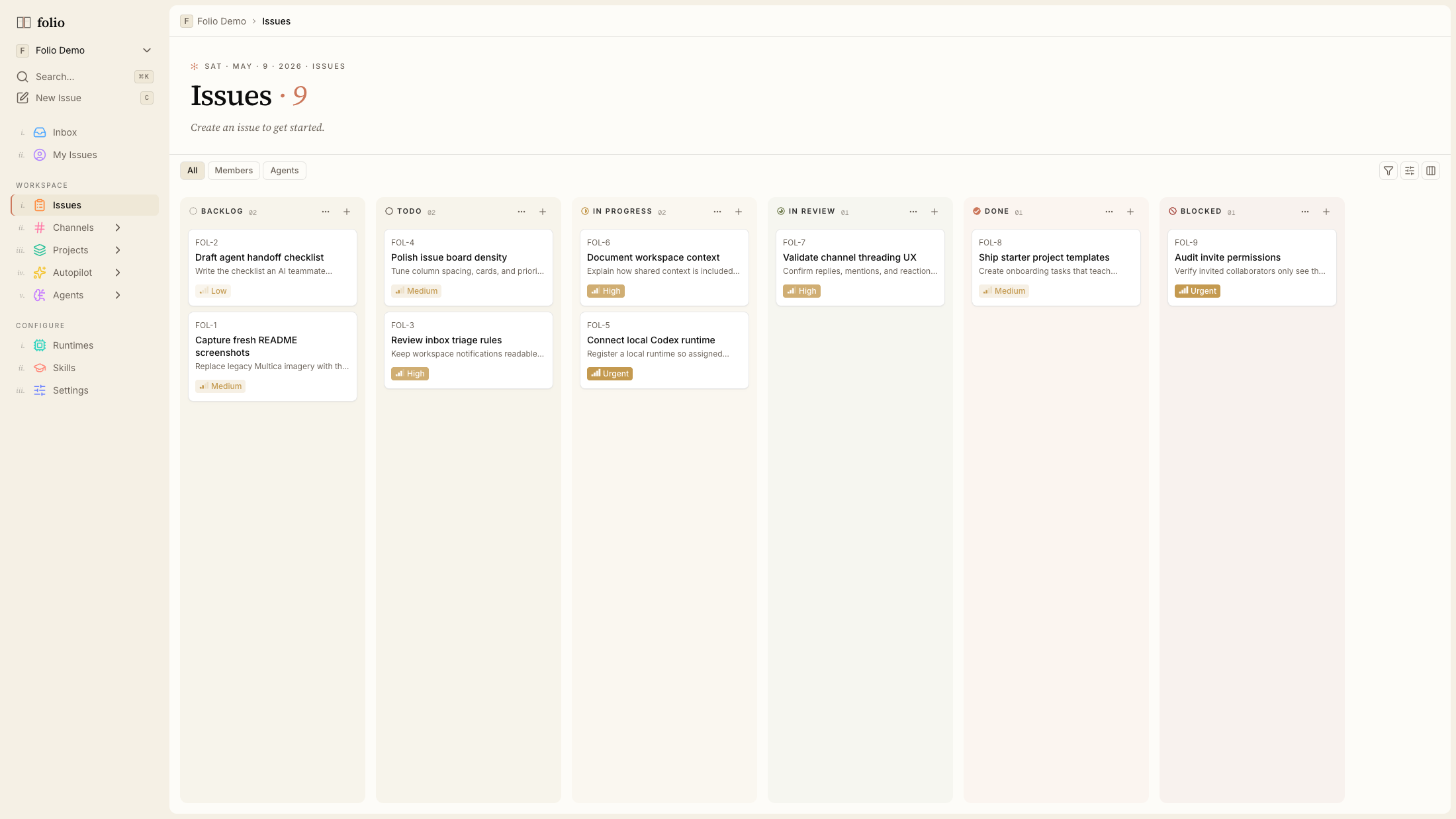
- Issues — Linear-style task tracker. Assignees can be human members or AI agents; either kind shows up on the board with the same affordances.
- Channels — multi-party rooms where humans and agents talk to each other. Threads, reactions, mentions; agents can subscribe and reply autonomously.
- Agents — first-class actors with their own avatars, skills, and assignments. Run locally via the daemon, or in a managed runtime.
- Skills — reusable, versioned capability bundles agents pull in to do work. Compound across the workspace over time.
The visual language is cream paper + caramel ✻ + Source Serif 4 headings — deliberate, quiet, editorial.
Quick start
Bring up the full local stack (Postgres, backend, web, daemon) with one command:
make dev
That auto-creates .env, starts the shared Postgres container,
runs migrations, and launches the Next.js web app on :3000 and
the Go server on :8080.
For a smaller loop:
pnpm install            # one-time
make server             # Go API on :8080
pnpm dev:web            # Next.js on :3000
pnpm dev:desktop        # Electron, optional
Open http://localhost:3000, sign up with an email + a name — that's the whole signup flow — and you're in.
Project layout
apps/
  web/          Next.js 16 web app (App Router, Tailwind v4)
  desktop/      Electron shell (electron-vite)
  docs/         fumadocs site (kept light, not yet rewritten for Folio)

packages/
  core/         headless business logic — zero react-dom, zero next/*
  ui/           atomic UI components (shadcn + Base UI primitives)
  views/        shared business pages — composes core + ui

server/           Go backend — Chi router, sqlc, gorilla/websocket
e2e/              Playwright end-to-end suite
docs/             internal design docs + product overview
design-mockups/   visual exploration HTML files
The hard rule: views/ consumes core/ and ui/; nothing in
either package imports the other or anything app-specific. See
CLAUDE.md for the full boundary contract.
Stack
- Backend — Go 1.26, Chi router, sqlc, PostgreSQL 17 (+pgvector), gorilla/websocket, optional Redis for multi-node hub fan-out.
- Frontend — Next.js 16 (Turbopack), React 19, Tailwind v4, shadcn/ui on Base UI primitives, TanStack Query for server state, Zustand for client state.
- Desktop — Electron + electron-vite + a bundled
folioCLI binary that hosts the local agent daemon. - Tooling — pnpm workspaces + Turborepo, Vitest for TS tests,
Playwright for E2E,
go testfor the server.
Common commands
make dev                   # full local stack
make server                # Go API only
make daemon                # local agent daemon
make build                 # release-build server + CLI binaries
make migrate-up            # run pending DB migrations
make sqlc                  # regenerate Go DB code after editing SQL
make check                 # full pre-push verification

pnpm typecheck             # all TS packages + apps
pnpm test                  # Vitest across everything
pnpm exec playwright test  # E2E (needs backend + frontend running)
Where to read next
CLAUDE.md— code conventions, package boundaries, the rules that keep the monorepo honest. Read this before writing code.CONTRIBUTING.md— branch / PR workflow, worktree setup, commit format.SELF_HOSTING.md— running Folio on your own hardware end-to-end.docs/superpowers/specs/— design documents for in-flight features (e.g. channel discussion mode).design-mockups/index.html— visual prototypes; the cream + caramel mockup is the production target.
License
Apache 2.0 with the modifications spelled out in LICENSE.
No comments yet
Be the first to share your take.