
🌿 FERNme
Fuzzy-Edged Recall Network
Agent personalization memory that models the user, not the transcript.
A user-owned personalization memory layer for AI agents: zero-LLM deterministic core, with optional low-cost human-approved enrichment. It turns consented interactions into an inspectable model of each person's preferences, habits, communication style, and constraints, staying token-flat as it grows while people can see, edit, delete, and own what agents use to personalize.







Cheap to write · flat to read · interpretable by design · owned by the user
✨ The one-paragraph pitch
Most agent memory is written by an LLM on every turn (expensive, hallucination-prone), evaluated on question-answering (not actions), and assumes a single user. FERNme is built for the opposite world: agents that act for many people, in any domain. It starts where agents already act today, websites, and builds a user-owned personalization model the person can inspect and control. Each user is a sparse, fuzzily-weighted node in a per-site graph; the graph also supports opt-in typed entities with labeled, Hebbian-weighted relations while the deterministic write/recall core stays at zero LLM calls. Optional propose-only enrichment can add connection suggestions powered by the agent you already use or a model you choose; nothing lands in memory truth until a human accepts it. Retrieval is spreading activation, and the prompt-facing card stores only deviations from a population prior.
What it is / is not
| FERNme is | FERNme is not |
|---|---|
| A user-owned personalization memory layer for agents | A generic transcript store |
| A fuzzy graph of preferences, habits, style, constraints, and outcomes | A folder of chat logs with search |
| Deterministic-first memory writes with optional LLM enrichment | An LLM extraction call on every turn |
| A bounded prompt card that stays small as memory grows | Full-history injection |
| An inspectable and editable user model | Hidden behavioral profiling |
| Consent-first, per-site, default-deny sharing | Cross-site surveillance |
🎯 Why FERNme (the strong points)
| Zero-LLM deterministic core | Every write and recall runs with no model calls and bounded cost. Optional opt-in enrichment only proposes connections for human approval, powered by the agent you already use or a model you choose. |
| 📉 Flat token cost forever | The prompt card holds ~25 tokens whether it's a visitor's first day or fifth year. A full-history baseline is 77.4× larger by 120 interactions. |
| 🧠 Measured trade-offs, no collapse | The unified synthetic harness is the README source of truth: FERNme stays zero-call and token-flat across static, abrupt/gradual drift, staleness, context, fragmented-entity, and outcome regimes. It does not win every table, but it is the only method with entity aggregation and an outcome feedback loop. |
| 🧬 Typed people & relations | Entities with aliases, contact fields, labeled relations (ceo_of, family_of, ...), and inert relation facts strengthened Hebbian-style; deterministic path queries; opt-in and byte-identical when off. |
| Suggest-and-approve canonicalization | Deterministic alias/entity-link candidates land in a human review queue. Rejections stick, accepted suggestions use existing reversible entity alias APIs, and nothing auto-applies to memory truth. |
| 🪟 Glass-box & user-owned | Every preference is visible and editable. People fix what's wrong, delete everything, or export it. Privacy becomes a feature, not a liability. |
| 🏬 Built for outcomes | Evaluated by conversion, not QA. A simulated storefront shows +17% conversion lift vs. non-personalized recommendations. |
| 🧩 User-owned supernode | Sign in across sites → your memories assemble like Lego into one profile you control, default-deny, sensitive data walled off. Not surveillance — the mirror image of it. |
| Cost/quality dial | One engine, a default-off enrichment gate: free key-less pure by default, optional agent/model proposal sources when you need typed links and relation candidates, and human approval before truth changes. |
| 🔐 Verifiable & unlearnable | Every action is logged in a tamper-evident HMAC chain the user can replay to detect any alteration; forget_everywhere wipes the profile and unlearns the person from the population prior — provable right-to-be-forgotten. |
| 🛡 Injection-proof by design | Writes are arithmetic, not LLM extraction, so page/user text can't be "talked into" becoming a belief — tested that injected instructions never enter memory. |
| 🧠 Private collective intelligence | New users benefit from crowd patterns on turn one (cold-start from a population prior), with k-anonymity + differential privacy so no individual leaks. A network-effect moat single-user memories can't have. |
| Cross-user assoc isolation | Shared co-occurrence edges are k-suppressed by default (assoc_min_users=2): a rare pair from one user stays visible to that user, but cannot influence another user's retrieval until at least two users reinforce it. |
| 🗣 Style & mood memory | Learns how each person communicates (terse/verbose, formal/casual, energy) and tracks their mood with trend detection, so the agent can match tone and notice when someone's frustration is rising — in any domain. |
| 🎯 Outcome-learning, any goal | Memory is reinforced by results — not just recall. record_outcome(success) strengthens what worked and weakens what backfired, where "success" is any goal (purchase, booking, resolved ticket, completed lesson…). |
| 🔍 Explainable | Ask why(user, attr) — get the evidence (observations + good/bad outcomes + dates). No black box. |
| 🔌 Deployable plumbing (research preview; harden per SECURITY.md) | SQLite or Postgres (tested on real PG 16), REST + MCP servers, consent gating, injection-safe writes, proactive triggers — all tested. |
📊 Benchmarks
Honest scope: the numbers below are on synthetic or LLM-authored data, not real users. They validate the mechanism and surface failures; a real-human pilot is the pending next step. The Mem0 (LLM) head-to-head needs an API key and is not yet run. Entity-layer validation includes synthetic acceptance fixtures, the entity micro-eval, and one scoped maintainer-copy check; broader real-profile benchmarks are still pending.
On LLM-authored people (closest to real, agentic ingestion)
A sample of 16 of 92 third-person profiles (ChatGPT-authored), read as prose only and remembered agentically, then scored against hidden answer keys:
| metric | result |
|---|---|
| preference coverage vs. hidden key | 75% |
| communication style — formality | 100% |
| mood sign / mood arc | 94% / 100% |
| preference drift detected | 94% |
| injection attempts ignored | 100% |
| note → card compression | 7.3× |
(The "agent" here is an LLM reading prose, so these reflect agent + engine together — the engine is solid; the extraction quality is the agent's.)
Cost, recall, and Pareto (synthetic, multi-seed)
Reproduce:
python -m fernme.eval.cost_variance·... quality·... drift·... context·... retention·... ablation·... pilot·... entities
Unified harness:
python -m fernme.eval.harness --seeds 6 --json reports/eval_harness.json
Canonicalization queue:
python -m fernme.eval.canonicalization --seeds 6 --json reports/canonicalization.json
Propose-only enrichment:
python -m fernme.eval.enrichment --seeds 6 --json reports/enrichment.json
Unified Phase 8.1 harness - synthetic hidden-answer-key scenarios for static, abrupt drift, gradual drift, staleness, contextual, fragmented-entity, and outcome regimes. Same events/probes for every method; BM25 reads Cabinet event text with a pure-Python scorer; all methods in this table make no model calls. Outcome rows include action quality; non-FERN baselines do not have an outcome feedback mechanism.
| regime | method | recall@5 | precision@5 | stale recall | action | tokens | LLM calls |
|---|---|---|---|---|---|---|---|
| static | FERNme pure | 0.750 +/- 0.000 | 0.600 +/- 0.000 | 0.000 +/- 0.000 | 0.600 +/- 0.000 | 41.7 +/- 0.7 | 0 |
| static | FERNme entities | 0.750 +/- 0.000 | 0.600 +/- 0.000 | 0.000 +/- 0.000 | 0.600 +/- 0.000 | 38.0 +/- 1.2 | 0 |
| static | recency | 0.583 +/- 0.118 | 0.467 +/- 0.094 | 0.000 +/- 0.000 | 0.467 +/- 0.094 | 25.7 +/- 1.1 | 0 |
| static | frequency | 0.958 +/- 0.093 | 0.767 +/- 0.075 | 0.000 +/- 0.000 | 0.767 +/- 0.075 | 26.8 +/- 0.4 | 0 |
| static | BM25 Cabinet | 1.000 +/- 0.000 | 0.800 +/- 0.000 | 0.000 +/- 0.000 | 0.800 +/- 0.000 | 119.8 +/- 35.2 | 0 |
| abrupt drift | FERNme pure | 0.625 +/- 0.125 | 0.500 +/- 0.100 | 0.417 +/- 0.118 | 0.500 +/- 0.100 | 40.8 +/- 4.5 | 0 |
| abrupt drift | FERNme entities | 0.625 +/- 0.125 | 0.500 +/- 0.100 | 0.417 +/- 0.118 | 0.500 +/- 0.100 | 40.8 +/- 4.5 | 0 |
| abrupt drift | recency | 1.000 +/- 0.000 | 0.800 +/- 0.000 | 0.000 +/- 0.000 | 0.800 +/- 0.000 | 28.7 +/- 0.9 | 0 |
| abrupt drift | frequency | 0.292 +/- 0.093 | 0.233 +/- 0.075 | 0.958 +/- 0.093 | 0.233 +/- 0.075 | 29.3 +/- 0.7 | 0 |
| abrupt drift | BM25 Cabinet | 0.250 +/- 0.000 | 0.200 +/- 0.000 | 1.000 +/- 0.000 | 0.200 +/- 0.000 | 907.3 +/- 30.6 | 0 |
| gradual drift | FERNme pure | 0.625 +/- 0.000 | 1.000 +/- 0.000 | 0.000 +/- 0.000 | 1.000 +/- 0.000 | 48.7 +/- 0.5 | 0 |
| gradual drift | FERNme entities | 0.625 +/- 0.000 | 1.000 +/- 0.000 | 0.000 +/- 0.000 | 1.000 +/- 0.000 | 48.7 +/- 0.5 | 0 |
| gradual drift | recency | 0.562 +/- 0.062 | 0.900 +/- 0.100 | 0.000 +/- 0.000 | 0.900 +/- 0.100 | 31.0 +/- 0.6 | 0 |
| gradual drift | frequency | 0.562 +/- 0.062 | 0.900 +/- 0.100 | 0.167 +/- 0.167 | 0.900 +/- 0.100 | 32.5 +/- 0.5 | 0 |
| gradual drift | BM25 Cabinet | 0.479 +/- 0.047 | 0.767 +/- 0.075 | 0.389 +/- 0.124 | 0.767 +/- 0.075 | 86.0 +/- 17.0 | 0 |
| staleness | FERNme pure | 0.714 +/- 0.000 | 1.000 +/- 0.000 | 0.000 +/- 0.000 | 1.000 +/- 0.000 | 36.7 +/- 2.7 | 0 |
| staleness | FERNme entities | 0.714 +/- 0.000 | 1.000 +/- 0.000 | 0.000 +/- 0.000 | 1.000 +/- 0.000 | 36.7 +/- 2.7 | 0 |
| staleness | recency | 0.714 +/- 0.000 | 1.000 +/- 0.000 | 0.000 +/- 0.000 | 1.000 +/- 0.000 | 32.0 +/- 0.6 | 0 |
| staleness | frequency | 0.571 +/- 0.000 | 0.800 +/- 0.000 | 0.250 +/- 0.000 | 0.800 +/- 0.000 | 31.8 +/- 0.4 | 0 |
| staleness | BM25 Cabinet | 0.714 +/- 0.000 | 1.000 +/- 0.000 | 0.000 +/- 0.000 | 1.000 +/- 0.000 | 58.7 +/- 16.6 | 0 |
| contextual | FERNme pure | 0.750 +/- 0.144 | 0.600 +/- 0.115 | 0.000 +/- 0.000 | 0.600 +/- 0.115 | 42.5 +/- 0.5 | 0 |
| contextual | FERNme entities | 0.750 +/- 0.144 | 0.600 +/- 0.115 | 0.000 +/- 0.000 | 0.600 +/- 0.115 | 42.5 +/- 0.5 | 0 |
| contextual | recency | 0.542 +/- 0.093 | 0.433 +/- 0.075 | 0.000 +/- 0.000 | 0.433 +/- 0.075 | 28.5 +/- 1.0 | 0 |
| contextual | frequency | 0.583 +/- 0.118 | 0.467 +/- 0.094 | 0.000 +/- 0.000 | 0.467 +/- 0.094 | 28.5 +/- 0.5 | 0 |
| contextual | BM25 Cabinet | 1.000 +/- 0.000 | 0.800 +/- 0.000 | 0.000 +/- 0.000 | 0.800 +/- 0.000 | 842.0 +/- 0.0 | 0 |
| fragmented entity | FERNme pure | 0.000 +/- 0.000 | 0.000 +/- 0.000 | 0.000 +/- 0.000 | 0.000 +/- 0.000 | 47.7 +/- 0.9 | 0 |
| fragmented entity | FERNme entities | 0.500 +/- 0.500 | 0.100 +/- 0.100 | 0.000 +/- 0.000 | 0.100 +/- 0.100 | 43.8 +/- 3.0 | 0 |
| fragmented entity | recency | 0.000 +/- 0.000 | 0.000 +/- 0.000 | 0.000 +/- 0.000 | 0.000 +/- 0.000 | 30.2 +/- 1.8 | 0 |
| fragmented entity | frequency | 0.000 +/- 0.000 | 0.000 +/- 0.000 | 0.000 +/- 0.000 | 0.000 +/- 0.000 | 31.0 +/- 0.0 | 0 |
| fragmented entity | BM25 Cabinet | 0.000 +/- 0.000 | 0.000 +/- 0.000 | 0.000 +/- 0.000 | 0.000 +/- 0.000 | 90.0 +/- 0.0 | 0 |
| outcome | FERNme pure | 0.500 +/- 0.000 | 0.500 +/- 0.000 | 0.000 +/- 0.000 | 0.500 +/- 0.000 | 30.0 +/- 0.0 | 0 |
| outcome | FERNme entities | 0.500 +/- 0.000 | 0.500 +/- 0.000 | 0.000 +/- 0.000 | 0.500 +/- 0.000 | 30.0 +/- 0.0 | 0 |
| outcome | recency | 0.000 +/- 0.000 | 0.000 +/- 0.000 | 0.000 +/- 0.000 | 0.000 +/- 0.000 | 28.0 +/- 0.0 | 0 |
| outcome | frequency | 0.000 +/- 0.000 | 0.000 +/- 0.000 | 0.000 +/- 0.000 | 0.000 +/- 0.000 | 28.0 +/- 0.0 | 0 |
| outcome | BM25 Cabinet | 0.000 +/- 0.000 | 0.000 +/- 0.000 | 0.000 +/- 0.000 | 0.000 +/- 0.000 | 60.0 +/- 0.0 | 0 |
Read this as a quality gate, not a victory lap: BM25 wins when query text directly matches Cabinet prose but spends far more context tokens; recency wins the deliberately abrupt drift fixture; frequency fails staleness; entity flags matter on fragmented identity; and only FERNme exercises the outcome loop. FERNme stays compact and zero-call, but it does not dominate every synthetic regime.
Cost — per-turn memory tokens vs. profile size (5 seeds):
| metric | FERNme | baseline |
|---|---|---|
| card size | 25.1 ± 0.6 tokens (flat) | full history grows linearly |
| at 120 interactions | 1× | 77.4× ± 1.3 larger |
| LLM calls per write | 0 | ~2 (extraction memory) |
Older focused recall modules remain regression checks, but the unified harness above is the README source of truth for cross-method quality claims.
Cold-start ablation — population prior gives +0.06 precision@5 at turns 1–3, washing out by turn 10 (a real but modest, cold-start-only benefit).
Typed-entity A2 micro-eval (python -m fernme.eval.entities) — synthetic,
fictional alias-fragmentation fixture. It reports the rank of a fragmented person
entity with entity_aggregation off vs. on. The entity layer also has one scoped
maintainer-copy check listed in Honest status; treat that as n=1 evidence, not a
general real-profile benchmark.
Suggest-and-approve canonicalization eval (python -m fernme.eval.canonicalization --seeds 6 --json reports/canonicalization.json) - synthetic,
fictional fragmented-alias fixture with planted duplicate aliases. The queue is
propose-only: no candidate changes memory truth unless a human accepts it.
| metric | result |
|---|---|
| suggestion precision | 1.000 +/- 0.000 |
| suggestion recall | 1.000 +/- 0.000 |
| suggestions per seed | 4.000 +/- 0.000 |
Propose-only enrichment eval (python -m fernme.eval.enrichment --seeds 6 --json reports/enrichment.json) - synthetic, fictional relation-link fixture with a mock proposal source. OFF is inert; ON reads Cabinet text in a batch, validates proposals, and enqueues suggestions only.
| metric | enrichment OFF | enrichment ON |
|---|---|---|
| precision | 0.000 +/- 0.000 | 1.000 +/- 0.000 |
| recall | 0.000 +/- 0.000 | 1.000 +/- 0.000 |
| suggestions | 0.000 +/- 0.000 | 2.000 +/- 0.000 |
| FERNme-initiated LLM calls | 0.000 +/- 0.000 | 1.000 +/- 0.000 |
| recall delta | 1.000 |
Agent-driven proposals spend the caller agent's tokens outside FERNme and leave svc.llm_calls at 0. This eval is a harness wiring check, not a real-model quality claim.
Cost / quality status for enrichment - the old gated/offline Pareto table was modeled before Phase 12. The current backed number is the synthetic propose-only enrichment eval above. Real-model quality and cost are deliberately not claimed until an owner-run model eval exists.
Simulated outcome pilot — fake storefront, learn-from-behavior shoppers: +17% relative conversion lift over a popularity baseline; tied at visit 1 (cold start), pulling ahead as it learns, recovering through a mid-pilot taste drift.
Memory modes and enrichment
FERNme ships one deterministic memory core with a deployment-level switch: FernService(memory_mode=...). Every hot write and recall stays model-free in every mode. Optional enrichment is a separate, default-off proposal tier.
| path | model use | cost accounting | status |
|---|---|---|---|
pure (default) |
none | cheapest, flat | tested, key-less |
| agent proposals | external agent proposes via MCP tools | svc.llm_calls remains 0 because FERNme made no call |
wired, human-approved |
batch enrich(llm_fn=...) |
caller-supplied model function, off hot path | svc.llm_calls counts FERNme-initiated batch calls and returns a token estimate |
mock-validated synthetic eval |
| no source configured | none | clean no-op | tested graceful skip |
propose_relation(...)andpropose_entity_link(...)enqueue suggestions into the existing human review queue. Accepting applies throughentity_relateorentity_link_alias; rejecting sticks.- Model or agent output is untrusted data. Relation vocabulary, entity kind checks, same-surname/low-confidence rules, and injection filters run before anything is enqueued.
- The old
gated/offlinemode names remain for compatibility, but they do not write model-derived truth duringobserve.consolidate()is now a compatibility wrapper around propose-only enrichment. - See the synthetic enrichment eval above for the current measured ON/OFF delta with a mock proposal source. Real-model numbers are owner-run only.
🧭 The 9 leapfrog dimensions (status)
FERNme's edge isn't the mechanism (that's now a crowded 2026 category) — it's competing on dimensions single-user, vendor-owned, recall-optimized systems structurally can't.
| # | Dimension | Status |
|---|---|---|
| 9 | Communication-style & mood memory | ✅ built + tested |
| 2 | Outcome-learning for any goal (reinforce on results) | ✅ built + tested |
| 8 | Explainable provenance (why) |
✅ built + tested |
| - | Persisted edge provenance (stated vs inferred) |
built + tested |
| - | Typed identity entities + relations | validated on synthetic acceptance fixtures; no real-profile validation yet |
| - | Entity-aware card aggregation/enrichment | validated on synthetic acceptance fixtures; no real-profile validation yet |
| 1 | Private collective priors (network-effect cold-start; k-anonymity + bounded-mean DP) | ✅ built + tested |
| 4 | Verifiable, cryptographic data ownership (tamper-evident HMAC chain, cascading unlearning) | ✅ built + tested |
| 7 | Multi-timescale memory (fast context vs. slow identity) | ✅ built + tested |
| 6 | Self-tuning forgetting (learn decay from outcomes; adapts to drift) | ✅ built + tested |
| 5 | Injection-resistant by construction (deterministic writes can't be talked into beliefs) | ✅ built + tested |
| 3 | Open user-owned memory protocol (portable across any agent, with consent) | ◑ spec stage |
These are deliberately the things HippoGraph et al. can't follow: they're single-user (no collective priors), vendor-owned (no user-owned protocol), and recall-optimized (no outcome loop). Built in honest, tested slices — research-dependent ones are marked.
🏗 Architecture
flowchart TD
    V[Visitor on a website] -->|prompt + action| API[FERNme Service]
    API --> CONSENT{consent?}
    CONSENT -->|no| STOP[blocked]
    CONSENT -->|yes| ENGINE
    subgraph ENGINE[Engine - zero-LLM write/recall core]
      W[Hebbian write + decay] --> G[(Per-site preference graph<br/>fuzzy 0-9 edges)]
      W --> E[(Entity tables<br/>entities, aliases, fields, relations)]
      E -->|opt-in alias aggregation| R
      G --> R[Spreading-activation retrieval]
      R --> CARD[Token-minimal card ~25 tok]
      PRIOR[Population prior<br/>differential encoding] --> R
    end
    CARD --> AGENT[Agent: recommend / act]
    G --> CAB[(Cabinet: raw event log)]
    API --> STORE[(SQLite or Postgres<br/>multi-tenant)]
    API --> GLASS[🪟 Glass-box editor]
    API -.user signs in.-> SUPER[User-owned Supernode<br/>cross-site, default-deny]
🧠 How FERNme works (visual walkthrough)
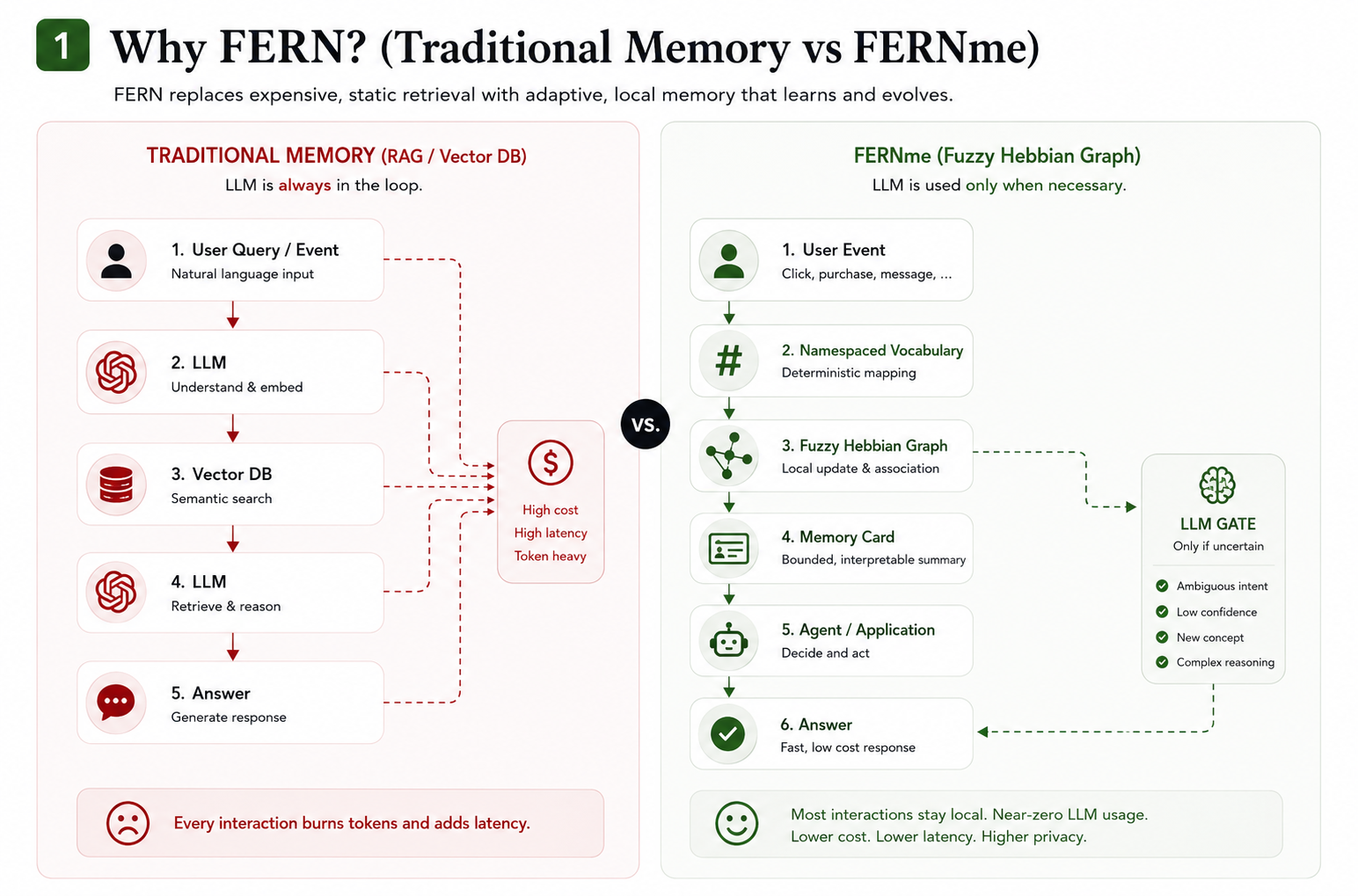 Why FERNme - adaptive local memory instead of expensive RAG/vector retrieval in the loop. Why FERNme - adaptive local memory instead of expensive RAG/vector retrieval in the loop. |
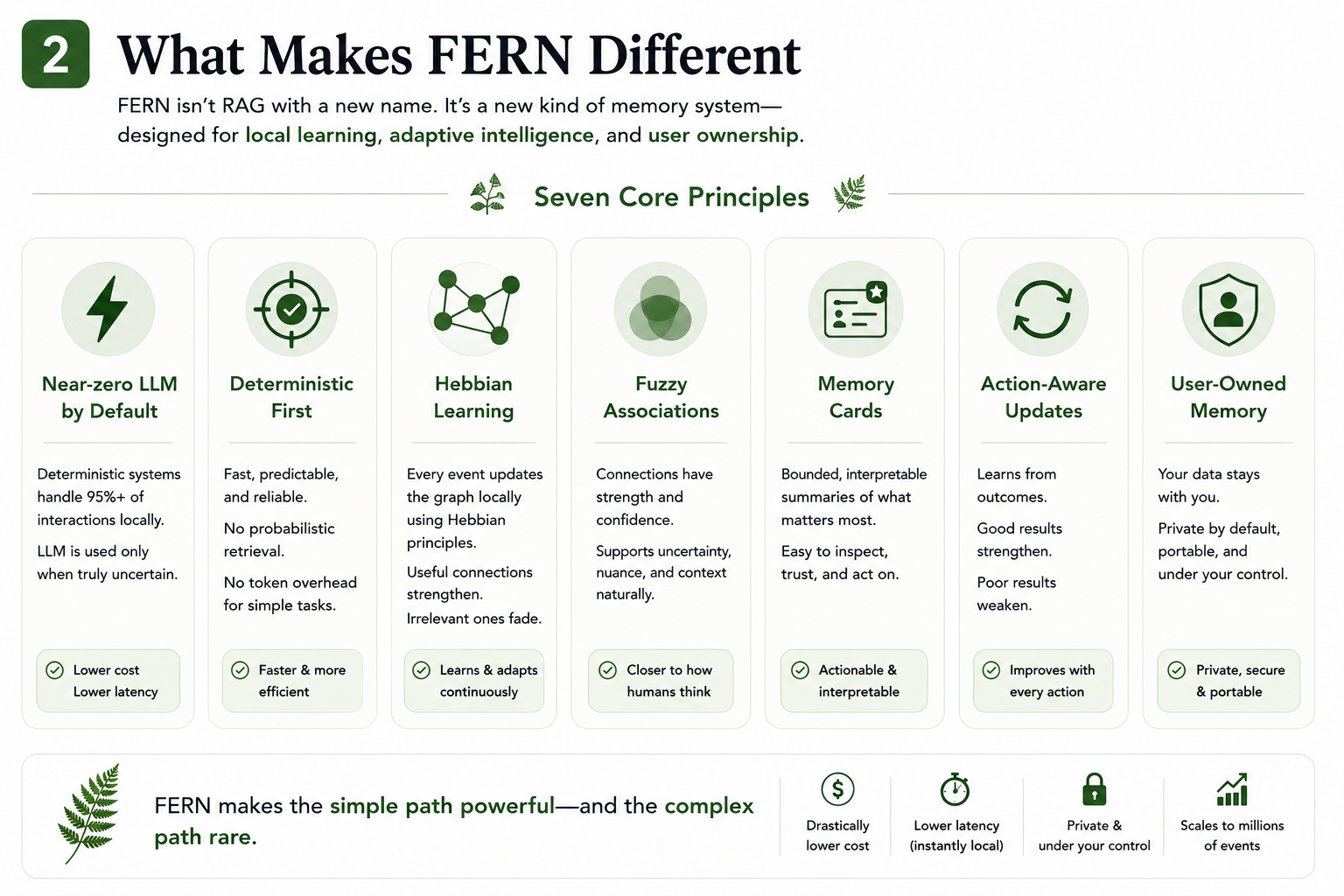 Core principles - zero-LLM deterministic core, optional human-approved enrichment, Hebbian, fuzzy, memory cards, action-aware, user-owned. Core principles - zero-LLM deterministic core, optional human-approved enrichment, Hebbian, fuzzy, memory cards, action-aware, user-owned. |
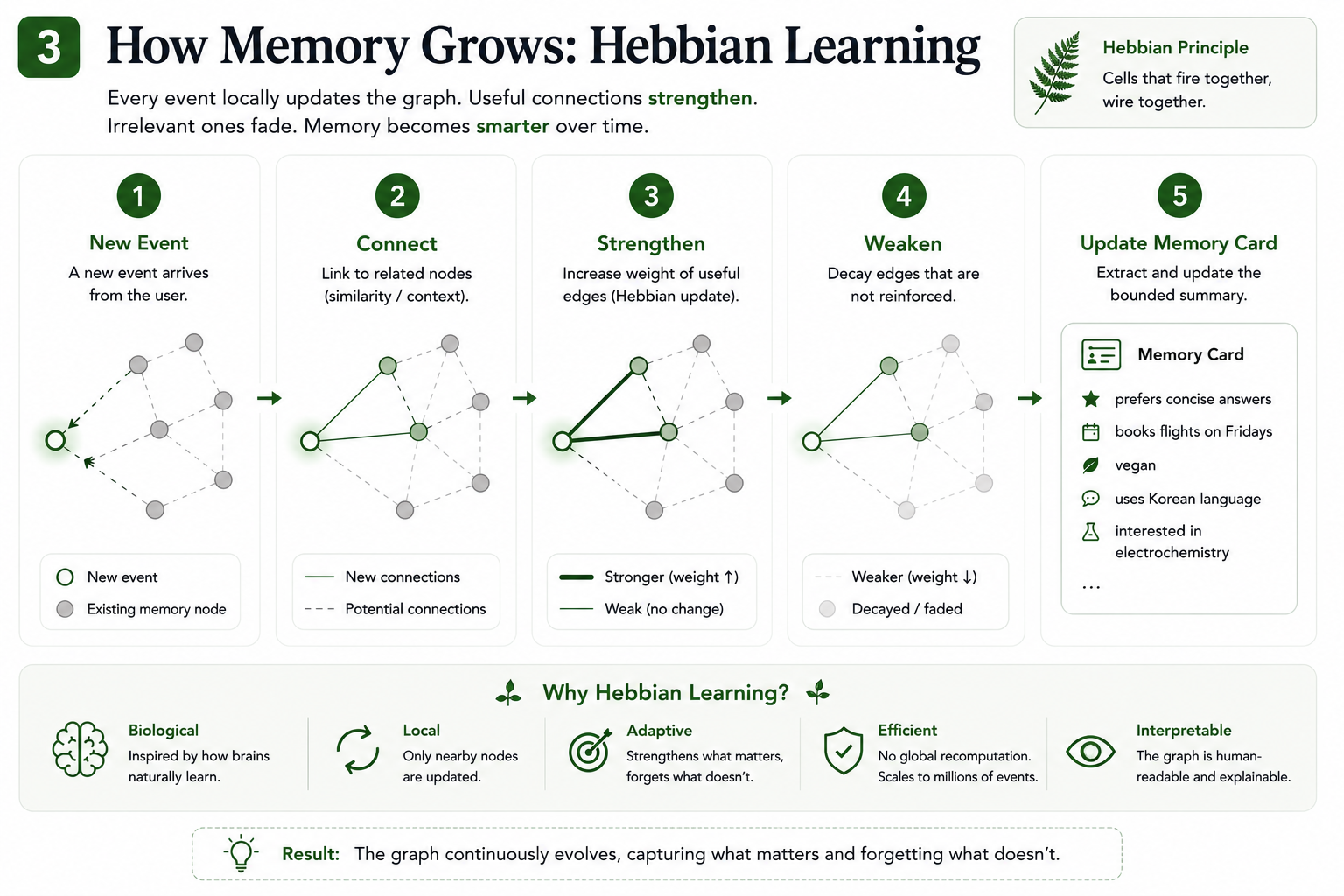 How memory grows — new event → connect → strengthen → decay → update the card. How memory grows — new event → connect → strengthen → decay → update the card. |
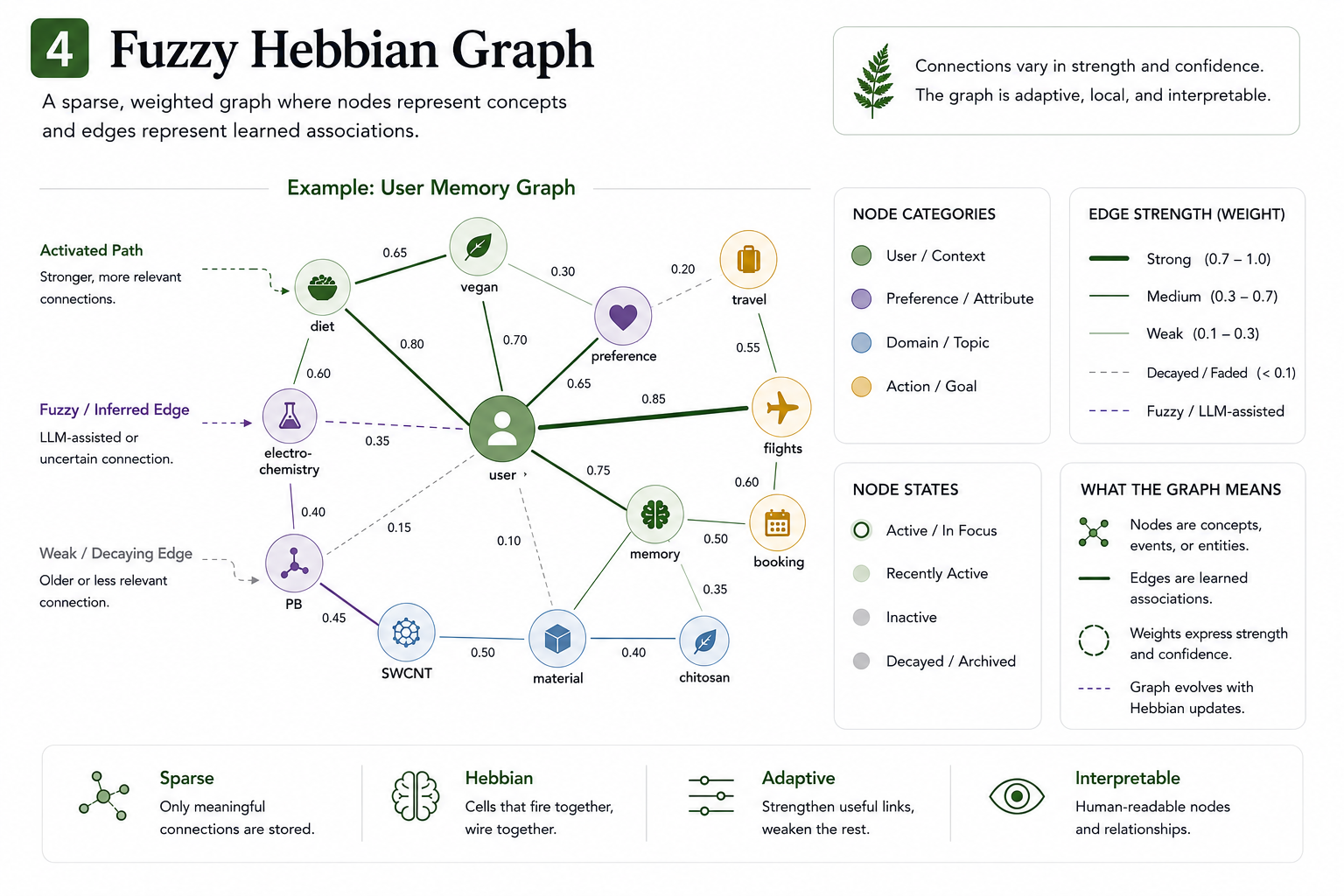 Fuzzy Hebbian graph — sparse, weighted (0–9) edges for users, preferences, topics, and goals. Fuzzy Hebbian graph — sparse, weighted (0–9) edges for users, preferences, topics, and goals. |
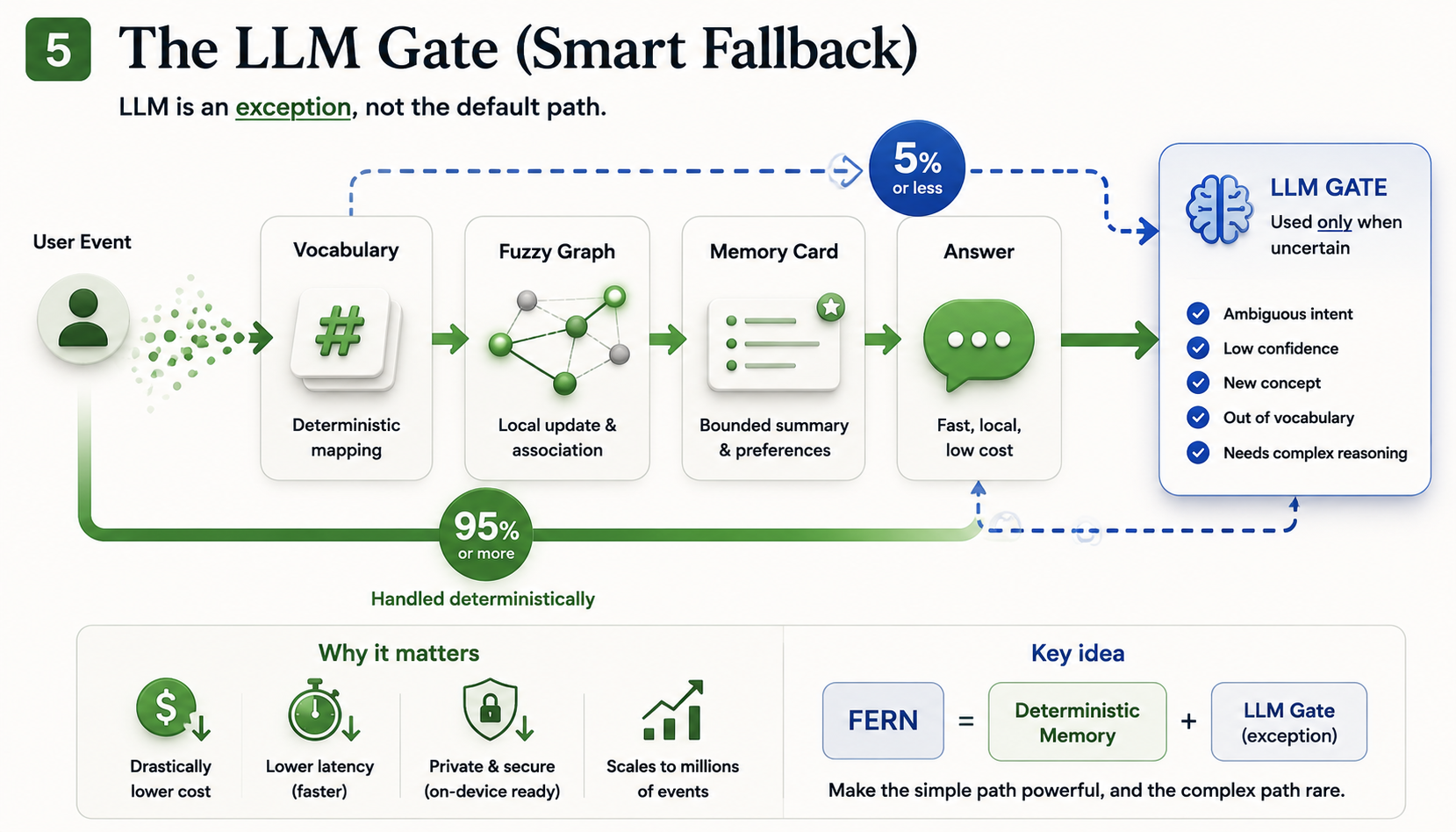 Propose-only enrichment - agent/model suggestions go to review; nothing auto-writes truth. Propose-only enrichment - agent/model suggestions go to review; nothing auto-writes truth. |
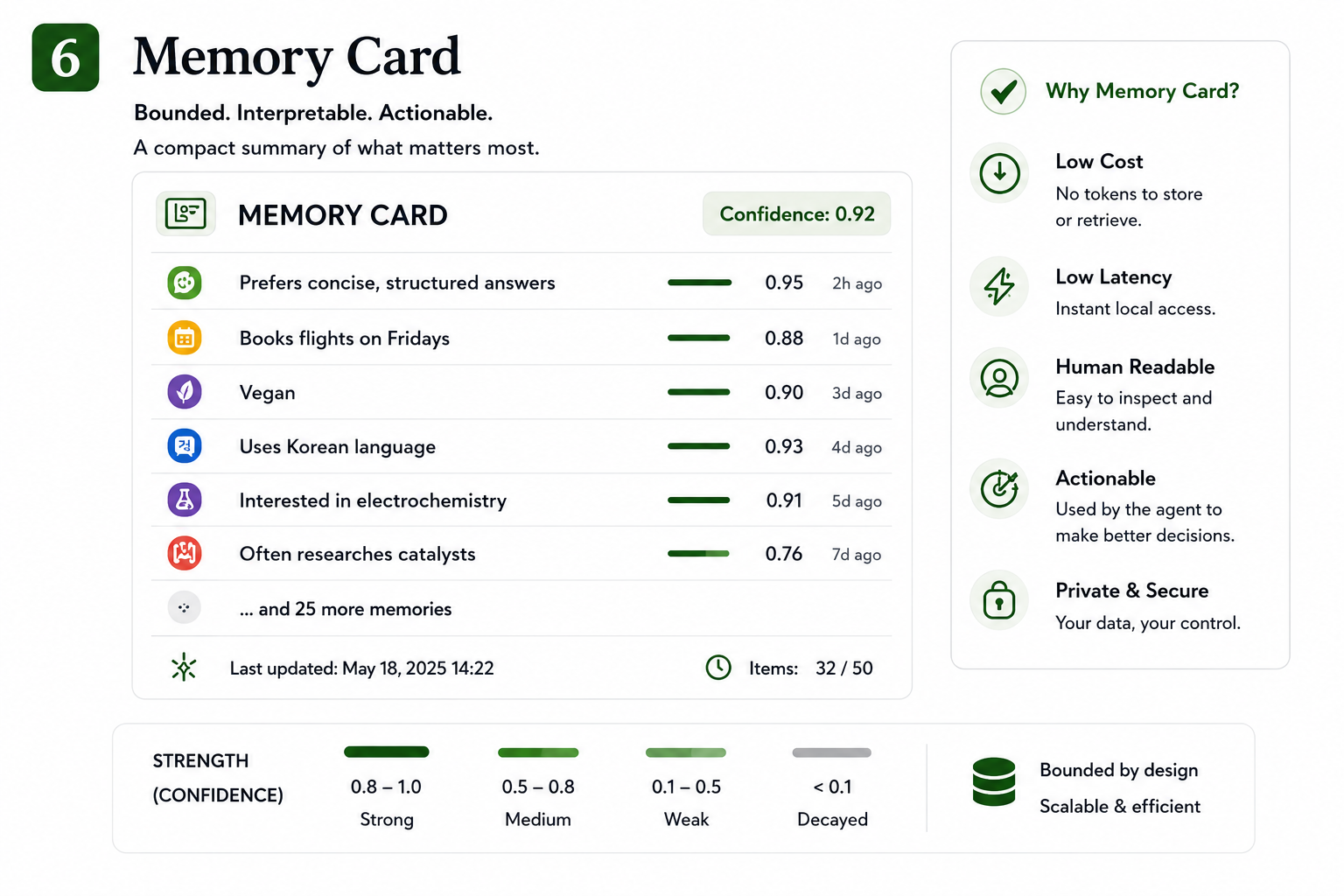 Memory card - bounded, interpretable, token-minimal context for the agent. Memory card - bounded, interpretable, token-minimal context for the agent. |
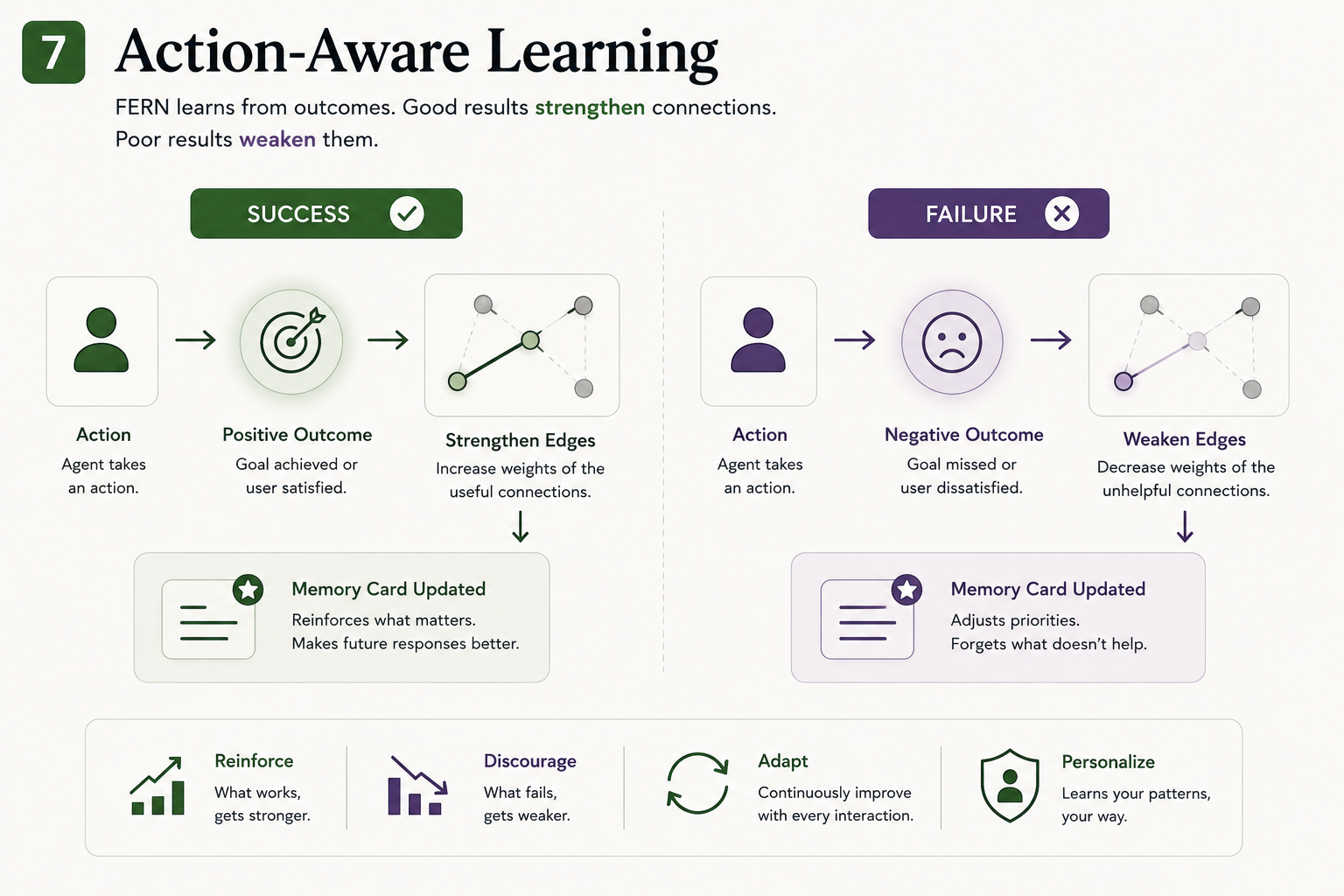 Action-aware learning - good outcomes strengthen connections, bad outcomes weaken them. Action-aware learning - good outcomes strengthen connections, bad outcomes weaken them. |
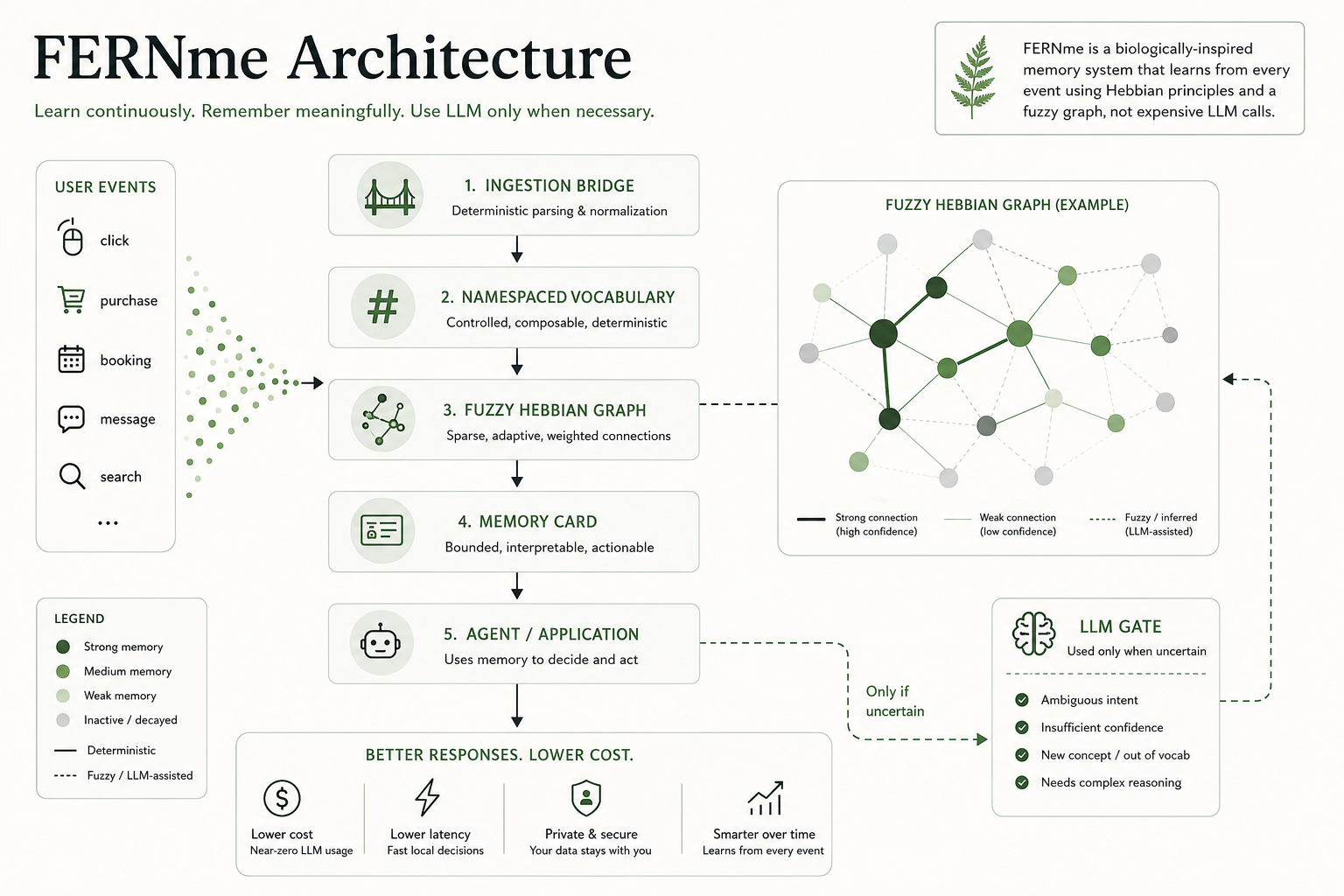 Architecture - ingestion bridge -> vocabulary -> fuzzy graph -> memory card -> agent, with optional proposal enrichment off the hot path. Architecture - ingestion bridge -> vocabulary -> fuzzy graph -> memory card -> agent, with optional proposal enrichment off the hot path. |
Local graph UI demo: FERNme now ships a bundled React SPA at /ui/graph
instead of the old single-file HTML graph. The screenshot below is generated
only from the checked-in synthetic Elena fixture, not from a private database.
The UI has source-owned assets, remembered site/user defaults, canonical
entity-kind filters, category filters, known-only filtering, search/focus,
relation hover labels, animated focused links, 2D plus optional spatial mode,
and a flip-in selected tag/entity card with evidence and confidence details.
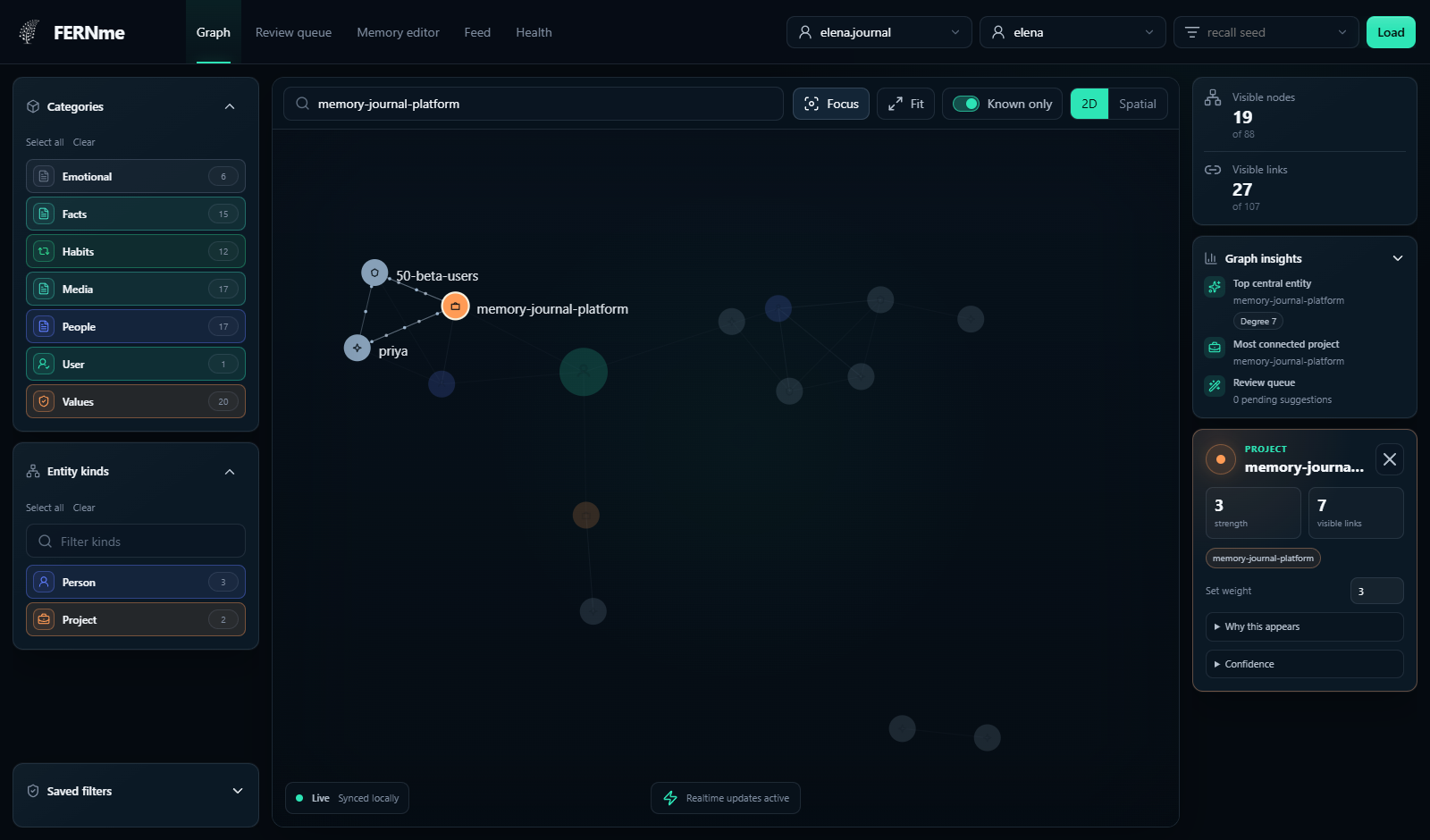
Elena's memory (fictional demo) — local SPA graph UI with canonical entity filters, focused relation animation, and an inspectable project card. Every visible node stays synthetic and every relation remains explainable.
🚀 Quickstart
pip install <path-to>/fernmark-0.4.0a9-py3-none-any.whl
pip install -e ".[dev,api,fernmark]"

python run_demo.py                      # cold-start → learning → glass-box edit
python supernode_demo.py                # one person, three sites, one owned profile
python -m pytest tests -q               # 283 passing, 2 skipped with FERNmark installed

# experiments
python -m fernme.eval.drift               # FERNme beats a frequency counter when tastes change
python -m fernme.eval.retention           # permanent facts persist while stale volatile facts fade
python -m fernme.eval.pilot               # +17% simulated conversion lift

# run it live
FERNME_API_KEY=secret uvicorn fernme.api.rest:app --port 8077   # REST API (docs at /docs)
fernme-ui --site demo --user elena --port 8077 --no-open    # local SPA + graph UI
open http://localhost:8077/ui/graph                         # graph, review queue, editor, feed, health
open http://localhost:8077/graph                            # legacy redirect to /ui/graph
fernme-mcp --print-db-path                                   # show the shared SQLite DB path
fernme-mcp                                                   # MCP server for agents/Codex/Claude
python -m fernme.import_obsidian ./vault --site demo --user elena --dry-run
python -m fernme.import_fernmark ./document.fernmark.json --site demo --user elena --dry-run
🗄 Storage: defaults to
~/.fernme/fernme.db(SQLite). For production usePostgresStore— same interface, tested against a real Postgres 16. Keep SQLite off cloud-synced folders.
MCP and plugin packaging
Install and find your database:
pip install fernme
fernme-mcp --print-db-path
fernme-mcp
The default install includes the MCP server. On first use, FERNme creates one
SQLite database at ~/.fernme/fernme.db unless FERNME_DB points somewhere
else. fernme-mcp --print-db-path prints the resolved path to stdout and exits;
normal MCP startup logs the path to stderr so stdout remains clean for JSON-RPC.
Set that same FERNME_DB in Codex/Cowork MCP config env, the CLI importer, and
the UI process when you want the agent and graph to use the same memory. Optional
FERNME_SITE and FERNME_USER provide local defaults for tools that omit them.
For the graph UI dependencies, install pip install "fernme[ui]".
Bundled local plugin manifests live under packaging/:
codex plugin marketplace add ./packaging/codex
claude plugin marketplace add ./packaging/claude
The Codex package includes .codex-plugin/plugin.json, .mcp.json, and a
fernme-memory skill. The Claude Code/Cowork package follows the current
.claude-plugin/plugin.json plus .mcp.json layout, and the repo root includes
.claude-plugin/marketplace.json for GitHub marketplace discovery.
For Cowork after the owner pushes the repo: Customize > Plugins > "+" > Add
marketplace from GitHub > enter the repo URL > Install fernme-memory >
authorize the MCP server. For Claude Code CLI: /plugin marketplace add mirkofr/FERNme, then /plugin install fernme-memory@fernme-local.
The shipped MCP configs run:
uvx --with "fernmark @ git+https://github.com/mirkofr/FERNmark.git@23e16ea5b01f4ce77fee81b5bf4f7e0d87d77bae" --from "fernme[mcp] @ git+https://github.com/mirkofr/[email protected]" fernme-mcp
The bundled plugin enables managed documents. It can preview an explicitly
named raw FERNmark-supported file or existing envelope using
import_document(..., confirm=false) and returns only redacted metadata. After
the user agrees, confirm=true writes UTF-8 Markdown plus a canonical envelope
below FERNME_VAULT, stores a durable catalog row, and returns only relative
pointers. Semantic tags remain proposals until a human accepts them.
No PyPI publish is required for the plugin route. The plugin is pinned to the
reproducible release ref v0.4.0b4, so external testers get the same server
build. The owner must push main and create plus push the v0.4.0b4 tag on a
public or otherwise reachable repo before testers can fetch it. PyPI publish is
an owner action triggered by that v* tag after trusted publishing is configured.
See docs/mcp.md for local development alternatives.
Import your Obsidian vault
FERNme can import a local Obsidian vault deterministically:
python -m fernme.import_obsidian ./vault --site demo --user elena --dry-run
python -m fernme.import_obsidian ./vault --site demo --user elena --max-notes 100
The importer requires consent, preserves Markdown note bodies in the Cabinet as
data, maps simple frontmatter tags through the existing vocabulary, extracts
structured fields such as email and ISO dates into event payloads, and queues
wikilink or alias candidates for human review. It never auto-applies entity
truth. Through MCP, agents call import_obsidian(site, user, path, ...); the
path is on the MCP server machine and the returned summary is counts-only.
Managed document evidence (FERNmark)
FERNme can convert raw supported files locally or ingest FERNmark's validated schema-v1 envelope without adding an LLM call. The optional dependency is pinned to an immutable public Git commit. Use a placeholder path in shared instructions, never a machine-specific path:
pip install "fernme[fernmark]"
set FERNME_MANAGED_DOCUMENTS=true
set FERNME_VAULT=<vault-root>
The engine flag is default-off; the bundled plugin enables it. Preview performs
conversion and validation in memory with zero persistent writes. Confirmation
stores full Markdown as Cabinet evidence and catalog metadata separately from
the normal hot graph, and writes through the same single CapturePipeline ->
service.observe() path as every other import, so native identity tags
(doc:, mime:, quality:, plus origin/vault/status/title facts) always
reach the graph. recall_documents returns a bounded metadata overlay with
relative pointers and continuation (with a hint naming import_document on
an empty catalog), while normal recall_card and its assoc_floor remain
unchanged. Archive, supersede, pin, authority, and selective forget operations
are explicit. read_document gives bounded, audit-logged, paged access to a
document's stored Markdown by reference only. remember_document_use records
that a document was used for something, as a byproduct of work already done
in the turn -- never a reason for a separate model call. backfill_documents
(also python -m fernme.backfill_documents) catalogs pre-Phase-18 document
imports without duplicating events or graph edges. The agent may infer at most
eight topical tags while already reading selected Markdown, but must link them
to the document via propose_tags; FERNme never auto-accepts semantic tags.
See docs/fernmark-document-adapter.md for the vault and lifecycle contract.
Photo memory (default off)
Install fernme[media], set [media] enabled = true in fern.toml, and use the
two-step MCP flow remember_photo(..., confirm=false) followed by
confirm=true only after the user agrees. JPEG, PNG, and WebP files are
re-encoded without EXIF/GPS, stored in a local blob directory beside the SQLite
database, and linked to agent-emitted tags as asset:<uuid> nodes;
forget_photo deletes the files and graph evidence. Honest cost: this adds 0
extra model calls when tags ride an agent turn that already perceived the image.
Silent or bulk ingestion without an agent is not implemented and is out of
scope for this phase.
Minimal API example
from fernme.service import FernService

svc = FernService(db_path=":memory:")
svc.consent("shop.example", "elena", True)

svc.observe(
    "shop.example",
    "elena",
    "chat",
    {
        "tags": ["pref:concise", "pref:oat_milk"],
        "text": "Elena prefers concise answers and oat milk.",
    },
)

print(svc.card("shop.example", "elena")["wire"])
Typed entities are opt-in (entities=True, entity_aggregation=True):
from dataclasses import replace; from fernme.config import DEFAULT
svc = FernService(db_path=":memory:", cfg=replace(DEFAULT, entities=True, entity_aggregation=True)); svc.consent("demo.example", "alex", True)
alex = svc.entity_create("demo.example", "alex", "person", "Alex Chen")
dana = svc.entity_create("demo.example", "alex", "person", "Dana Reyes")
svc.entity_relate("demo.example", "alex", alex, "friend_of", dana)
print(svc.recall_path("demo.example", "alex", alex, dana))
🧱 What's inside
- Engine - zero-model-call Hebbian write/recall core, ACT-R decay, spreading activation, token-minimal card.
- Population prior — IDF cold-start; differential (deviation-only) storage is
enforced by an explicit
prune_to_priorpass (redundant edges read through to the prior). - Stores —
SQLiteStore(zero-setup) andPostgresStore(tested vs real PG 16), one interface. - Ingestion bridge - a per-site catalog (item_id->tags) plus a controlled namespaced vocabulary (
vocabulary.py) that canonicalizes catalog, free-text, and agent-supplied tags to one form (pref:,topic:,goal:,context:) so the same concept does not drift across months. The deterministic Obsidian importer uses the same vocabulary and queues wikilink aliases for review. Enrichment proposals are separate and human-approved. - Structured-field capture — regex-only contact/date extraction keeps email, phone, URL, handle, and ISO-date values in the Cabinet payload as data, not tags.
- Typed entity layer - opt-in service APIs and additive SQLite/Postgres tables for entities, tag aliases, fields, Hebbian typed relations, relation facts, alias aggregation, and compact entity-aware card enrichment behind default-off flags.
- Propose-only enrichment - default-off
propose_relation,propose_entity_link, and batchenrich(llm_fn=...)validation into the existing suggestion queue; human accept/reject is the only truth write trigger. - The Cabinet — append-only event log with
recall()for specific facts. - Edge provenance — persisted
stated/inferredauthority metadata on graph edges across SQLite, Postgres, and consolidation undo. - Supernode (
supernode.py+auth.py) — user-owned cross-site profile, built by sign-in (verified token → opaque person id), default-deny scoped views, sensitive categories walled off. - Proactive triggers — due-to-reorder + fading-favorite nudges.
- Safety — event tags treated as untrusted data: injection-pattern dropping, size/value caps.
- Interfaces — REST (
/observe /card /recall /edit /export /delete /triggers …) + MCP tools + a bundled local React SPA at/ui/graph(graph, review queue, memory editor, feed, health;/graphredirects for old bookmarks). - Governance — consent-gated everywhere; export & right-to-be-forgotten built in.
🔬 How FERNme compares
FERNme is a different category from conversational memories — it is a user-owned personalization graph evaluated by actions, not a transcript store optimized for QA recall. Don't benchmark it only on LoCoMo; that's the wrong axis.
| 🌿 FERNme | Mem0 | Zep/Graphiti | Letta | MemOS | |
|---|---|---|---|---|---|
| Write | zero-LLM deterministic core; optional propose-only enrichment | LLM | LLM-built KG | LLM-paged | LLM |
| Typed relations | deterministic, opt-in entity/relation graph | LLM-extracted memories | LLM-built KG per episode | model-managed pages | hybrid |
| Retrieval | spreading activation | vector | graph+time | OS paging | hybrid |
| Eval axis | outcomes | QA | temporal QA | long-horizon | QA |
| User-owned + glass-box | ✅ | – | – | – | – |
| Multi-tenant per-site | ✅ | passport | – | – | – |
Leads on: write cost, interpretability, per-site user-ownership/consent. Honestly behind on: nuanced/causal preferences (LLM extraction wins), benchmark credibility, ecosystem & distribution.
⚖️ Honest status
Done & tested (283 passing, 2 skipped with FERNmark installed; 274 passing, 11 skipped without the optional extra): engine, SQLite + real-Postgres stores, supernode + sign-in, triggers, safety, REST/MCP, bundled local SPA, 2D/spatial memory graph view, canonical entity-kind filters, review-backed re-kind suggestions, selected-node evidence cards, class-targeted volatility retention, contradiction-scoped verify, persisted edge provenance, structured-field ingest, suggest-and-approve canonicalization, cross-user assoc k-suppression, deterministic Obsidian and FERNmark document import, MCP packaging smoke coverage, self-configuring install paths, and the full results suite above.
🆕 Typed entity layer: deterministic, consent-gated service APIs plus additive
SQLite/Postgres tables for entities, aliases, fields, typed relations, and inert
relation facts with Hebbian strengthening/decay. Opt-in retrieval integration can aggregate fragmented
aliases and enrich card slots with compact entity context. It is validated on
synthetic acceptance fixtures and the python -m fernme.eval.entities micro-eval;
First real-profile validation (n=1, maintainer's own 722-tag profile): with entity flags on, a fragmented person's card rank improved 11→6, a previously-missed contact_of relationship surfaced in the card, and token cost stayed flat (~150 vs ~155). Synthetic-vs-real caveat applies: one profile, one probe set. Structured-field ingest now retains email, phone, URL, handle, and ISO-date extractions in event payloads as Cabinet data; entity-field writes are available through the service API, with automatic promotion left for a later pass.
Suggest-and-approve canonicalization: deterministic alias-merge and
entity-link suggestions are persisted per site/user for human review. This is
synthetic-validated by python -m fernme.eval.canonicalization (precision
1.000 +/- 0.000, recall 1.000 +/- 0.000 on planted duplicate aliases), opt-in at
the service/API layer, and propose-only: rejected suggestions do not resurface,
and accepted suggestions apply through existing entity alias APIs.
Propose-only enrichment: default-off agent/model proposal surfaces enqueue typed relation and entity-link candidates into the same review queue. With enrichment disabled, outputs are byte-identical and propose_*/enrich() are inert. With enrichment enabled, proposals are sanitized, vocabulary/entity-kind checked, counted when dropped, and never written to memory truth until accepted by a human. Synthetic mock eval: precision 1.000 +/- 0.000, recall 1.000 +/- 0.000, 2.000 suggestions/seed, and 1.000 FERNme-initiated batch LLM call/seed. Agent-driven proposals make 0 FERNme LLM calls.
Cross-user assoc isolation: assoc graph reads are k-suppressed by default
(assoc_min_users=2). This is a deliberate privacy-motivated behavior change on
multi-user sites: one user's rare co-occurrence pair cannot influence another
user's retrieval until at least two distinct users reinforce it. Single-user sites
are unchanged because each user's own assoc contributions remain visible to them;
assoc_min_users=1 is the compatibility escape hatch for the old shared-site
behavior.
🆕 New default behavior: class-targeted volatility retention is on by default. Permanent facts use very long retention, volatile/current facts fade fast, and drift-tested taste classes stay short. Synthetic R5 retention eval: permanent facts above floor at day 700 improve 0.000 -> 1.000, stale volatile weight improves 2.114 -> 0.000, and slow changed facts still prefer the new value 1.000. Legacy focused drift checks remain regression coverage; cross-method claims use the unified harness above.
🆕 Verify scope: contradiction-scoped verify is on for genuine single-value-slot conflicts and marks only the older side of the contradiction. Synthetic R5 eval: contradicted-stale verify precision 1.000, recall 1.000, nag 0.000, with 0.959 +/- 0.156 conflict pairs/user. The perfect contradicted-stale score is by construction, so it validates wiring, not real-world conflict-detector quality. Confidence separates "keep it" from "trust it"; stale-high-confidence-wrong improves in the fixture (0.070 -> 0.004) because middle-class confidence no longer decays slower than flat.
🚧 Still open (genuinely needs the outside world):
- A real-human per-site pilot — only live users close the loop a simulator can't.
- The Mem0 (LLM) head-to-head — harness wired; run locally with
OPENAI_API_KEY. - Embeddings for context-to-attribute matching; optional propose-only enrichment for messy inputs.
- Silent staleness verify
No comments yet
Be the first to share your take.