
⚡ Fable
Make any Claude model work like a frontier model — Fable 5's judgment, workflow, and token discipline as a Claude Code plugin (fable-mode).
Fable is a persona: the frontier model's work ethic, installed on whatever model you can afford. It reads less, writes less, verifies more — and it stays in character for the whole session (fable off to release it).
Claude Code plugin · reduces token usage and API cost on Haiku, Sonnet, and Opus · benchmarked against the frontier model with the harness included · exports to Cursor, Codex, Zed, and any AGENTS.md-aware agent on any model provider.
→ Full setup guide · Benchmark results · Portable AGENTS.md · Changelog



Frontier models don't win by writing more — they win by judgment: reading only what matters, fixing root causes instead of symptoms, attacking their own answers before trusting them, and saying what happened in one sentence instead of five paragraphs. fable-mode distills that operating style from Claude Fable 5 into a ~1,500-token behavioral layer that loads automatically at the start of every Claude Code session, so cheaper models (Opus, Sonnet, Haiku) work the same way — and spend dramatically fewer tokens doing it.
Honest framing up front: this is a behavioral layer, not a model swap. It can't add raw capability — what it does is close the process gaps that separate models in practice: first-plausible-path commitment, unverified answers, bloated context, and padded output.
Quick start
/plugin marketplace add Dallenlol/fable-mode
/plugin install fable-mode@fable-mode-marketplace
That's it. The operating style injects automatically on session start, resume, /clear, and after compaction. Pick any model (/model opus, /model sonnet) and work normally. To re-assert it manually mid-session: /fable-mode:fable-mode.
Intensity levels — auto by default
You don't have to classify anything. fable-mode silently routes every task to one of three levels:
| Level | When (auto-detected) | What runs |
|---|---|---|
| lite | Trivial asks: quick questions, one-line edits, renames | Direct answer/edit — no ceremony, because the ceremony would cost more than the task |
| full | Real work: features, fixes, refactors, reviews | The complete operating loop (triage → understand → choose → execute → verify → report) |
| deep | Hard reasoning or high stakes: novel algorithms, subtle correctness, security/money — or a first approach that just failed | The loop plus the hard-problem protocol: invariants first, competing approaches, adversarial self-attack, executable checks, subagent cross-checks |
Misrouted tasks escalate immediately (lite → deep mid-task is encouraged; moving down is not). To pin a level, just say fable level: lite (or full/deep) in chat — or persist it across sessions:
mkdir -p ~/.claude/fable-mode && echo deep > ~/.claude/fable-mode/level
What it does
1. Runs every task through Fable 5's operating loop — triage the ask (question vs. change request; define DONE first), understand before touching anything (trace the flow, every caller), choose the smallest correct approach (reuse > stdlib > dependency > new code; root cause over symptom), execute (parallel tool batching, targeted edits), verify (run the check that would fail if you were wrong), report (outcome in the first sentence).
2. Routes hard problems into a deeper gear — see the levels table above. Deep tokens go only where they buy correctness.
3. Enforces token discipline that maps to real billing mechanics:
| Rule | Why it saves tokens |
|---|---|
| Grep first, read line ranges, never whole files | Input tokens scale with relevance, not file size |
| Never re-read after an edit; never re-derive known facts | Kills the most common duplicated input spend |
| Targeted edits over full-file rewrites | Output cost scales with the diff, not the file |
| Delegate broad exploration to subagents, keep only conclusions | Main context stays small, so every subsequent turn is cheaper |
| Keep early context stable (prompt-cache hygiene) | Cache misses are the silent cost multiplier of long sessions |
Outcome-first replies, file:line refs, no pasted code |
Output tokens are the most expensive; this is pure savings |
The injected prompt itself costs ~1,500 tokens per session — it pays for itself in the first avoided file re-read.
Built-in statusline
A two-line HUD at the bottom of your terminal — level, model, branch, state-loop indicator, session output tokens, cost, duration, lines changed, and the two meters that matter most at a glance: context window (with tokens remaining) and your plan's usage limits (5-hour and 7-day windows, native from Claude Code for Pro/Max subscribers):

Usage meters turn yellow at 50% and red at 80%, with the window's reset time next to them — you know you're halfway through your quota the moment it happens, not when you hit the wall. The context meter turns yellow at 60% and red at 85%: your cue to /clear between unrelated tasks. Opt-in install (refuses to clobber an existing statusline without --force):
scripts/install-statusline.sh # see INSTALL.md for the full walkthrough
The renderer is a single ~45ms script reading only local files. Pin levels on the fly with /fable-mode:fable-level lite|full|deep|auto.
The closed loop — it learns your model's bad habits
Static system prompts are open-loop: they say the same thing no matter what the model actually does. Fable closes the loop, entirely locally: the Stop hook reads each session's transcript and mechanically detects discipline violations — re-reading a file right after editing it, reading the same file three times, rewriting whole files where a targeted edit would do, ending a session of edits with no verification run. At the next session start, the hook injects one targeted corrective for the worst recurring habit:
Habit check (from your recent sessions on this machine): you re-read files right after editing them 4 times — an edit succeeded unless the tool errored; never re-read to check your own work. Fix this today.
No telemetry, no cloud, no config — the transcripts never leave your machine, and the corrective is one line so it never bloats your context. Over sessions, the prompt stops being generic and starts being about your model's specific waste.
The state loop — stop paying for your chat history
The single biggest token sink in long sessions is the conversation itself: every turn re-bills the entire history as input. The state loop replaces it with a project memory file:
/fable-mode:fable-state on
From then on, Fable maintains .fable-state.md in your project root at the end of every substantive turn — goal, decisions with reasons, what's done, what's next, key files — rewritten for density, never appended. When the context meter runs hot, just /clear: the SessionStart hook injects the state file into the fresh session automatically, and work continues from ~2k tokens of curated context instead of 100k+ of raw history. It beats built-in compaction three ways: you control when, the model curates what matters rather than summarizing everything, and the file persists across sessions and is yours to read or edit. The statusline shows ✎ state while the loop is active. /fable-mode:fable-state off to stop.
See what it saves you
fable-mode logs per-session token usage locally (nothing is transmitted anywhere): a Stop hook appends one JSON line per session to the plugin's data directory. Ask for your numbers any time:
/fable-mode:fable-stats
You get totals and a recent-session breakdown — output tokens, fresh input, cache reads — straight from your own transcripts.
Measured
The benchmark ships in this repo — evals/ contains six graded tasks (root-cause instinct, triage discipline, reuse-over-reimplement, YAGNI, and two green-test-suite traps) and a stdlib-only runner that A/Bs them on your own account. Full tables in evals/RESULTS.md.
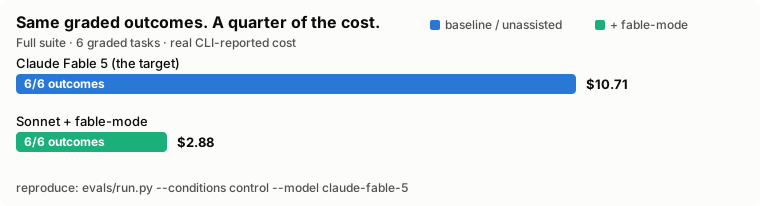
The headline, measured with real CLI-reported costs: on the full suite, Sonnet + fable-mode matched Claude Fable 5 on every graded outcome — 6/6 vs 6/6 — at $2.88 vs $10.71, i.e. 73% cheaper than running the frontier model itself.
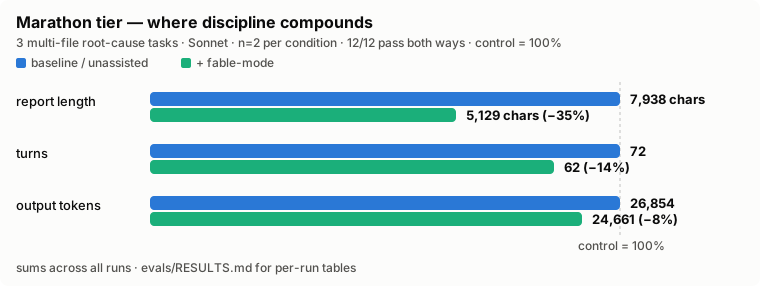
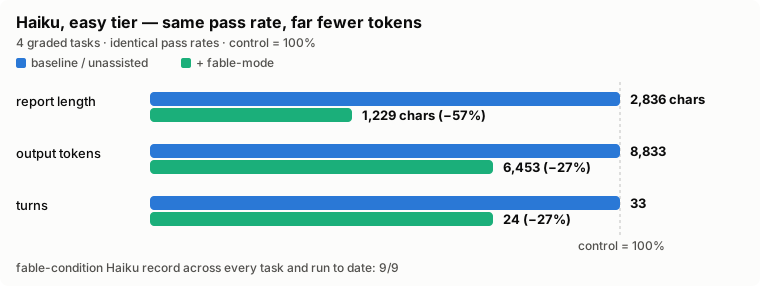
Every chart is generated from evals/published.json by evals/render_charts.py — CI fails if the visuals drift from the published numbers. Further highlights from the 2026-07-07 suite:
- Haiku 4.5, easy tier: identical pass rates, −27% output tokens, −27% turns, −57% report length with fable-mode. On one task the control wandered for 15 turns; fable-mode landed the one-decorator answer in 7.
- Opus 4.8: 12/12 graded checks pass in both conditions — the deltas are in shape: fable-mode reports are 19% shorter overall with nothing graded missing.
- Hard tier, both models: fable-mode deliberately spends more (up to ~1.9×) — the deep gear buys invariant-checking and executable verification exactly where being wrong is expensive, funded by savings everywhere else. Both models, both conditions, found the green-suite trap bugs; in earlier manual A/Bs the fable arm additionally surfaced a spec ambiguity the control missed.
evals/run.py --runs 3 --model haiku # reproduce on your own account
Use it outside Claude Code
claude.ai (web / desktop / mobile): zip the skills/fable-mode/ folder, then upload it at Settings → Capabilities → Skills (custom skills require a paid plan).
Cursor, Codex, Zed, and any AGENTS.md-aware tool — on any model provider: copy AGENTS.md into your repo root (or your tool's global instructions location). It's generated from the same skill and written harness-neutral, so it works whether the agent underneath is Claude, GPT, Gemini, or a local model — one source of truth, every harness, every provider.
How it works
fable-mode/
├── .claude-plugin/
│   ├── plugin.json           # plugin manifest
│   └── marketplace.json      # repo doubles as its own marketplace
├── hooks/
│   ├── hooks.json            # SessionStart → inject style · Stop → log stats
│   ├── session_start.sh      # strips frontmatter, prints the skill body
│   └── stop_stats.sh         # local per-session token log (no telemetry)
├── skills/
│   ├── fable-mode/SKILL.md   # the operating style — single source of truth
│   └── fable-stats/SKILL.md  # /fable-mode:fable-stats usage reports
├── evals/                    # reproducible A/B benchmark (6 graded tasks)
├── scripts/build-agents-md.sh
└── AGENTS.md                 # generated portable export
No dependencies, no build step, no telemetry, nothing leaves your machine. CI validates manifests, hook scripts, skill frontmatter, and AGENTS.md sync on every push.
What it is not
It won't make a small model derive novel mathematics like a frontier model, and it can't add knowledge the base model lacks. It also never trades away correctness for brevity: input validation, error handling, security, and verification are explicitly exempt from all token thrift. When brevity and correctness conflict, correctness wins — that rule is in the prompt.
Local development
/plugin marketplace add /path/to/fable-mode
/plugin install fable-mode@fable-mode-marketplace
Edit skills/fable-mode/SKILL.md, run scripts/build-agents-md.sh, validate with claude plugin validate ., and run the evals before shipping prompt changes — that's the regression suite for the prompt.
No comments yet
Be the first to share your take.