
entwurf
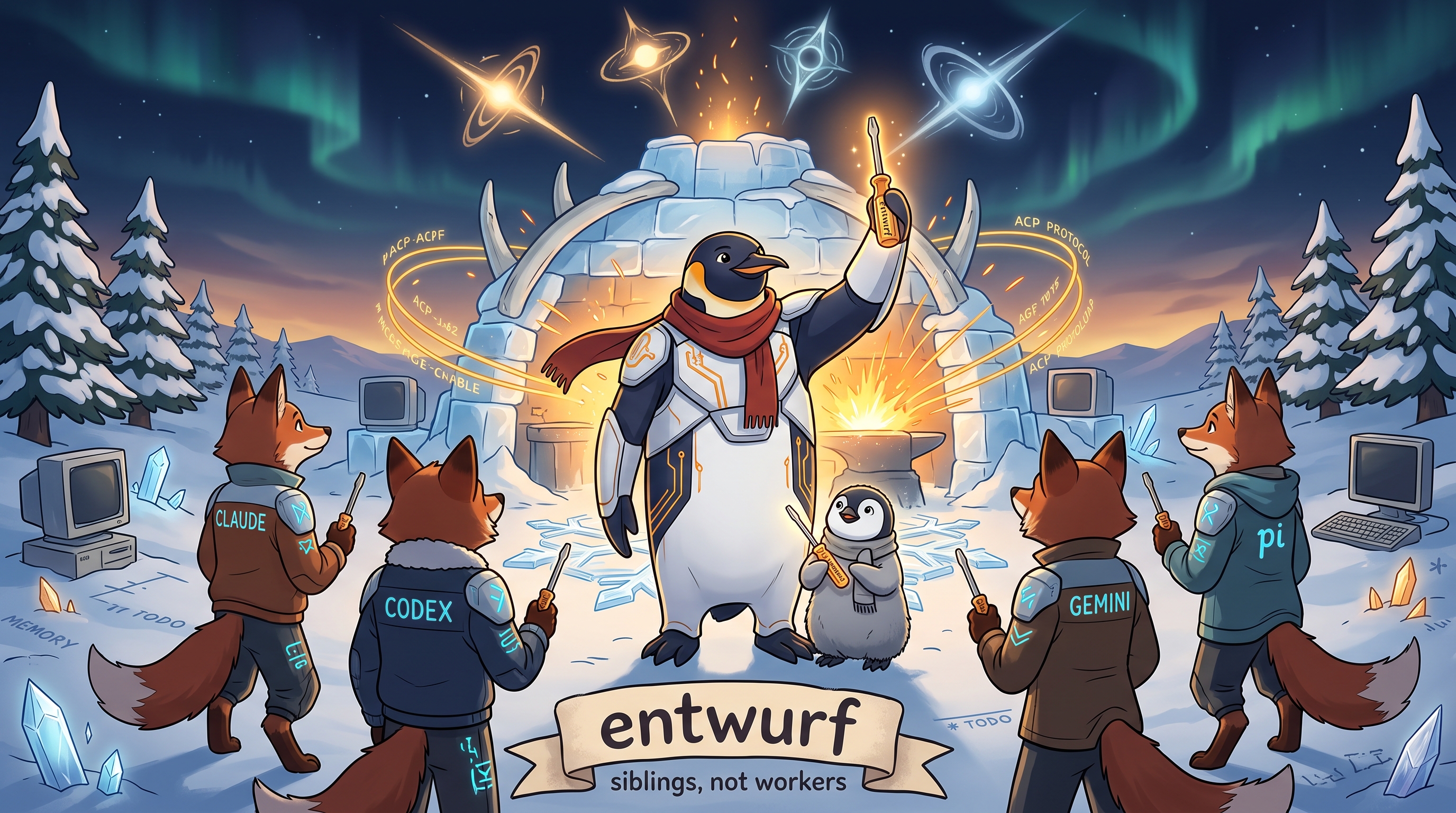
entwurf is a garden-citizen dispatch substrate: a thin bridge that lets already-existing agent harnesses address one another by garden id without pretending to own each other's transcript, auth, or runtime.

npm package: https://www.npmjs.com/package/@junghanacs/entwurf
Legacy package: @junghanacs/pi-shell-acp. entwurf is its 0.12+ successor line: the same work renamed around the garden-citizen dispatch substrate rather than the pi adapter.
Repository shape. This repo is entwurf-core (v2 dispatch) + native-harness bridges + a pi adapter + an ACP plugin. Pi is one supported harness adapter — important because it supplies control sockets and hosts the ACP plugin today — but it is not the project subject. Claude Code is shipped as a mailbox-backed meta-session; Antigravity (
agy) is shipped as a native-push citizen with automaticPreInvocationbirth, ambient garden-id status, and a managed MCP/permission install surface. Codex has a launch-mode-specific verified delivery probe documented in DELIVERY.md, but no managed native-citizen install lane yet. The ACP plugin ships two backends through one adapter rail: Claude (the reference) and Snowflake Cortex Code (landed in 0.13.0 under the measured contract in docs/acp-backend-rail.md).
Claude Code / Codex / agy / pi
  → garden id
    → entwurf_v2
      → control-socket | meta-mailbox | native-push
entwurf_v2 is the canonical dispatch surface over existing garden citizens — live control-socket send, meta-mailbox enqueue, and native-push into a live Antigravity conversation. It starts no process on any rail: the hidden background resume that used to answer a dormant target was withdrawn under the visible-first rule, so a dormant citizen rejects honestly here and is reopened by a separate lifecycle verb, entwurf_resume_call. The meta-record is the sole address authority (#50 C4): a record-less control socket is refused as a record-less-socket diagnostic, never dispatched. The v1 entwurf verbs are gone. Fresh siblings and resumes are separate verbs — entwurf_fresh_call opens a NEW sibling in the operator's own tmux session and learns its garden id from the callback it makes, while entwurf_resume_call reopens a DORMANT pi citizen under its own garden id in a visible window without running a turn; the non-Claude ACP lane landed earlier — Snowflake Cortex Code became the second backend in 0.13.0.
Garden id is deliberate vocabulary. It is not a decorative synonym for session id, worker, delegate, or subagent. The unfamiliar word is a guard: each harness keeps its own identity and transcript, while entwurf supplies a narrow addressable surface between siblings.
A narrow harness tool surface is discipline, not a missing feature. When entwurf drives a backend the way pi taught — the ACP Claude session, a pi-native sibling — it runs without a sub-agent tool or a todo tool, on a narrow tool surface in auto-approve (yolo) mode (the ACP backend yolo-runs inside its isolated overlay). That restraint is the point: it keeps the one forged screwdriver from drifting into a second orchestrator, and keeps the operator's own driver — not a hidden agent swarm — the thing actually steering. See AGENTS.md North Star.
The ACP plugin is one ingress, not the boundary. It re-enters as a pi provider/model on a host --entwurf-control session that is already a v2 socket-citizen; it does not mint its own socket / peers / citizen layer (see AGENTS.md §ACP Plugin Boundary). No OAuth proxy, no subscription bypass, no CLI transcript scraping, no Claude Code emulation.
pi --entwurf-control
  → entwurf ACP plugin
    → claude-agent-acp
      → Claude backend under the operator's local auth
Native bridges reach beyond ACP transport. A global SessionStart hook registers native Claude Code sessions as garden-native meta-sessions with a garden id, a mailbox, and a trusted sender marker. That makes an already-running Claude Code terminal addressable through entwurf_v2 (the mailbox path), self-identifying through entwurf_self, and replyable by garden id — without turning pi into a second harness or importing Claude's transcript.
native Claude Code
  → SessionStart hook
    → mailbox-backed meta-session <garden-id>
      → entwurf-bridge MCP
        → entwurf_self | entwurf_v2 | entwurf_inbox_read
Antigravity uses a separate shipped rail. Its PreInvocation hook births or re-attaches the conversation by native conversationId, writes a record-backed sender marker, and leaves delivery to the live native LS gRPC route. There is no mailbox or receiver marker on this rail: entwurf_v2 probes the conversation and direct-injects with native-push.
native Antigravity / agy
  → PreInvocation imprint → meta-session <garden-id>
  → entwurf-bridge MCP sender identity
  ↔ entwurf_v2 native-push
Claude's install-meta-bridge and agy's install-agy-{bridge,statusline,hooks} are distinct managed install surfaces because their lifecycle and delivery transports are genuinely different. Codex remains verified probe evidence, not a shipped managed native-citizen lane; see DELIVERY.md.
Direction. Inverse of
pi-acp.pi-acplets external ACP clients talk to pi;entwurflets garden citizens talk across harness boundaries — with pi as one adapter, not the center.
Concept primer
A few words that look unusual for a coding tool.
- Entwurf (기투, projection-of-self) — sibling sessions with their own runtime boundary. Not "delegate," not "worker," not "sub-agent." Opening a visible sibling (
entwurf_fresh_call), live peer messaging (entwurf_v2) and reopening a dormant one (entwurf_resume_call) are first-class; the hidden background resume that preceded the last of those was withdrawn under the visible-first rule. - Garden / garden id — the garden is the shared address space where independent harness sessions become citizens without losing their own runtime or transcript. A garden id is the stable address of one such citizen (for pi, a garden-native session id like
YYYYMMDDTHHMMSS-<6hex>; for native harnesses, a meta-session id minted from an authoritative lifecycle hook — ClaudeSessionStart, agyPreInvocation). It is not a worker name and not proof that pi owns the session. The same-looking id may name a live control socket, a dormant pi record, a mailbox-backed native session, or a native-push conversation, so callers discover facts withentwurf_peersand deliver withentwurf_v2instead of choosing a transport by hand. - Engraving — optional short operator text delivered through each backend's native identity carrier. Not a giant hidden prompt, not a tool catalog.
- MCP — in this repo, MCP is just the transport by which ACP-backed sessions receive pi capabilities that native pi exposes directly as extensions. It is not a general MCP platform. Explicit
entwurfProvider.mcpServersonly; no ambient~/.mcp.jsonscanning, no automatic retrieval. The sameentwurf-bridgeentry can also be wired into another host's MCP catalog (Claude Code, Codex, Antigravity, …) when the operator chooses.entwurf_selfreturns an authoritative pi-session or trusted meta-session identity envelope;entwurf_v2requires an authoritative sender by default (#50 C4) — a plain external MCP host with no identity lane is refused unless the operator explicitly wires the documented anonymous hatch, and even then it is never replyable. - Session persistence — re-attaches pi to the same remote ACP session. Does not hydrate backend transcripts into pi history.
Install
entwurf is a neutral npm package first. Install the package with npm (or
pnpm/yarn) and then wire the harness you want to use. Pi is still the
adapter that hosts the ACP plugin and live control-socket surface, but the base
install is not pi install npm:... anymore.
The package exposes five bins:
entwurf→run.sh(installer, checks, native-bridge doctors/installers)entwurf-bridge→ the MCP stdio launcher (mcp/entwurf-bridge/start.sh)entwurf-statusline→ the Claude Code statusline renderer (scripts/meta-bridge-statusline.sh)entwurf-agy-statusline→ the Antigravity garden-id statusline renderer (scripts/agy-statusline.sh)entwurf-agy-imprint→ the AntigravityPreInvocationbirth/sender hook (scripts/agy-imprint.sh)
The bridge/renderers/hook use stable bin names so package upgrades do not bake versioned package-store paths into native-harness settings.
The bridge does not provide backend credentials, tokens, or subscription access,
and does not bypass any backend auth. Whatever the operator's local claude /
codex / agy / pi runtime already trusts is what entwurf can use.
From npm — user/global install
npm install -g @junghanacs/entwurf

# wire a target project for the pi adapter / ACP plugin lane
cd /path/to/your-project
entwurf install .
entwurf check-bridge
This writes .pi/settings.json in the target project with the absolute path to
the installed entwurf-bridge launcher. (The old ~/.pi/agent/ target-registry
link is gone — #50 C3; nothing reads it.) The global install is the easiest path when
Claude Code's USER-scope MCP registration should work from every cwd.
From npm — project-local install
cd /path/to/your-project
npm install --save-dev @junghanacs/entwurf

npx entwurf install .
npx entwurf check-bridge
For an npm upgrade, rerun the install command in the same scope (use
@junghanacs/entwurf@latest when you want the registry's stable line explicitly),
then make the first check from that same scope: entwurf check-bridge for a global
install or npx entwurf check-bridge for a project-local install. Native-harness
installers and process restarts remain a separate post-upgrade step below.
For manual MCP registration from a project-local install, point the host at:
/path/to/your-project/node_modules/.bin/entwurf-bridge
or at the package launcher directly:
/path/to/your-project/node_modules/@junghanacs/entwurf/mcp/entwurf-bridge/start.sh
From source — development clone
git clone https://github.com/junghan0611/entwurf ~/repos/gh/entwurf
cd ~/repos/gh/entwurf
pnpm install

./run.sh install /path/to/your-project
./run.sh check-bridge
A development clone runs the bridge source through Node's strip-types path;
an npm-installed package runs the prebuilt JS under mcp/entwurf-bridge/dist/
because Node refuses to strip .ts files under node_modules. The dev launcher's
source path means ./run.sh check-bridge needs no build. After git pull, however,
run pnpm install when the lockfile changed and run pnpm run build-bridge before
artifact-consuming checks such as ./run.sh check-bridge-delivery: dist/ is
gitignored and may be absent or stale immediately after a checkout or pull.
Pi adapter / ACP plugin lane
To use the entwurf provider inside pi, install a compatible pi binary
separately (@earendil-works/pi-coding-agent >=0.84.2 <0.85). Then point pi at
the npm-installed package or development clone:
# global npm install path
pi -e "$(npm root -g)/@junghanacs/entwurf" --list-models entwurf

# project-local install path
pi -e ./node_modules/@junghanacs/entwurf --list-models entwurf
For daily operator sessions, launch pi with --entwurf-control — no id
injection; the meta-record mints the garden address (see Garden launcher). Older pi
versions may silently miss the provider/extension surface, so treat the pi floor
as release-critical for the ACP/plugin lane. A host that only uses
entwurf-bridge from Claude Code / Codex / Antigravity does not need pi at all for
delivery: no entwurf_v2 rail launches a pi process.
Native harness install and doctors
A plain MCP registration exposes the bridge tools; a garden-native session also needs entwurf's lifecycle hook and identity marker. Use the managed installers rather than editing native-harness state by hand:
# Claude Code (Linux-certified axis)
entwurf install-meta-bridge
entwurf doctor-meta-bridge

# Antigravity / agy
entwurf install-agy-bridge
entwurf install-agy-statusline
entwurf install-agy-hooks
entwurf doctor-agy-bridge
entwurf doctor-agy-statusline
entwurf doctor-agy-hooks
Claude Code uses the supported floor >=2.1.217; older versions silently discard the
exec-hook args, so install and doctor fail loud rather than falling back. After any
upgrade, rerun the installer for the native harness you use and restart its existing
processes. A claimed Claude host is certified only when a new session using the
installed artifact makes doctor-meta-bridge exit 0 with the live owner join.
Linux is the only currently certified Claude meta-bridge axis. New macOS wiring is
refused because the strict live-owner doctor depends on /proc; Darwin uninstall
remains available for legacy cleanup, and the neutral package itself has no os
restriction. Detailed diagnosis and clean-host steps live in
docs/setup-clean-host.md.
The active citizen store is V3-only. A store that fails certification is never
silently migrated: quiesce the native sessions, run entwurf meta-bridge-fresh-cut,
then reinstall. The cut archives routing records only—never native transcripts or
external memory—and no runtime reads the archive. Exit meanings and the complete
operator contract are in docs/fresh-cut-policy.md.
entwurf check-bridge proves the MCP surface boots without backend auth. A real ACP
turn requires LIVE=1 entwurf smoke-acp-provider-live; the full release protocol and
host evidence boundaries are VERIFY.md and BASELINE.md.
Extension set — do not filter. The ACP provider,
entwurf-control, andmodel-lockextensions ship as one set. Disable the package as a whole rather than filtering individual entries into a partially wired state.
Backend prerequisites
Claude is the reference ACP backend. The Claude ACP server package (@agentclientprotocol/claude-agent-acp, pinned with @agentclientprotocol/sdk) ships as a pinned dependency of entwurf; backend authentication still belongs to the operator's local claude CLI / runtime. Once the bridge is installed, the resolver picks the ACP server in this order:
CLAUDE_AGENT_ACP_COMMANDenv override — explicit override for an alternative binary or a wrapper command.require.resolve(...)against the bundled package dependency (@agentclientprotocol/claude-agent-acp). This is the default path; no extra global install needed.PATH:claude-agent-acpfallback — used when the package resolution fails (e.g. a hand-editednode_modules).
The curated model registry exposes unprefixed Claude ids plus cortex- rows.
Codex is not an ACP backend or a shipped managed citizen lane: it has verified
native-delivery probe evidence only. No managed Codex support is claimed; lifecycle,
identity, installation, and doctors remain prerequisites for any such lane.
Snowflake Cortex Code is the second ACP backend (contract and audit:
docs/acp-backend-rail.md). Curated ids are
cortex-auto, cortex-claude-opus-5, cortex-claude-sonnet-5, and
cortex-openai-gpt-5.4.
The operator supplies an authenticated cortex CLI and selects a connection with
entwurfProvider.cortexConnection or ENTWURF_ACP_CORTEX_CONNECTION. CORTEX_HOME
must be absent: the adapter refuses it because it would bypass the session-scoped
HOME containment. Explicit MCP servers are projected into the overlay-private
cortex/mcp.json; only the bridge receives the real operator HOME needed for the
garden store.
check-acp-cortex runs in pnpm run check:full. Real acceptance is deliberately on demand:
LIVE=1 ENTWURF_ACP_CORTEX_CONNECTION=<conn> entwurf smoke-acp-cortex-live
The aggregate Claude floor does not run this smoke, so silence is not a Cortex PASS.
Emacs frontends
Works from terminals and from Emacs frontends that launch pi-coding-agent.

For a dedicated agent socket, pass the socket name:
(setq pi-coding-agent-extra-args
      '("--entwurf-control" "--emacs-agent-socket" "pi"))
The bridge exports the socket name to ACP children as PI_EMACS_AGENT_SOCKET, so skills call Emacs without hardcoding:
emacsclient -s "${PI_EMACS_AGENT_SOCKET:-server}" --eval '(...)'
Settings
Reference shape lives in pi/settings.reference.json. Minimum:
{
  "compaction": { "enabled": false },
  "entwurfProvider": {
    "appendSystemPrompt": false,
    "settingSources": [],
    "strictMcpConfig": true,
    "showToolNotifications": true,
    "tools": ["Read", "Bash", "Edit", "Write"],
    "skillPlugins": [],
    "permissionAllow": ["Read(*)", "Bash(*)", "Edit(*)", "Write(*)", "mcp__*"],
    "mcpServers": {
      "entwurf-bridge": {
        "command": "/path/to/entwurf/mcp/entwurf-bridge/start.sh",
        "args": []
      }
    }
  }
}
mcpServers is the only ACP MCP injection path. In practice this repo is about the bundled entwurf-bridge, which carries pi capabilities into ACP-backed sessions — not about being a general MCP catalog. Invalid entries throw McpServerConfigError — broken tool state surfaces as broken tool state. ./run.sh install writes the bundled entwurf-bridge entry and prunes the legacy bundled session-bridge entry from older installs.
appendSystemPrompt: false is intentional. Pi / AGENTS context rides the first-user augment; putting it into the Claude _meta.systemPrompt carrier can route OAuth sessions to metered "extra usage" billing.
Which keys reach which backend. entwurfProvider is one block for both backends, but its keys are not universal. tools / permissionAllow / disallowedTools / settingSources / skillPlugins / appendSystemPrompt are Claude's declaration surface: they do not shape a cortex session, which runs its own native tools and reaches MCP through the overlay-private mcp.json projection instead. They are not inert, though — the bridge still reads tools for its backend-invariant exclude-tools preflight and folds all of them into the config signature, so editing one still forces a fresh cortex session. cortexConnection is cortex-only. mcpServers is the one declaration surface that reaches both, each through its own transport. (compaction is a top-level pi key, not an entwurfProvider one — it is pi's own transcript policy and is not a backend knob at all; see §Compaction.) Unknown and retired keys are ignored rather than rejected, so a key aimed at the wrong backend fails silently: if a cortex session does not show the surface you configured, check that the key is one cortex actually consumes before suspecting the bridge.
External MCP registration
entwurf-bridge can also be registered in a separate MCP-aware harness (Claude Code,
Codex CLI, Antigravity). Two shapes exist and they are not interchangeable:
- plain external MCP host — no garden meta-record or sender marker. It can read the
surfaces, but
entwurf_v2is refused by default: there is no authoritative sender. - garden-native session — a trusted lifecycle hook minted a garden id, so it is addressable and replyable by that id.
claude mcp add --scope user entwurf-bridge entwurf-bridge
Per-harness registration (Claude Code ~/.mcp.json, Codex ~/.codex/config.toml, the
managed install-agy-* surfaces), the PATH/env boundary for GUI-launched MCP servers, the
anonymous-sender hatch, and the full external/meta-session semantics are in
docs/external-mcp-host.md.
For the maintained multi-harness setup and skill/command packaging details, see agent-config. See also the MCP entry in Concept primer, the sender envelope contract in AGENTS.md, and Custom skills for the in-pi ACP skill surface.
Per-backend operating surface
The Claude ACP backend keeps its native model / API / tools; entwurf shapes only what enters from pi. Claude honors an explicit CLAUDE_CONFIG_DIR export when set by the operator.
Claude uses _meta.systemPrompt for the engraving carrier (kept short and pure — billing-safe; rich operator context rides the first user message instead, see Context carriers) and CLAUDE_CONFIG_DIR for a whitelist overlay so auth/runtime entries stay available while operator memory, hooks, agents, history, local settings, and project memory remain hidden. The overlay writes an explicit empty hooks: {} because Claude SDK organic compaction needs the configured-empty shape; no operator hook definitions are inherited. It also pins permissions.defaultMode: "bypassPermissions" so an unattended ACP turn cannot suspend on an interactive permission prompt; explicit tools / disallowedTools still constrain the callable surface and backend authentication remains the operator's. The four-tool baseline is Read, Bash, Edit, and Write; permissionAllow carries their allow declarations, and Skill is added automatically when skillPlugins is non-empty. Operator context cap override: ENTWURF_ACP_CLAUDE_CONTEXT=<int>.
Codex is not an ACP backend here. Its native delivery probe remains separate from the governed ACP adapter rail and does not yet constitute a managed garden citizen.
Antigravity is also not an ACP backend. It is a native-push citizen: PreInvocation supplies birth/sender identity, entwurf_v2 probes and direct-injects replies into the live conversation, and no mailbox/receiver marker is involved.
entwurf owns no memory layer at all — the ACP plugin's boundary explicitly excludes a memory DB (see AGENTS.md §ACP Plugin Boundary), and no backend is a memory authority for another. What this overlay does is narrower: Claude's native memory layer is pinned off so operator memory, project state, and history never leak into an ACP session. Whatever semantic-memory / Denote tooling an operator runs is their own skill surface on whichever harness hosts it — deliberately kept out of the MCP bridge, and not a pi privilege.
Smoke commands
pnpm check                              # everyday core (prints wall time; <=60s on the reference host)
pnpm run check:full                     # full deterministic floor (adds the hermetic + package/install tiers)
./run.sh check-bridge                   # entwurf-bridge direct MCP smoke (no backend auth)
./run.sh smoke-agy-install-state        # agy MCP + exact permission ownership lifecycle (install/uninstall/doctor/inverse)
./run.sh smoke-agy-statusline-state     # agy ambient garden-id install surface
./run.sh smoke-agy-hooks-state          # agy PreInvocation birth hook
./run.sh check-agy-sender-identity      # record-backed pid/start-key sender identity

# source-maintainer only — qualification snapshots the git work surface, and both
# commands are source-contract gates rather than installed operator checks:
./run.sh check-agy-permission-matrix    # AGY permission contract space as a literal table (declared cells + stated exclusions)
./run.sh check-gate-qualification       # kill-proof: committed defect mutants must turn their gates red for the claimed reason

# agy LIVE acceptance — requires an already-running conversation:
LIVE=1 AGY_CONVERSATION_ID=<id> ./run.sh smoke-agy-native-push-live

# ACP plugin LIVE acceptance — need the operator's local Claude auth/credit:
LIVE=1 ./run.sh smoke-acp-socket-citizen-live   # turn-free socket citizenship (S1)
LIVE=1 ./run.sh smoke-acp-raw-turn-live         # pinned ACP pipe + raw 1 turn (S2a)
LIVE=1 ./run.sh smoke-acp-overlay-live          # config overlay + hooks:{} + tool meta (S2b)
LIVE=1 ./run.sh smoke-acp-provider-live         # real pi provider path + progress/L3 (S2c/S2f)
LIVE=1 ./run.sh smoke-acp-session-reuse-live    # process-scoped reuse + codeword recall (S2d)
LIVE=1 ./run.sh smoke-acp-carrier-augment-live  # augment delivery + empty-carrier billing clean (S2e-1)

LIVE=1 ./run.sh release-gate /tmp/scratch --cut # the single cut gate (MUST + BEHAVIOR; --cut refuses any MUST SKIP)
LIVE=1 ENTWURF_ACP_CORTEX_CONNECTION=<conn> ./run.sh smoke-acp-cortex-live  # Cortex is on-demand: the aggregate does not re-certify it
pnpm run check:full includes the AGY permission contract matrix; the committed-mutant
gate qualification is scheduled separately (./run.sh check-gate-qualification — the CI
check job runs it on every push, and release-gate carries it as a MUST step). A gate a
release touches must kill its known defect for the claimed [QK:<claim>] reason —
the descriptions above name what each smoke covers, and no check count is quality
evidence on its own. Gate qualification needs the git work surface, while the matrix
is the source permission-contract gate; both run from a clone, never as a post-install
operator step.
Custom skills
Claude sessions accept custom skills through skillPlugins — an array of absolute paths to directories matching the Claude Agent SDK plugin layout:
<your-plugin-root>/
├── .claude-plugin/
│   └── plugin.json
└── skills/
    └── <skill-name>/
        └── SKILL.md
A self-contained example lives at pi/skill-plugin-example/. Put plugin roots anywhere on disk except under ~/.pi/agent/ (pi's internal cache).
{
  "entwurfProvider": {
    "skillPlugins": ["/absolute/path/to/your-plugin-root"]
  }
}
Skill is auto-added to tools and Skill(*) to permissionAllow whenever skillPlugins is non-empty. Each entry is validated at settings parse time and throws when the path is missing, not absolute, not a directory, or missing .claude-plugin/plugin.json. The Claude session does not start until the violation is fixed. The bridge does not validate plugin.json contents or SKILL.md bodies — that is the Claude Agent SDK's contract.
To verify, start a fresh Claude session and ask the model to list its skills; the names declared in your SKILL.md frontmatter should appear among the visible skills. The operator-driven version of this check is Q-SKILL-CALLABLE in VERIFY.md.
skillPlugins is a Claude-backend-only install surface. Codex exposes skills through native ~/.codex/skills/ passthrough.
For a real consumer arranging many skills, see agent-config.
Entwurf orchestration
Entwurf is one dispatch capability with native-pi and MCP surfaces. Native pi exposes it directly as extension tools; ACP-backed and external native-harness sessions reach it through entwurf-bridge. The purpose is not to invent a different sub-agent system, but to preserve the same sibling-based model across harnesses.
A sibling has its own runtime boundary and its own provider/model identity — not a worker, delegate, or sub-agent. Today every transport targets an existing garden citizen, and none of them starts a process. entwurf_v2 routes from rail-specific liveness: live pi fire-and-forget → control socket; dormant pi → an honest reject; active self-fetch → meta-mailbox; probe-alive agy → native-push. A control-socket-domain dispatch takes the per-target lock, which now serializes concurrent live sends at one garden id; mailbox and native-push use their own deliverability evidence and remain lock-free.
A two-pane recording covers the pre-0.12 v1 surface end-to-end — sibling resume, cross-process MCP dispatch across a different cwd, and a live peer greeting. It is archived evidence: it shows a resume verb this repo no longer has (see demo/README.md).
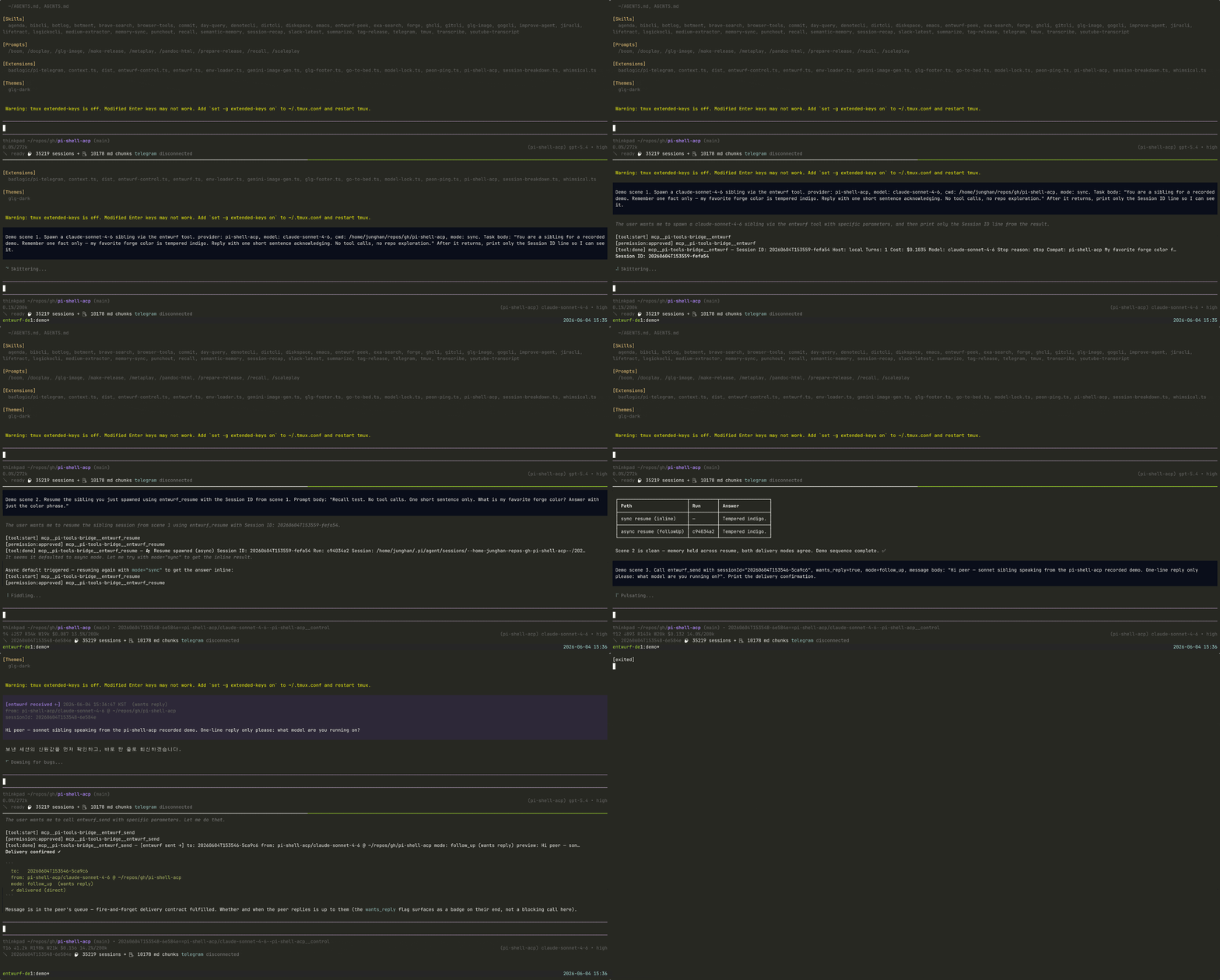
Live peer messaging carries a sender envelope { sessionId, agentId, cwd, timestamp, origin?, replyable? }; entwurf_self returns that authoritative envelope for the current pi session or trusted meta-session. Plain external MCP hosts are non-replyable. A garden-native meta-session carries a trusted meta-session envelope, but replyable is a fact its own rail decides, not a consequence of being trusted — a self-fetch citizen needs a live armed receiver, a native-push citizen needs an alive adapter probe, and a pi session needs its control socket. entwurf_self also reports which rail a meta-session reply would ride, because a native-push citizen has no mailbox to name. wants_reply is an etiquette marker rendered as a (wants reply) badge — not a transport contract, no wait, no polling. v2 never gates on it: a wants_reply from an external/non-replyable caller is passed through and surfaced honestly beside that sender's replyable: false, not rejected — the decider routes on target + intent, never on sender replyability. (The retired v1 entwurf_send did reject it; that behaviour went with the verb.)
In ACP-backed and external native-harness sessions, entwurf-bridge exposes seven tools: entwurf_v2, entwurf_peers, entwurf_fresh_call, entwurf_resume_call, entwurf_self, entwurf_inbox_read, and the explicit/manual entwurf_register_native fallback. Native pi exposes the shared capability directly through the extension surface (entwurf_v2, entwurf_peers, entwurf_fresh_call, entwurf_resume_call tools; the socket-scan /entwurf-sessions command is gone — #50 C4). For garden-id delivery/reply use entwurf_v2 — the canonical surface that classifies the target and routes to live-pi / Claude-Code-meta-mailbox / Antigravity-native-push, and refuses a dormant target instead of waking it. To open a sibling that does not exist yet use entwurf_fresh_call — it launches one fixed backend (pi or claude-code) as a visible window in the operator's own tmux session, requires an explicit model, accepts one optional literal absolute cwd (omit it or pass "" to use the caller's cwd), passes the model and selected directory through the runtime's visible launch path, and hands it a first task; the sibling's first action is a nonce callback whose sender envelope carries its garden id. The launch receipt records the requested model/cwd plus tmux coordinates and never claims that the runtime accepted them or completed delivery. (The v1 verbs entwurf / entwurf_resume / entwurf_send are gone.) Garden-native operator commands require --entwurf-control. There is no spawn target allowlist — the target registry is gone (#50 C3): entwurf_v2 and entwurf_resume_call address an existing record-backed citizen, while entwurf_fresh_call takes its explicit backend/model/task and optional cwd directly rather than resolving a model tuple from a registry file. To reopen a DORMANT pi citizen use entwurf_resume_call {target} — the record supplies transcript, model, provider and cwd, so it takes no prompt, no task and no model override; it runs no turn, returns a LAUNCH receipt and a separate OBSERVATION receipt (only the second says the citizen is back), refuses a non-pi target as target-not-pi, and on an unobserved socket leaves the visible window open and releases its lock rather than retrying.
entwurf_v2 — canonical dispatch verb
entwurf_v2 / runEntwurfV2 is the canonical v2 dispatch verb over existing garden targets — record-backed citizens only (#50 C4: the record is the sole address authority; a record-less control socket rejects pre-probe as record-less-socket, a diagnostic state, never a delivery target). You give a target garden id plus an intent (fire-and-forget — the axis is single-valued since the visible-first cut); one decider reads the target's liveness as a fact and picks the transport from a frozen table keyed on both the target's state and the intent — never on state alone — then reports one outcome under the v2 lock policy. A control-socket-domain dispatch takes a per-target lock; mailbox and native-push are lock-free, with deliverability guarded by their own receiver/probe evidence:
| target state | intent | transport |
|---|---|---|
| live pi | fire-and-forget | control-socket send |
| dormant pi | fire-and-forget | reject (dormant-fire-forget-unsupported — nothing is launched) |
| any pi | indeterminate probe | reject (indeterminate-no-spawn — an unestablished probe is not a measured death) |
| active self-fetch receiver | fire-and-forget | meta-mailbox enqueue + doorbell |
| inactive / terminated self-fetch receiver | fire-and-forget | reject (mailbox-undeliverable — no .msg, no doorbell) |
| live native-push conversation | fire-and-forget | native-push direct injection |
| dead / indeterminate native-push conversation | fire-and-forget | reject (native-push-target-dead / native-push-probe-indeterminate) |
| record-less control socket (no meta-record) | any | reject (record-less-socket — pre-probe; diagnostic state, #50 C4) |
entwurf_v2 is the canonical surface for garden-id delivery. When you have a garden id and want to reach whoever it names — message, reply, or hand-off — entwurf_v2 is the one surface that reads whether the target is live pi, dormant pi, mailbox-backed Claude Code, or native-push Antigravity and routes correctly; when unsure which transport, use entwurf_v2. This prevents callers from guessing a rail from the shape of an id.
What v2 provides is a deterministic dispatch substrate that moves the "which transport?" decision out of the fallible caller/model and into the decider, with transport-appropriate locking and an honest reject (no ✓ delivered, no .msg garbage) when a target cannot receive. It still does not mint siblings, and it does not relaunch one either: every row above either reaches a citizen that is already running or refuses. Reopening a dormant pi citizen is entwurf_resume_call, a separate lifecycle verb that never routes through this decider. Fresh creation is the separate entwurf_fresh_call verb. It opens one fixed Pi or Claude Code runtime visibly in the caller's tmux session with a required explicit model passed in that runtime's measured CLI dialect and one optional literal absolute cwd; omitted or "" means the caller's cwd. It returns only a synchronous launch receipt and lets the sibling report its new address asynchronously through the sender envelope of a nonce callback. Use this cwd input for a new cross-repository sibling; do not resume a dormant citizen as a cwd substitute. The meta-mailbox row requires an active self-fetch receiver; native-push requires a record-backed, probe-alive native conversation and never borrows mailbox state. The mux launch lane owns placement, fixed-runtime launch, and the two narrow compositions above it (fresh-call and resume-call placement); delivery does not import launch, and mux is not a delivery transport.
A live pi target is reached over its control socket, but the socket is dispatch-internal transport, never identity (#50 C4). A control socket that no meta-record claims — a pre-record-era resident, an unreadable store, or a stale/planted file — is refused for every intent as record-less-socket, and the reject names the fix (restart the resident so session_start births its record, or quiesce and run the fresh-cut). entwurf_peers reports the same state as an aggregated record-less-socket diagnostic rather than a peer row.
Direction. An Entwurf core (peer identity / garden id / inbox / liveness / dispatch / replyability / evidence) could later extract into its own repo with per-backend plugins; today this repo holds the v2 core + meta-bridge + ACP plugin together. ACP is one plugin, not the boundary — rationale: #38.
Garden launcher
A --entwurf-control session needs no special launcher (#50 C2): pi mints its own session id (a uuidv7 is normal), and session_start attaches the session to its meta-record — the record mints the garden id, keys the control socket on it, and PI_SESSION_ID carries that garden address to every MCP child. The old --session-id "$(run.sh new-session-id)" injection contract (and the header-id guard it fed) is gone; run.sh new-session-id survives only as the garden-id generator the record layer itself uses. Launch is simply:
pi --entwurf-control
Resuming an existing garden session. Use entwurf_resume_call {target}. It reopens a DORMANT pi citizen under the SAME garden id in a visible window in the caller's own tmux session, resolving the transcript, model, provider and cwd from the record — so it takes only the target id, and it runs no turn: the window comes back with the conversation and waits, and talking to it is still entwurf_v2. Two receipts arrive and mean different things: a LAUNCH receipt (tmux made a window and was asked to start pi) and an OBSERVATION receipt (the control socket answered under the same id, or resume-unobserved). Unobserved is a real outcome, not an error to retry — the window is visible, so read it. A citizen that is already live is refused; so is a non-pi target (target-not-pi), because only pi stands a control socket up. The predecessor, entwurf_v2 intent=owned-outcome, resumed by launching a hidden window-less background child and was withdrawn under the visible-first rule; delivery still starts no process. Identity preconditions live in resume-launch-identity.ts, gated by check-resume-launch-identity.
Starting a new session in-process — pi's own /new. Since the #50 C2 cut there is nothing to replace it with: /new, /fork, /clone and RPC session replacement are pi's again. The replacement session fires session_start, which upserts its own meta-record and rebinds the control socket to that record's garden id; the old socket is dropped. pi's session id (a uuidv7) is recorded as the citizen's nativeSessionId and is never an address. Gate: run.sh smoke-resident-garden-guard REPLACEMENT section (0-token RPC E2E).
Context carriers
System / developer carriers and rich pi
No comments yet
Be the first to share your take.