
EdgeCrab 🦀
"Your SuperAgent — built in Rust."







EdgeCrab is a SuperAgent — a personal assistant and coding agent forged in Rust. It carries the soul of Nous Hermes Agent (autonomous reasoning, persistent memory, user-first alignment) and the always-on presence of OpenClaw (17 messaging gateways, smart-home integration), packaged as a stripped native release binary of about 49 MB on current macOS arm64 builds, with zero Python or Node.js runtime dependencies. Runs on Linux, macOS, and Android (Termux).
Latest release: v0.10.0 — Hermes-parity terminal UX: live activity shelf with tool-progress tails,
/agentsdelegation dashboard (kill · replay · Gantt · spawn pause), queued-message composer,/modelinstant hot-swap, and modular TUI overlay stack. Plus Ralph loop goals, LSP diagnostics, native web search, OpenAI proxy, and subscription OAuth.
Architecture
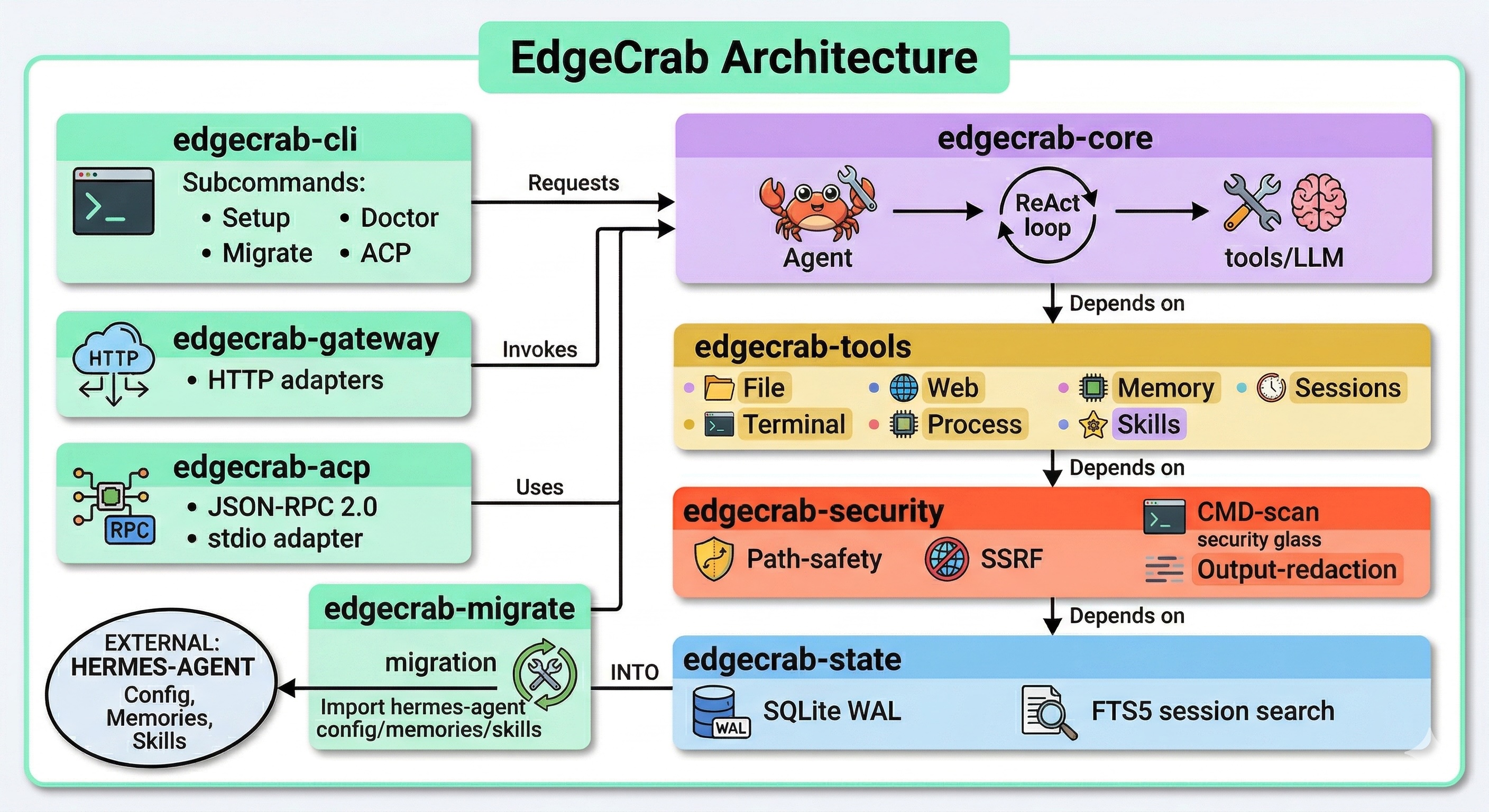
hermes-agent soul  +  OpenClaw vision  =  EdgeCrab
   (reasoning)          (presence)        (Rust)
| Metric | EdgeCrab 🦀 | hermes-agent ☤ |
|---|---|---|
| Binary | ~49 MB stripped release build | Python venv + uv |
| Runtime bootstrap | None | Python + uv |
| Memory | Workload-dependent native process | ~80–150 MB |
| LLM providers | 16 built-in | varies |
| Messaging platforms | 17 gateways | 7 platforms |
| Tests | 1629 passing (Rust) | — |
| Migrate from hermes | edgecrab migrate |
N/A |
Table of Contents
- EdgeCrab 🦀
- Architecture
- Table of Contents
- Why EdgeCrab?
- Quick Start (90 seconds)
- What EdgeCrab Can Do
- ReAct Tool Loop
- Built-in Tools
- Semantic Code Intelligence (LSP)
- File Tools (
filetoolset) - Terminal Tools (
terminaltoolset) - Web Tools (
webtoolset) - Browser Tools (
browsertoolset) - Memory & Honcho Tools (
memory+honchotoolsets) - Skills Tools (
skillstoolset) - Session & Search (
sessiontoolset) - Delegation & MoA (
delegation+moatoolsets) - Code Execution (
code_executiontoolset) - MCP Tools (
mcptoolset) - Media Tools (
vision/tts/transcribetoolsets) - Automation Tools
- File Tools (
- Sub-agent Delegation
- Sandboxed Code Execution
- Browser Automation
- 17 Messaging Gateways
- Persistent Memory & Learning
- Skills Library
- Skills Vs Plugins
- Plugin System
- Cron Scheduling
- Checkpoints & Rollback
- Profiles & Worktrees
- Vision, TTS & Transcription
- 16 LLM Providers
- 6 Terminal Backends
- MCP Server Integration
- ACP / VS Code Copilot Integration
- ratatui TUI
- All CLI Commands
- All Slash Commands
- Security Model
- Architecture
- Configuration
- SDKs
- Docker
- Migrating from hermes-agent
- Testing
- Project Structure
- Requirements & Build
- Contributing
- Release Channels
- License
Why EdgeCrab?
Most AI agents are either too constrained (coding agents that forget you exist after the session) or too heavy (Python runtimes, Node daemons, GBs of RAM). EdgeCrab is different.
It learns. Like Nous Hermes Agent, EdgeCrab maintains persistent memory across sessions, auto-generates reusable skills, and builds a cross-session Honcho user model that gets smarter over time.
It's everywhere. Like OpenClaw, EdgeCrab lives in your channels — Telegram, Discord, Slack, WhatsApp, Signal, Matrix, Mattermost, DingTalk, SMS, Email, Home Assistant, and more. Send it a voice memo on WhatsApp and get a PR back.
It's fast and lean. Unlike Python agents, EdgeCrab ships as a native Rust binary instead of a Python or Node.js runtime stack. Current stripped macOS arm64 release builds land around 49 MB, and security is compiled in — path jails, SSRF guards, command scanners — not runtime patches.
It's extensible. MCP servers, custom Rust tools, Python/JS sandboxes, sub-agents, Mixture-of-Agents consensus — the full toolkit for heavy-duty automation.
It's now plugin-native. Skill plugins inject prompt expertise, tool-server plugins expose external JSON-RPC tools, and script plugins run safe Rhai logic, all from ~/.edgecrab/plugins/ with persisted enable/disable policy.
Quick Start (90 seconds)
Option A — npm (no Rust required)
npm install -g edgecrab-cli
edgecrab update              # channel-aware updater
edgecrab setup               # interactive wizard — detects API keys, writes config
edgecrab doctor              # verify health
edgecrab                     # launch TUI
Option B — pip (no Rust required)
pip install edgecrab-cli
# OR: pipx install edgecrab-cli  (isolated install)
edgecrab update
edgecrab setup && edgecrab doctor && edgecrab
Option C — cargo
cargo install edgecrab-cli
edgecrab update --check
edgecrab setup && edgecrab doctor && edgecrab
Option D — build from source
git clone https://github.com/raphaelmansuy/edgecrab
cd edgecrab
cargo build --workspace --release         # ~30 s first build
./target/release/edgecrab setup
Guided Setup Output
EdgeCrab Setup Wizard
──────────────────────────────────────────────────────────────
✓ Detected GitHub Copilot (GITHUB_TOKEN)
✓ Detected OpenAI (OPENAI_API_KEY)

Choose LLM provider:
  [1] copilot      (GitHub Copilot — GPT-5 / Claude / Gemini catalog)  ← auto-detected
  [2] openai       (OpenAI — GPT-4.1, GPT-5, o3/o4)
  [3] anthropic    (Anthropic — Claude Opus 4.6)
  [4] ollama       (local — llama3.3)
  ...
Provider [1]: 1

✓ Config written to ~/.edgecrab/config.yaml
✓ Created ~/.edgecrab/memories/
✓ Created ~/.edgecrab/skills/

Run `edgecrab` to start chatting!
First Prompts
edgecrab "summarise the git log for today and open PRs"
edgecrab --model openai/gpt-5 "review this codebase for security issues"
edgecrab --model ollama/llama3.3 "explain this code offline"
edgecrab --quiet "count lines in src/**/*.rs"   # pipe-safe, no banner
edgecrab -C "continue-my-refactor"              # resume named session
edgecrab -w "explore that perf idea"            # isolated git worktree
OpenAI-compatible proxy (Aider, Cline, OpenAI SDK)
Expose EdgeCrab-configured LLM providers to third-party clients — not the full agent API
(distinct from the gateway api_server platform):
# Grok / xAI OAuth (recommended path)
edgecrab proxy setup grok             # writes config + token + client snippet
edgecrab proxy doctor
edgecrab proxy start --provider xai

# Or step by step
edgecrab proxy enable grok
edgecrab proxy token set
edgecrab proxy client                 # print OPENAI_API_BASE / Aider vars
edgecrab proxy start --provider xai
Point any OpenAI client at http://127.0.0.1:11434/v1 with Authorization: Bearer <proxy-token>.
Map friendly names in ~/.edgecrab/config.yaml:
proxy:
  port: 11434
  model_aliases:
    claude-sonnet: anthropic/claude-sonnet-4-20250514
    gpt-4o: openai/gpt-4o
    nous-portal: forward:nous          # Mode A — credential forwarder
  forward_upstreams:
    nous:
      adapter: nous_portal          # OAuth refresh + invoke JWT (Hermes NousPortalAdapter)
      auth_provider: nous
      base_url: https://inference-api.nousresearch.com/v1
      # Or read-only: adapter: hermes_auth
      # Or static bearer: bearer_env: NOUS_API_KEY
    xai:
      adapter: xai_oauth
      auth_provider: xai-oauth
      base_url: https://api.x.ai/v1
  default_forward_upstream: nous   # optional: GET /v1/models → upstream (Hermes-style)
  cors_allow_origins: []           # e.g. ["http://localhost:3000"] for browser clients
Aider (~/.aider.conf.yml):
openai-api-base: http://127.0.0.1:11434/v1
openai-api-key: <your-proxy-token>
Default bind is loopback-only; use --allow-public only with a strong token.
What EdgeCrab Can Do
EdgeCrab is an autonomous agent. Give it a goal in natural language; it reasons, calls tools, observes results, and loops until the task is done. Here's what it can actually reach.
ReAct Tool Loop
EdgeCrab uses a Reason → Act → Observe loop (ReAct pattern) implemented in crates/edgecrab-core/src/conversation.rs. Each turn:
- System prompt built once per session (SOUL.md, AGENTS.md, memories, skills, date/time, cwd) — cached for Anthropic prompt cache hits
- LLM decides what to do next (including parallel tool calls)
- Security check runs before every tool execution (path jail, SSRF guard, command scan)
- Tool executes — file I/O, shell, web, code, sub-agents, browser, etc.
- Result injected back into context
- Loop until no more tool calls (task done),
Ctrl-C, or 90-iteration budget exhausted - Context compression fires at 50% of context window — prunes old tool outputs, then LLM-summarizes
- Learning reflection auto-fires after ≥5 tool calls — agent can save new skills and update memory
The budget default is 90 iterations (max_iterations in config). Increase it for long autonomous tasks.
Built-in Tools
Tools are registered at compile time via the inventory crate — zero startup cost. The ToolRegistry dispatches by exact name with fuzzy (Levenshtein ≤3) fallback suggestions.
Semantic Code Intelligence (LSP)
EdgeCrab now exposes a dedicated LSP subsystem through the lsp toolset. When a language server is configured, the agent can prefer semantic operations over grep-style guesses:
- Claude-parity navigation:
lsp_goto_definition,lsp_find_references,lsp_hover,lsp_document_symbols,lsp_workspace_symbols,lsp_goto_implementation,lsp_call_hierarchy_prepare,lsp_incoming_calls,lsp_outgoing_calls - EdgeCrab-only semantic edits:
lsp_code_actions,lsp_apply_code_action,lsp_rename,lsp_format_document,lsp_format_range - Deep analysis:
lsp_inlay_hints,lsp_semantic_tokens,lsp_signature_help,lsp_type_hierarchy_prepare,lsp_supertypes,lsp_subtypes - Diagnostics:
lsp_diagnostics_pull,lsp_linked_editing_range,lsp_enrich_diagnostics,lsp_select_and_apply_action,lsp_workspace_type_errors
Built-in default server definitions now cover Rust, TypeScript, JavaScript, Python, Go, C, C++, Java, C#, PHP, Ruby, Bash, HTML, CSS, and JSON.
File Tools (file toolset)
| Tool | What it does |
|---|---|
read_file |
Read file with optional start_line/end_line — path-jailed, canonicalized |
write_file |
Write or create file (parent dirs auto-created) |
patch_file |
Search-and-replace patch — exact string match, atomic write |
search_files |
Regex + glob search across a directory tree |
Terminal Tools (terminal toolset)
| Tool | What it does |
|---|---|
terminal |
Execute shell command — persistent shell per task, env-var blocklist |
manage_process |
Start/stop/list/kill/read background processes |
Web Tools (web toolset)
| Tool | What it does |
|---|---|
web_search |
Web search via Firecrawl → Tavily → Brave → DuckDuckGo fallback chain |
web_extract |
Full-page extraction — HTML strip + PDF parse (EdgeParse) — SSRF-guarded |
Browser Tools (browser toolset)
| Tool | What it does |
|---|---|
browser_navigate |
Navigate Chrome via CDP |
browser_snapshot |
Accessibility tree snapshot (text, not pixel) |
browser_click |
Click element by @eN ref ID from snapshot |
browser_type |
Type text into focused input |
browser_screenshot |
Annotated screenshot with numbered elements |
browser_console |
Capture/clear browser console log |
Memory & Honcho Tools (memory + honcho toolsets)
| Tool | What it does |
|---|---|
memory_read |
Read MEMORY.md and USER.md from ~/.edgecrab/memories/ |
memory_write |
Write/append to memory files (prompt-injection scanned) |
honcho_profile |
Get/set user profile facts via Honcho cross-session model |
honcho_context |
Retrieve contextually relevant Honcho memories for current task |
Skills Tools (skills toolset)
| Tool | What it does |
|---|---|
skill_manage |
Create, view, patch, delete, list skills |
Session & Search (session toolset)
| Tool | What it does |
|---|---|
session_search |
SQLite FTS5 full-text search across all past sessions |
Delegation & MoA (delegation + moa toolsets)
| Tool | What it does |
|---|---|
delegate_task |
Fork a sub-agent — single task or batch of up to 3 in parallel |
mixture_of_agents |
Run task through Claude Opus 4.6, Gemini 2.5 Pro, GPT-4.1, DeepSeek R1 in parallel; synthesize consensus |
Code Execution (code_execution toolset)
| Tool | What it does |
|---|---|
execute_code |
Sandboxed Python / JS / Bash / Ruby / Perl / Rust execution with tool RPC |
MCP Tools (mcp toolset)
| Tool | What it does |
|---|---|
mcp_list_tools |
List tools exposed by all connected MCP servers |
mcp_call_tool |
Call a named tool on any connected MCP server |
Media Tools (vision / tts / transcribe toolsets)
| Tool | What it does |
|---|---|
vision_analyze |
Analyze image via multimodal model (URL or local path) |
text_to_speech |
Generate audio from text (OpenAI TTS or configured provider) |
transcribe_audio |
Transcribe audio file (Whisper or Groq/OpenAI) |
Automation Tools
| Tool | What it does |
|---|---|
manage_todo_list |
Structured checklist — create, update, complete, delete items |
manage_cron_jobs |
Schedule recurring and one-shot cron jobs |
checkpoint |
Filesystem snapshot for rollback (create, list, restore, diff) |
clarify |
Ask user a clarifying question (with optional choices) |
send_message |
Send message via gateway to any connected platform |
ha_get_states |
Fetch Home Assistant entity states |
ha_call_service |
Call HA service (e.g. light.turn_on) |
ha_trigger_automation |
Trigger HA automation |
ha_get_history |
Fetch HA entity history |
Control which toolsets are active:
edgecrab --toolset file,terminal "add tests"        # minimal dev
edgecrab --toolset all "go wild"                    # full capability
edgecrab --toolset coding "refactor this module"    # file+terminal+search+exec+lsp
edgecrab --toolset research "investigate this bug"  # web+browser+vision
Sub-agent Delegation
EdgeCrab can spawn sub-agents that run the full ReAct loop with their own session state. This enables parallelism for complex tasks.
# Example: agent delegates 3 subtasks in parallel
delegate_task([
  { task: "Review auth module for security issues" },
  { task: "Write unit tests for the payment service" },
  { task: "Update API documentation" }
])
# → 3 sub-agents run concurrently, results aggregated
How it works (crates/edgecrab-tools/src/tools/delegate_task.rs):
- Sub-agents share LLM provider Arc + tool registry Arc
- Each child gets its own
SessionState,ProcessTable,TodoStore,IterationBudget - Max concurrent: 3 sub-agents in parallel (configurable via
delegation.max_subagents) - Max depth: 2 levels (parent → child → grandchild blocked)
- Children cannot use
delegation,clarify,memory,code_execution, ormessagingtoolsets
Configure delegation:
delegation:
  enabled: true
  model: "openai/gpt-4o"   # use a capable shared model for sub-agents
  max_subagents: 3
  max_iterations: 50
Sandboxed Code Execution
The execute_code tool runs code in an isolated subprocess with strict resource limits:
- Languages: Python, JavaScript, Bash, Ruby, Perl, Rust
- Tool RPC: Scripts can call 7 tools via Unix domain socket —
web_search,web_extract,read_file,write_file,search_files,terminal,session_search - Limits: 50-tool call limit, 5-minute timeout, 50 KB stdout cap, 10 KB stderr cap
- Security: API keys/tokens stripped from child environment before execution
# Example: agent writes and executes this in a sandbox
import subprocess
result = subprocess.run(['cargo', 'test', '-p', 'edgecrab-core'], capture_output=True)
print(result.stdout.decode())
Browser Automation
Chrome DevTools Protocol-based browser automation — no Selenium, no Playwright dependency. ElementCrab connects directly to a CDP endpoint.
Requirements: Chrome/Chromium binary, or set CDP_URL to an existing instance
Check:         edgecrab doctor  (reports browser availability)
The browser_snapshot tool returns an accessibility tree — not pixels — so the LLM can reason about page structure without vision costs. browser_screenshot adds numbered element overlays for precise clicking.
17 Messaging Gateways
Start the gateway server and EdgeCrab becomes an always-on assistant in 17 messaging platforms simultaneously:
edgecrab gateway start           # runs in background
edgecrab gateway start --foreground   # keep in foreground
edgecrab gateway status          # check which platforms are live
edgecrab gateway stop
| Platform | Transport | Auth |
|---|---|---|
| Telegram | Long-poll REST | TELEGRAM_BOT_TOKEN |
| Discord | WebSocket gateway | DISCORD_BOT_TOKEN |
| Slack | Socket Mode WebSocket | SLACK_BOT_TOKEN + SLACK_APP_TOKEN |
| Baileys bridge (local Node subprocess) | edgecrab whatsapp QR pairing |
|
| Signal | signal-cli HTTP + SSE | SIGNAL_HTTP_URL + SIGNAL_ACCOUNT |
| Matrix | Client-Server REST + long-poll sync | MATRIX_HOMESERVER + MATRIX_ACCESS_TOKEN |
| Mattermost | REST v4 + WebSocket | MATTERMOST_URL + MATTERMOST_TOKEN |
| DingTalk | Stream SDK (no public webhook) | DINGTALK_APP_KEY + DINGTALK_APP_SECRET |
| SMS | Twilio REST v2010 | TWILIO_ACCOUNT_SID + TWILIO_AUTH_TOKEN |
| SMTP (lettre, rustls) + inbound webhook | EMAIL_PROVIDER + EMAIL_FROM + EMAIL_API_KEY |
|
| Home Assistant | WebSocket + REST | HASS_URL + HASS_TOKEN |
| Webhook | axum HTTP POST | any HTTP caller |
| API Server | axum OpenAI-compatible HTTP | API_SERVER_PORT (optional) |
| Feishu/Lark | REST | FEISHU_APP_ID + FEISHU_APP_SECRET |
| WeCom | WebSocket + REST + heartbeat | WECOM_BOT_ID + WECOM_SECRET |
| iMessage | BlueBubbles REST + webhook + attachments | BLUEBUBBLES_SERVER_URL + BLUEBUBBLES_PASSWORD |
| iLink Bot API POST-poll + AES CDN media | WEIXIN_TOKEN + WEIXIN_ACCOUNT_ID |
Streaming delivery: Edit-mode platforms (Telegram, Discord, Slack) receive live token streaming with 300ms edit intervals. Batch-mode platforms (WhatsApp, Signal, SMS, Email) accumulate the full response and send once.
Built-in gateway slash commands (send via chat):
/help      /new       /reset     /stop      /retry
/status    /usage     /background  /approve   /deny
Setup WhatsApp (one-time QR pairing):
edgecrab whatsapp      # launches QR code scanner wizard
# Scan with your phone — session persists across restarts
edgecrab gateway start
Cron-triggered messages: Schedule the agent to proactively message you:
# ~/.edgecrab/cron/daily-standup.json
schedule: "0 9 * * 1-5"     # every weekday at 9am
task: "Summarize open PRs and blockers for today's standup"
target: telegram             # deliver to your Telegram
Persistent Memory & Learning
EdgeCrab has a three-layer memory system:
Layer 1 — MEMORY.md (~/.edgecrab/memories/MEMORY.md): Free-form notes. The agent reads this at session start and can update it. You can also edit it directly.
Layer 2 — SQLite session history (~/.edgecrab/state.db): Every conversation stored in WAL-mode SQLite with FTS5 full-text search. Browse, search, and export sessions:
edgecrab sessions list                           # list recent sessions
edgecrab sessions search "auth bug from last week"  # FTS5 search
edgecrab sessions export <id> --format jsonl     # export session
edgecrab sessions browse                         # interactive browser
Layer 3 — Honcho cross-session user model: EdgeCrab builds a semantic model of you — your preferences, projects, working style — via the Honcho API. This context is injected at the start of new sessions to provide continuity.
Auto-learning: After ≥5 tool calls in a session, a learning reflection fires automatically. The agent can save new skills, update MEMORY.md, and record useful patterns without being asked.
Skills Library
Skills are reusable agent procedures — markdown files that define prompts, steps, and best practices for recurring tasks. Think recipe cards for your agent.
# Create a skill
edgecrab skills list                    # browse installed skills
edgecrab skills view git-workflow       # read a skill
edgecrab skills install my-skill.md    # install from file
edgecrab skills search "diagram"       # search remote skill sources
edgecrab skills install edgecrab:diagramming/ascii-diagram-master
edgecrab skills install hermes-agent:research/ml-paper-writing
edgecrab skills install raphaelmansuy/edgecrab/skills/research/ml-paper-writing
edgecrab skills update                 # refresh all remote-installed skills
edgecrab skills update ml-paper-writing

# Use a skill in a session
edgecrab -S git-workflow "review this branch for prod readiness"
edgecrab -S security,refactor          # load multiple skills
Inside TUI: /skills opens the installed-skill browser, and /skills search [query] opens the remote-skill browser with live search, source notes, and install/update actions.
Skills are saved to ~/.edgecrab/skills/ and loaded on demand. The agent can also create new skills mid-session during learning reflection.
Claude-style skill bundles with helper scripts are supported in the standalone skills runtime:
- bundled helper files under
references/,templates/,scripts/, andassets/ ${CLAUDE_SKILL_DIR}substitution to the concrete skill directory${CLAUDE_SESSION_ID}substitution to the active EdgeCrab session id- the same bundle rendering for
skill_viewand preloaded--skill/skills.preloadedflows - parsing and display of
when_to_use,arguments,argument-hint,allowed-tools,user-invocable,disable-model-invocation,context, andshell
Current boundary: EdgeCrab does not auto-execute Claude inline prompt-shell blocks and does not auto-fork a dedicated skill sub-agent from those metadata fields alone.
Skills Vs Plugins
First principles:
- A
skillis reusable guidance for the model. - A
pluginis an installable runtime unit that EdgeCrab discovers, enables, disables, updates, and audits.
That leads to a clean operational split:
- Use
skillswhen the extension is instructions-first: procedures, examples, checklists, workflow scaffolding, or bundled helper files/scripts that the agent uses through normal tools. - Use
pluginswhen the extension needs executable code, tool registration, hooks, readiness checks, trust metadata, or install lifecycle management. - A plain skill changes prompt behavior. It can bundle helper files such as
scripts/,references/,templates/, andassets/, but it still does not register a new runtime service or plugin lifecycle on its own. - A plugin may bundle a
SKILL.md, but that bundled skill is still part of a plugin-managed runtime bundle.
Concrete examples:
~/.edgecrab/skills/security-review/SKILL.mdis a standalone skill.~/.edgecrab/skills/security-review/scripts/check.pycan be bundled with that skill and referenced fromSKILL.md.~/.edgecrab/plugins/github-tools/plugin.tomlis a plugin.~/.edgecrab/plugins/calculator/plugin.yamlplus__init__.pyis a Hermes plugin.- A plugin of kind
skillis still managed throughedgecrab plugins ..., notedgecrab skills ....
Plugin System
Plugins extend EdgeCrab beyond the built-in tool inventory without forking the repo.
edgecrab plugins list
edgecrab plugins info github-tools
edgecrab plugins status
edgecrab plugins install github:edgecrab/plugins/github-tools
edgecrab plugins install hub:community/github-tools
edgecrab plugins install https://example.com/github-tools.zip
edgecrab plugins install ./plugins/github-tools
edgecrab plugins enable github-tools
edgecrab plugins disable github-tools
edgecrab plugins toggle [github-tools]
edgecrab plugins audit --lines 20
edgecrab plugins search github
edgecrab plugins search --source hermes weather
edgecrab plugins search --source hermes-evey telemetry
edgecrab plugins browse
edgecrab plugins update
edgecrab plugins remove github-tools
Inside the TUI, /plugins search ... and /plugins browse now open the same
kind of async remote browser EdgeCrab already uses for skills and MCP:
fuzzy filtering, background search, split-detail view, and one-key install or
replace from official registries.
EdgeCrab now supports four plugin kinds:
skillplugins loadSKILL.mdcontent from~/.edgecrab/plugins/<name>/into the session prompt with Hermes-compatible frontmatter, readiness checks, and platform filtering.tool-serverplugins spawn a subprocess and proxy MCP-compatible newline-delimited JSON-RPC over stdio, including reversehost:*calls for platform info, memory/session access, secret reads, safe conversation message injection, logging, and delegated tool execution.scriptplugins load Rhai code for lightweight local extension points and tool handlers without shipping a separate daemon.hermesplugins load Hermes-style Python directory plugins withplugin.yaml+__init__.py register(ctx)compatibility, includingrequires_envsetup gating, bundledSKILL.mdloading,post_tool_call,on_session_start,pre_llm_call, andon_session_end.
EdgeCrab also discovers legacy Hermes plugin roots from ~/.hermes/plugins/, plus ./.hermes/plugins/ when HERMES_ENABLE_PROJECT_PLUGINS=true. Plugin installs now stage in quarantine, run a static security scan, resolve trust from their source, and stamp plugin.toml with a directory checksum before activation. Plugin state persists in config.yaml under plugins:. Disabled or setup-needed plugins are excluded from tool exposure or prompt injection without uninstalling them.
Runtime exposure is live:
- enabled plugin tools are registered into the
pluginstoolset and appear in/tools - disabling a plugin removes its tools from the active registry without restarting EdgeCrab
- re-enabling a plugin re-exposes those tools immediately in the same TUI session
Inside the TUI you can verify that directly:
/plugins                 # open the installed-plugin browser overlay
/tools                   # shows active built-in + plugin tools
/plugins disable demo
/tools                   # demo plugin tools are gone
/plugins enable demo
/tools                   # demo plugin tools are back under the plugins toolset
Remote plugin search is cached by first principles:
- hub indexes and repo-backed source trees are cached under
~/.edgecrab/plugins/.hub/cache/ - repo-backed plugin descriptions are cached separately so repeated searches do not refetch
plugin.yamlorSKILL.md - expired cache is refreshed when possible, but stale cache is still used on refresh failure so plugin search degrades gracefully instead of going empty
Example: install a Hermes guide-style local plugin with a bundled skill:
calculator/
├── plugin.yaml
├── __init__.py
├── schemas.py
├── tools.py
├── SKILL.md
└── data/
    └── units.json
edgecrab plugins install ./calculator
edgecrab plugins info calculator
edgecrab plugins status
This repository also ships official Hermes-format examples that are indexed by
the edgecrab-official search source:
edgecrab plugins search --source edgecrab calculator
edgecrab plugins search --source edgecrab json

edgecrab plugins install ./plugins/productivity/calculator
edgecrab plugins install ./plugins/developer/json-toolbox

edgecrab plugins info calculator
edgecrab plugins info json-toolbox
Those examples prove two different Hermes runtime surfaces:
plugins/productivity/calculatorregisters tools plus apost_tool_callhookplugins/developer/json-toolboxregisters tools plus a top-level CLI command
Example: install real Hermes assets directly from a local clone of NousResearch/hermes-agent:
edgecrab plugins install ~/src/hermes-agent/plugins/memory/holographic
edgecrab plugins info holographic

# pip entry-point plugins are discovered through the selected Python runtime
EDGECRAB_PLUGIN_PYTHON=~/.venvs/hermes/bin/python \
  edgecrab plugins list
EDGECRAB_PLUGIN_PYTHON=~/.venvs/hermes/bin/python \
  edgecrab entry-demo status
Standalone Hermes skills are browsed from the skills surface instead of the plugin browser:
edgecrab skills search 1password
edgecrab skills install hermes-agent:security/1password
Example: search and install curated community Hermes plugins from 42-evey/hermes-plugins:
edgecrab plugins search --source hermes-evey telemetry
edgecrab plugins install hub:hermes-evey/evey-telemetry
edgecrab plugins install hub:hermes-evey/evey-status
edgecrab plugins info evey-telemetry
For a step-by-step authoring tutorial, see docs/007_memory_skills/005_building_hermes_style_plugins.md and the site guide at site/src/content/docs/guides/build-hermes-plugin.md.
Compatibility proof currently covers:
- official repo Hermes examples
calculatorandjson-toolbox, including search visibility and local end-to-end install/runtime proof - guide-style Hermes plugin install and end-to-end tool execution from the upstream "Build a Hermes Plugin" contract
- real upstream Hermes plugin install and runtime execution for
holographic - real upstream Hermes optional-skill compatibility for
1passwordvia local bundle install - real upstream Python import/runtime shims plus
cli.py register_cli(subparser)CLI bridging forhoncho - real
42-evey/hermes-pluginsruntime execution forevey-telemetryandevey-status - pip entry-point discovery and top-level Hermes CLI command execution through
ctx.register_cli_command() - Hermes hub indexing for upstream
plugins/...directories and42-eveyrepo-root Hermes directories in the plugin browser - full Hermes
VALID_HOOKSsurface in the CLI runtime:pre_tool_call,post_tool_call,pre_llm_call,post_llm_call,pre_api_request,post_api_request,on_session_start,on_session_end,on_session_finalize,on_session_reset - gateway per-chat session isolation and session-boundary parity proof for
on_session_start,on_session_end,on_session_finalize, andon_session_reset
Cron Scheduling
Schedule recurring or one-shot tasks:
edgecrab cron list
edgecrab cron add "0 9 * * 1-5" "Summarize open PRs for standup"
edgecrab cron add "@daily" "Update MEMORY.md with project progress"
edgecrab cron pause <id>
edgecrab cron resume <id>
edgecrab cron remove <id>
edgecrab cron run <id>      # manual trigger
edgecrab cron tick          # process due jobs (called by system cron)
Or from within a TUI session:
/cron list
/cron add "0 18 * * 5" "Generate weekly summary"
The manage_cron_jobs tool also lets the agent schedule its own follow-ups autonomously.
Checkpoints & Rollback
Before destructive operations, EdgeCrab creates filesystem snapshots:
# Manual checkpoint
edgecrab sessions
# → checkpoint auto-created before every file write

# Inside TUI
/rollback                    # restore last checkpoint
/rollback checkpoint-abc123  # restore specific checkpoint
Configuration:
checkpoints:
  enabled: true
  max_snapshots: 50    # keep last 50 checkpoints per session
The checkpoint tool is also available to the agent itself — it can snapshot before risky operations and offer rollback if something goes wrong.
Profiles & Worktrees
Profiles give EdgeCrab isolated runtime homes with separate config.yaml,
.env, SOUL.md, memories, skills, plugins, hooks, MCP tokens, and
state.db. EdgeCrab now seeds three starter profiles by default:
work, research, and homelab.
edgecrab profile list                # default + bundled starters
edgecrab profile show work
edgecrab profile use work            # sticky default profile
edgecrab -p research "compare SDKs"  # one-shot override
edgecrab profile alias work --name w
edgecrab profile list
Starter profile examples:
# ~/.edgecrab/profiles/work/config.yaml
model:
  default: "openai/gpt-5"
  max_iterations: 90

display:
  personality: "technical"
  tool_progress: "verbose"
  show_cost: true

reasoning_effort: "high"
# ~/.edgecrab/profiles/research/config.yaml
model:
  default: "openai/gpt-5"
  max_iterations: 120

display:
  personality: "teacher"

reasoning_effort: "high"
In the TUI, /profile now mirrors Hermes and shows the active profile name
plus its effective home directory. /profiles opens the interactive browser,
and /profile show <name> jumps that browser to a specific profile. Inside it: Enter switch,
C config, S SOUL, M memory, T tools, A alias, E export,
D delete, N create, I import, O rename, Tab or Left/Right
cycle detail views, and Home/End jump through results. The runtime
switch is live, not deferred to the next launch.
Worktrees isolate each agent session in a separate git worktree:
edgecrab -w "explore that refactor idea safely"
# Creates .worktrees/edgecrab-<id>/ inside the current git repo
# Changes stay isolated on an ephemeral branch until you merge or discard them
You can also enable always-on worktree mode in config:
# ~/.edgecrab/config.yaml
worktree: true
Inside the TUI, /worktree opens a report overlay for t
No comments yet
Be the first to share your take.