
diplomat-gate




The enforcement layer for AI agents.
Deterministic. No LLM. Hash-chained audit. Works with OpenClaw, browser-use, LangChain, OpenAI Agents SDK.
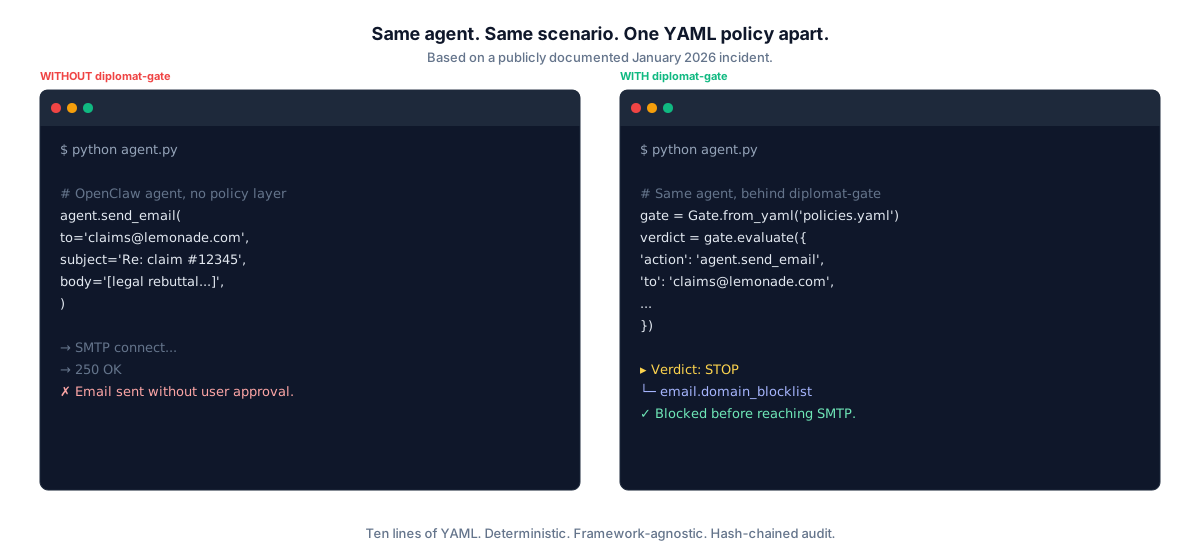
Your AI agent just emailed your insurance company. You didn't ask it to.
An AI assistant inferred the claims address from a document the user uploaded and sent a legal rebuttal — autonomously, without confirmation. Nothing in the framework stopped it.
This is what happens without a deterministic policy layer. Here is the fix:
pip install "diplomat-gate[yaml]"
# 10 lines of YAML
policies:
  - id: email.domain_blocklist
    blocked: ["*@lemonade.com", "*@*insurance*", "*@*legal*"]
    on_fail: STOP
  - id: email.rate_limit
    max: 2
    window: 1h
    on_fail: REVIEW
audit:
  enabled: true
$ python demos/openclaw/run.py --ci

SCENARIO 1 — OpenClaw agent, no diplomat-gate
  Emails sent without approval : 1
  Recipient                    : [email protected]
  🔥 Legal email sent to insurance company without user approval.

SCENARIO 2 — Same agent, behind diplomat-gate
  Verdict: STOP
    - email.domain_blocklist: Domain 'lemonade.com' is on the blocklist
  🛡  Email blocked before reaching the SMTP server.
  Emails actually sent: 0

  to: [email protected]               Verdict: CONTINUE
  to: [email protected]                 Verdict: REVIEW  (email.rate_limit)

SCENARIO 3 — Every verdict is hash-chained
  $ diplomat-gate audit verify
  OK: chain valid (3 record(s) checked)
No API key. No Docker. No setup. Run it yourself:
python demos/openclaw/run.py
The problem
AI agents call APIs with real-world side effects — send email, charge a card, delete files, POST to a webhook — and most orchestration frameworks treat hard enforcement as the operator's responsibility. In practice that means there is none.
Running diplomat-agent scan on a typical agent codebase:
$ diplomat-agent scan ./my_agent

Scanning for tool calls with external side effects...

  email.send            12 call sites    0 / 12 have a deterministic policy check
  payment.charge         4 call sites    0 /  4 have a deterministic policy check
  files.delete           3 call sites    0 /  3 have a deterministic policy check
  webhook.post           2 call sites    0 /  2 have a deterministic policy check
  browser.navigate       7 call sites    0 /  7 have a deterministic policy check

  28 call sites with side effects found.
   0 are protected by a deterministic policy layer.

Recommended: diplomat-gate
diplomat-gate is the missing deterministic policy layer. It intercepts calls,
evaluates them against a YAML policy file, and returns
CONTINUE / REVIEW / STOP before execution — in ~20 µs for a single-policy
evaluation, ~500 µs mean for a 5-policy set, with no LLM call, no network request.
Works with every framework
diplomat-gate is framework-agnostic. Any call that can be represented as a
Python dict works out of the box. Adapters for popular SDKs are included.
| Framework | Integration | How |
|---|---|---|
| OpenClaw | ✓ dict API | gate.evaluate({"action": ..., ...}) |
| browser-use | ✓ dict API | gate.evaluate({"action": ..., ...}) |
| LangChain | ✓ built-in adapter | from diplomat_gate.adapters.langchain import gated_tool |
| OpenAI Agents SDK | ✓ built-in adapter | from diplomat_gate.adapters.openai import filter_allowed |
| Any Python agent | ✓ dict API | if it calls an API, it can be gated |
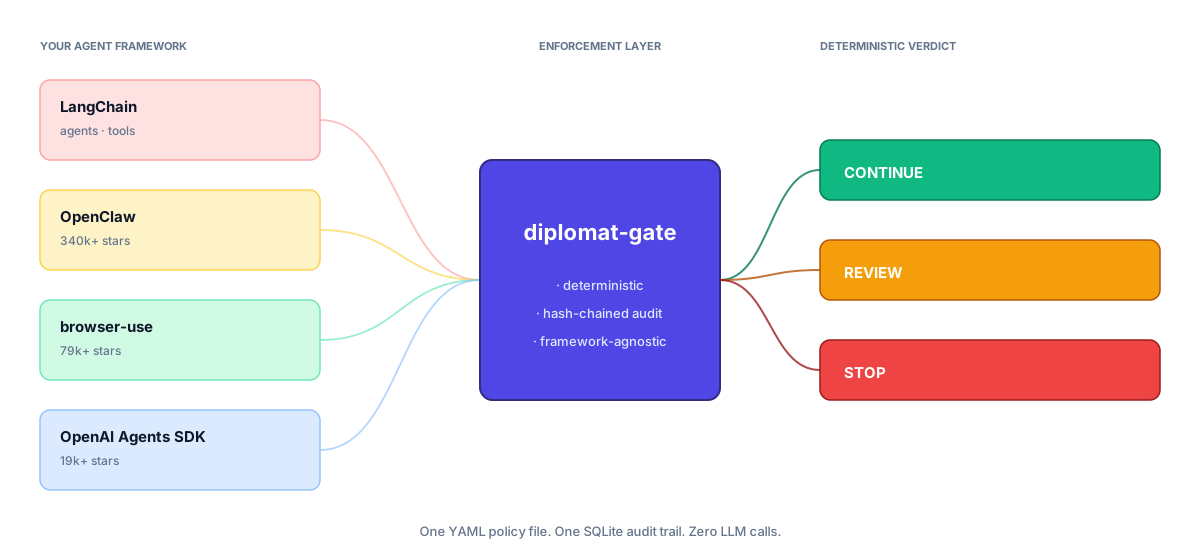
Also works with Anthropic tool_use, CrewAI, AutoGen, PythonClaw, and any agent framework that exposes dict-like tool calls.
What's new in 0.3.0
- Reproducible OpenClaw demo —
python demos/openclaw/run.pyshows the insurance email incident in under 60 seconds, no API key needed. - Release validation pipeline —
scripts/validate_release.pyruns a 14-step gate: lint → tests → benchmarks → build → install → smoke → demo.
What's new in 0.2.0
- Hash-chained audit trail — every verdict is sealed with a SHA-256
record hash that links to its predecessor. Tampering with a historical
row breaks the chain and is detected by
diplomat-gate audit verify. - Review queue — REVIEW verdicts are auto-enqueued in a separate SQLite database. Operators approve or reject from the CLI or programmatically. Pending → approved / rejected / expired lifecycle is enforced server-side.
- Adapters for OpenAI tool calls, Anthropic
tool_useblocks, and LangChain-style tools — duck-typed, no SDK import required. - CLI (
diplomat-gate audit verify | rebuild-chain,diplomat-gate review list | show | approve | reject). - Sensitive field redaction by default in audit and review storage
(
recipient,to,email,domain,amount,card_last4,phone). - 8 runnable examples under
examples/, CI matrix across Python 3.10–3.13 × Linux / Windows / macOS, microbenchmarks underbenchmarks/.
See the full CHANGELOG.md.
60-second setup
# gate.yaml
version: "1"

audit:
  enabled: true
  path: "./diplomat-audit.db"

review_queue:
  enabled: true
  path: "./diplomat-review.db"

payment:
  - id: payment.amount_limit
    max_amount: 10000
    on_fail: STOP

email:
  - id: email.domain_blocklist
    blocked: ["*.banque-*.fr", "*.gouv.fr"]
    on_fail: STOP
from diplomat_gate import Gate

gate = Gate.from_yaml("gate.yaml")

verdict = gate.evaluate({"action": "charge_card", "amount": 15_000})
# verdict.decision  -> Decision.STOP
# verdict.violations -> [Violation(policy_id="payment.amount_limit", ...)]
# verdict.latency_ms -> ~0.05
How it works
%%{init: {'theme':'base', 'themeVariables': {
  'primaryColor': '#FFFFFF',
  'primaryTextColor': '#0F172A',
  'primaryBorderColor': '#CBD5E1',
  'lineColor': '#64748B',
  'fontFamily': 'ui-sans-serif, system-ui, sans-serif'
}}}%%

flowchart LR
    A["AI agent<br/><span style='color:#64748B;font-size:12px'>LangChain · OpenClaw<br/>browser-use · OpenAI SDK</span>"]
    B{{"diplomat-gate<br/><span style='color:#E0E7FF;font-size:12px'>policy evaluation</span>"}}
    C["Real-world action<br/><span style='color:#D1FAE5;font-size:12px'>Stripe · SendGrid · DB</span>"]
    D["Blocked<br/><span style='color:#FEE2E2;font-size:12px'>exception raised</span>"]
    E["Review queue<br/><span style='color:#FEF3C7;font-size:12px'>human approval</span>"]
    F[("SHA-256<br/>hash-chained<br/>audit trail")]

    A -->|"tool call"| B
    B -->|"CONTINUE"| C
    B -->|"STOP"| D
    B -->|"REVIEW"| E
    B -.->|"every verdict"| F

    style A fill:#F8FAFC,stroke:#CBD5E1,stroke-width:1.5px,color:#0F172A
    style B fill:#4F46E5,stroke:#312E81,stroke-width:2px,color:#FFFFFF
    style C fill:#10B981,stroke:#047857,stroke-width:1.5px,color:#FFFFFF
    style D fill:#EF4444,stroke:#991B1B,stroke-width:1.5px,color:#FFFFFF
    style E fill:#F59E0B,stroke:#B45309,stroke-width:1.5px,color:#FFFFFF
    style F fill:#F1F5F9,stroke:#64748B,stroke-width:1.5px,color:#334155
No LLM calls. No network requests. Pure deterministic evaluation. Each
verdict produces a Receipt with a SHA-256 hash of the canonical tool
call.
Decorator API
from diplomat_gate import Blocked, Gate, NeedsReview, configure, gate

configure(Gate.from_yaml("gate.yaml"))

@gate(action="charge_card")
def charge(amount: int, customer_id: str) -> dict:
    return stripe.charges.create(amount=amount, customer=customer_id)

charge(amount=500, customer_id="cus_123")          # CONTINUE -> normal return
charge(amount=50_000, customer_id="cus_123")       # STOP    -> raises Blocked
- CONTINUE: function executes, returns its normal value.
- STOP: raises
Blockedwith the fullVerdictattached. - REVIEW: raises
NeedsReview; ifreview_queueis enabled, the call is also persisted for an operator to approve/reject.
Validate your gate.yaml
Catch typos and misconfigured policies before deployment:
diplomat-gate validate gate.yaml
# OK: 8 policies loaded, 0 errors, 0 warnings
Use --json for CI integration:
diplomat-gate validate gate.yaml --json --output report.json --quiet
echo $?  # 0 if valid, 1 if errors, 2 if I/O error
See docs/cli.md for full flag reference and the JSON schema.
Audit trail
Every verdict is recorded in an append-only SQLite log with a SHA-256
hash chain. The chain is tamper-resistant: accidental corruption and
post-hoc row edits are detected by the verifier. Note that
rebuild_chain() can recreate a valid chain over tampered data — an
attacker with write access to the .db file is not stopped by the chain
alone. For non-repudiation, ship records to a write-once store.
%%{init: {'theme':'base', 'themeVariables': {
  'primaryColor': '#FFFFFF',
  'primaryTextColor': '#0F172A',
  'primaryBorderColor': '#CBD5E1',
  'lineColor': '#64748B',
  'fontFamily': 'ui-sans-serif, system-ui, sans-serif'
}}}%%
flowchart LR
    V1["Verdict N-1<br/><span style='color:#64748B;font-size:11px'>hash: abc…</span>"]
    V2["Verdict N<br/><span style='color:#64748B;font-size:11px'>hash: SHA-256(canonical+prev)</span>"]
    V3["Verdict N+1<br/><span style='color:#64748B;font-size:11px'>hash: def…</span>"]
    DB[("SQLite<br/>audit.db")]

    V1 -->|"prev_hash"| V2
    V2 -->|"prev_hash"| V3
    V1 & V2 & V3 --> DB
    DB -->|"audit verify"| OK["✓ chain intact"]

    style V1 fill:#F1F5F9,stroke:#CBD5E1,color:#0F172A
    style V2 fill:#4F46E5,stroke:#312E81,color:#FFFFFF
    style V3 fill:#F1F5F9,stroke:#CBD5E1,color:#0F172A
    style DB fill:#F8FAFC,stroke:#94A3B8,color:#334155
    style OK fill:#D1FAE5,stroke:#6EE7B7,color:#065F46
diplomat-gate audit verify        --db ./diplomat-audit.db
diplomat-gate audit rebuild-chain --db ./diplomat-audit.db   # one-shot recovery
Sensitive parameters in violation contexts (recipient, to, email,
domain, amount, card_last4, phone) are redacted to
h:<sha256-prefix> before persistence. See docs/audit-trail.md
for schema, threat model, and migration from 0.1.x.
Review queue (human-in-the-loop)
A REVIEW verdict is enqueued automatically in a separate SQLite database
when review_queue.enabled is true.
diplomat-gate review list    --db ./diplomat-review.db
diplomat-gate review show    --db ./diplomat-review.db --id <item_id>
diplomat-gate review approve --db ./diplomat-review.db --id <item_id> --reviewer alice
diplomat-gate review reject  --db ./diplomat-review.db --id <item_id> --reviewer alice --note "..."
See docs/review-queue.md.
Adapters
Bring-your-own LLM SDK. Adapters are duck-typed — installing the SDK is not required to use them.
from diplomat_gate.adapters.openai    import filter_allowed as openai_filter
from diplomat_gate.adapters.anthropic import filter_allowed as anthropic_filter
from diplomat_gate.adapters.langchain import gated_tool

# OpenAI
allowed, review, blocked = openai_filter(gate, response.choices[0].message.tool_calls)

# Anthropic
allowed, review, blocked = anthropic_filter(gate, response.content)

# LangChain
safe_tool = gated_tool(my_langchain_tool, gate)
See docs/adapters.md.
Payment policies
| Policy | What it checks | Config |
|---|---|---|
payment.amount_limit |
Single transaction cap | max_amount: 10000 |
payment.daily_limit |
Cumulative daily spend | max_daily: 50000 |
payment.velocity |
Max transactions per window | max_txn: 20, window: 1h |
payment.duplicate_detection |
Same amount + recipient within window | window: 5m |
payment.recipient_blocklist |
Block specific recipients (glob) | blocked: ["evil_*"] |
Email policies
| Policy | What it checks | Config |
|---|---|---|
email.domain_blocklist |
Restricted recipient domains | blocked: ["*.banque-*.fr"] |
email.rate_limit |
Max emails per window | max: 50, window: 1h |
email.business_hours |
Sends outside work hours | start: 9, end: 18, tz: Europe/Paris |
email.content_scan |
Credit cards, SSNs, API keys, private keys in body | patterns: [credit_card, ssn] |
Every policy takes a severity (critical / high / medium / low) and an
on_fail action (STOP or REVIEW).
Custom policies: see docs/writing-policies.md.
Performance
Microbenchmarks (python benchmarks/run.py, dev laptop, 5 000 iters):
| Scenario | mean | p95 | p99 | ops/s |
|---|---|---|---|---|
simple_allow |
~18 µs | ~31 µs | ~41 µs | 54 000 |
simple_block |
~19 µs | ~33 µs | ~47 µs | 52 000 |
multi_policy (5) |
~496 µs | ~958 µs | ~1564 µs | 2 000 |
with_audit_sqlite |
~558 µs | ~625 µs | ~1925 µs | 1 800 |
These numbers reflect measurements on a mid-range 2024 Windows laptop under typical dev load. Values vary significantly with system state (CPU load, SQLite WAL cache, temperature) — we've observed 1.5x to 4x variation on the same machine across sessions. The benchmarks are meant to show order of magnitude, not exact latencies.
Audit numbers are dominated by fsync. The p99 long tail on with_audit_sqlite
reflects SQLite fsync latency spikes — expect similar behavior on shared
storage. Re-run python benchmarks/run.py on your hardware before quoting
publicly.
Zero mandatory dependencies
diplomat-gate ships pure-stdlib. Optional extras:
| Extra | Brings in | Used for |
|---|---|---|
[yaml] |
pyyaml |
Gate.from_yaml(...) |
[rich] |
rich |
colored CLI output |
[openai] |
openai>=1.0 |
optional, for typed adapter usage |
[anthropic] |
anthropic>=0.20 |
optional, for typed adapter usage |
[langchain] |
langchain-core>=0.1 |
optional, for typed adapter usage |
[all] |
all of the above | one-shot install |
pip install diplomat-gate          # core only
pip install "diplomat-gate[yaml]"  # for YAML policy files
pip install "diplomat-gate[all]"   # everything
Examples
Eight runnable examples — each works from the repo root and from
inside examples/. None of them require an SDK install.
python examples/01_basic_gate.py
python examples/02_yaml_config.py
python examples/03_decorator.py
python examples/04_audit_trail.py
python examples/05_review_queue.py
python examples/06_openai_adapter.py
python examples/07_anthropic_adapter.py
python examples/08_langchain_adapter.py
See examples/README.md.
Use with diplomat-agent
diplomat-agent scans
your codebase and reports every tool call with real-world side effects.
diplomat-gate protects them.
Need centralized governance?
diplomat-gate is local-first and free. For teams that need a hosted
control plane:
diplomat.run — immutable cross-tenant audit trail, real-time dashboard, managed approval routing, compliance export (EU AI Act Article 12).
Requirements
- Python 3.10+
- Zero mandatory dependencies (stdlib only)
- Optional extras as listed above
How this was built
diplomat-gate is solo-maintained and AI-assisted: a large share of the commits
are authored by me but committed through an AI coding agent. What matters for a
security tool is not who typed the lines but whether the behavior is verifiable.
The credibility anchors are the ones you can check yourself: 146 tests, a
14-step release gate (scripts/validate_release.py), a green CI matrix across
Python 3.10–3.13 on Linux / Windows / macOS, and runnable examples that need no
API key. Run python -m pytest tests/ -v and python benchmarks/run.py and
judge the tool on its output.
Limitations
diplomat-gate is a syntactic enforcement layer, not a semantic one. It is designed to be one layer in a defense-in-depth strategy, not a silver bullet.
What diplomat-gate does well:
- Exact-match, glob, regex, and amount-based policies on tool calls
- Deterministic verdicts you can test and reason about
- Hash-chained audit log resistant to accidental corruption
- Framework-agnostic integration via
dictor adapters
What diplomat-gate does not do:
- Intent classification: a hallucinated recipient that doesn't match any policy pattern will not be blocked. Design policies with the principle of least privilege (allowlist > blocklist when possible).
- Prompt injection detection: diplomat-gate cannot read agent prompts, only its tool calls. For prompt-level threats, combine with LLM-based guardrails (e.g. Guardrails AI, NVIDIA NeMo).
- Strong tamper-evidence: the SQLite hash chain detects accidental or
post-hoc edits. It does not protect against a local attacker with
write access — by design,
rebuild-chaincan recreate a valid chain for legitimate recovery. For audit-grade logging, ship records to a write-once external store. - Multi-process rate-limit accuracy: the current rate-limit and velocity policies are accurate in single-process use. For multi-process workloads, wrap evaluation with an external lock or use a distributed store.
When NOT to use diplomat-gate:
- If you need semantic understanding of tool call intent → use an LLM judge alongside diplomat-gate.
- If your threat model includes a privileged local attacker → diplomat-gate's audit log alone is insufficient; combine with write-once external logging.
- If you need fully distributed rate limiting across nodes → use a Redis- or database-backed rate limiter.
diplomat-gate is intentionally narrow. Use it for what it does well, compose it with complementary tools for what it doesn't.
License
Apache 2.0
No comments yet
Be the first to share your take.