







DeltaLLM
DeltaLLM is a self-hosted LLM gateway. Point OpenAI-compatible clients at one endpoint, then manage model deployments, routing, scoped API keys, budgets, guardrails, MCP tools, and usage from one control plane.
One Endpoint For Your Apps
from openai import OpenAI

# Before: call OpenAI directly.
client = OpenAI(api_key="sk-...")

# After: send the same OpenAI-compatible requests through DeltaLLM.
client = OpenAI(
    base_url="http://localhost:4002/v1",
    api_key="sk-deltallm-key",
)
Your application keeps its OpenAI request format. DeltaLLM handles provider credentials, routing, policy checks, caching, failover, and spend tracking.
What It Handles
- Unified API - Use one OpenAI-compatible endpoint across OpenAI, Anthropic, Azure OpenAI, Bedrock, Gemini, Groq, and other providers.
- Scoped API keys - Issue virtual keys with model allowlists, rate limits, budgets, owners, and expiry.
- Routing and failover - Route by strategy, retry failed deployments, and separate provider credentials from application code.
- Batch API - Run embeddings and non-streaming chat completions asynchronously through OpenAI-compatible files and batches, even when upstream providers are synchronous.
- MCP gateway - Register external MCP servers and expose approved tools through controlled gateway flows.
- Guardrails - Detect PII and prompt injection before provider calls.
- Spend and usage - Attribute cost by key, team, organization, model, and provider.
- Admin UI - Manage models, credentials, route groups, teams, users, usage, audit logs, and settings in the browser.
- Operations - Export Prometheus metrics, request logs, audit events, cache behavior, and health checks.
Admin UI
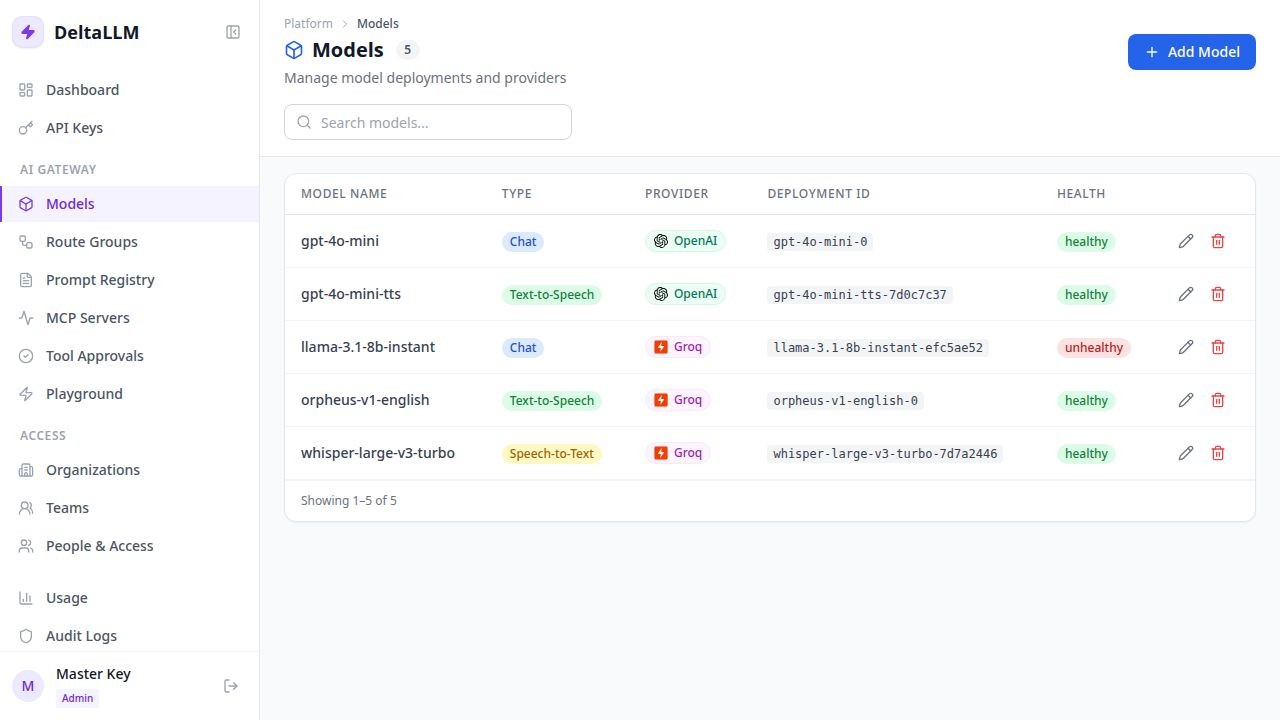
The UI is the control plane for model deployments, route groups, API keys, access, usage, guardrails, audit logs, and runtime settings.
Quick Start With Docker
Use Docker Compose for the shortest local evaluation path. It starts DeltaLLM, PostgreSQL, and Redis.
git clone https://github.com/deltawi/deltallm.git
cd deltallm
cp config.example.yaml config.yaml
For a first local request, enable one-time model bootstrap in config.yaml:
general_settings:
  model_deployment_source: db_only
  model_deployment_bootstrap_from_config: true
Generate the required secrets:
python3 -c 'import secrets; print("DELTALLM_MASTER_KEY=sk-" + secrets.token_hex(20) + "A1")'
python3 -c 'import secrets; print("DELTALLM_SALT_KEY=" + secrets.token_hex(32))'
Create .env with the generated values and a provider key:
DELTALLM_MASTER_KEY=sk-your-generated-master-key
DELTALLM_SALT_KEY=your-generated-salt-key
OPENAI_API_KEY=sk-your-openai-key
[email protected]
PLATFORM_BOOTSTRAP_ADMIN_PASSWORD=ChangeMe123!
Start the stack:
docker compose --profile single up -d --build
Check health and send a request:
curl http://localhost:4002/health/liveliness

curl http://localhost:4002/v1/chat/completions \
  -H "Authorization: Bearer $DELTALLM_MASTER_KEY" \
  -H "Content-Type: application/json" \
  -d '{
    "model": "gpt-4o-mini",
    "messages": [
      {"role": "user", "content": "Hello from DeltaLLM"}
    ]
  }'
Open the Admin UI at http://localhost:4002.
Full Docker setup, environment variables, HA Compose, and Dockerfile usage are covered in the Docker guide.
Deployment Paths
| Path | Use it for | Start here |
|---|---|---|
| Railway | Managed evaluation with hosted PostgreSQL and Redis | Railway deployment |
| Docker Compose | Local evaluation, demos, small teams, simple self-hosting | Docker guide |
| Kubernetes | Multi-instance production, ingress, autoscaling, and managed infrastructure | Kubernetes guide |
| Local development | Backend, UI, and contributor workflow from the repository | Installation guide |
Documentation
- Getting started
- Gateway usage examples
- Configuration reference
- Model deployments
- Features
- Admin UI guide
- API reference
- Deployment guide
Contributing
- Report issues
- Request features
- PRs are welcome. Start with the local installation guide.
License
See LICENSE.
No comments yet
Be the first to share your take.