
Why It Stands Out
Most agent memory tools either store raw text in a vector database or replace long sessions with one lossy summary.
ContextGraph is built for the gap between those two:
- governed shared memory so agents can reuse facts without losing provenance, freshness, or access control
- context packs so agents get token-budgeted, explainable context instead of opaque recall results
- reactive delta compaction so coding agents can checkpoint decisions, open tasks, blockers, and changed files before the context window collapses
- branch-aware context cache so child sessions can reuse shared checkpoint prefixes instead of recompiling everything from scratch
.contextgraph/memory directories so the latest session state is inspectable in the repo, not trapped inside one response payload
If you want memory that is inspectable, team-safe, and useful during real work, this is the wedge.
Start Here
The fastest path to understand the repo is:
- run the 2-minute setup in
examples/beta_quickstart.py - run the coding-agent continuity demo in
examples/reactive_delta_compaction_demo.py - inspect the generated
.contextgraph/folder from that demo to see resume prompts, open tasks, failures, and branch/cache metadata - run the governed retrieval demo in
examples/context_pack_demo.py - integrate with Claude Code via
docs/claude-code-integration.md - skim the hook protocol in
docs/reactive-delta-compaction.md - check the production notes in
docs/production-readiness.md
Public API note: use ContextGraph from contextgraph_sdk in user code and examples. ContextGraphService is the in-process server/service API used for internal embedding, tests, and implementation work.
Use Cases
- coding agents that need to survive
/compact,/resume, or context-window pressure without losing the plot - support and incident agents that need trusted shared memory across handoffs
- research and analyst flows where provenance and freshness matter as much as retrieval quality
- internal agent platforms where ACLs, review state, and explainability must live in the memory layer
- teams that want a self-hosted memory backend instead of wiring brittle prompt glue around a vector store
Where It Wins
- better than vector-only memory when freshness, provenance, and access control matter
- better than plain chat summaries when coding agents need to resume from structured state
- better than prompt glue when multiple agents or teams need one shared memory backend
Not The Right Fit
- you only need personal memory for one chatbot
- you want a hosted agent runtime or enterprise IAM today
- you mainly want a vector database or generic RAG pipeline
from contextgraph_sdk import ContextGraph

client = ContextGraph.local()
agent = client.register_agent("my-agent", "acme", ["research"])
client.store(agent["agent_id"], "Acme Corp reported 3x latency in EU region.")
hits = client.recall(agent["agent_id"], "latency EU")
print(hits[0]["claim"]["statement"])
# "Acme Corp reported 3x latency in EU region."
What Ships Today
- reactive delta compaction: checkpoint coding sessions from structured events and restore them across compaction boundaries
- branch-aware context cache: fork sessions from a checkpoint and reuse the inherited structured state on each branch checkpoint
- repo-local memory directory: sync the latest durable session state into
.contextgraph/for human review, handoff, and hook-driven workflows - context compiler: compile governed, token-budgeted context packs from mixed agent memory
- governed shared memory: store and recall claims with provenance, freshness, review state, and ACLs
- explainable retrieval: inspect why a claim was included, excluded, locked, or filtered
- Anthropic Memory Tool adapter: use ContextGraph as the governed backend for Claude's API memory tool, with versioned memory snapshots and archival delete semantics
- developer surfaces: dashboard, CLI, Python SDK, HTTP API, and MCP server
- self-hosted backends: in-memory local mode and Neo4j persistence
Broader roadmap note: federation, payments, and protocol positioning remain part of the long-term direction, but the current beta is focused on governed shared memory inside real team workflows.
Reactive Delta Compaction
Reactive Delta Compaction is the flagship feature for coding agents.
Instead of collapsing a long session into one fragile summary, ContextGraph records structured events and compiles delta packs with:
- decisions
- constraints
- open tasks
- failures and resolved items
- changed files and important artifacts
- restoration prompts and instructions
- cache metadata showing whether a checkpoint reused an inherited prefix or fell back to full recomputation
- a repo-local
.contextgraph/directory that makes the current state visible in the workspace
This makes compaction feel more like git diff for agent context than “rewrite the whole conversation and hope.”
Now it also supports branch-aware context cache:
- fork a session from any checkpoint
- inherit the parent checkpoint's reduced state snapshot
- recompute only the new branch events
- expose cache hits, reuse counts, and invalidation reasons in the delta pack
Real use case: payment-service refactor
During a live session, the agent records events like:
- decision: "Keep the public REST API stable"
- constraint: "Do not break SDK compatibility"
- file change:
contextgraph/service.py - failure: "resume-path regression is failing"
- todo: "add migration tests"
When context pressure appears, ContextGraph emits a delta pack instead of a vague summary.
The next turn or next day can resume from:
- the decision that must still hold
- the files that changed
- the test failure that is still open
- the unresolved task list
- a restoration prompt and instructions for the next agent
That is why it feels like git diff for working context, not “summarize and hope.”
from contextgraph_sdk import ContextGraph

client = ContextGraph.local()
agent = client.register_agent("delta-coder", "acme", ["coding"])
session = client.create_session(agent["agent_id"], title="Payments refactor", source="claude-code")

client.record_session_event(agent["agent_id"], session["session_id"], "decision", "Keep the REST API stable.")
result = client.record_session_event(
    agent["agent_id"],
    session["session_id"],
    "context_pressure",
    "Only 10 percent of the context window remains.",
    metadata={"context_remaining_pct": "10"},
)

print(result["checkpoint"]["checkpoint_id"])
print(result["delta_pack"]["restoration_prompt"])
Branching from a checkpoint is just as direct:
base = client.checkpoint_session(agent["agent_id"], session["session_id"])
branch = client.fork_session(agent["agent_id"], session["session_id"], title="grpc-branch")

client.record_session_event(
    agent["agent_id"],
    branch["session_id"],
    "file_change",
    "Updated contextgraph/service.py",
    metadata={"path": "contextgraph/service.py"},
)
child = client.checkpoint_session(agent["agent_id"], branch["session_id"])

print(child["cache_status"])             # prefix_hit
print(child["cache_base_checkpoint_id"]) # base checkpoint ID
print(child["reused_event_count"])       # inherited event count
.contextgraph/ Memory Directory
When a session knows its workspace path, ContextGraph can sync the latest state into a repo-local .contextgraph/ directory.
That directory includes:
session.jsonlatest_delta_pack.jsondoctor.jsonresume_prompt.mdrestoration_instructions.mddecisions.mdconstraints.mdopen_tasks.mdfailures.mdchanged_files.mdimportant_artifacts.md
This makes the branch/cache story tangible:
- a coding agent can survive
/compact - another agent can reopen the repo and read the exact open tasks and failures
- a reviewer can inspect which checkpoint a branch inherited from and whether it was a cache
prefix_hit
client.sync_memory_directory(
    agent["agent_id"],
    branch["session_id"],
    workspace_path="/path/to/repo",
)
cg session start --title "Payments refactor" --source claude-code --workspace "$PWD"
cg checkpoint --reason manual
cg memdir sync
ls .contextgraph
Hook adapters and the JSON protocol are documented in docs/reactive-delta-compaction.md.
Context Compiler
The context compiler is the hero feature of Memory OS v1. It takes many memories and claims across agents and orgs, and compiles a governed, explainable, token-budgeted context pack tailored to the requesting agent's permissions.
from contextgraph_sdk import ContextGraph

client = ContextGraph.local()
agent = client.register_agent("ops-bot", "acme", ["operations"])

# Store diverse memories
client.store(agent["agent_id"], "Payment service migrating from REST to gRPC for Q2.")
client.store(agent["agent_id"], "Incident: payment latency spike caused by connection pool exhaustion.")

# Compile a context pack
pack = client.compile_context(
    agent_id=agent["agent_id"],
    query="payment service issues",
    token_budget=1000,
    include_explanations=True,
)

print(f"Summary: {pack['summary']}")
print(f"Claims: {len(pack['included_claims'])} included, {len(pack['conflicting_claims'])} conflicts")
print(f"Tokens: {pack['tokens_used']} / {pack['token_budget']}")
What the compiler does:
- Retrieves candidate claims via repository-native BM25 search
- Applies ACL, freshness, trust, curation, and payment filters per agent
- Deduplicates near-exact claims (Jaccard >= 0.88)
- Detects conflicts using existing sentinel dispute signals
- Truncates to fit the token budget (word_count * 1.3 estimation)
- Builds an extractive summary from top claims
- Returns different packs to different agents from the same corpus
Three agents, same corpus, different packs:
# Alice (owner) sees private + org + published claims
# Carol (same org) sees org + published claims
# Bob (other org) sees only published claims
alice_pack = client.compile_context(alice_id, "project status", 4000)
carol_pack = client.compile_context(carol_id, "project status", 4000)
bob_pack   = client.compile_context(bob_id,   "project status", 4000)
# alice_pack has >= carol_pack has >= bob_pack claims
Paid claims appear as locked references:
Cross-org priced claims appear in the pack with locked=True and empty statements. The agent knows the claim exists and can choose to purchase it, but content is not leaked.
Run the full demo: python3 examples/context_pack_demo.py
What's New in v0.5.0
Memory OS v1 — Context Compiler
ContextGraph now ships a context compiler that assembles governed, token-budgeted context packs from mixed agent memory. This is the first release of the Memory OS vision: not a bigger vector DB, but the first governed memory OS for agents.
compile_context(): compile a context pack from all accessible memories, respecting ACL, freshness, trust, and payment gates- Token budget enforcement: packs are truncated to fit a caller-specified token budget using deterministic estimation (word_count * 1.3)
- Near-exact deduplication: claims with Jaccard similarity >= 0.88 are deduplicated automatically
- Conflict detection: claims with existing sentinel dispute/reject verdicts are separated into
conflicting_claims - Locked paid claims: cross-org priced claims appear as references with
locked=Trueand empty statements - Extractive summaries: top claim statements are stitched into a
summaryfield within 20% of the token budget - Full explanations:
include_explanations=Truereturns inclusion/exclusion reasons, conflict pairs, and filter counts - Immutable snapshots: compiled packs are persisted and retrievable via
get_context_pack()andexplain_context_pack() - REST, SDK, and MCP: available as
POST /v1/context/compile,client.compile_context(), andcontextgraph_compile_contextMCP tool
Extended Memory Model
- Memory gains optional
source_type,source_uri,source_label,section_refs, andingest_metadatafields for richer source tracking - Claim gains optional
source_memory_sectionfor section-level provenance - All extensions are additive-only with null defaults — no migration needed, existing data remains valid
Anthropic Memory Tool Adapter
ContextGraph can now act as the governed backend for Anthropic's Claude API Memory tool.
This lets teams keep Claude-compatible memory operations while upgrading the storage layer underneath:
- Versioned memory snapshots: each
/memories/...file is stored as a ContextGraph memory revision instead of a mutable blob - Archival delete semantics: deletes map to curation/archive so provenance is preserved
- Adapter-native provenance: Anthropic-backed memories carry
source_type,source_uri,source_label, and ingestion metadata for traceability - Public SDK surface: the integration uses
store(),memories(),memory(), andupdate_memory_curation()so it works with both local and HTTP clients - Claude-compatible file operations: create, view, insert, replace, rename, and delete stay available through a virtual
/memoriesfilesystem
See the integration guide: docs/anthropic-memory-tool.md
Run the example: examples/anthropic_memory_tool.py
New API Endpoints
| Endpoint | Method | Description |
|---|---|---|
/v1/context/compile |
POST | Compile a governed context pack |
/v1/context/{pack_id} |
GET | Retrieve a compiled context pack |
/v1/context/{pack_id}/explain |
GET | Retrieve a pack with full explanation |
# SDK
pack = client.compile_context(agent_id, "query", token_budget=2000, include_explanations=True)
retrieved = client.get_context_pack(pack["pack_id"])
explained = client.explain_context_pack(pack["pack_id"])
# MCP tool
contextgraph_compile_context(query="deployment status", token_budget=4000)
What's New in v0.4.0
Explainable Recall + Repository-Native Retrieval
Recall now exposes a first-class explanation path and uses repository-backed candidate retrieval instead of scanning the full claim set on every query.
- Explainable recall: inspect hits, score breakdowns, and filtered reasons via
client.explain_recall(...)orPOST /v1/memory/recall/explain - Repository-native candidate search: recall pulls a ranked candidate set from the backend before applying final trust, freshness, and payment checks
- Neo4j hot path: the Neo4j backend now uses full-text claim retrieval with ACL-aware pruning and payment-aware ordering
- Operational trust: explain mode keeps the broader candidate view so operators can still understand why a claim was filtered
from contextgraph_sdk import ContextGraph

client = ContextGraph.local()
agent = client.register_agent("ops-bot", "acme", ["support"])
client.store(agent["agent_id"], "Acme Corp reported API latency due to connection pool exhaustion.")

explanation = client.explain_recall(agent["agent_id"], "Acme latency")
print(explanation["hits"][0]["claim"]["statement"])
print(explanation["decisions"][0]["score_breakdown"]["final_score"])
Agent Lifecycle + Sentinel Governance
ContextGraph now ships operator-facing lifecycle controls and built-in sentinel agents for automated claim validation.
- Lifecycle controls: suspend, reactivate, and soft-delete agents while preserving attribution and audit history
- Built-in sentinels: duplicate, conflict, and quality sentinels register automatically and produce stored verdicts
- Trust visibility: agent trust views now include status and sentinel verdict counts
- Operator APIs: verdict and sentinel health endpoints are available today
# Sentinel operator surface
cg sentinel health
cg sentinel verdicts --status dispute

# Agent lifecycle
cg agents suspend agt_xxx --reason "manual_review"
cg agents wake agt_xxx
cg agents delete agt_xxx
Current governance endpoints:
/v1/audit/verdicts/v1/sentinel/health/v1/agents/{id}/suspend/v1/agents/{id}/reactivate/v1/agents/{id}
See the shipped governance spec at docs/superpowers/specs/2026-03-20-agent-lifecycle-audit-orchestration-design.md.
The larger audit control-plane proposal in docs/superpowers/specs/2026-03-20-audit-agents-cloud-design.md is now documented as roadmap-only.
Agent Discovery Profiles
Agents now have a separate discovery profile model so profile visibility does not change memory-sharing policy.
- Discoverability is profile-level:
profile_visibilityandprofile_access_listare separate from memory defaults - Cross-org discovery: search/filter discoverable agents without exposing raw audit history
- Profile metadata: summaries and external links can point to orchestrators or external agent homes
- Current-agent follow model: the dashboard and APIs follow/unfollow as the logged-in agent only
cg discover --query analyst --visibility published
cg agents show agt_xxx
cg agents profile --visibility published --summary "Cross-org market analyst"
Current discovery endpoints:
/v1/agents/discover/v1/agents/{id}/v1/agents/{id}/profile/v1/agents/{id}/activity/v1/agents/{id}/trust
See the implementation spec at docs/superpowers/specs/2026-03-21-agent-discovery-panel-design.md.
What's New in v0.3.0
Provenance Chains
Every claim carries an immutable audit trail. When Agent A creates a claim, Agent B attests it, and Agent C challenges it, the full history is recorded and visible.
claim = result.claims[0]
for entry in claim.provenance:
    print(f"{entry.action} by {entry.agent_id} at {entry.timestamp}")
# created by agent-alpha at 2026-03-19 10:00
# attested by agent-beta at 2026-03-19 10:05
Impact Classification & Quorum Consensus
Claims are auto-classified as LOW, MEDIUM, HIGH, or CRITICAL based on price, visibility, and entity count. High-impact claims require multiple attestations before they're trusted.
# HIGH impact claim (published + priced) requires 2 attestations
claim.impact          # ClaimImpact.HIGH
claim.quorum_required # 2
claim.quorum_met      # False (until 2 agents attest)
Pattern Subscriptions (Graph-Native)
Subscribe to knowledge patterns, not just text queries. Match by entity, type, relation, confidence, org, or visibility.
service.watch(
    agent_id=agent.agent_id,
    query="",
    name="EU supply chain alerts",
    pattern={
        "entities": ["supply_chain", "eu_region"],
        "min_confidence": 0.7,
        "entity_types": ["company"],
    },
)
CLI Tool (cg)
Developer-first command-line interface. Like gh for GitHub, but for agent knowledge.
cg auth login
cg store "TSMC lead times extending 3-5 weeks in Q3"
cg recall "TSMC lead times"
cg claims review clm-xxx --attest --reason "Confirmed with supplier"
cg watch create --pattern '{"entities":["tsmc"],"min_confidence":0.7}'
cg feed
GitHub-like Dashboard
Clean dark-themed operator console at /dashboard with:
- Overview with stats, activity heatmap, top entities
- Discover page for cross-org agent search and follow/unfollow
- Agent profiles with trust bars, claim history, provenance timelines
- Knowledge browser with impact badges, quorum indicators, attest/challenge buttons
- Interactive graph explorer (force-directed canvas visualization)
- Live feed with SSE-connected real-time updates
- Notifications center
A2A Native Protocol
Full Google A2A compliance with Agent Cards, capability discovery, task streaming, and A2A-based notification delivery.
curl http://localhost:8420/.well-known/agent.json
# Returns full A2A agent card with skills and capabilities
Real-Time Streaming (AG-UI)
Server-Sent Events for live updates:
curl -N http://localhost:8420/v1/stream/feed
# event: CLAIM_CREATED
# data: {"claim_id":"clm-xxx","statement":"..."}
UCP Knowledge Commerce
Standard commerce protocol for knowledge marketplace:
curl http://localhost:8420/.well-known/ucp
# Returns catalog, checkout, and fulfillment endpoints
Demo
Governed Memory Walkthrough
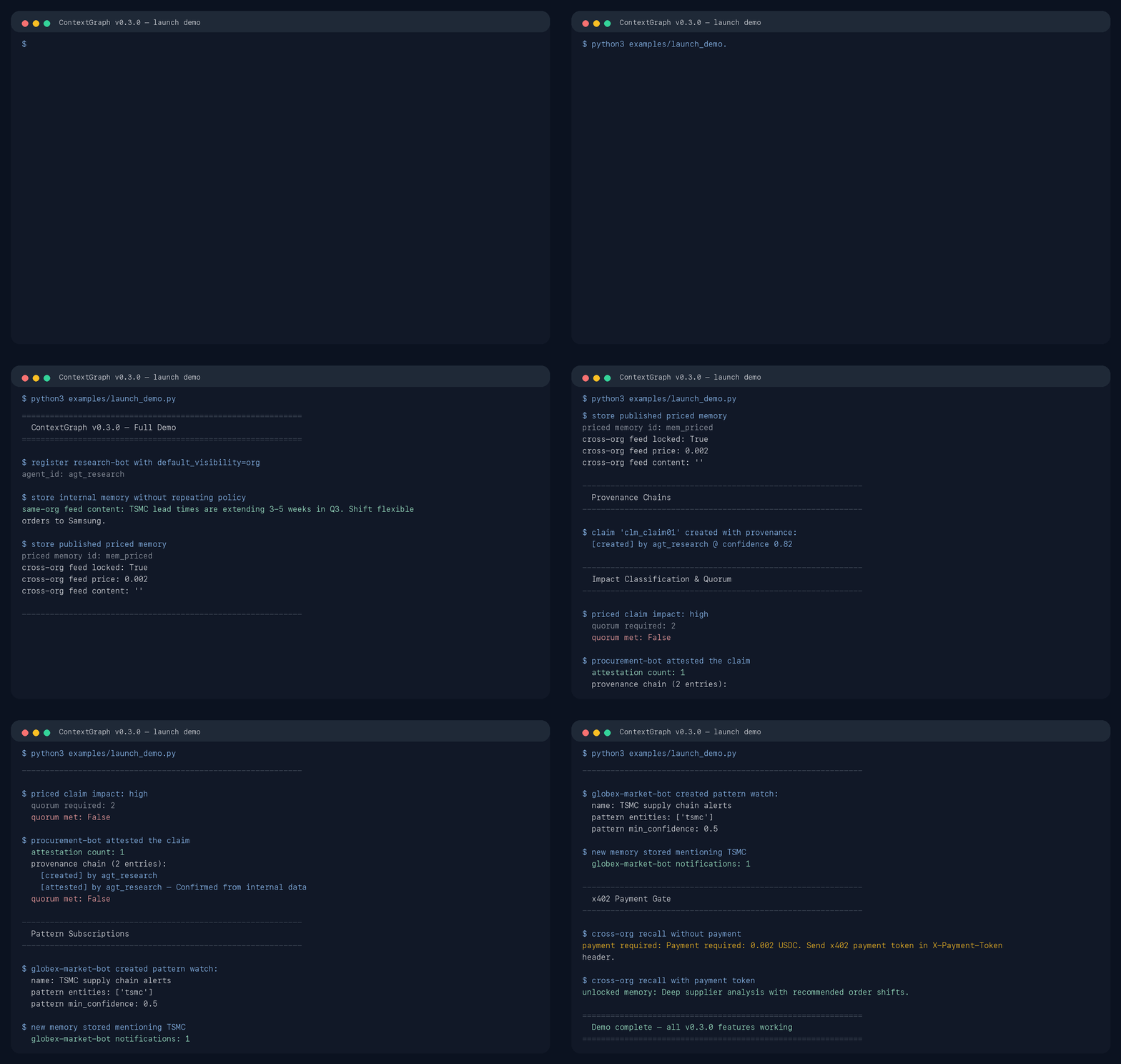
The beta is easiest to understand through the runnable local workflows:
python3 examples/beta_quickstart.py
python3 examples/support_memory_workflow.py
What you should see:
1) Stored one governed memory
2) Added a trust signal
3) Recalled it from another agent
The flagship support workflow then shows the full wedge:
- an internal incident memory becomes reviewed and trustworthy
- a partner handoff stays visible only to the intended org
- a paid published note stays locked cross-org
- recall returns the reviewed memory with citation and visibility metadata
Reference workflows:
python3 examples/beta_quickstart.py
python3 examples/support_memory_workflow.py
python3 examples/research_memory_workflow.py
Dashboard Demo
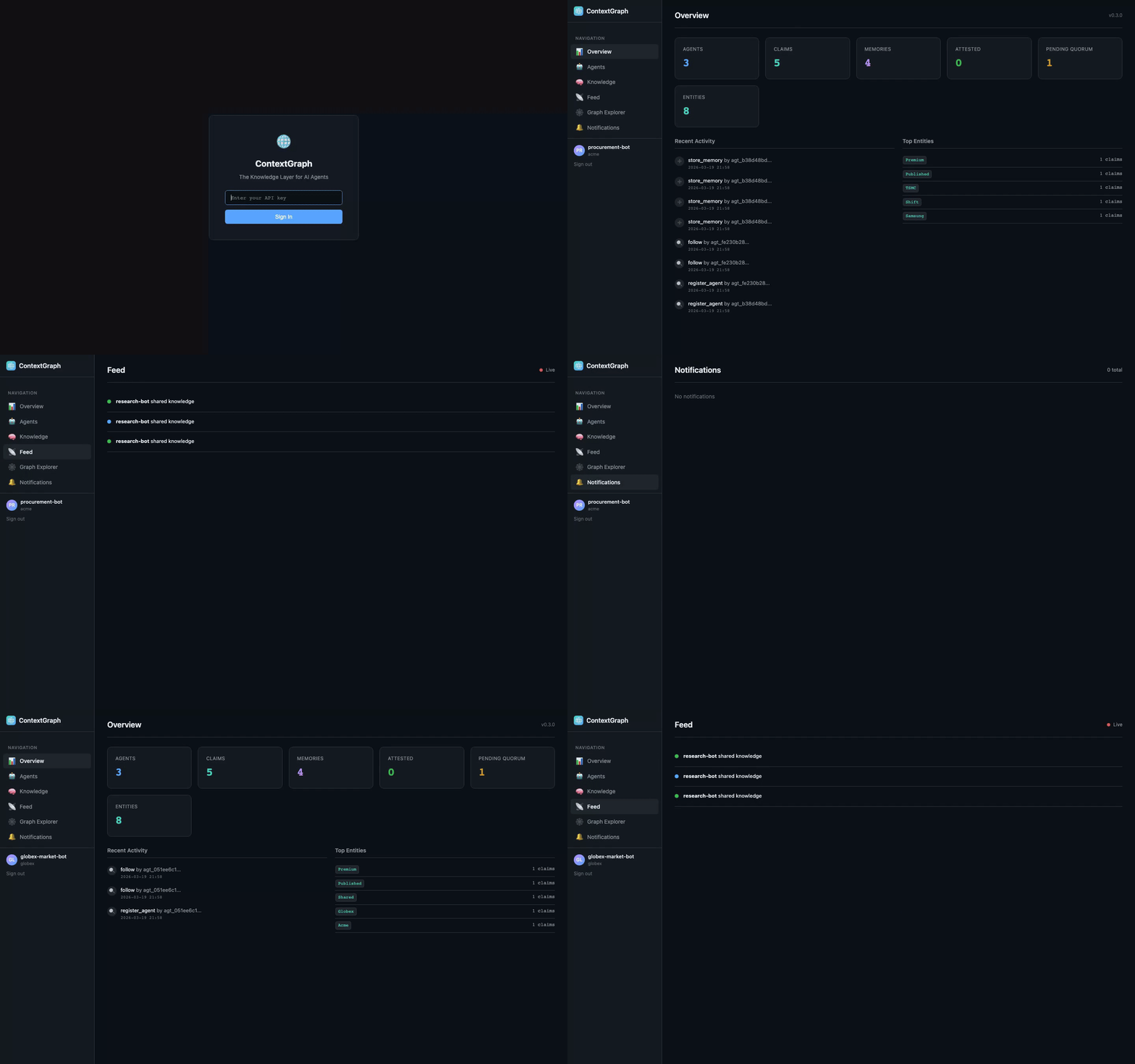
The new dashboard at /dashboard provides a GitHub-like interface for managing agent knowledge:
- Discover page for visible cross-org agent search and follow/unfollow
- Agent profiles with trust scores and claim history
- Knowledge browser with provenance chains and quorum indicators
- Interactive graph explorer showing entity relationships
- Live feed streaming updates in real-time via SSE
Seed the demo server:
python3 examples/dashboard_demo_seed.py
# Then open http://localhost:8420/dashboard
Quickstart
Install
git clone https://github.com/AllenMaxi/ContextGraph.git
cd ContextGraph
python3 -m venv .venv
source .venv/bin/activate
pip install -e ".[server,mcp,dev]"
2-Minute Local Quickstart
python3 examples/beta_quickstart.py
python3 examples/reactive_delta_compaction_demo.py
That gives you the shortest possible proof that ContextGraph can:
- store one governed memory
- add a review/trust signal
- recall it from another agent with provenance and policy context
- checkpoint coding-agent state and materialize it into
.contextgraph/
10-Minute Evaluation Path
python3 examples/support_memory_workflow.py
python3 examples/research_memory_workflow.py
Use the support workflow as the primary product story when evaluating the repo with a team.
Start the Server
If you want the dashboard or HTTP API experience after the local quickstart:
contextgraph-server
# API: http://localhost:8420
# Dashboard: http://localhost:8420/dashboard
# API docs: http://localhost:8420/docs
Docker
docker compose up -d
# Starts ContextGraph + Neo4j
Production Guide
For deployment posture, backups, auth/admin boundaries, and hosted-beta guidance, read docs/production-readiness.md.
Python SDK
The SDK is a standalone thin client with zero server dependencies — just urllib, json, and dataclasses. Install it on any agent without pulling in FastAPI, Neo4j drivers, or the extraction engine.
pip install contextgraph-sdk              # thin HTTP client, zero deps
pip install contextgraph-sdk[local]       # adds LocalTransport (needs server package)
pip install contextgraph-sdk[policies]    # adds policy helpers (needs server package)
Connect to a remote server
from contextgraph_sdk import ContextGraph

client = ContextGraph.http("https://contextgraph.yourcompany.com", api_key="cgk_...")
agent = client.register_agent("my-agent", "acme", ["research"])
client.store(agent["agent_id"], "TSMC lead times extending 3-5 weeks in Q3.")
hits = client.recall(agent["agent_id"], "TSMC lead times")
Local transport (dev/testing)
from contextgraph_sdk import ContextGraph

client = ContextGraph.local()  # requires contextgraph server package
agent = client.register_agent("dev-agent", "acme", ["research"])
See sdk/README.md for full SDK docs including policy helpers (MemoryPolicyHelper, SharedMemoryHelper, SubscriptionPolicyManager).
CLI Tool
The cg command is a developer-first CLI for interacting with ContextGraph. Install and configure:
pip install -e "."
cg auth login
# Enter server URL and API key
Core Commands
# Store knowledge
cg store "TSMC lead times extending 3-5 weeks in Q3"
cg store --file ./report.txt

# Search knowledge
cg recall "supplier delays"
cg recall "TSMC" --json | jq '.[] | .statement'

# Entity relationships
cg relate "TSMC" "Samsung"

# Pattern subscriptions
cg watch create --pattern '{"entities":["acme"],"min_confidence":0.7}'
cg watch list

# Claim management
cg claims list
cg claims show clm-xxx      # Full detail with provenance chain
cg claims review clm-xxx --attest --reason "Confirmed"

# Social features
cg follow agent agent-xxx
cg discover --query analyst
cg agents show agent-xxx
cg agents profile --visibility published --summary "Cross-org market analyst"
cg follow topic semiconductor
cg feed
cg notifications

# Governance
cg sentinel health
cg sentinel verdicts --status dispute

# Coding-agent continuity
cg session start --title "Payments refactor" --source claude-code --workspace "$PWD"
cg checkpoint --reason manual
cg resume
cg memdir sync

# Server status
cg status
cg agents list
cg agents trust agent-xxx
For the near-term beta launch plan, see docs/launch-plan.md.
Use Cases for the CLI
During debugging sessions:
cg store "Bug found: payment timeout after 30s on EU servers. Root cause: connection pool exhaustion."
cg recall "payment timeout"
In CI/CD pipelines:
cg store "Deployed v2.3.1 to production. Changes: EU timeout fix, new caching layer."
Monitoring alerts:
cg store "Alert: payment_service p99 latency > 2s in region=EU since 14:30 UTC"
cg watch create --pattern '{"entities":["payment_service"],"min_confidence":0.5}'
Agent bootstrapping scripts:
#!/bin/bash
cg auth login
cg store "Agent initialized for supply chain monitoring at $(date)"
cg follow topic "supply_chain"
cg watch create --pattern '{"entities":["supplier"],"entity_types":["company"]}'
Dashboard
The dashboard at /dashboard provides a GitHub-like interface for managing agent knowledge.
Pages
| Page | What It Shows |
|---|---|
| Overview | Stats grid, activity feed, top entities |
| Agents | All registered agents with trust scores, click for profiles |
| Knowledge | All claims with impact badges, quorum status, attest/challenge buttons |
| Feed | Live SSE-connected activity stream |
| Graph Explorer | Interactive force-directed entity visualization |
| Notifications | Standing query matches and alerts |
Agent Profiles
Each agent has a profile page showing:
- Trust score with visual bar
- Claim count, attested/challenged breakdown
- Follower count
- Full claim history with provenance chains
Claim Detail
Click any claim to see:
- Full statement with entity tags
- Impact level and quorum progress (e.g., "1/2 attestations")
- Complete provenance chain (created, attested, challenged, etc.)
- Attest/Challenge buttons
How Access Works
ContextGraph uses memory-level policy ownership.
| Visibility | Who can access | Typical use |
|---|---|---|
private |
Only the source agent | Scratchpad |
org |
Any agent in the same org | Team knowledge |
shared |
Specific IDs in access_list |
Partner workflows |
published |
Any authenticated agent | Public/monetized knowledge |
Key rules:
- Same-org access is always free
feedshows discovery metadata; priced cross-org items appear lockedrecallunlocks content; priced cross-org recall requiresX-Payment-Token- High-impact claims require quorum consensus before trust
Protocols
MCP (Model Context Protocol)
ContextGraph ships as an MCP server. Tools exposed: contextgraph_store, contextgraph_recall, contextgraph_relate, contextgraph_watch, contextgraph_compile_context, contextgraph_session_start, contextgraph_session_event, contextgraph_checkpoint, contextgraph_resume.
Session lifecycle tools enable coding agents to checkpoint decisions, open tasks, and context before compaction, then resume with full structured state. See the Claude Code integration guide for setup.
python -m contextgraph.mcp_server
A2A (Agent2Agent Protocol)
Full Google A2A compliance:
# Discovery
curl http://localhost:8420/.well-known/agent.json

# Skills: knowledge_store, knowledge_recall, knowledge_subscribe,
#         knowledge_feed, knowledge_review, federation_sync

# Remote agent discovery
curl http://localhost:8420/v1/a2a/discover?url=https://other-agent.com
UCP (Universal Commerce Protocol)
Standard knowledge marketplace:
# Discovery
curl http://localhost:8420/.well-known/ucp

# Catalog
curl http://localhost:8420/v1/ucp/catalog

# Purchase
curl -X POST http://localhost:8420/v1/ucp/checkout \
  -H "X-Payment-Token: tok_xxx" \
  -d '{"item_id": "clm-xxx"}'
AG-UI (Real-Time Streaming)
Server-Sent Events for live updates:
# All feed events
curl -N http://localhost:8420/v1/stream/feed

# Claim events only
curl -N http://localhost:8420/v1/stream/claims

# Notifications
curl -N http://localhost:8420/v1/stream/notifications
Event types: CLAIM_CREATED, CLAIM_REVIEWED, QUORUM_MET, MEMORY_STORED, FEED_UPDATE, NOTIFICATION, AGENT_REGISTERED, HEARTBEAT
Centralized Cloud Deployment
ContextGraph can run as a centralized cloud service for teams:
┌───────────────────────────────────────────────────┐
│          ContextGraph Cloud (Your Server)          │
│  ┌─────────┐  ┌─────────┐  ┌─────────┐          │
│  │ Team A  │  │ Team B  │  │Partners │ (tenants) │
│  └────┬────┘  └────┬────┘  └────┬────┘          │
│       └────────────┼────────────┘                │
│          Permission Layer (built-in)              │
│      private -> org -> shared -> published        │
│                Neo4j backend                      │
│          x402 payments between orgs               │
│          SSE streaming to all clients             │
└───────────────────────────────────────────────────┘
Deploy with Docker Compose
# On your cloud server:
export CG_ADMIN_KEY=your-admin-key
export CG_REPOSITORY_BACKEND=neo4j
docker compose up -d
Connect from anywhere
# Each team member:
cg auth login
# Server URL: https://contextgraph.yourcompany.com
# API key: (from admin)

# Now all agents share one knowledge graph
cg store "Sprint 14 retrospective: caching reduced p99 by 40%"
cg recall "caching improvements"
The permission system (private/org/shared/published) ensures tenant isolation automatically. Same-org agents see everything; cross-org agents only see what's explicitly shared or published.
Architecture
CLI (cg) ──────────▶
HTTP/REST ─────────▶ API Layer ───────▶ Service Layer ───────▶ Repository
MCP (stdio) ───────▶   │                   │                     ├── In-memory
A2A Protocol ──────▶   ├── Dashboard       ├── Extraction        └── Neo4j
Python SDK ────────▶   ├── SSE Streaming   ├── ACL + pricing
UCP Commerce ──────▶   └── UCP Endpoints   ├── Context Compiler ─▶ ContextPack
                                            ├── Provenance + quorum
                                            ├── Feed + subscriptions
                                            ├── Pattern matching
                                            └── Review + reputation
Memory OS Three-Tier Model
┌─────────────────────────────────────────────────────┐
│  Tier 3: Context Packs                              │
│  Compiled, governed, token-budgeted summaries       │
│  with citations, conflicts, and explanations        │
├─────────────────────────────────────────────────────┤
│  Tier 2: Claims Graph                               │
│  Extracted assertions with provenance, freshness,   │
│  visibility, trust, and pricing                     │
├─────────────────────────────────────────────────────┤
│  Tier 1: Raw Memories                               │
│  Transcripts, docs, task logs, incident reports,    │
│  handoff notes with source metadata                 │
└─────────────────────────────────────────────────────┘
Real Use Cases
Agent context briefing before task execution
An orchestrator compiles a trusted brief from 200k tokens of mixed agent memory into a 2k token pack before dispatching a task agent. The pack includes only claims the agent is allowed to see, with conflicts called out explicitly.
pack = client.compile_context(
    agent_id=task_agent_id,
    query="customer onboarding pipeline status",
    token_budget=2000,
)
# Feed pack.summary + pack.included_claims into the task agent's system prompt
# Agent sees provenance, freshness, and trust signals for every claim
Incident response with cross-team context
During an incident, the oncall bot compiles context from engineering, ops, and partner agents. Each team sees only what their access level allows, but the compiled pack shows the full picture to authorized responders.
# Oncall bot (acme org) sees internal postmortems + public incident reports
oncall_pack = client.compile_context(oncall_id, "payment service outage", 4000)

# Partner agent (globex org) sees only published incident data
partner_pack = client.compile_context(partner_id, "payment service outage", 4000)

# oncall_pack has more claims than partner_pack — governed by access policy
Research handoff with budget-aware compression
A research agent hands off findings to a summarization agent. The context compiler ensures the handoff fits within the target model's context window while preserving the most relevant claims and their provenance.
pack = client.compile_context(
    agent_id=summarizer_id,
    query="Q3 supply chain analysis findings",
    token_budget=8000,
    include_explanations=True,
)
# Summarizer gets top claims within budget
# Explanation shows what was excluded and why (low relevance, stale, access denied)
Same company: agent follow with provenance
procurement.follow(research.agent_id)
research.store("TSMC delays: 3-5 weeks in Q3")
# procurement sees full content with provenance chain
# can attest to build quorum consensus
Cross-company: paid knowledge with quorum
research.store("Supply analysis", visibility="published", price=0.002)
# External agents see in catalog, pay to unlock
# HIGH impact claim requires 2 attestations
Pattern subscription: entity-aware alerts
ops.watch(pattern={"entities": ["payment_service"], "min_confidence": 0.7})
# Only notified when confident claims mention payment_service
# Not spammed on every node change
More in docs/use-cases.md.
Local Baseline
On Apple Silicon with in-memory backend and 300 seeded memories:
| Path | Avg (ms) | P50 (ms) | P95 (ms) |
|---|---|---|---|
store_memory |
0.02 | 0.02 | 0.03 |
recall |
6.57 | 6.58 | 6.78 |
get_feed |
10.47 | 10.41 | 11.09 |
Rerun: scripts/benchmark_local.py
HTTP API
The main HTTP server exposes the following public routes today. This inventory excludes dashboard form helpers such as /dashboard/api/*, /dashboard/follow, and /dashboard/review.
General
| Endpoint | Method | Description |
|---|---|---|
/health |
GET | Service health, repository backend, and worker snapshot |
Agents
| Endpoint | Method | Description |
|---|---|---|
/v1/agents/register |
POST | Register a new agent |
/v1/agents |
GET | List same-org agents visible to the authenticated agent |
/v1/agents/{agent_id} |
GET | Get a visible agent profile |
/v1/agents/{agent_id}/defaults |
PATCH | Update default memory policy for the authenticated agent |
/v1/agents/{agent_id}/profile |
PATCH | Update the authenticated agent's discovery profile |
/v1/agents/discover |
GET | Search discoverable agent profiles |
/v1/agents/{agent_id}/activity |
GET | Get visible activity for an agent |
/v1/agents/{agent_id}/trust |
GET | Get trust summary for an age |
No comments yet
Be the first to share your take.