
A production-grade Python rebuild of Claude Code that runs long agentic coding sessions with up to 200x cost savings through token compression and prefix caching. It provides a CLI agent interface supporting multiple LLM providers including DeepSeek, OpenAI, Anthropic, and Meta, with features like /eco token filtering, WebSearch integration, and multi-turn reasoning.
Token efficient Claude Code full Python rebuild. AI Coding Agent in 270K LoC pure Python. Up to 200X Cost Saving!
864Stars
154Forks
35Open issues
22Watching
TypeScript MIT v1.6.0 Updated 2 weeks ago
At a glance
Python Actively maintained Commercial OK
README
English | 中文 | Français | Русский | हिन्दी | العربية | Português
ClawCodex
A production-oriented Python rebuild of Claude Code — real architecture, reliable CLI agent
Ported from the TypeScript reference implementation and extended with a Python-native runtime




🔥 Active Development • New Features Weekly 🔥
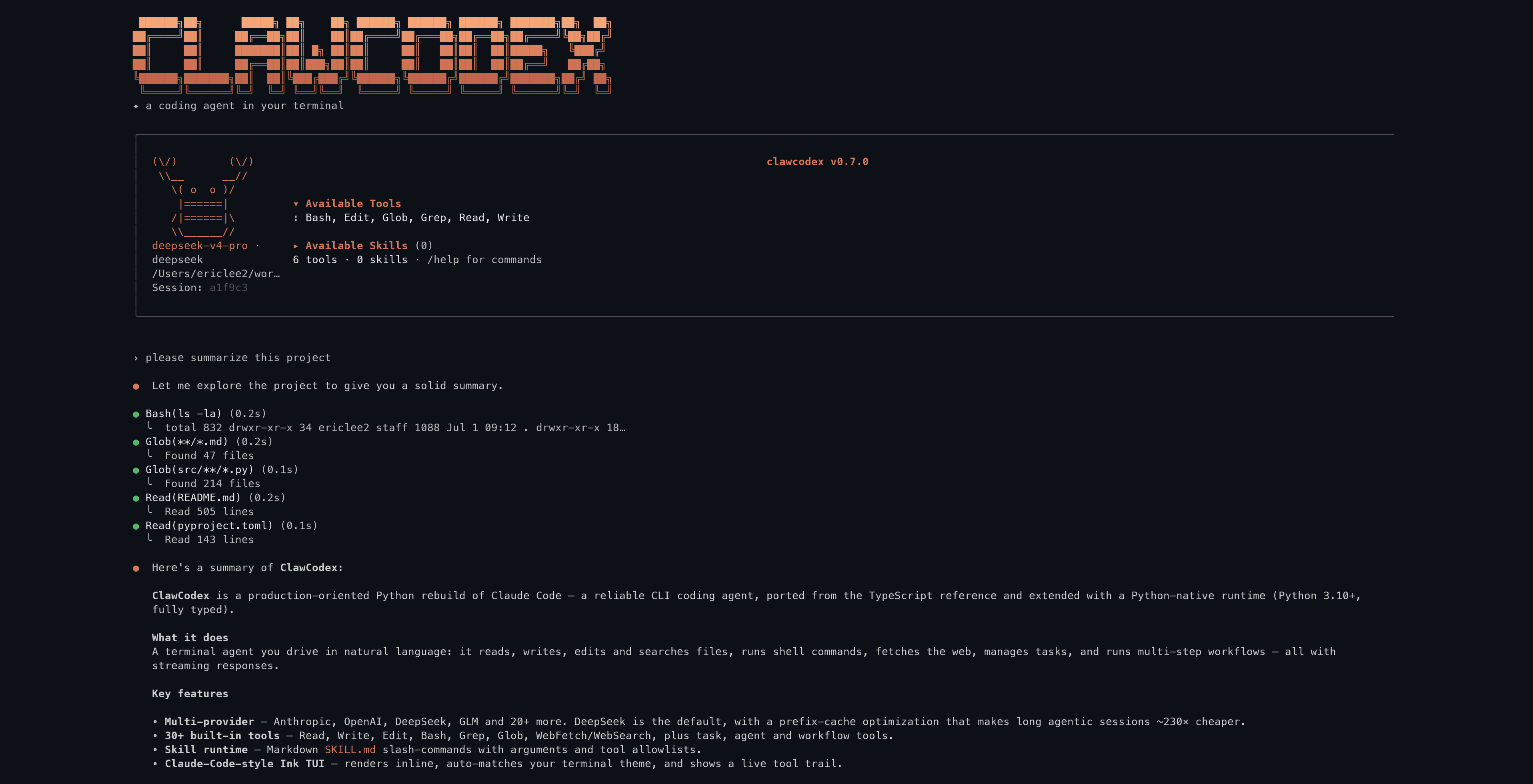
🏆 Terminal-Bench 2.1
80.9% on Claude Opus 5 — a top-tier open-source result
72 of 89 tasks solved (pass@1) on the verified 89-task suite. On the public leaderboard that slots around 3rd — behind Claude Code / Fable 5 (83.8%) and Codex / GPT-5.5 (83.1%), ahead of Claude Code on Opus 4.8 (78.9%).
ClawCodex — the open-source Python rebuild of Claude Code — run headless on claude-opus-5 at effort=xhigh.
A single run (k=1) against the board's k=5 averages; benchmarked on main at #756. Fully reproducible from the
open-source Harbor adapter. Read the full breakdown ↓
🌿✂️ /eco Token Compression
Same session, 80% fewer Bash-output tokens
Measured, not estimated: 27 real command outputs replayed through the production pipeline — 92,989 → 17,767 tokens (-80%). Failure summaries keep the error lines that matter; anything lossy is teed to disk, one tail away.
One toggle, deterministic filters — failure-focused test summaries, git/pip/npm ceremony
stripping, log dedup, recoverable head-caps — guarded to be never worse than the raw rendering.
Stacks with the DeepSeek prefix cache: the cache makes your stable
prefix nearly free, /eco shrinks the fresh suffix every turn actually pays for.
See the measured benchmark ↓
🐋🔥 DeepSeek Prefix Cache
Run long agentic coding sessions for pennies
Cache-hit input bills at ~$0.0435 / 1M tokens — about 230× cheaper than Claude Fable 5 ($10 / 1M).
ClawCodex keeps your request prefix byte-stable, so DeepSeek's prompt cache covers your whole
system + tools + history span across turns. The longer you code, the more you save.
🐜 --nano Mode
The pi-style minimal harness, built in
Full Terminal-Bench 2.1, same model, head-to-head with the pi harness (its own TB setup, vision+websearch matched): nano 64/89 (71.9%) at $1.31 vs pi 63/89 (70.8%) at $2.01 — equal-or-better score, 35% cheaper, k=1.
Six tools, a ~2K-token fixed payload (vs ~16K default), zero per-turn injections, /eco on.
clawcodex --nano -p "<task>" ports the pi harness's edit ladder (multi-edit + fuzzy match),
truncation guard, and compaction file-ledger — while non-nano behavior stays byte-identical.
docs/nano.md
⚡ Quick Install
One line — installs uv, Python 3.10+, and puts clawcodex on your PATH.
macOS / Linux / WSL / Git Bash:
curl -fsSL https://clawcodex.app/install.sh | bash
Windows (native PowerShell — no WSL needed):
irm https://clawcodex.app/install.ps1 | iex
Then configure a provider and start coding:
clawcodex login   # interactive provider + API key setup → ~/.clawcodex/config.json
clawcodex         # start it in any project — Full Access by default, /permissions to change
Both installers ship the same clawcodex lifecycle helpers — doctor (diagnose your
environment), verify (health-check the install), update, and uninstall — and are
re-run-safe. To pass flags through the pipe:
curl -fsSL https://clawcodex.app/install.sh | bash -s -- --dry-run on POSIX, or
& ([scriptblock]::Create((irm https://clawcodex.app/install.ps1))) -DryRun on Windows.
Windows prerequisite: Git for Windows — its Git Bash
is what the shell tool runs commands with.
git clone https://github.com/agentforce314/clawcodex.git
cd clawcodex
python3 -m venv .venv && source .venv/bin/activate   # Python 3.10+
pip install -r requirements.txt

python -m src.cli login   # writes config to ~/.clawcodex/config.json

python -m src.cli   # start it (Full Access by default; /permissions to change)
The configuration file is saved at ~/.clawcodex/config.json. Minimal example:
{
  "default_provider": "deepseek",
  "providers": {
    "deepseek": {
      "api_key": "xxx-xxx",
      "base_url": "https://api.deepseek.com",
      "default_model": "deepseek-v4-pro"
    }
  },
  "env": {
    "TAVILY_API_KEY": "tvly-YOUR-TAVILY-API-KEY"
  }
}
Note:
TAVILY_API_KEYis required for the WebSearch tool — get a key at tavily.com.
The session, settings, and env blocks are optional — sensible defaults apply when they're omitted. See Configure for the full structure.
📰 News
- 2026-08-15 (v1.6.0): ClawCodex Web — the whole agent in a browser tab (
ui-web/,clawcodex web) — one command serves the full agent at a stable, typeable address:http://127.0.0.1:8081. It is deliberately not a second server: the browser drives the same in-process agent, JSON-RPC gateway, and durable session store as the TUI and the Desktop app — start a session in one surface, resume it in another. The UI is a three-column shell (session tree | conversation | details) with streaming replies and collapsible reasoning, live tool cards (ANSI-colored terminal transcripts, unified diffs, line-numbered file reads), permission approvals as a composer takeover with once/session/always grants, a prompt queue for follow-ups typed mid-turn, slash-command completion, a context meter with per-category breakdown, a To-dos panel folded live from the transcript, and light/dark/system themes. Two views per session: Chat is the conversation; Trajectory is the same run as a metered ledger — every model request and tool call on a three-lane timeline with per-step tokens and timing (TTFT, throughput, cache-hit rate), model time and tool time reported separately. A Settings page covers what used to need slash commands or hand-editingconfig.json: provider API keys (add / replace / disconnect, stored whereclawcodex loginstores them), the default provider new sessions start on, the approvals default (with a Full-access confirmation that means it), response language, output style, and the end-of-turn recap toggle.GET /inlines the session token so the bare URL works after launch — and because of that,clawcodex webbinds loopback only unless you explicitly pass--allow-remote. - 2026-08-09 (later that day): ClawCodex Desktop runs and packages on Windows —
npm run dist:win:nsisinui-desktop/now produces a working unsigned NSIS installer (ClawCodex-<version>-win-x64.exe, crab icon and version info stamped via rcedit, node-pty conpty binaries staged), andclawcodex desktoplaunches the dev app natively. The packaged app boots the same%USERPROFILE%\.clawcodex\clawcodexbackend thatinstall.ps1creates — one shared install, config, and session store across CLI, TUI, and Desktop. Verified live on Windows 11: silent NSIS install → app boot → backend spawned from the shared venv → healthy loopback gateway → real DeepSeek turns on the shared keys. Also fixed along the way: the in-app updater's relaunch resolver pointed at the upstreamapps/desktop/layout (never matchingui-desktop/), its bash relaunch handoff now honestly reports manual-restart on Windows, and a hashbang broke vitest collection of the packaging tests. - 2026-08-09: Native Windows support for the CLI — ClawCodex now runs first-class on Windows 10/11 (PowerShell / cmd / Windows Terminal, no WSL required), installed with one line:
irm https://clawcodex.app/install.ps1 | iex. The newinstall.ps1mirrorsinstall.shend to end — uv install, Python provisioning, lock-pinned deps, PATH registration, TUI build, plus the samedoctor/verify/update/uninstalllifecycle. Under the hood the port is structural, not cosmetic: a shell platform layer resolves Git Bash for the Bash tool (explicitly refusing the WSLSystem32\bash.exeshim), so shell commands keep their POSIX semantics everywhere; process-tree kills go throughtaskkill /T; the mailbox/transcript/lockfile gain realmsvcrtlocking (the Windows CRT'sO_APPENDemulation can silently lose concurrent writes); the permission layer folds NTFS case-insensitivity and refuses whole-drive grants and drive-relative escapes (deny-side only); and@-mentions,CLAWCODEX.md@includes, and persistent-cdtracking all round-trip realC:\paths. The full test suite now runs onwindows-latestalongside Ubuntu in CI. - 2026-08-08 (v1.5.0): ClawCodex Desktop — the whole agent in a native app (#802–#808) — ClawCodex now ships a real desktop application (
ui-desktop/): streaming chat with a live tool trail and reasoning, permission approvals with once/session/always grants, a session sidebar that lists and resumes the same durable sessions as the TUI, side-by-side previews, settings, and the official pixel-art crab as the dock icon and in-app brand mark.clawcodex desktoplaunches it from a checkout (first run installs the UI deps;--no-devbuilds once and launches Electron directly). The architecture is the interesting part: the app spawnsclawcodex serve— one loopback port serving/api/*REST plus a JSON-RPC WebSocket gateway at/api/ws— and sessions run on the same in-process agent core the TUI uses, so both surfaces share one config, one session store, one skills set, and one permission system; the wire contract is the TUI's own gateway vocabulary, adapted server-side. The port itself is one of the largest single features ClawCodex has landed: ~310K lines of TypeScript across ~1,500 files brought over from the reference desktop implementation, rebranded end to end, with every quality gate held to the reference's own baseline (typecheck green, lint identical, unit-test failure set byte-identical) and the whole loop verified live — boot → real chat turn → streamed reply rendered in the window. macOS packaging works today (npm run dist:mac→ DMG/zip via electron-builder, hardened-runtime config in place). Ship-week fixes landed the same day: the root.gitignore's Python-orientedlib/pattern had silently kept 180 renderer source files out of the initial import — fresh clones failed at boot until #806; the default UI scale moved from the reference's dense 90% preset to Chromium's 100% actual size (#807); and a secondclawcodex desktopnow gets a friendly "already running" message instead of a vite stack trace (#808). - 2026-08-02 (v1.4.0): Fusion models — give a text-only model vision (#771, #787) — several strong reasoning models cannot see images at all:
deepseek-v4-prorejects an image content block outright (400 unknown variant \image_url``), so pasting a screenshot,@-mentioning one, or lettingReadreturn one ended the turn. A fusion model pairs that base model with a second, vision-capable one — every image is described by the vision model first, and the base model reads the description./fusion create <name> <base> <vision>saves one; it then behaves like a normal model in the/modelpicker, as--model <name>, in-p, and across restarts. Ported from claude-code-router's Fusion Model concept, with one deliberate difference: CCR is a proxy, so it can only offer vision as a tool the model may choose to call — which cannot help a pasted image, already on the wire before the model gets a turn. ClawCodex owns the agent loop, so it substitutes images in place, covering paste,@file.png,Read, and Bash image output at once. Verified end to end on Terminal-Bench 2.1'scode-from-imagetask — transcribing handwritten pseudocode from a PNG and reproducing its output — withdeepseek-v4-flash+openai:gpt-5.6-luna(#787); the base model alone returns a 400 on the same image. Also in v1.4.0: GPT-5.6 Sol/Terra/Luna (#773); four more OpenAI-compatible providers — groq, cerebras, baseten, xai — taking the registry to 30 (#784);/modebecomes/permissionswith a three-level picker and Full Access by default (#768);AskUserQuestionfinally renders a real picker instead of returning JSON to the model (#774); the OpenAI provider now picks its wire protocol from the model rather than the auth mode, which is what makesgpt-5.6-lunausable on an API key (#783); cached prompt tokens are billed at the cache rate instead of the full input rate, and OpenRouter's streamed reasoning is no longer discarded (#785, #786); and headless runs stop reporting a cut-short run as a success (#777–#782). - 2026-07-29 (v1.3.0): ClawCodex scores 80.9% on Terminal-Bench 2.1 — a top-tier open-source result on Opus 5 (#720–#725, #747–#754) — running headless on
claude-opus-5ateffort=xhigh, ClawCodex solved 72 of 89 Terminal-Bench 2.1 tasks: 80.9% pass@1 on a single run. On the public 2.1 leaderboard (k=5 averages) that would slot around third — behind Claude Code / Fable 5 (83.8%) and Codex / GPT-5.5 (83.1%), statistically level with the 79–80% cluster, and ahead of Claude Code on Opus 4.8 (78.9%) and Sonnet 5 (74.6%). Getting there was open, unglamorous parity work: a Harbor eval adapter (eval/harbor/) for three-way ClawCodex-vs-openclaude-vs-Claude-Code runs (#720, #724, #725), then a run of prompt- and reliability-parity fixes — restored task-tool skip conditions and parallel-tool guidance, deferred nonessential initial tools, and recovery of trials lost to empty turns and transport drops (#747–#754). Also in v1.3.0:claude-opus-5support with an interactive/effortfix (#746), bounded persistent memory with a background self-improvement review (#731), a VS Code extension driving the agent-server over stdio (#727), image-paste input with an[Image #N]un-attach chip (#761, #762), theCLAUDE.md → CLAWCODEX.mdcontext-file rebrand (#732), and transport-retry hardening (#757, #760). Stated plainly: this is a single k=1 pass (binomial 1σ ±4.2pp) against the board's k=5 ± ~1.2pp averages, benchmarked onmainat #756 (before the v1.3.0 tag), so read it as directional rather than a ranked submission. - 2026-07-13:
/ecotoken compression — -80% Bash-output tokens, measured, now a headline (#708, #712) — a new session toggle compresses the model-bound rendering of every Bash result with deterministic filters ported from RTK's method set: failure-focused test summaries (kept error lines are never rewritten),git/pip/npmceremony stripping, log dedup with[×N]counts, and a recoverable head-cap — all behind a never-worse guard, with every lossy compression teeing the full output to disk behind a runnable recovery hint (#708). A reproducible benchmark (eval/eco/) replays 27 real command outputs through the exact production pipeline and counts real tokenizer tokens: 92,989 → 17,767 (-80%) corpus-wide, -88% on filter hits, plus an honestly conservative recompute of RTK's own 30-minute-session model (-19% under their averaged assumptions — real sessions are fat-tailed) (#712). Full tables: the/ecosection andeval/eco/results/. - 2026-07-12 (v1.1.0): ClawCodex v1.1.0 — run OpenAI and Claude models on your subscription, not metered API billing — the headline of 1.1.0 is subscription auth for the two biggest model families, so you can point ClawCodex at a plan you already pay for. Sign in with ChatGPT (#698):
clawcodex login → openai → subscription(browser, device-code, or import from an existing Codex CLI login) routes requests through the ChatGPT Codex backend's Responses API —gpt-5.5,gpt-5.4,gpt-5.4-mini, andgpt-5.3-codex-sparkon your Plus/Pro allowance, with encrypted-reasoning replay across turns and $0 metered cost. Claude Pro/Max (#697):clawcodex login → anthropic → subscriptionconnects a Claude subscription via OAuth (PKCE) with automatic token refresh and the same $0 accounting; follow-ups repaired the login after Anthropic moved its OAuth endpoints toplatform.claude.com(#702) and stopped sending adaptive thinking to models that don't support it (#699). A configured API key always wins, and subscription usage reportsbilling_mode: subscription. More models: a Meta (api.meta.ai) provider with the 1M-contextmuse-spark-1.1reasoning model (#692) and refreshed MiniMax parameters (#696). Workflow & TUI:/planmode with implicit plan-mode entry/exit (#676),--worktree/-wsession isolation for parallel runs in separate git worktrees (#672), the/memorypicker +$EDITORspawn (#693), config/state directories rebranded.claude → .clawcodexwith a one-time migration (#678),/logostartup color schemes (#677), plus TUI polish — Tab accepts the suggested placeholder (#690), past inputs get the Claude-Code highlight band (#691), clickable agent URLs (#694), and a per-terminal link-open affordance (#701). Quality: semantic tool-input coercion with parity validation errors (#700) and looser, Claude-Code-faithful permission granting (#673). - 2026-07-07:
/loopscheduled tasks now actually fire — full port of Claude Code's session-scoped scheduler (#680) — the bundled/loopskill finally has a real engine behind it: a newsrc/scheduled_tasksmodule parses standard 5-field cron expressions and fires due prompts between turns from the agent-server's idle poll.CronCreate/CronList/CronDeleteregister real firing jobs (8-char IDs, 50-job cap, deterministic jitter, 7-day recurring expiry with one final fire), and the newScheduleWakeuptool drives self-paced/loopmode — the model picks each next delay (1 min–1 hr),stop: trueends the loop, and a ~20-minute fallback wakeup catches iterations that forget to reschedule. Typed skill slash commands now reach the backend (newskill_commandcontrol), so/loop 5m check ciworks from the composer with completion + argument hint; the TUI shows a live countdown indicator (⟳ loop wakeup in 2m 14s · ⏰ 1 scheduled) and Esc while idle stops a waiting loop./cleardrops session tasks,--resumerestores unexpired ones,CLAWCODEX_DISABLE_CRON=1disables the scheduler. 117 new tests; verified live over stdio NDJSON and a real PTY TUI drive (typed dispatch → CronCreate → a real wakeup fire between turns → Esc-stop). - 2026-07-07: Bounded the ESC-cancel chunk queue in OpenAI-compatible streaming (#278) —
OpenAICompatibleProvider.chat_stream_response's worker-thread queue (added in #148) was an unboundedqueue.Queue. A non-graceful disconnect from a proxy that keeps sending bytes after ESC (and never closes the SDK iterator) let the orphaned worker thread accumulate chunks in memory indefinitely. The queue is now capped at 64 chunks, soput()blocks the worker once full instead of growing without bound. - 2026-07-06 (v1.0.0): ClawCodex v1.0.0 — the 1.0 release: goal-directed autonomy, hooks & MCP wired for production, and a hardened permission system — 86 commits since v0.7.0 (#580–#668) finish wiring the big subsystems end-to-end and graduate ClawCodex to 1.0. Goal-directed autonomy: the
/goal+/subgoalcompletion-condition loop keeps the agent working until an LLM judge confirms the goal is actually met (#664), the new Monitor tool streams long-running shell output with backpressure (#665), background-bash completion notifications (#663), coordinator mode wired end-to-end on the live paths (#634), and/advisortoken-efficient worker/reviewer pairing restored on the Ink TUI (#668). Hooks live in production: configured hooks now actually fire — bootstrap Hooks abstraction (#583), UserPromptSubmit (#597), multi-scope + lifecycle hooks (#595),ifpre-filters (#643), PreToolUsepermissionDecision(#655), PermissionRequest hooks at the ask seam (#637), MCP elicitation hooks (#659), and teammate TaskCompleted / TeammateIdle stop hooks (#642). MCP completion: OAuth server auth via the/mcpflow (#662), livetools/list_changedrefresh (#598, #604), server instructions injected into the system prompt (#654), andclawcodex mcp servere-exposes ClawCodex tools as an MCP stdio server (#635). Permission hardening: readable approval boxes with broadenable, persistent session grants (#608–#611), compound-command permission parity (#622), Bash normalization hardening (#626),disableBypassPermissionsModelockdown (#660), an honest refuse-to-start unsandboxed guard (#658), subprocess secret-scrubbing (#650), and a flag-gated LLM security-classifier lane for auto mode (#589). TUI maturity: faithful Claude Code look & feel — diff rendering, tool-call transcript, task list, composer + permission-mode badge, busy line (#612–#616) — plus a minimal vim editing engine (#667), Esc-interrupt with a defanged Ctrl+C (#625), fully editable multi-line input (#621), slash-command argument hints (#631), a persistent session-stats line (#657), and restored/cost,/skills, and/model(#627, #629, #630). Reliability: the production compaction pipeline is wired and auto-compact actually applies its result (#587, #607), full retry lane + model fallback + message-history caching (#586), parallel Agent fan-out with the concurrency-cap deadlock fixed (#590), killing a background agent really stops the run (#606), and output styles work end-to-end (#640). Codebase stats: 1,170 Python files, 256,909 lines (up from 233,520 lines on 2026-06-11). - 2026-06-30 (v0.7.0): ClawCodex v0.7.0 — TUI auto-theming, faithful inline rendering & a Claude-Code-style tool trail — the Ink TUI now detects your terminal's background color (OSC 11) on startup and selects the light/dark theme to match, so text stays readable on any terminal with no env var needed (#577). Inline mode renders truly inline like Claude Code: no screen wipe on launch, and no overlap with prior terminal output on startup or with the returning shell prompt on exit (#573, #575). The tool trail reads Claude-style — workspace-relative paths (
Read(src/foo.ts)),Grep(pattern)labels, and aRead N linesresult collapse (#574) — and the banner gains a 🦞 mascot with brighter secondary text on dark themes (#576). - 2026-06-23: One-click installer —
curl -fsSL https://clawcodex.app/install.sh | bashinstalls uv (no sudo), provisions Python 3.10+, clones to~/.clawcodex, creates a lock-pinned venv, and registersclawcodexon PATH; ships status / doctor / verify / update / uninstall subcommands, is safe to re-run, and works on macOS / Linux / WSL. 📚 Older items have moved to the full News archive.
🎯 Why ClawCodex?
ClawCodex is a production-oriented Python rebuild of Claude Code, ported from the real TypeScript architecture and shipped as a working CLI agent, not just a source dump.
- Real Agent Runtime — tool-calling loop, streaming REPL, session history, and multi-turn execution
- High-Fidelity Port — keeps the original Claude Code architecture while adapting it to idiomatic Python
- Built to Hack On — readable Python codebase, rich tests, and markdown-driven skill extensibility
- Multi-LLM providers — the biggest step forward vs. upstream: Claude Code is built around Claude-series models only; ClawCodex is dedicated to wiring in all major LLM providers so you can choose the most flexible and cost-effective stack for agentic coding
A real Claude Code-style terminal workflow in Python: stream replies, call tools, fetch context, and extend behavior with skills.
🚀 Try it now! Fork it, modify it, make it yours! Pull requests welcome!
🏆 SWE-bench Verified — clawcodex outperforms openclaude on the same model
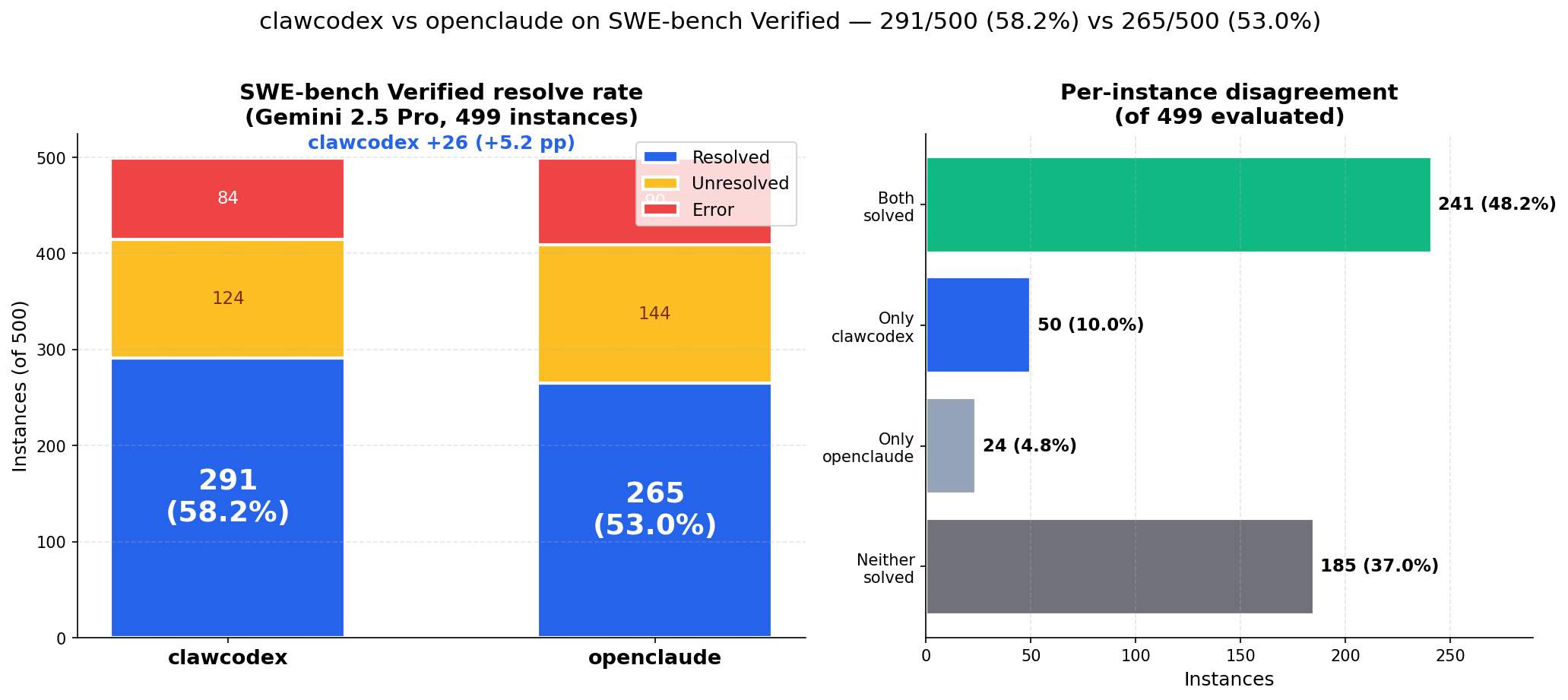
On the full SWE-bench Verified split (499 instances, the public agent-coding leaderboard), both agents driven by Gemini 2.5 Pro under our standardized harness:
| Agent | Resolved | Unresolved | Error |
|---|---|---|---|
| clawcodex | 291 / 499 (58.2%) | 124 | 84 |
| openclaude | 265 / 499 (53.0%) | 144 | 90 |
- ✅ Both solved: 241 🟢 Only clawcodex: 50 🔵 Only openclaude: 24 ❌ Neither: 184
Reproduce locally — see eval/README.md for the full workflow (cumulative batching, --predict-workers N, --capture-traces).
🌿 /eco Token Compression — -80% Bash-output tokens, measured
Long agentic sessions drown in tool output: failing test logs, git progress spam,
2,000-line listings. Toggle /eco on and ClawCodex compresses the model-bound
rendering of every Bash result with deterministic filters ported from
RTK's method set — failure-focused test summaries,
command-scoped ceremony stripping, log deduplication with [×N] counts, and a
recoverable head-cap — while the full raw output stays on disk behind a runnable
recovery hint. No model in the loop, no command rewriting, nothing to learn.
$ pytest        # 128 lines → 37 lines, 1,347 → 390 tokens (-71%)
Pytest: 5 failed, 29 passed in 0.04s

1. [FAIL] test_unknown_sku_message
   with pytest.raises(OrderError, match="unknown sku 'gold-bar'"):
   >           o.total()
   tests/test_orders.py:34:
   ⋮
5. [FAIL] test_truncate_one
   >       assert truncate_words("alpha beta", 1) == "alpha..."
   E       AssertionError: assert 'alpha beta...' == 'alpha...'
[full output: ~/.clawcodex/<ws>/<session>/eco/1707_pytest.log]
Command failed with exit code 1
Measured, not estimated. RTK's README models a 30-minute session and estimates
-80%. We ran the experiment instead: a 27-operation corpus of real command
outputs — failing pytest/go test/jest runs, pip/npm installs, git
workflows, repo-scale listings, a 34,000-line system log, captured live (RTK's own
"never synthetic" fixture rule) — replayed through the exact production pipeline,
counting tiktoken cl100k_base tokens of the model-bound text with /eco off vs on:
| Operation | Filter | Raw tokens | /eco tokens |
Saved |
|---|---|---|---|---|
pytest (failing run) |
failure focus | 1,347 | 390 | -71% |
pytest -v (failing run) |
failure focus | 1,925 | 392 | -79% |
pytest -v (green run) |
one-line collapse | 359 | 60 | -83% |
go test -v ./... (failing run) |
failure focus | 527 | 227 | -56% |
npx jest (failing run) |
failure focus | 444 | 175 | -60% |
npm install jest |
ceremony strip | 188 | 8 | -95% |
pip install flask |
ceremony strip | 514 | 85 | -83% |
git clone --progress |
ceremony strip | 6,868 | 18 | -99% |
git push --progress |
ceremony strip | 6,458 | 75 | -98% |
git status (dirty tree) |
advice strip | 143 | 91 | -36% |
git log -n 300 |
recoverable head-cap | 7,714 | 946 | -87% |
git diff v1.0.0..v1.1.0 -- src |
recoverable head-cap | 7,561 | 748 | -90% |
ls -R src |
recoverable head-cap | 9,088 | 225 | -97% |
cat (900-line file) |
recoverable head-cap | 6,833 | 552 | -91% |
grep -rn 'def ' src/ |
recoverable head-cap | 7,582 | 1,219 | -83% |
log show --last 90s (34k lines) |
log dedup | 10,512 | 1,977 | -81% |
| Whole corpus (27 operations) | 92,989 | 17,767 | -80% |
The corpus also includes 8 operations that (correctly) pass through byte-identical
— a clean git status, docker ps, ruff check findings, a small failing go test,
a 370-line grep that sits under the head-cap threshold — because /eco guarantees
never worse: a compression that doesn't beat the raw rendering is discarded.
Full tables: eval/eco/results/results.md.
RTK rewrites commands into its own CLI (rtk ls, rtk read, rtk grep), so every
operation in its session model compresses. /eco deliberately compresses results
only — the command the model wrote is the command that runs — and small outputs pass
through untouched. Recomputing RTK's session table with our measured ratios (0%
where our corpus shows passthrough at RTK's assumed sizes):
| Operation | Freq | Standard | rtk (estimated) | clawcodex /eco (measured) |
|---|---|---|---|---|
ls / tree |
10x | 2,000 | 400 | 2,000 (0%) |
cat / read |
20x | 40,000 | 12,000 | 40,000 (0%) |
grep / rg |
8x | 16,000 | 3,200 | 16,000 (0%) |
git status |
10x | 3,000 | 600 | 1,908 (-36%) |
git diff |
5x | 10,000 | 2,500 | 10,000 (0%) |
git log |
5x | 2,500 | 500 | 2,500 (0%) |
git add/commit/push |
8x | 1,600 | 120 | 1,007 (-37%) |
cargo test / npm test |
5x | 25,000 | 2,500 | 9,850 (-60%) |
ruff check |
3x | 3,000 | 600 | 3,000 (0%) |
pytest |
4x | 8,000 | 800 | 2,320 (-71%) |
go test |
3x | 6,000 | 600 | 6,000 (0%) |
docker ps |
3x | 900 | 180 | 900 (0%) |
| Total | ~118,000 | ~23,900 (-80%) | ~95,500 (-19%) |
Under RTK's averaged assumptions (every cat ≈ 2,000 tokens, every ls ≈ 200) the
honest number for a results-only compressor is -19% — those mid-size outputs are
exactly what ClawCodex already handles with Read-tool line caps and 30k-char Bash
truncation. But real sessions aren't averages: they're fat-tailed, and one 2,000-line
git log, one failing suite, or one npm install blows more context than fifty small
commands. /eco targets precisely that tail — which is why the measured number on
real outputs is -80%, the same figure RTK estimates, with none of the risk of
rewriting commands.
The RTK safety rules, kept (see src/eco/):
- Never worse — every compressed rendering is token-checked against the exact baseline it replaces; the baseline wins ties. Worst case is 0% saved, never negative.
- Failures survive — error/failure lines are never rewritten, only ceremony drops; a green summary with a non-zero exit code is treated as untrusted and passed through.
- Everything recoverable — lossy compressions tee the full output to the session
dir and append a runnable hint (
[see remaining: tail -n +61 …]); no tee, no compression. - Semantics untouched — exit codes,
is_error, images, background tasks, and interrupted runs are never altered; any filter exception falls back to passthrough.
/eco status shows per-filter savings for the session. Compression stacks with the
DeepSeek prefix cache: the cache makes the stable prefix
nearly free, /eco shrinks the fresh suffix every turn actually pays for. Reproduce:
python3 eval/eco/capture_corpus.py --workdir /tmp/eco-bench   # capture real outputs
.venv/bin/python eval/eco/measure.py                          # replay + count tokens
⭐ Star History
View star history on star-history.com
✨ Features
Streaming Agent Experience
>>> /stream on
>>> Explain tests/test_agent_loop.py
[streaming answer...]
• Read (tests/test_agent_loop.py) running...
  ↳ lines 1-180
>>> /render-last
- True API streaming for direct replies plus richer streaming during tool-driven agent loops
- Built-in
/streamtoggle for live output and/render-lastfor clean Markdown re-rendering on demand - Designed for real terminal demos: streaming text, visible tool activity, and stable fallback behavior
Programmable Skill Runtime
---
description: Explain code with diagrams and analogies
allowed-tools:
  - Read
  - Grep
  - Glob
arguments: [path]
---

Explain the code in $path. Start with an analogy, then draw a diagram.
- Markdown-based
SKILL.mdslash commands - Supports project skills, user skills, named arguments, and tool limits
Multi-Provider Support
ClawCodex’s main advantage is multi-provider support: while Claude Code targets Claude models, we aim to support every major LLM provider behind the same agent runtime—so you can swap vendors, regions, and price tiers without giving up tools, skills, or the coding loop. That flexibility is what makes agentic coding practical at scale.
providers = [
    # Native / bespoke wire formats
    "anthropic", "minimax", "deepseek", "zai", "openrouter", "openai", "gemini",
    # OpenAI-compatible vendors
    "nvidia-nim", "atlascloud", "wanjie-ark", "volcengine", "xiaomi-mimo",
    "novita", "fireworks", "siliconflow", "siliconflow-cn", "arcee", "moonshot",
    "huggingface", "together", "stepfun", "deepinfra", "meta",
    "groq", "cerebras", "baseten", "xai",
    # Local servers (no API key required)
    "ollama", "vllm", "sglang",
]  # 30 providers; aliases like `nim`, `kimi`, `hf`, `grok` resolve automatically
Any new OpenAI-compatible vendor is a one-row addition to
src/providers/openai_compatible_specs.py (base URL + default model + API-key
env vars). API keys resolve from config or the provider's standard env var
(e.g. TOGETHER_API_KEY, MOONSHOT_API_KEY), so most providers work without
editing config.json.
Interactive UI (TypeScript Ink TUI)
The interactive UI is the TypeScript Ink TUI — a terminal client that spawns and owns a Python agent-server child and talks to it over a pipe (NDJSON). Running clawcodex with no mode flags launches it; clawcodex tui is the explicit form. (The former in-process Rich REPL and Textual TUI were removed in favor of this single, higher-fidelity client.)
> Hello!
Assistant: Hi! I'm ClawCodex, a Python reimplementation...

> /help                       # Show commands
> /theme dark                 # Switch color theme
> @src/cli.py                 # @-mention a file (fuzzy file index)
> /explain-code qsort.py      # Run a SKILL.md skill (or /skill …)

# Needs Node 18+ and a built ui-tui/dist (the installer builds it); `clawcodex -p` is the no-Node headless path.
Web UI (browser)
clawcodex web serves the same agent in a browser tab — same backend, same gateway, and the same durable sessions as the TUI and Desktop app, with a chat view, a per-request Trajectory view, live tool cards, permission approvals, and a settings page (provider keys, default provider, approvals, language, output style, recap).
clawcodex web                 # serve + open http://127.0.0.1:8081
clawcodex web --port 9000     # explicit port (taken → clean refusal, not a neighbor)
clawcodex web --no-open       # print the URL without launching a browser
clawcodex web --build         # rebuild ui-web/dist first (needs Node 18+)
The default port is stable (8081, scanning upward if taken), and GET / inlines the session token — so once the server is up, typing 127.0.0.1:8081 into the address bar is enough. The page hands out that token, so the server binds loopback only; --allow-remote exists for deployments that put their own auth in front. First run from a source checkout needs the bundle built once: clawcodex web --build (the installer builds the TUI, not the web bundle).
Complete CLI
clawcodex                       # Interactive Ink TUI (default)
clawcodex tui                   # Interactive Ink TUI (explicit)
clawcodex web                   # Web UI at http://127.0.0.1:8081 (see Web UI section)
clawcodex login                 # Configure API keys (interactive)
clawcodex logout anthropic      # Remove Claude Pro/Max OAuth credentials
clawcodex logout openai         # Remove ChatGPT subscription OAuth credentials
clawcodex config                # Show ~/.clawcodex/config.json-backed settings
clawcodex --version             # Version string

# Non-interactive / scripting (pipes, CI, agents)
clawcodex -p "Summarize src/cli.py"
clawcodex -p "Hello" --output-format json
clawcodex -p --output-format stream-json --input-format stream-json < events.ndjson

# Overrides for a single run
clawcodex --provider anthropic --model claude-sonnet-4-6 -p "Hi"
clawcodex --max-turns 10 --allowed-tools Read,Grep -p "Find TODOs"

# Permission control (TUI and -p both honor these)
clawcodex --permission-mode plan                       # plan / default / acceptEdits / dontAsk
clawcodex --dangerously-skip-permissions -p "ls"       # bypass all permission checks
clawcodex --allow-dangerously-skip-permissions         # Full Access selectable, but don't start in it
Permissions
An interactive clawcodex starts in Full Access — it can edit any file and
run any command without asking. Use /permissions at any time to pick a level:
| Level | What it allows |
|---|---|
| Ask for approval | Read files and run read-only commands freely. Editing files, running other commands, or touching anything outside the workspace asks first. |
| Approve for me | Auto-accept file edits in the workspace and a small set of safe shell commands. Everything else still asks. |
| Full Access (default) | Edit any file and run any command without asking, except where you configured a deny or ask rule. |
The level you pick is saved to permissions.defaultMode in
~/.clawcodex/settings.json and applies to later sessions, so dialing
permissions down sticks. --permission-mode and
--dangerously-skip-permissions override it for a single run without changing
it.
clawcodex -p (headless) is not loose by default — it stays in default
unless you say otherwise, and a saved Full Access does not change that:
persistence dials headless down, never up. Say otherwise explicitly with
--dangerously-skip-permissions or
Comments (0)
Sign in to join the discussion.
No comments yet
Be the first to share your take.