
ckw-design
ckw-design is Conner K. Ward's frontend design skill for Claude Code — direction, design system, and visual philosophy distilled into a loadable skill: how to set tone/domain/color-world, build tokens and typography, and hold a high review bar.
What this is: A personal design skill — direction and taste, packaged. (For the deterministic measurement/judgment layer, see deterministic-design.)
Install (Claude Code plugin)
/plugin marketplace add connerkward/ckw-design-skill
/plugin install ckw-design@ckw-design
Or install the whole set: /plugin marketplace add connerkward/connerkward-skills. Or drop this repo's SKILL.md into your agent's skills directory.
License
MIT © Conner K Ward
Claude Design Skills
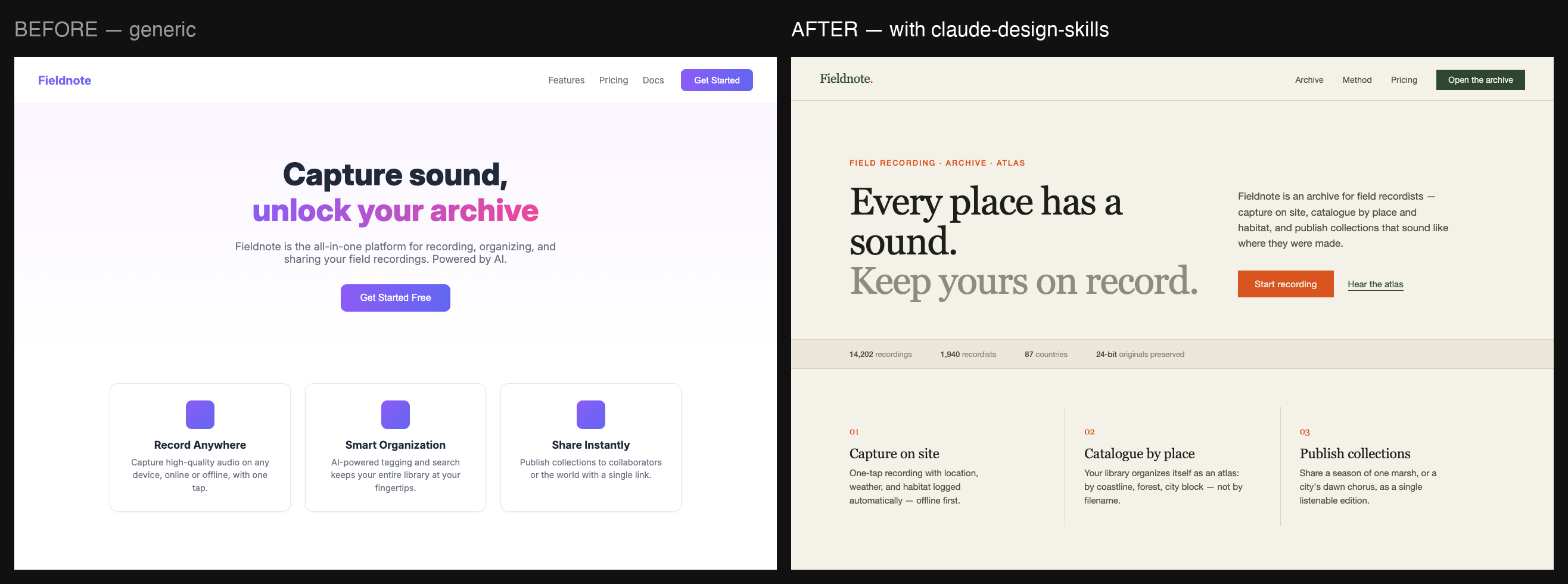
Claude Code skills for frontend design — five composable agent skills that push Claude toward distinctive, production-grade UI design and away from generic AI aesthetics (Inter, purple gradients, three equal cards, centered single-column mush).
They cover design direction, design systems (tokens, typography, color), spatial composition and layout, loading/FOUT discipline, motion timing, and high-concept art direction — for any web UI work: components, pages, dashboards, landing pages, React/Vue/plain HTML-CSS.
What's inside
| Skill | File | When it loads |
|---|---|---|
| design (entry) | design/SKILL.md |
Any time Claude builds or touches the look of a web UI — styling, spacing, layout, typography, color, polish, "make this look better" — even without the word "design". Routes to the four sub-skills. |
| design-thinking | design/design-thinking/SKILL.md |
Every design task, before coding. Defines purpose, tone, domain vocabulary, color world, a review bar, and a cross-domain lens (cinema, architecture, marketing, UX, automotive, industrial design). |
| design-system | design/design-system/SKILL.md |
When implementing: token architecture, typography hierarchy, resource loading order, FOUT prevention (no font pop-in, ever), graceful loading states, layout-stable chrome, motion timing, color semantics. |
| design-spatial | design/design-spatial/SKILL.md |
When composing layout, or when generated UI looks off — collisions, weak hierarchy, "looks like every startup site". Render-then-critique loop with a separate judge; deliberate deviation from the statistical mean. |
| design-philosophy | design/design-philosophy/SKILL.md |
High-concept work, campaigns, visual manifestos, unmistakable art-like aesthetics. Includes a reference of condensed philosophy examples. |
Install
Claude Code discovers skills in ~/.claude/skills/ (user-wide) or <project>/.claude/skills/ (per-project). Copy the design/ directory there:
# user-wide (all projects)
git clone https://github.com/connerkward/claude-design-skills.git
mkdir -p ~/.claude/skills
cp -R claude-design-skills/design ~/.claude/skills/design
# or per-project
mkdir -p .claude/skills
cp -R claude-design-skills/design .claude/skills/design
That's it — no build step, no dependencies. The skills are plain Markdown prompt content. Restart Claude Code (or start a new session) and they're available.
How skills trigger
Each SKILL.md has YAML frontmatter with a name and a description. Claude Code injects all skill descriptions into the model's context; when a task matches a description, Claude loads that skill's full body on demand. The descriptions here are written to be "pushy" — they fire on styling, spacing, fonts, color, responsiveness, and "make it look nicer", not just the literal word "design".
The entry skill (design) is the router: it loads first and tells Claude which sub-skills to pull in for the task at hand (direction → design-thinking, implementation → design-system, layout → design-spatial, art direction → design-philosophy). Sub-skill bodies are only read when relevant, keeping context cost low.
Philosophy
A language model's first design idea is the average of its training data — and there is more than one average: the generic-AI mean (Inter, purple-on-white, three equal cards) and the flashier designer-trend mean (oversized condensed caps, dark mode + grain, monospace "vibes" microtext). Neither is taste. These skills insist on two disciplines instead of prescribing a style: look at the rendered output with fresh eyes (a model can't see the collisions in its own token stream — screenshot it and have a separate judge critique the image), and deviate from the first instinct toward the product's specific world — its domain vocabulary, its color world, one signature element that could only exist for this product. Process over prescription; intentionality over intensity.
License
MIT — see LICENSE.
🧭 ckw-skills — part of Conner K. Ward's collection of Claude Code skills & MCP servers.
No comments yet
Be the first to share your take.