
centralmcp — HPE Networking MCP toolkit




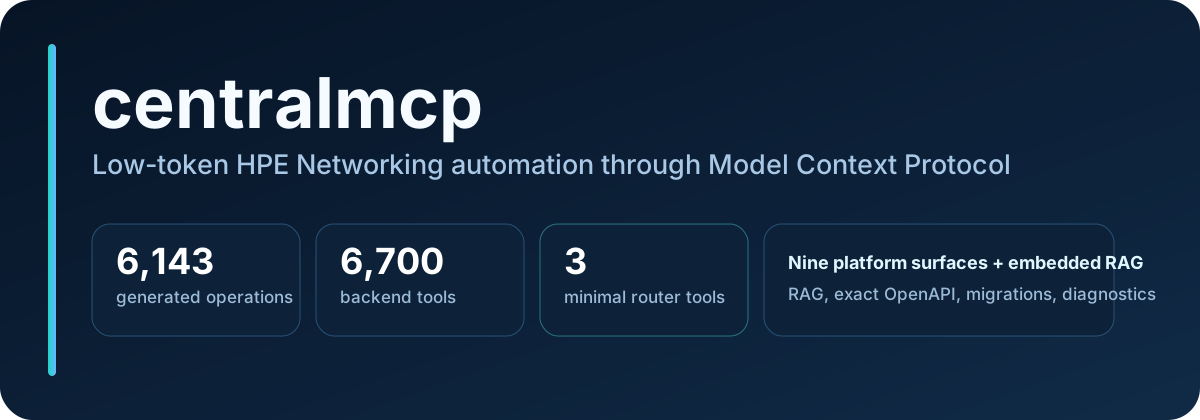
The banner tracks the current backend catalog: a large tool surface stays available on demand, while the MCP client itself only ever sees three router tools by default.
Low-token Model Context Protocol (MCP) server for HPE Networking automation: Aruba Central, HPE GreenLake Platform (GLP), ClearPass, Juniper Mist, Apstra, ArubaOS 8 migration automation, EdgeConnect, HPE Aruba UXI, and Axis Atmos Cloud.
centralmcp gives MCP-capable AI clients a low-token way to search Aruba/HPE
docs, look up exact OpenAPI details, inspect Central health, run
troubleshooting workflows, manage configuration, execute guarded ArubaOS 8
migrations, and use guarded GreenLake Platform operations. It is built around
direct REST calls with httpx.
For the full visual walkthrough of this same information — audience picker,
diagrams, and write-safety flow — see the
centralmcp GitHub Pages site.
This README stays intentionally short; canonical guides live under docs/.
Who it's for
| You are... | Start with |
|---|---|
| A first-time MCP user | The five-minute credential-free quickstart below, then Getting started |
| An Aruba network operator | Example prompts and typed product workflows |
| A centralmcp developer | Architecture overview and Contributing guide |
Five-minute credential-free quickstart
Verify the install, build the router catalog, and start the MCP HTTP server before adding any Aruba Central or GreenLake Platform credentials:
git clone https://github.com/secure-ssid/centralmcp.git
cd centralmcp
python3 scripts/setup_wizard.py --yes --skip-credentials
uv run python scripts/doctor.py
MCP_PORT=8010 bash scripts/run_http_router.sh
Expected outcomes:
- The wizard prints each completed phase and ends with a setup-complete summary; no Central/GLP calls are made.
doctor.pyreports local dependency, config-path, and index checks — everything readsOKor lists what to fix, without calling any vendor API.- The HTTP router prints a
Uvicorn running on http://127.0.0.1:8010line and keeps running in the foreground.
The same six steps this diagram shows — clone, run the wizard, check the doctor, connect, discover, and call safely — are exactly what the commands above walk through.
Connect any MCP-capable client to http://127.0.0.1:8010/mcp, then try a
credential-free discovery call:
find_tool("ask Aruba docs with citations")
invoke_read_tool("ask_docs", {"question": "WPA3 SAE transition mode", "top_k": 5})
Expected outcome: a short, cited answer from the embedded docs index — this call only reaches the local RAG index, never Central or GLP.
Write safety at a glance
find_toolonly searches the local tool catalog; it never calls a vendor API.invoke_read_toolblocks any backend tool that is not annotated read-only.invoke_toolis deliberately marked destructive because it can also dispatch write/destructive backend tools — use it only when a write is intended.- Use
dry_run=Truefirst when supported; real execution then requires eitherconfirm=Trueor MCP elicitation, depending on the tool schema. - Optional product writes stay blocked by default (
CENTRALMCP_PRODUCT_ACCESS=read-only); a global or per-platform override is required for lab read-write access. - Credentials stay in
config/credentials.yamlor environment variables and are never committed.
See Tool router for the complete discovery/dispatch/write-safety model.
Project snapshot
| Area | Current snapshot |
|---|---|
| Tool catalog | Non-additive profiles: 363 core tools / 2824 read-only optional starters / 5804 read-write optional starters; complete backend index: 6,703 |
| RAG | 51,737 prose chunks; 244 specs, 3,796 endpoints, 11,293 schemas, 60,568 fields, 102 advisories, 346 lifecycle records |
| Optional platforms | ClearPass, Mist, Apstra, AOS8, EdgeConnect, UXI, Axis Atmos Cloud |
| Safety | Per-platform write gates, dry-run + confirmation, HTTP host/origin and bearer controls, credential-gated live-test config |
Full per-backend counts live in Tool catalog. See the 0.7.0 release notes for everything added in the current release, and the capability gap matrix for reproducible tool/benchmark comparisons.
Why the router matters
Point your MCP client at one server: mcp_servers/tool_router.py. The
recommended minimal profile keeps the client-visible tool list at three
entries while still reaching the full backend catalog:
find_tool— discover the right backend tool.invoke_read_tool— dispatch read-only calls.invoke_tool— dispatch intentional write/destructive calls only.
Task-oriented guides
| Need | Guide |
|---|---|
| Full setup, credentials, and MCP client connection | Getting started |
| Copy/paste stdio or streamable HTTP client config | MCP client recipes |
| Router modes, toolsets, and safe dispatch in depth | Tool router |
| Real prompts with expected call shapes | Example prompts |
| Enable ClearPass, Mist, Apstra, AOS8, EdgeConnect, UXI, or Axis | Optional product starters |
| Typed product-specific workflow roadmap | Product workflows |
| Fix setup, credential, HTTP, or catalog issues | Troubleshooting |
| Architecture, data flow, and safety diagrams | System overview |
| Every backend's tool counts and coverage | Tool catalog |
| The complete task-based visual gateway | centralmcp GitHub Pages |
| Every documentation page, grouped by purpose | docs/README.md |
| Contribute, get support, or report a security issue | CONTRIBUTING.md, SUPPORT.md, SECURITY.md |
Local setup essentials
The default MCP client profile stays lean:
CENTRALMCP_ROUTER_MODE=minimal
CENTRALMCP_TOOLSETS=central,glp,rag
Enable optional products only when needed:
CENTRALMCP_PRODUCTS=clearpass,mist,apstra,aos8,edgeconnect,uxi,axis,design
CENTRALMCP_PRODUCT_ACCESS=read-only
.claude/launch.json ships a matching minimal aruba-tool-router launch
profile for daily use. find_tool omits full JSON schemas by default; request
include_schema=true only when a client needs the full parameter shape.
Build or refresh the router tool index, and download the prebuilt RAG/OpenAPI indexes instead of scraping locally:
uv run python scripts/ingest_tools.py --products all
uv run python scripts/download_indexes.py
See Getting started for credentials, region selection, optional-product env vars, and the full ingestion/refresh path.
Streamable HTTP mode
MCP_PORT=8010 bash scripts/run_http_router.sh
Then point any MCP-capable client at http://127.0.0.1:8010/mcp. The server
also exposes /livez, /readyz, and /healthz. Non-loopback binds require
explicit MCP_ALLOWED_HOSTS/MCP_ALLOWED_ORIGINS and can be protected with
MCP_HTTP_BEARER_TOKEN. See MCP client recipes
for copy/paste stdio and HTTP configs.
Project layout
mcp_servers/     Low-token router + Central/GLP/RAG/optional-product servers
pipeline/        httpx clients, 8-stage migration pipeline, SSID helpers
ingestion/       Docs/API scraping and LanceDB + SQLite index builders
docs/            Setup, router, architecture, product, and release guides
scripts/         Setup wizard, local doctor, HTTP router helper, release validation
tests/           Unit, integration, and RAG eval coverage
config/          Credentials template; real credentials stay git-ignored
run_pipeline.py  Migration pipeline CLI
run_ssid.py      SSID helper CLI
The full repository map, including generated/git-ignored paths, lives in System overview.
Validation
uv run pytest tests/unit -q
uv run python scripts/validate_release.py --catalog-products all --strict-rag --strict-tool-index --min-tools 6703
The release helper runs unit tests, optional RAG/API eval when indexes exist, tool catalog floor checks, and local tool-index freshness checks. Unit tests also include static guards for the active MCP/pipeline code, committed low-token MCP config examples, local-only config files, router product/toolset docs, bounded generic read-only GET tools, MCP list default bounds, RAG/search top_k bounds, public tool-count claims, tool-count docstrings, tracked Markdown local links and images, Pages sitemap and robots metadata, documented router example arguments, product workflow tool-name tables, and wizard optional-product env tables.
Related projects and thanks
centralmcp is an independent HPE Networking MCP toolkit, improved by watching the official MCP ecosystem and community work:
- HewlettPackard/gl-mcp - official GreenLake Platform MCP server
- modelcontextprotocol/python-sdk - MCP Python SDK
- KarthikSKumar98/central-mcp-server - community Aruba Central MCP server
- nowireless4u/hpe-networking-mcp - unified HPE networking MCP reference
Disclaimer
centralmcp is an independent community project. It is not an official HPE or HPE Aruba Networking product and is not endorsed by or supported by HPE.
License
MIT - see the repository license. Generated API metadata and upstream implementation references are documented in THIRD_PARTY_NOTICES.md.
No comments yet
Be the first to share your take.